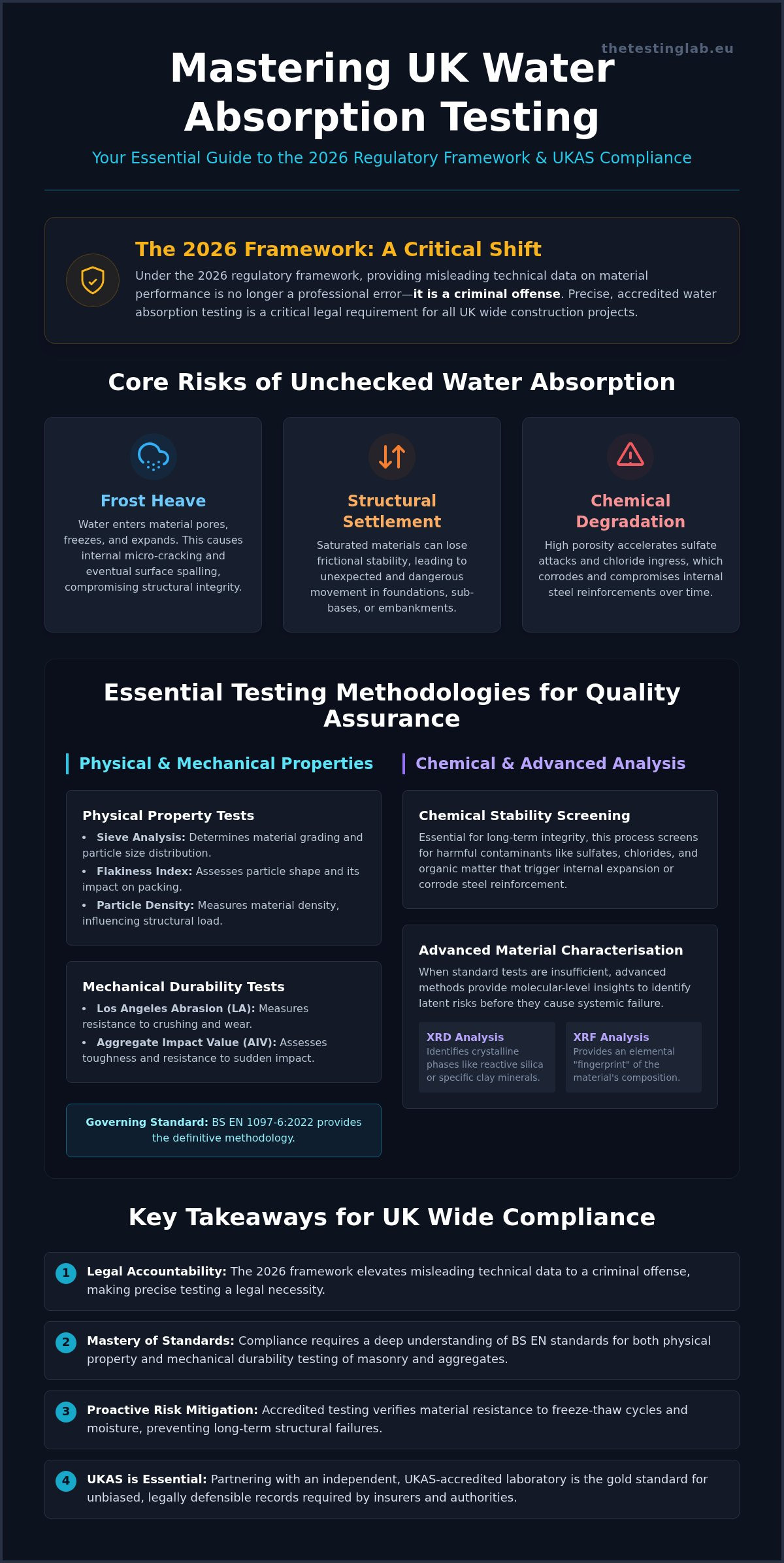
With the 2026 regulatory framework now in full effect, providing misleading technical data on material performance is no longer just a professional error; it’s a criminal offense. We recognize that navigating the intricacies of BS EN 772-11:2011 or BS EN 1097-6 can feel like a significant burden for project managers across the country. It’s a common concern that substandard materials or non-accredited results might lead to structural failure or costly delays on site. This guide provides the clarity you need to master the standards and legal requirements for water absorption testing UK wide. We’ll break down the 2026 compliance landscape, verify material suitability thresholds, and show you how to mitigate long term risks through UKAS accredited precision. By aligning your projects with the latest PAS 2000:2026 code of practice, you ensure every structure is both legally defensible and physically resilient.
Key Takeaways
- Understand how the 2026 regulatory framework classifies misleading technical data as a criminal offense, making precise water absorption testing UK wide a critical legal requirement.
- Master the technical distinctions between physical property testing and mechanical durability tests to ensure your materials meet current BS EN standards for masonry and aggregates.
- Learn to mitigate long-term structural risks by verifying aggregate resistance to freeze-thaw cycles and moisture-holding capacity through accredited laboratory methodologies.
- Discover why partnering with an independent, UKAS-accredited consultancy is essential for maintaining unbiased, legally defensible records across multi-region infrastructure developments.
Why Water Absorption Testing is Critical for UK Construction Safety
Water absorption testing UK wide is a fundamental engineering process used to determine the porosity and moisture-holding capacity of materials like aggregates, concrete, and masonry. By exploring the science of water absorption, we can quantify how much water a material retains, which directly impacts its density and strength. This data is vital for ensuring compliance with the Specification for Highway Works (SHW) and various UK Building Regulations. It’s the primary defense against using substandard materials that appear sound but fail under environmental stress. For those managing complex redevelopments, integrating these tests with broader environmental surveying ensures a holistic approach to site safety.
Moisture is the leading cause of structural deterioration in the British Isles. Systematic testing allows us to mitigate specific operational risks across UK wide infrastructure:
- Frost Heave: When water enters a material’s pore structure and freezes, the resulting expansion leads to internal micro-cracking and eventual spalling.
- Structural Settlement: Saturated materials can lose their frictional stability, leading to unexpected movement in sub-bases or embankments.
- Chemical Degradation: Higher porosity often accelerates sulfate attacks and chloride ingress, compromising steel reinforcements.
UKAS accreditation stands as the gold standard for laboratory competence and technical integrity across the United Kingdom.
The Legal Framework: UK Legislation and BS EN Standards
Modern construction relies on the Construction Products Regulation (CPR) to maintain safety standards. Compliance often involves adhering to British Standards such as BS EN 12620 for concrete aggregates or BS EN 772-11 for masonry. For UK wide developments, professional indemnity insurers and project lenders typically mandate UKAS-accredited results to underwrite risk effectively. Failing to provide these results can lead to significant project delays or the rejection of materials by local authorities. Our UK wide guide to UKAS accredited laboratories explains how these standards serve as a benchmark for technical excellence and legal defensibility.
Essential Water Absorption and Aggregate Testing Methods for Quality Assurance
Quality assurance begins with defining the geometric and mechanical profile of the material. Physical property testing includes sieve analysis for grading, flakiness index for shape, and particle density. These factors influence how an aggregate packs and interacts with binders. For mechanical durability, we measure the Los Angeles Abrasion (LA) value and Aggregate Impact Value (AIV) to assess resistance to crushing and wear. The BS EN 1097-6:2022 standard provides the definitive methodology for these procedures, ensuring that water absorption testing UK results remain consistent and reproducible across all sites. High-quality data at this stage prevents premature failure in high-traffic infrastructure.
Chemical stability is equally vital for long-term integrity. We screen for sulfates, chlorides, and organic matter, as these contaminants can trigger internal expansion or corrode steel reinforcement. When managing site-won materials or imported fill, integrating Waste Acceptance Criteria (WAC) testing ensures environmental compliance alongside structural suitability. If you’re managing complex ground conditions, you can request a technical consultation to align your water absorption testing UK regime with specific project risks.
Advanced Analysis: XRD and XRF for Material Characterisation
Standard tests sometimes fail to detect latent risks like reactive silica or specific clay minerals. We employ XRD analysis services to identify crystalline phases and XRF analysis for elemental fingerprinting. These advanced methods provide molecular insights, allowing engineers to identify potentially reactive minerals in UK wide construction aggregates before they cause systemic failure. This level of precision transforms testing from a mandatory task into a strategic risk management tool for modern developers.
Choosing a UK Wide Accredited Laboratory for Your Project
Selecting an independent laboratory is a critical decision for developers managing multi-region infrastructure projects. Unbiased, legally defensible data is essential when facing regulatory scrutiny or insurance audits. While local facilities might offer proximity, they often lack the scalable capacity required for UK wide developments. Partnering with a national provider ensures that your water absorption testing UK protocols remain uniform across every site, wherever your project is located within the UK. This consistency eliminates the regulatory gaps identified in 2026, where inconsistent testing methodologies previously led to significant compliance risks.
The Testing Lab PLC acts as a strategic partner, removing the burden of professional responsibility from the client’s shoulders. We manage structural risk through UKAS accredited excellence, ensuring every material meets the rigorous safety frameworks established post-2022. Our service extends beyond material analysis; we integrate these findings with broader site compliance, including asbestos and legionella surveying. This holistic approach ensures that all environmental and structural hazards are identified through a single, reliable knowledge base, streamlining the path to project completion.
The Importance of UKAS Accreditation UK Wide
UKAS accreditation to ISO/IEC 17025 is the only way to guarantee that results are technically valid and internationally recognised. It ensures that the sample chain of custody remains intact, preventing cross-contamination or data degradation during transit. Whether you’re assessing recycled aggregates or natural stone, the precision of water absorption testing UK depends on rigorous, methodologically sound laboratory environments. Maintaining this standard across all locations is vital for the integrity of your structural analysis. To secure your project’s future and ensure it meets all national standards, you can request a quote for material testing today.
Securing Structural Longevity through Methodological Precision
Achieving structural integrity in the 2026 regulatory environment requires more than a simple checklist; it demands a commitment to technical precision. By implementing rigorous water absorption testing UK protocols, you protect your infrastructure against frost heave, chemical degradation, and the legal risks of non-compliance. We’ve explored how molecular characterisation and mechanical durability tests provide the data needed to secure investment and insurance. It’s clear that independent, accredited validation is now a commercial necessity for every developer, and those looking to integrate these insights into broader building physics and energy consulting can discover Ingenieurbüro Lohse.
The Testing Lab PLC stands as your strategic partner, offering UKAS accredited laboratory facilities and independent professional consultancy across every region. Our UK wide national coverage ensures that your material verification remains consistent and legally defensible. Don’t leave your project’s compliance to chance. Contact The Testing Lab PLC for UK Wide Accredited Testing to ensure every material meets the highest standards of safety and performance. We’re here to help you build a more resilient future.
Frequently Asked Questions
What is the most common test for construction aggregates in the UK?
The most common method is the BS EN 1097-6 test for water absorption testing UK wide. This procedure determines both particle density and moisture-holding capacity for aggregates in concrete. It’s the industry standard for ensuring materials meet the 1% threshold for freeze-thaw resistance, providing the data needed for structural durability in high-traffic infrastructure.
How long does a standard water absorption and grading test take?
A standard water absorption testing UK procedure typically takes between 24 and 48 hours to complete. This timeframe allows for the mandatory oven-drying phase followed by a 24-hour immersion period to achieve full saturation. While grading results via sieve analysis are faster, the absorption phase requires this specific duration to ensure it’s accurate for structural integrity.
Why is UKAS accreditation mandatory for aggregate testing on UK infrastructure projects?
UKAS accreditation is mandatory because it provides independent verification that a laboratory operates to ISO/IEC 17025 standards. For UK wide infrastructure, this ensures that data is legally defensible. When combined with environmental surveying, it creates a robust compliance framework that local authorities and professional indemnity insurers recognise as the industry benchmark for safety.
Can water absorption testing help in meeting Waste Acceptance Criteria (WAC)?
Yes, water absorption analysis is often a prerequisite for comprehensive WAC assessments when managing site-won materials. It helps determine the physical stability of the material before chemical leaching tests are performed. By identifying how porous a waste material is, engineers don’t have to guess its behavior in landfill environments or its suitability for recycled aggregate applications.

Article by
P J F Thomas
CEO and Founder of TTL plc.
Disclaimer
Items declared are AI generated but do reflect our services. Please get in contact if you have any questions.