
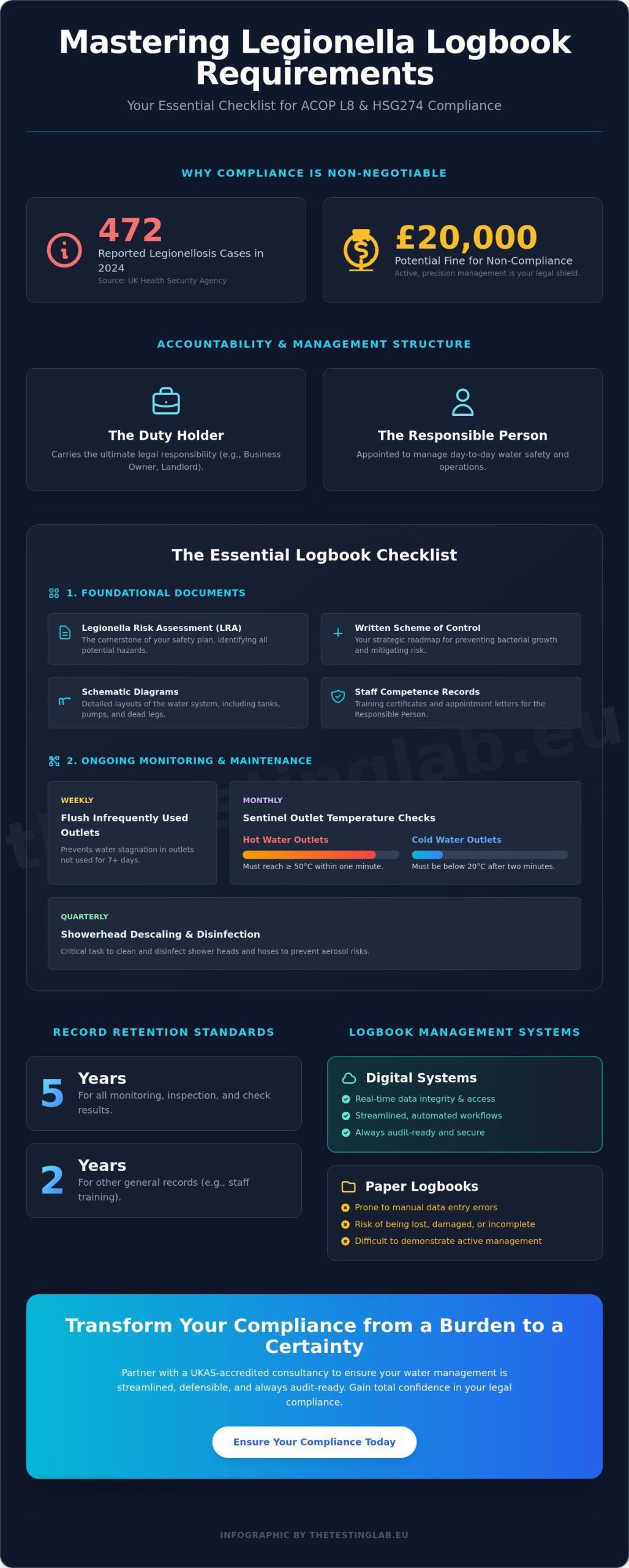
Would your current water safety records stand up to a Crown Court inspection if an outbreak occurred tomorrow? With the UK Health Security Agency reporting 472 cases of legionellosis in 2024, the HSE isn’t just looking for a dusty folder of papers; they’re looking for documented evidence of active, precision management. Understanding the specific legionella logbook requirements is the difference between a routine audit and a potential £20,000 fine. It’s natural to feel overwhelmed by the volume of manual data entry and the complexities of the Renters’ Rights Act that came into force on May 1, 2026.
We believe that water safety shouldn’t be a source of anxiety or a drain on your professional resources. This article provides a comprehensive checklist grounded in ACOP L8 and the latest HSG274 guidance to help you master your legal obligations. You’ll gain a clear list of mandatory records, learn the critical five-year retention rules, and discover how to build a streamlined process that provides total confidence during any inspection. We’re moving beyond simple record-keeping to help you create a proactive legal shield for your organization.
Key Takeaways
- Understand the primary UK legislation, including the Health and Safety at Work Act 1974 and the 2026 Renters’ Rights Act, that dictates your water safety responsibilities.
- Identify every mandatory document needed to satisfy legionella logbook requirements, from the initial risk assessment to the comprehensive written scheme of control.
- Master the critical record retention standards, ensuring you adhere to the 2-year rule for general records and the 5-year rule for all monitoring and inspection results.
- Evaluate the operational advantages of transitioning from traditional paper-based folders to digital compliance systems for real-time data integrity.
- Learn how partnering with a UKAS-accredited consultancy can transform your water management from a manual burden into a streamlined, audit-ready process.
Understanding Legionella Logbook Requirements: UK Legislative Framework
A Legionella logbook isn’t just a collection of temperature readings; it’s the central repository for all water hygiene evidence required by UK law. Under the Health and Safety at Work etc. Act 1974 and the Control of Substances Hazardous to Health Regulations 2002 (COSHH), employers and those in control of premises have a strict legal duty to manage the risk of exposure to Legionella bacteria. Understanding Legionnaires’ disease is the first step in recognizing why these legionella logbook requirements exist. Without a robust logbook, you lack the documented proof needed to demonstrate compliance during an HSE audit or a legal inquiry.
The Role of ACOP L8 and HSG274
The Approved Code of Practice (ACOP) L8 serves as the primary benchmark for compliance. It dictates exactly what must be done to meet your legal obligations. While ACOP L8 has a special legal status, the HSG274 technical guidance series provides the engineering and management detail on how to record and monitor your systems. Following these guidelines creates a “safe harbour.” If you’re prosecuted for a breach of health and safety law, proving you followed the ACOP is usually enough to demonstrate you’ve done everything reasonably practicable to comply with the law.
Who is Responsible for Record Keeping?
The Duty Holder, often the business owner or landlord, carries the ultimate legal weight. However, they usually appoint a “Responsible Person” to oversee the day-to-day management of water safety. The Responsible Person is the individual with day-to-day managerial responsibility for water safety. Because accountability is paramount, the first page of any logbook should clearly map out your management structure, including contact details and defined roles.
While the HSE only mandates written records for businesses with five or more employees, we strongly advise every organization to maintain a logbook. In a post-2026 regulatory environment, having no evidence is a significant risk, regardless of your company’s size. For those starting this process, a professional Legionella risk assessment provides the foundation for every entry in your logbook.
The Essential Legionella Logbook Checklist: What Must Be Recorded?
Meeting legionella logbook requirements isn’t just about ticking boxes; it’s about building a defensible narrative of safety. Your logbook must serve as a living document that proves you are following the HSE ACOP L8 to the letter. This starts with the Legionella Risk Assessment (LRA) and its summary of findings. However, simply having the LRA isn’t enough. You must also include the Written Scheme of Control, which acts as your strategic roadmap for bacterial prevention and risk mitigation.
A critical oversight in many compliance folders is the lack of detailed schematic diagrams. UK law requires these to show the layout of the water system, including all tanks, pumps, and potential dead legs. Additionally, you must document the competence of your team. This means including training certificates and clear appointment letters for the Responsible Person. The logbook should explicitly state who is authorized to carry out specific tasks. This ensures accountability is never in question if an inspector asks to see your management chain. If you’re unsure if your current documentation is sufficient, our team can help you review your risk assessment and control schemes for total peace of mind.
Monthly Monitoring and Maintenance Tasks
Annual and Exceptional Records
Record Retention and Data Integrity: Meeting HSE Standards
Maintaining the integrity of your data is just as critical as the data itself. To meet UK legionella logbook requirements, you must navigate the dual retention periods mandated by the HSE. The “2-Year Rule” applies to your high-level management documents, such as the current risk assessment and the written scheme of control. However, the “5-Year Rule” is more demanding. You must retain all records of monitoring, inspections, tests, or checks for at least five years. This includes everything from monthly temperature logs to annual tank inspections. If you can’t produce a temperature reading from four years ago during an audit, you’re technically in breach of compliance.
The legal danger of “retrospective logging” cannot be overstated. Attempting to fill in gaps in your records months after the tasks were supposedly completed is a significant red flag for inspectors. From a precision engineering perspective, digital timestamps are far superior to paper records. They provide contemporaneous proof that checks occurred exactly when claimed. This level of transparency builds trust with auditors and proves that your water management isn’t just a paper exercise but a lived safety culture.
Organising Records for an Audit
A well-organised logbook should include a “Summary of Non-Conformance.” This section highlights every time a system fell out of specification and, crucially, what you did to fix it. Proving you spotted a problem and resolved it is often more impressive to an auditor than a “perfect” log with no issues. You should also maintain a signature log for all staff and contractors to ensure absolute accountability. For those struggling to structure these folders, you can learn more about our Legionella risk assessment services and how we help clients build audit-ready documentation.
Managing Contractor Reports
External contractors often provide their own reports, but the legal responsibility for these records stays with the Duty Holder. You must integrate external lab results and certificates of chlorination directly into your central logbook. Don’t just file them away; review them for accuracy. We recommend verifying that any service provider is a member of the Legionella Control Association. Including their proof of competence and UKAS accreditation within your own logbook folder demonstrates that you’ve exercised due diligence in appointing “competent persons” to manage your site’s risks.
Digital vs. Paper Logbooks: Choosing the Right Management System
Choosing between a physical ring-binder and a digital platform is a strategic decision that directly impacts how easily you meet legionella logbook requirements. Traditional paper logbooks are intuitive and require no technical training, but they carry significant physical risks. A single leak, fire, or misplaced folder can destroy years of mandatory evidence, leaving you legally vulnerable during an audit. Conversely, the rise of SaaS and mobile applications has introduced real-time compliance tracking, where data is backed up instantly and accessible from any location.
Modern water management now leverages remote temperature monitoring to bridge the gap between manual checks. Automated sensors can be retrofitted to sentinel points to feed data directly into your digital logbook. This technology eliminates the “fudge factors” often seen in manual recording and ensures that data security requirements are met. To satisfy UKAS standards for data integrity, your chosen system must ensure that once a record is created, it cannot be altered or deleted. This provides an immutable audit trail that is far superior to handwritten notes. If you’re looking to modernize your approach, Explore our specialist water testing services to see how we integrate these precision technologies.
The Benefits of Digital Transformation
Digital systems act as a proactive partner in your compliance journey. They send automated alerts for missed tasks or out-of-range temperatures, allowing for immediate remedial action before a risk escalates. When an HSE inspector arrives, you don’t need to hunt through dusty folders. You can provide instant accessibility via a cloud-based portal, showing a level of technological magabiztosság that builds immediate trust. This precision reduces human error and ensures your data integrity remains beyond reproach.
When to Stick with Paper
Paper isn’t obsolete for every site. For very small residential properties or sites with only two or three outlets, the cost of a digital subscription might outweigh the operational benefit. Some high-risk environments also still prefer physical signature logs for specific on-site tasks to ensure the person was physically present at the point of testing. However, even in these cases, we recommend digitizing the completed pages. This ensures you meet the long-term retention rules without the risk of physical degradation over the required five-year period.
Professional Support: How The Testing Lab Ensures Audit-Ready Compliance
Compliance isn’t a static goal; it’s a continuous process of verification and refinement. At The Testing Lab, we position ourselves as a strategic partner rather than a mere service provider. Our UKAS-accredited consultants bridge the gap between complex risk assessments and the daily reality of meeting legionella logbook requirements. We understand that for many duty holders, the burden of quality assurance can feel overwhelming. Our engineering-led approach takes that weight off your shoulders, ensuring your water management systems are robust, transparent, and technically sound.
Independent auditing is the ultimate safeguard for your organization. While internal teams handle daily checks, an external review from our specialists identifies potential blind spots in your record-keeping before they become legal liabilities. We verify the accuracy of your temperature logs, the effectiveness of your flushing regimes, and the integrity of your digital or physical data storage. This scientific rigor provides the magabiztosság you need to face any HSE inspection with total peace of mind. Booking a comprehensive water safety review is the most effective way to transition from reactive fixes to proactive excellence.
Expert Legionella Consultancy
We create tailored written schemes of control that simplify your logging requirements by focusing only on what is necessary for your specific system. Our team doesn’t just hand over a document; we provide staff training to ensure your onsite team knows exactly what to record and why it matters. This clarity reduces manual data entry errors and ensures your logbook remains a precise reflection of your safety culture. If you’re ready to streamline your processes, you can request a quote for Legionella specialists today.
Beyond Water: Holistic Compliance
Building safety is interconnected. Structural risks and water hygiene often overlap, which is why we offer a holistic suite of services including UKAS accredited asbestos testing. Whether you’re managing a single commercial unit or a UK-wide portfolio, our multidisciplinary expertise ensures that every aspect of your environmental compliance is handled with laboratory-level precision. Don’t leave your legal protection to chance. Contact us for UK-wide compliance support and let our experts take care of the technical details while you focus on your core business.
Building a Defensible Water Safety Culture
Mastering legionella logbook requirements is about more than just avoiding a £20,000 fine; it’s about protecting your people and your reputation through technical precision. We’ve explored how the five-year retention rule and the shift toward digital timestamps create a robust audit trail that HSE inspectors trust. Whether you choose paper or cloud-based systems, the consistency of your temperature logs and remedial actions remains the backbone of your compliance strategy.
As a UKAS Accredited Laboratory with national UK-wide coverage, we ground every recommendation in the latest ACOP L8 and HSG274 standards. Don’t let manual data entry or regulatory confusion leave you exposed. Secure your water safety compliance with our expert Legionella services and let us handle the technical burden of your record-keeping. You’ve got the checklist; now it’s time to implement the systems that ensure your building remains safe and your business stays compliant for years to come.
Frequently Asked Questions
Is a Legionella logbook a legal requirement in the UK?
Yes, maintaining a Legionella logbook is a legal requirement under the Health and Safety at Work Act 1974 and COSHH 2002. While the law doesn’t specify the exact physical format, it mandates that you keep records of all risk assessments and control measures. If you have five or more employees, these records must be written. For smaller businesses, a logbook is still the only way to prove you’ve met your legal duty of care.
How long must I keep Legionella monitoring records?
You must retain general records of your risk assessment and written scheme for at least two years. However, all records of monitoring, inspections, tests, or checks must be kept for a minimum of five years. This includes temperature logs and contractor reports. Keeping these records ensures you have a long-term audit trail to show the system has been consistently managed and hasn’t just been “cleaned up” for an inspection.
Do I need a separate logbook for every building I manage?
Yes, every building requires its own site-specific logbook because each water system has unique risks, schematics, and assets. Combining multiple sites into one folder makes it difficult for an inspector to verify compliance for a specific location. Site-specific documentation ensures that the Responsible Person for that building has immediate access to the necessary data, which is a core part of meeting legionella logbook requirements effectively.
Can an HSE inspector fine me for an incomplete logbook?
An HSE inspector can certainly issue a fine or an improvement notice for an incomplete logbook. Fines for health and safety breaches can reach £20,000 in a Magistrates’ Court and are potentially unlimited in a Crown Court. Incomplete records suggest a lack of control over the system. This often leads to deeper investigations into your entire water management process, increasing the risk of severe legal penalties or even imprisonment in extreme cases.
What happens if I miss a monthly temperature check?
If you miss a check, don’t leave a blank space or falsify the entry. Record the omission as a non-conformance in your logbook and perform the check as soon as possible. You should also document why it was missed and what steps you’ve taken to ensure it doesn’t happen again. This transparency shows an auditor that you’re actively managing the system rather than ignoring your legal responsibilities or attempting to hide operational gaps.
Can I use an Excel spreadsheet as my Legionella logbook?
You can use an Excel spreadsheet, but it’s often the least secure method for meeting legionella logbook requirements. The main issue is data integrity; spreadsheets are easily altered and lack the secure, automated timestamps of dedicated SaaS platforms. If you use Excel, you must ensure that previous entries are protected and that you have a clear version history to prove the records haven’t been retrospectively changed before an audit.
Who is allowed to sign off on logbook entries?
Only the Appointed Responsible Person or a designated “competent person” should sign off on logbook entries. This individual must have the necessary skills, knowledge, and training to understand the results they’re recording. If a contractor performs the task, they’ll sign the service report, but the internal Responsible Person must still review and sign off on the document to confirm the work meets the site’s specific written scheme.
What should I do if a Legionella test comes back positive?
If a test comes back positive, immediately follow the emergency procedures outlined in your Written Scheme of Control. This usually involves isolating the affected area, performing a chemical or thermal disinfection, and re-sampling the water. You must record every action taken in your logbook. This documentation is vital to prove that you responded quickly and effectively to mitigate the risk to building occupants and followed HSE guidance to the letter.

Article by
P J F Thomas
CEO and Founder of TTL plc.
Disclaimer
Items declared are AI generated but do reflect our services. Please get in contact if you have any questions.