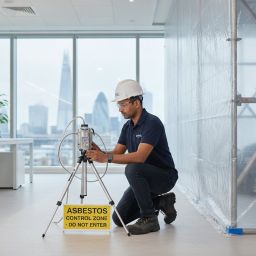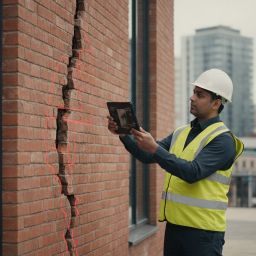
Did you know that an estimated 83% of state schools in England still contain asbestos? With over 450 teaching professionals lost to mesothelioma since 1980, the weight of responsibility on UK dutyholders has never been heavier. Understanding how to manage asbestos in a school is no longer just a box-ticking exercise; it’s a critical safety mission that requires laboratory-grade precision and strategic foresight to protect the next generation.
You’re likely juggling complex legislative jargon while worrying about the budget for remediation or the fear of school closures during surveys. It’s a high-stakes environment where the safety of pupils and staff depends on your every move. This guide provides a clear compliance roadmap to help you master the legal requirements and practical steps needed for professional asbestos management. We’ll break down the 2026 regulatory shifts, including the mandatory independence of analysts and the vital role of UKAS accreditation in maintaining a safe, compliant learning environment.
Key Takeaways
- Clarify your legal obligations under the Control of Asbestos Regulations 2012 (CAR 2012) and identify whether the Academy Trust or Local Authority holds the primary “duty to manage.”
- Implement a structured five-step roadmap on how to manage asbestos in a school, moving from initial management surveys to a live, robust risk assessment strategy.
- Recognise the critical value of UKAS-accredited laboratory analysis in providing the scientific precision needed to identify specific asbestos fibre types.
- Protect staff and contractors during building works by correctly commissioning Refurbishment and Demolition (R&D) surveys before any intrusive maintenance begins.
- Eliminate conflicts of interest by appointing an independent asbestos consultancy to oversee remediation and ensure 4-stage air clearance compliance.
Understanding the Legal “Duty to Manage” Asbestos in UK Schools
The Control of Asbestos Regulations 2012 (CAR 2012) isn’t just a set of guidelines; it’s the legal bedrock of safety in the UK education sector. If you’re responsible for a school building, understanding how to manage asbestos in a school starts with identifying who holds the “Duty to Manage.” This responsibility isn’t always uniform across the sector. For local authority-maintained schools, the council usually holds the primary duty. In contrast, for academies, free schools, and voluntary-aided schools, the Academy Trust or governing body typically takes on this legal mantle.
Failure to uphold these duties carries severe consequences. We’re talking about criminal offenses that can lead to unlimited fines or up to two years in prison for individuals in leadership roles. It’s a heavy burden, but it exists to ensure the safety of thousands of pupils and staff. Because of the widespread historical use of asbestos overview materials in construction, the law is clear: any school building constructed or refurbished before the year 2000 must be presumed to contain asbestos until a specialist proves otherwise.
The Role of the Appointed Person
While the legal duty often sits with a board or trust, the daily execution falls to an “appointed person.” This individual manages the asbestos register and ensures it stays current. They aren’t just filing papers; they’re the gatekeepers of site safety. Their role involves:
- Maintaining the asbestos register and keeping it as a live document.
- Ensuring the Asbestos Management Plan (AMP) is accessible to all contractors before they start work.
- Organising mandatory training for maintenance teams and janitorial staff so they can identify potential risks.
- Monitoring the condition of known asbestos-containing materials (ACMs) at regular intervals.
Legislative Framework and 2026 Standards
The Duty to Manage is the legal obligation to identify and control asbestos risks in non-domestic premises. In 2026, the Health and Safety Executive (HSE) has shifted its focus toward much stricter enforcement and higher standards of professional competence. It’s no longer enough to have a static folder on a shelf. You need a dynamic approach that reflects the current state of your school’s fabric. Engaging with a specialist asbestos consultancy helps bridge the gap between complex legislation and practical, on-site safety. Modern standards now place a heavy emphasis on independent oversight, ensuring that the professionals surveying your halls provide unbiased, laboratory-backed data.
The 5-Step Process for Managing Asbestos in School Buildings
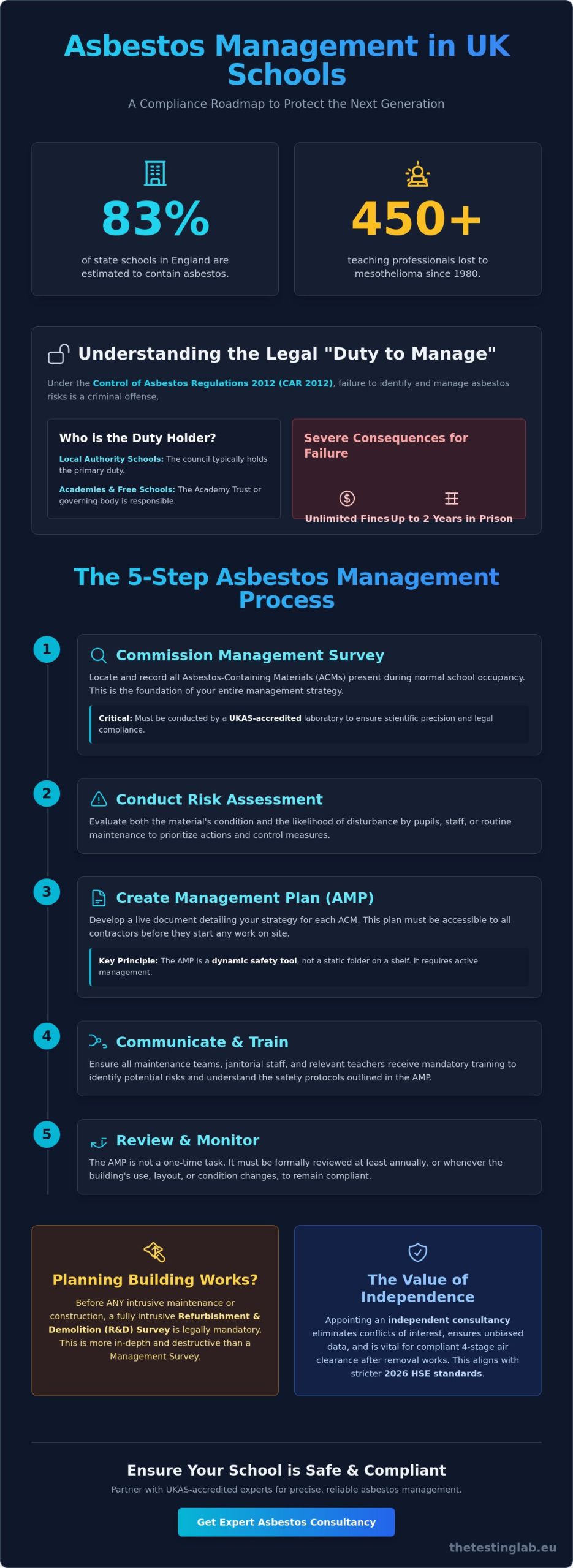
Transitioning from legal understanding to on-site action requires a disciplined, structured framework. Mastering how to manage asbestos in a school involves a five-step sequence designed to eliminate guesswork. First, you must commission a management survey to locate and record asbestos-containing materials (ACMs). Second, you need to conduct a robust risk assessment, evaluating both the material’s condition and the likelihood of disturbance by pupils or staff.
The third step is creating the Asbestos Management Plan (AMP), a live document that details your strategy for each identified material. Fourth, you must establish communication and training protocols, ensuring that janitorial staff and teachers understand the risks. Finally, regular reviews and monitoring are essential. The AMP isn’t a static folder; it’s a dynamic safety tool that must be updated annually or whenever the building’s use changes.
Conducting the Asbestos Management Survey
The management survey is your primary tool for identification during normal occupancy. It’s fundamentally different from a Refurbishment and Demolition (R&D) survey, which is a fully intrusive investigation required before any construction work begins. For schools, UKAS accredited asbestos testing is non-negotiable. It provides the technical assurance that your data is scientifically accurate. This precision is vital for “system-built” school structures, such as CLASP or SCOLA buildings. In these designs, asbestos was often used in structural column casings and window gaskets, making them harder to identify without expert, accredited eyes.
Addressing Asbestos in School Soils
Safety shouldn’t stop at the school walls. ACMs frequently migrate to school playing fields or playgrounds, often left behind from historical demolition debris or contaminated topsoil used in previous landscaping projects. When schools plan for new extensions or sports pitches, disturbing this ground can pose a significant risk. Professional asbestos in soils testing is a critical component of external risk management. It identifies fibre concentrations in the earth, allowing you to manage soil contamination safely during landscaping or expansion works.
A proactive approach ensures that every square metre of your site is accounted for. If you’re currently reviewing your school’s safety protocols, a specialist asbestos consultancy can provide the laboratory-backed insights needed to secure your premises. This strategic partnership takes the burden of complex quality assurance off your shoulders, allowing you to focus on education while we handle the technical precision of site safety.
Laboratory Analysis: The Science of School Safety
Visual checks are deceptive because asbestos fibres are microscopic and often hidden within composite materials. When determining how to manage asbestos in a school, you can’t rely on a caretaker’s intuition or a visual “hunch.” Only a UKAS accredited laboratory provides the precision required to confirm the presence and specific type of minerals. This accreditation isn’t just a badge; it’s your guarantee that the lab’s methods, equipment, and staff competence meet rigorous international standards for accuracy and reliability.
Bulk identification through laboratory analysis distinguishes between the three most common types: Chrysotile (white), Amosite (brown), and Crocidolite (blue). Each mineral has distinct properties and risk profiles, but all are hazardous if disturbed. Identifying these through Polarised Light Microscopy (PLM) remains the industry benchmark. This scientific certainty is vital for your risk assessment because it dictates the specific level of control measures and PPE required during any subsequent maintenance or removal work.
A robust “Chain of Custody” is equally essential for legal evidence. This process meticulously tracks a sample from the moment it’s harvested in a classroom to the second it’s analysed under a microscope. It prevents cross-contamination and ensures that the results you receive are legally defensible. Should the HSE investigate your compliance, having a transparent, laboratory-backed paper trail is your strongest protection against claims of negligence.
Advanced Analysis Techniques: XRD and XRF
When standard microscopy reaches its limits, we deploy advanced mineralogical tools. Utilising XRD analysis allows our team to identify minerals based on their unique atomic arrangements. XRD analysis provides definitive identification of asbestos crystal structures to ensure 100% accuracy. Additionally, XRF analysis supports comprehensive material testing by determining the elemental composition of a sample. These laboratory-grade techniques move beyond simple identification, providing the deep technical insights needed for complex “system-built” school structures where asbestos might be bound in unusual materials.
Air Monitoring and 4-Stage Clearance
Air monitoring is required whenever there’s a risk of fibre release or to verify the effectiveness of enclosures during removal. In a school environment, this is the ultimate safety gate. Following any licensed asbestos removal or significant remedial works, a mandatory 4-stage clearance process must be completed by an independent analyst. This involves a preliminary site check, a thorough visual inspection, air monitoring (clearance testing), and a final post-enclosure assessment. Only after these four stages are successfully passed can the area be certified as safe for re-occupation by pupils and staff, giving parents and governors the peace of mind they deserve.
Managing Maintenance and Building Works in Schools
The true test of how to manage asbestos in a school occurs when contractors arrive on site for maintenance or upgrades. While management surveys are sufficient for normal occupancy, they don’t provide the level of detail required for intrusive works. Before any hammer hits a wall or a floorboard is lifted, you must commission a Refurbishment and Demolition (R&D) survey. This investigation is destructive by nature, designed to uncover “hidden” asbestos in wall cavities, ceiling voids, or under floorboards that a standard survey would miss.
Integrating your asbestos register into the contractor induction process is a legal necessity, not a choice. Every plumber, electrician, or IT technician needs to know exactly where ACMs are located in their specific work area. If an ACM is accidentally disturbed, your emergency procedures must be immediate and decisive. Stop all work instantly, evacuate the affected area, and seal it to prevent fibre migration. You’ll then need a specialist to assess the extent of the release and perform air monitoring before the area can be cleaned and reopened.
Contractor Management and Compliance
Safe management relies on a robust permit-to-work system. This ensures that no high-risk maintenance occurs without a formal review of the asbestos register. You shouldn’t just take a firm’s word for their competence; you must verify that every individual on site has up-to-date asbestos awareness training. Documenting every action is vital. When works affect the status or condition of an ACM, your register must be updated immediately to reflect the new reality of the building’s fabric. This creates a transparent audit trail that protects school leadership from liability.
Waste Management and Disposal
Asbestos is classified as hazardous waste, and its disposal is strictly regulated under the Hazardous Waste Regulations. You can’t simply throw ACMs into a standard skip. For larger renovation projects where soil or demolition rubble is involved, WAC (Waste Acceptance Criteria) testing is essential to determine how the waste is classified for landfill. This ensures you aren’t hit with unexpected fines or rejection at the gate. Always ensure you receive a waste transfer note from the carrier and keep these records for at least three years as part of your compliance documentation.
If you’re planning upcoming building works and need technical assurance that your site is ready, request a professional R&D survey quote to ensure your project stays on the right side of the law.
The Value of Independent Asbestos Consultancy
Choosing an independent partner is the most critical decision you’ll make when deciding how to manage asbestos in a school. The 2026 HSE focus on mandatory analyst independence underlines a simple truth: you can’t mark your own homework. When the same company handles both the removal and the final air clearance, a clear conflict of interest arises that could jeopardise the safety of your entire school community. Independent oversight ensures that the safety of your pupils isn’t compromised by a contractor’s desire to cut corners or rush a project.
By engaging a specialist asbestos consultancy, you gain a strategic partner who works solely in your interest. Professional surveys don’t just ensure safety; they reduce long-term remediation costs by preventing unnecessary removals. When you have precise data on the condition of asbestos-containing materials (ACMs), you can manage them in situ rather than defaulting to expensive, disruptive extraction. A laboratory-backed long-term strategy for how to manage asbestos in a school prevents the panic-driven spending that often follows a surprise HSE inspection. This scientific approach provides genuine peace of mind for parents and staff, proving that their safety is backed by more than just a promise.
Achieving Compliance with The Testing Lab PLC
We provide national coverage for school asbestos surveys and laboratory testing, ensuring that whether you’re managing a single site or a large multi-academy trust, our precision remains consistent. Our London-based surveying expertise allows us to integrate asbestos management with other critical safety requirements, such as Legionella risk assessments. This holistic approach simplifies your compliance workflow and takes the burden of quality assurance off your shoulders. If you need to establish a baseline for your 2026 safety strategy, you can request a professional quote for school asbestos services today.
Next Steps for School Leaders
Your first move should be a gap analysis of your current asbestos register. Does it meet the 2026 standards? If your last survey was conducted several years ago, it’s likely out of date. To maintain a safe environment, you should follow these steps:
- Review your current asbestos register against the latest HSE guidance.
- Schedule an annual audit of your Asbestos Management Plan to reflect any building changes.
- Ensure all staff have received up-to-date asbestos awareness training.
- Engage with a UKAS accredited partner for all sampling and analysis to ensure legal defensibility.
Following this roadmap ensures that you aren’t just following the law; you’re creating a culture of safety. Precision in testing leads to confidence in management. By treating asbestos management as a precision process rather than a chore, you protect both your budget and your people.
Securing the Future of Your School Estate
Compliance in 2026 isn’t about ticking a box; it’s about building a robust safety culture backed by scientific evidence. Mastering how to manage asbestos in a school requires a transition from reactive maintenance to proactive, laboratory-backed management. By understanding your legal “Duty to Manage” and implementing a strict five-step process, you eliminate the risks of accidental exposure and criminal liability. The precision of a UKAS accredited laboratory ensures that every decision you make is based on definitive data rather than guesswork.
Partnering with an independent consultancy removes the burden of quality assurance from your shoulders. We provide national UK coverage, combining technical expertise with a commitment to transparency that protects your pupils, staff, and budget. Whether you’re reviewing an existing register or planning major refurbishment works, we’re here to serve as your strategic partner. Contact The Testing Lab PLC for professional school asbestos management to secure your site today. You’ve got the expertise to lead your school, and we’ve got the precision to keep it safe.
Frequently Asked Questions
Who is the dutyholder for asbestos in a school?
The dutyholder is the person or body responsible for the maintenance and repair of the premises. In local authority-maintained schools, this is typically the council. For academies, free schools, and voluntary-aided schools, the Academy Trust or the governing body usually holds this legal responsibility. It’s critical to identify this role clearly as they carry the criminal liability for non-compliance with CAR 2012.
How often should a school asbestos management plan be reviewed?
You must review your school asbestos management plan at least once every 12 months. However, a review is also mandatory if there’s any reason to suspect the plan is no longer valid, such as significant building work or if an asbestos-containing material (ACM) is damaged. Keeping this document live ensures your strategy for how to manage asbestos in a school remains effective against the daily wear and tear of a busy education environment.
Is asbestos dangerous in schools if it is not disturbed?
Asbestos-containing materials are generally not a risk to health if they are in good condition and remain undisturbed. The danger arises when the material is damaged, sanded, or broken, which releases microscopic fibres into the air. In a school setting, high-traffic areas like corridors or classrooms require more frequent monitoring to ensure that accidental impacts from pupils don’t compromise the material’s integrity and lead to fibre release.
What should a school do if asbestos is accidentally damaged?
If an ACM is damaged, you must immediately evacuate the area and prevent anyone from entering. Seal the room to contain potential fibres and switch off any ventilation systems that could spread dust. You’ll need to contact a UKAS accredited professional to assess the damage, conduct air monitoring, and oversee any necessary cleaning or repairs. Never attempt to clean up asbestos debris with a standard vacuum cleaner or broom.
Do all schools built before 2000 contain asbestos?
While not every single building contains it, any school constructed or refurbished before the year 2000 is legally presumed to contain asbestos. Given that approximately 83% of state schools in England still contain these materials, the probability is high. The only way to rebut this presumption is through a thorough management survey and laboratory analysis of samples to prove the absence of asbestos minerals in the building’s fabric.
Can school staff carry out asbestos inspections themselves?
Staff can perform routine visual monitoring of known ACMs if they’ve received adequate asbestos awareness training. However, they cannot carry out official asbestos surveys or take samples for analysis. These tasks require a high level of technical competence and specific equipment. To ensure compliance and safety, always use UKAS accredited surveyors for the initial identification and any subsequent sampling required for your register.
What is the difference between a management survey and an R&D survey for schools?
A management survey is a standard, non-intrusive inspection designed to locate ACMs during normal school occupancy. In contrast, a Refurbishment and Demolition (R&D) survey is a fully intrusive investigation required before any construction or maintenance work begins. The R&D survey involves breaking into walls and floors to find hidden asbestos, ensuring that contractors don’t accidentally disturb materials that were not visible during the initial management inspection.
How long must a school keep asbestos records?
You should keep your asbestos register and management plan for the entire life of the building. If any staff members are involved in licensed asbestos work or are accidentally exposed, their health records must be kept for at least 40 years. For general waste transfer notes, the statutory retention period is three years. Maintaining a meticulous long-term archive is essential for proving your historical compliance and protecting the school from future legal claims. When these sensitive records eventually exceed their mandatory retention period, utilizing a professional service like ASK Mobiele Data & Archiefvernietiging B.V. ensures the secure and reliable destruction of confidential archives and data carriers.

Article by
P J F Thomas
CEO and Founder of TTL plc.
Disclaimer
Items declared are AI generated but do reflect our services. Please get in contact if you have any questions.