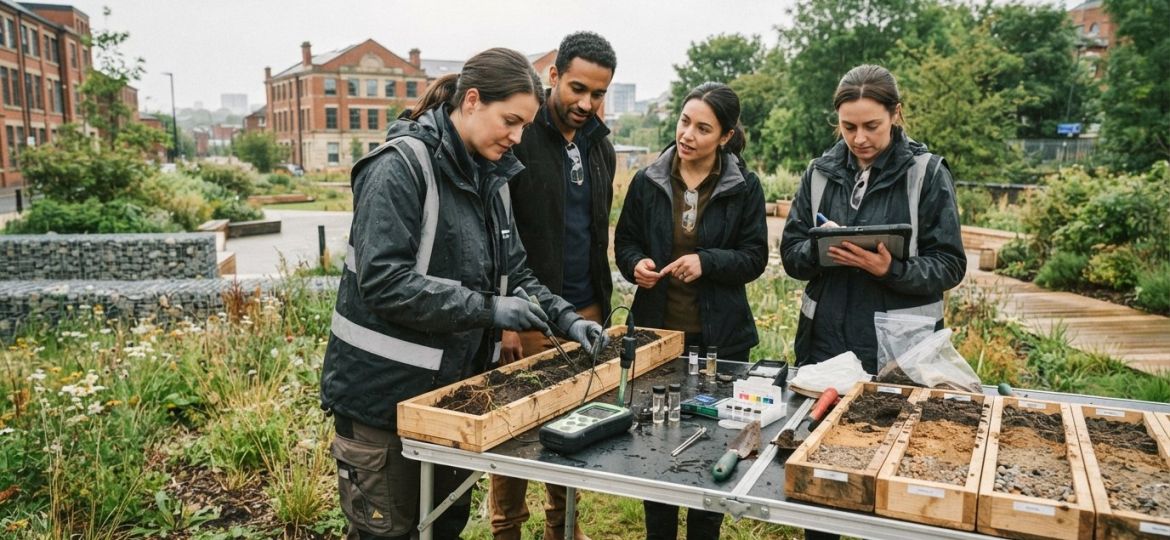
A single failed planting scheme on a brownfield site can cost more in litigation and remediation than the entire original soil specification. You understand that a project’s legacy depends on the ground it’s built upon, yet the complexity of WAC or WM3 requirements often creates significant project friction. This 2026 guide simplifies soil testing for landscape architects, providing the technical clarity needed to master BS 3882:2015 and BS 8601:2013 standards. You’ll learn how UKAS-accredited laboratory analysis mitigates risk and ensures healthy plant establishment through precise nutrient and contaminant profiling.
From our head office in Doncaster, The Testing Lab PLC serves as a strategic partner for projects UK wide, delivering the defensible data required for regulatory sign-off. We’ll examine how to secure your site’s future while maintaining full compliance with UK environmental legislation and Biodiversity Net Gain requirements.
Key Takeaways
- Master the technical specifications of BS 3882:2015 and BS 8601:2013 to ensure all imported soils meet rigorous UK statutory standards.
- Identify potential phytotoxicity and chemical contaminants early through UKAS-accredited analysis to mitigate the risk of plant failure and long-term project liability.
- Streamline your project workflow with comprehensive soil testing for landscape architects delivered UK wide from our central technical hub in Doncaster.
- Align soil physical and chemical properties with 2026 Biodiversity Net Gain (BNG) requirements to guarantee the successful establishment of diverse native habitats.
Understanding BS 3882:2015 and UK Soil Specification Standards
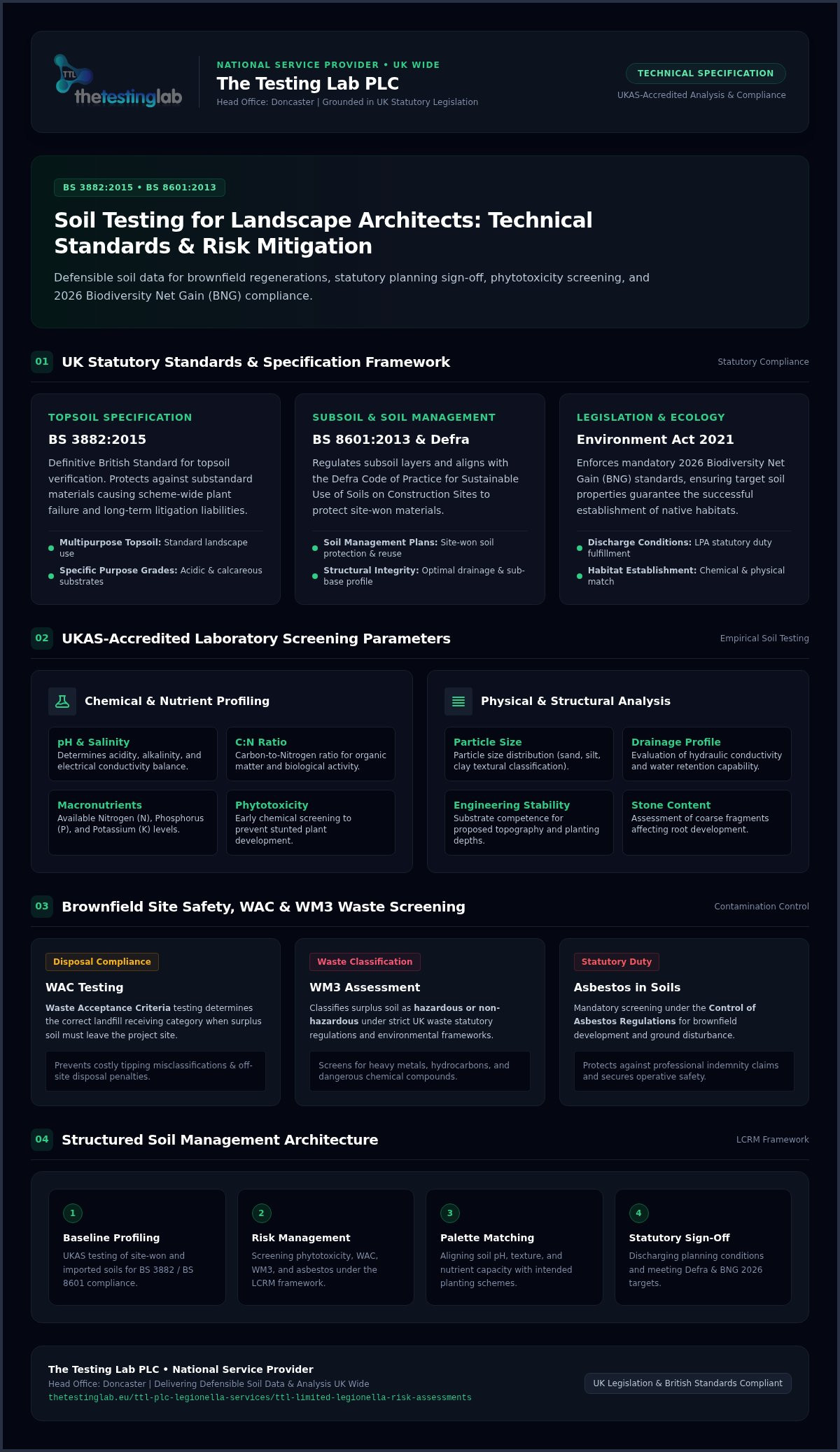
BS 3882:2015 serves as the definitive British Standard for topsoil specification across the UK. For landscape architects, this standard isn’t just a technical guideline; it’s a critical risk-management framework. Adhering to these specifications prevents the use of substandard materials that lead to widespread plant failure or environmental non-compliance on national projects. By distinguishing between Multipurpose topsoil and Specific Purpose grades, such as acidic or calcareous soils, professionals can ensure the substrate supports the intended ecology of the site.
Rigorous soil testing for landscape architects identifies potential issues like high salinity or nutrient imbalances before they compromise a design. Failing to verify imported soil against BS 3882:2015 can result in significant legal and financial liability, especially on complex brownfield regenerations where soil quality is often variable. It’s about protecting your professional reputation and ensuring the long-term health of the landscape.
The Role of UKAS Accredited Analysis in Specification
Planning authorities increasingly demand UKAS accredited laboratory results to discharge planning conditions and satisfy statutory duties under the Environment Act 2021. Relying on a robust soil testing methodology ensures that parameters like pH, Carbon-to-Nitrogen ratios, and nutrient levels (N, P, K) are accurately measured. At The Testing Lab PLC, we operate UK wide from our head office in Doncaster, providing the precision required to match soil profiles with specific planting palettes. Our BS 3882:2015 topsoil testing services give architects the defensible data needed to guarantee long-term scheme viability. This engineering-led approach removes the burden of technical uncertainty from your shoulders. We focus on the critical details, from electrical conductivity to particle size distribution, ensuring every sample meets the highest standards of quality control.
Essential Soil Tests for Landscape Design and Site Regeneration
Get instant Quote
Effective landscape design begins with empirical data. Beyond basic nutrient levels, soil testing for landscape architects must address the physical and chemical constraints of the site. Chemical analysis identifies phytotoxicity, which can stunt development, while physical analysis determines if the soil texture provides sufficient drainage and engineering stability for the proposed topography. Adhering to the Defra Code of Practice for the Sustainable Use of Soils is essential for creating robust Soil Management Plans. This ensures site-won materials are protected and reused efficiently, reducing the environmental footprint of the project.
Contamination Screening: WAC and WM3 Testing for Site Safety
Urban sites require rigorous screening for heavy metals and hydrocarbons. When surplus soil must leave the site, Waste Acceptance Criteria (WAC) testing determines the appropriate landfill category. Simultaneously, WM3 testing classifies the material as hazardous or non-hazardous, ensuring compliance with UK waste regulations. This precision prevents costly disposal errors and regulatory delays.
Under the Control of Asbestos Regulations, asbestos in soils analysis is a critical safety requirement for brownfield developments. Identifying these fibers early protects landscape architects from professional indemnity claims and ensures site operative safety. From our head office in Doncaster, we provide these critical screenings UK wide, delivering the technical certainty needed for complex regenerations. If you need technical support for your next project, you can request a specialist soil analysis quote to secure your site’s safety and regulatory compliance.
Implementing a Soil Management Strategy with The Testing Lab PLC
Get instant Quote
Implementing a robust strategy requires more than just a site visit. It demands a structured approach that aligns with the Land Contamination Risk Management (LCRM) framework. From our head office in Doncaster, The Testing Lab PLC operates as a national service provider, managing a sophisticated logistics network UK wide. This ensures that soil testing for landscape architects remains efficient, with samples reaching our UKAS-accredited facilities without delay. Our engineering-led approach transforms raw technical data into actionable insights that support your architectural vision while removing the burden of professional liability. We don’t just deliver spreadsheets; we provide a clear, defensible roadmap for soil improvement.
Our workflow follows a logical progression: preliminary site assessment, targeted sampling, precision laboratory analysis, and comprehensive reporting. This systematic method ensures that every technical requirement of UK building and environmental regulations is met with absolute clarity. We act as a strategic partner, bridging the gap between design aspiration and ground-level reality.
Professional Sampling and Laboratory Reporting for Project Success
Precision starts in the field. Representative sampling is vital to ensure that BS 3882:2015 analysis accurately reflects the site’s true conditions. We guide you through the transition from initial site surveys to final compliance verification. Once the lab report is issued, our team helps you interpret complex parameters to refine your soil handling strategies. This collaborative process ensures long-term plant health and protects against unforeseen failures. For projects with complex drainage needs, we also provide effluent discharge permit monitoring to maintain environmental integrity throughout the construction phase. By integrating these technical safeguards, we provide the defensible data needed for a successful, low-risk project handover.
Get instant Quote
Securing Project Longevity through Technical Certainty
Mastering the technical requirements of BS 3882:2015 is the most effective way to ensure the longevity of your landscape vision. By integrating rigorous soil testing for landscape architects into your standard workflow, you mitigate the risks of plant failure and professional liability. Whether you’re navigating WAC requirements or managing asbestos in soils on complex brownfield sites, accredited data provides the defensible evidence needed for regulatory sign-off. Our engineering-led approach removes the uncertainty from site regeneration.
From our head office in Doncaster, The Testing Lab PLC operates as a strategic partner, delivering UKAS accredited laboratory results UK wide. We provide the precision required to satisfy both planning conditions and mandatory Biodiversity Net Gain targets. Don’t leave your project’s success to chance. You can Get instant Quote for Professional Soil Testing today to ensure your next site meets the highest standards of safety. We’re ready to support your next development with methodology you can trust.
Get instant Quote
Frequently Asked Questions
Is soil testing a legal requirement for landscape architects in the UK?
Soil testing becomes a legal necessity when local planning authorities in cities like Leeds or Manchester set specific conditions for site development. Under the Town and Country Planning Act 1990 and the Environment Act 2021, you must demonstrate that the soil profile supports biodiversity and public safety. Failing to provide UKAS accredited reports can lead to enforcement notices and significant project delays across the UK.
What is the difference between BS 3882 and BS 8601 soil standards?
The primary distinction lies in the soil layer they govern. BS 3882:2015 specifies requirements for multipurpose and specific purpose topsoil, whereas BS 8601:2013 focuses on subsoil. For successful soil testing for landscape architects, both standards must be applied to ensure the total rooting depth is chemically and physically compatible with the intended planting scheme. This dual approach is vital for large scale national projects.
How much soil testing is required for a standard urban landscape project?
The frequency of testing depends on the volume of soil and the site’s previous use. For imported topsoil, a common verification rate is one sample per 250 to 500 cubic metres, or a minimum of three samples per source. Projects in urban hubs like Sheffield or Liverpool often require higher frequencies to satisfy stringent local authority contamination verification plans and ensure long term plant health.
Can I use a generic soil test for a brownfield site regeneration?
Generic tests are insufficient for brownfield sites due to the high risk of legacy contaminants. Site regeneration requires targeted soil testing for landscape architects that includes asbestos screening, heavy metals, and hydrocarbons. Using a basic nutrient test on a former industrial site in cities like Middlesbrough or Sunderland could lead to professional indemnity claims if phytotoxic elements or hazardous materials are later discovered.
From our head office in Doncaster, The Testing Lab PLC provides these critical screenings UK wide, ensuring your project remains compliant with all UK legislation. Our engineering led approach removes the technical burden from your team, delivering the precision required for modern landscape architecture.

Article by
P J F Thomas
CEO and Founder of TTL plc.
Disclaimer
Items declared are AI generated but do reflect our services. Please get in contact if you have any questions.