
If you believe a single asbestos survey fulfills your long term legal obligations, you are exposing your UK wide portfolio to significant regulatory risk. With the HSE’s 2026 inspection campaign now in full effect, the distinction between an initial assessment and an ongoing Asbestos Re-inspection has never been more critical for duty holders. We understand the logistical strain of managing compliance across multiple sites while trying to avoid operational downtime. It’s common to feel overwhelmed by the technical nuances of Regulation 4 and the recent transition to ISO/IEC 17020:2026 standards. This guide will help you master the legal requirements and technical precision needed to maintain a robust, UKAS-compliant safety management plan. You’ll learn how to differentiate between survey types, implement actionable management strategies, and ensure total legal protection under CAR 2012 without disrupting your daily business operations.
Key Takeaways
- Gain clarity on your legal “Duty to Manage” under Regulation 4 of CAR 2012, ensuring your compliance extends far beyond the initial management survey.
- Identify the technical nuances of a UKAS-accredited Asbestos Re-inspection, focusing on precision material assessments and the evaluation of surface treatments.
- Develop an actionable, UK wide management plan that leverages laboratory data to determine the most cost-effective remediation or encapsulation strategies.
- Prepare for the 2026 HSE inspection campaign by aligning your protocols with the updated ISO/IEC 17020:2026 standards for inspection bodies.
Understanding the Legal Mandate: CAR 2012 and Asbestos Re-inspection
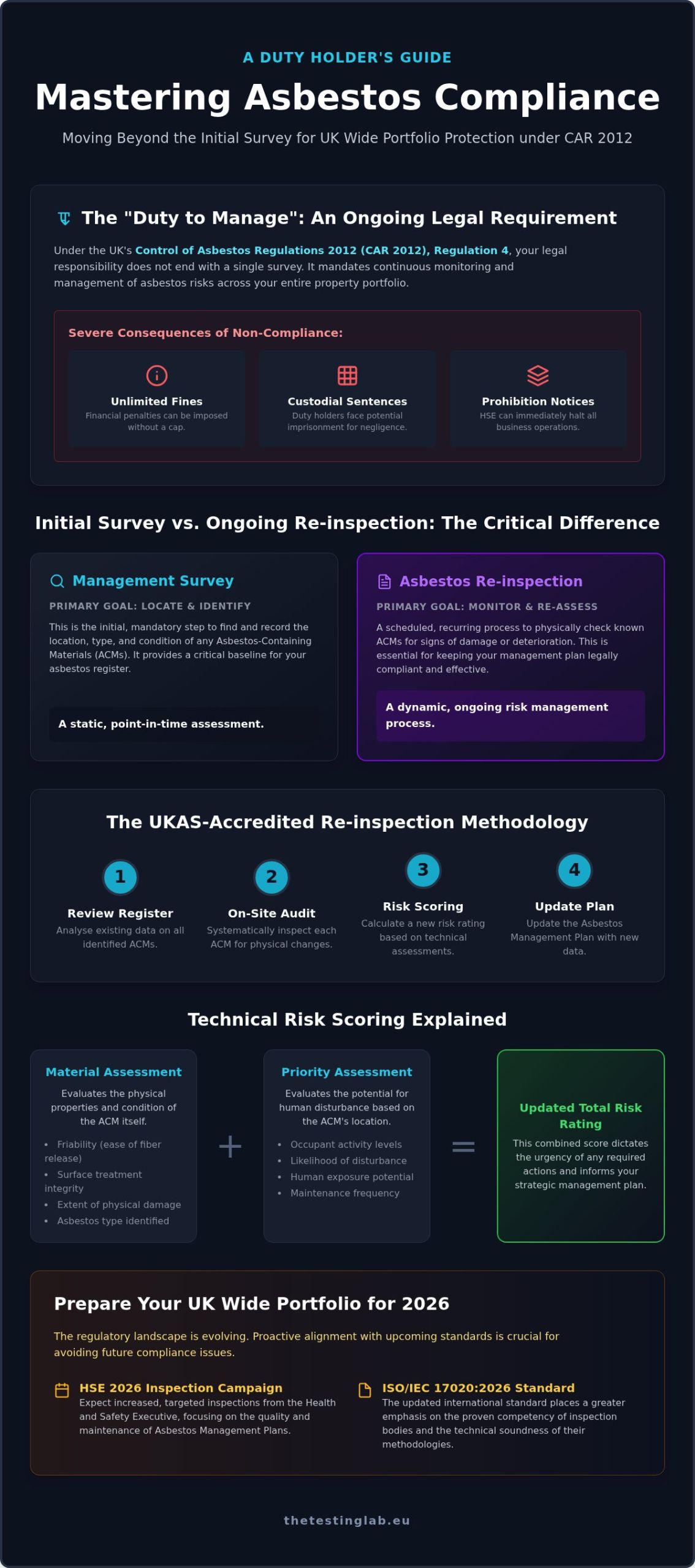
The Control of Asbestos Regulations 2012 (CAR 2012) establishes a clear legal “Duty to Manage” under Regulation 4. This mandate places the burden of responsibility on building owners and managers to identify and control asbestos risks. Simply commissioning an initial Management Survey doesn’t discharge this duty. It’s merely the baseline. To maintain UK wide compliance, you must ensure that your asbestos register remains accurate and that the condition of all materials is monitored through a scheduled Asbestos Re-inspection.
Failing to maintain an up-to-date register carries severe legal consequences across your estate. The HSE actively monitors compliance, and the repercussions of negligence are significant:
- Unlimited fines and potential custodial sentences for duty holders.
- Immediate prohibition notices that halt business operations.
- Increased liability in civil litigation from exposed individuals.
Beyond legal threats, the primary risk is the accidental disturbance of degraded materials. A static document from five years ago is insufficient for modern safety standards. Effective management requires an agile approach to risk calibration.
The Critical Distinction Between Management Surveys and Re-inspections
While a Management Survey is designed to locate and identify asbestos-containing materials (ACMs), an Asbestos Re-inspection focuses exclusively on monitoring their condition over time. It’s a precision exercise to check for signs of deterioration, physical damage, or changes in surface treatment. This data serves as the primary engine for updating your Asbestos Management Plan (AMP). Our asbestos consultancy services ensure this process remains transparent and technically robust.
A re-inspection identifies if an ACM that was once “low risk” has become “high risk” due to environmental factors or site activity. This systematic calibration ensures your safety protocols remain aligned with actual site conditions rather than outdated assumptions. It allows you to prioritise resources where they’re most needed, protecting both your budget and your people.
Technical Methodology: How UKAS Accredited Inspections Ensure UK Wide Compliance
A professional Asbestos Re-inspection follows a rigorous, engineering-led methodology to ensure data accuracy across your national estate. The process begins with a desk-based review of the existing asbestos register to locate all previously identified materials. On-site, the surveyor performs a systematic physical audit, focusing on two critical scoring metrics: the Material Assessment and the Priority Assessment. It’s not just a visual check; it’s a technical calibration of risk.
- Material Assessment: This evaluates the physical state of the ACM, including its friability and the integrity of any surface treatments or encapsulation.
- Priority Assessment: This factors in the human element, such as occupant activity levels and the likelihood of accidental disturbance during routine maintenance.
By combining these scores, we calculate a total risk rating that dictates the urgency of any required actions. If you’re managing complex portfolios, you can request a technical consultation to align these inspections with your broader operational goals and budget cycles.
Assessing Material Degradation and Environmental Risk Factors
Environmental changes can compromise asbestos safety without warning. Water ingress from a leaking pipe or impact damage in a high-traffic corridor can transform a stable material into a high-risk hazard overnight. Our inspectors look for subtle signs of weathering and delamination that untrained eyes often miss. Under the new ISO/IEC 17020:2026 standards, the emphasis on surveyor competency is higher than ever. UKAS accreditation ensures that every data point collected during an Asbestos Re-inspection is legally defensible and technically sound. It’s what provides the transparency needed to manage risks UK wide with absolute confidence, ensuring your management plan isn’t just a document, but a precise reflection of site reality.
Strategic Asbestos Management: Beyond the Annual Inspection
Mastering asbestos safety requires a shift from reactive compliance to proactive risk mitigation. An effective Asbestos Re-inspection strategy doesn’t just satisfy the HSE; it protects your long term asset value UK wide. By identifying trends in material degradation across multiple sites, duty holders can move away from emergency repairs toward planned, cost-effective maintenance. This foresight reduces the likelihood of fiber release and ensures your safety protocols remain ahead of regulatory changes.
Data integrity is the cornerstone of this strategic shift. Leveraging precise laboratory data allows you to make informed decisions between high-cost remediation and strategic encapsulation. We maintain a seamless sample chain of custody within our UKAS accredited facilities. This ensures every testing result is accurate and legally defensible, providing the technical foundation for your management decisions. When you treat data as a strategic asset, you gain the clarity needed to manage complex portfolios with absolute precision.
Integrating Soil and Water Analysis into Your Management Plan
Comprehensive risk management extends beyond the building fabric. A thorough Asbestos Re-inspection should consider external environmental factors, such as asbestos in soils or potential water contamination on site. We support national portfolios by providing integrated environmental monitoring that covers the entire site footprint. This holistic approach prevents unforeseen liabilities during groundworks or landscaping projects. To align your safety protocols with these technical standards, you can request a technical quote for UK wide surveying. Our team acts as your strategic partner, taking the weight of professional responsibility off your shoulders.
Secure Your National Portfolio with Technical Precision
Maintaining a safe built environment requires more than basic compliance; it demands a system of continuous risk calibration. By shifting from reactive fixes to a structured Asbestos Re-inspection programme, you protect your occupants and your asset’s long term value. Our approach integrates rigorous material assessments with our UKAS Accredited Laboratory data to provide total transparency. As an independent professional consultancy, we take the technical burden off your shoulders, offering specialist soil and water analysis to cover every environmental risk factor UK wide.
Don’t leave your 2026 compliance to chance. Book your UK wide asbestos re-inspection with our accredited specialists today to ensure your management plan remains robust and legally defensible. We’re here to help you navigate these complex requirements with absolute confidence and engineering-led precision.
Frequently Asked Questions
How often is an asbestos re-inspection required by UK law?
Re-inspections are typically conducted every 12 months to satisfy the Duty to Manage under CAR 2012. The exact frequency depends on the risk assessment within your management plan. High-traffic areas or materials in poor condition require more frequent monitoring. Conversely, stable materials in low-risk locations might justify different intervals if documented correctly across your UK wide estate.
Who is qualified to carry out an asbestos re-inspection survey?
A competent professional with specific training and experience must carry out these surveys. We advise appointing a UKAS-accredited inspection body to ensure compliance with the ISO/IEC 17020:2026 standard. This provides independent assurance that the surveyor holds recognized qualifications, like the BOHS P402, and follows a precise, peer-reviewed methodology for every Asbestos Re-inspection.
What happens if the condition of an asbestos-containing material has deteriorated?
When deterioration is identified, you must update your asbestos register and risk scores immediately. The inspector will recommend specific remedial actions, such as encapsulation to seal the surface or professional removal if the risk of fiber release is too high. Prompt intervention ensures you remain legally protected while preventing accidental exposure to building occupants or maintenance contractors.
Does a re-inspection require taking new physical samples of the material?
New physical samples aren’t usually required during a re-inspection. The process focuses on visually assessing the condition of materials already identified in your initial survey. Sampling only becomes necessary if the surveyor discovers previously unrecorded suspect materials or if the degradation is so severe that it warrants fresh laboratory analysis to calibrate the risk accurately.

Article by
P J F Thomas
CEO and Founder of TTL plc.
Disclaimer
Items declared are AI generated but do reflect our services. Please get in contact if you have any questions.