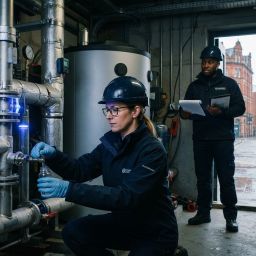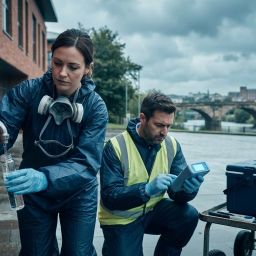
Could a single temperature reading tell you whether a water system is safe? Not on its own. Its value depends on where and when it was taken, and whether the result is recorded and acted on. This legionella temperature monitoring guide explains how temperature control supports UK water safety management under the Health and Safety at Work etc. Act 1974, the COSHH Regulations 2002 and HSE guidance.
Clear benchmarks and a consistent routine make it easier to spot readings that need attention, particularly when results vary or records are incomplete. This guide covers hot- and cold-water temperatures, practical ways to keep useful logs, and what to do when a reading falls outside the expected range. The Testing Lab PLC provides water testing and Legionella services across the UK. Doncaster is the head office of this national service provider, which supports organisations in Carlisle, Chester, Lancaster, Liverpool, Manchester, Preston, Salford, Berwick-upon-Tweed, Durham, Middlesbrough, Newcastle upon Tyne, Sunderland, Bradford, Doncaster, Huddersfield, Hull, Leeds, Sheffield and Wakefield.
Key Takeaways
- This legionella temperature monitoring guide explains HSE benchmarks for hot-water storage and outlets, and cold-water systems.
- Use your risk assessment and written scheme to set monitoring points and frequency, rather than relying on a one-size-fits-all routine.
- Take readings consistently, record the details needed to interpret them, and review results for trends.
- Before reacting to an unexpected result, check how and where it was measured. Repeated or unexplained readings should prompt a review of controls.
Legionella temperature monitoring: what temperatures should you check?
Temperature monitoring is one control in a risk-based approach to managing Legionella in water systems. It helps show whether hot water is kept hot and cold water cold, but it cannot establish safety by itself. Under UK health and safety legislation, including the Health and Safety at Work etc. Act 1974 and COSHH Regulations 2002, dutyholders must manage risks using suitable controls informed by the system and how it is used. HSE’s ACoP L8 and HSG274 provide practical guidance.
The commonly cited HSE benchmarks are useful reference points, not a guarantee that a system is free from risk. System design, water use, stagnation and the reliability of the measurement all affect how a reading should be interpreted. Consider the result alongside the site’s risk assessment and written scheme.
Which hot- and cold-water temperatures are commonly monitored?
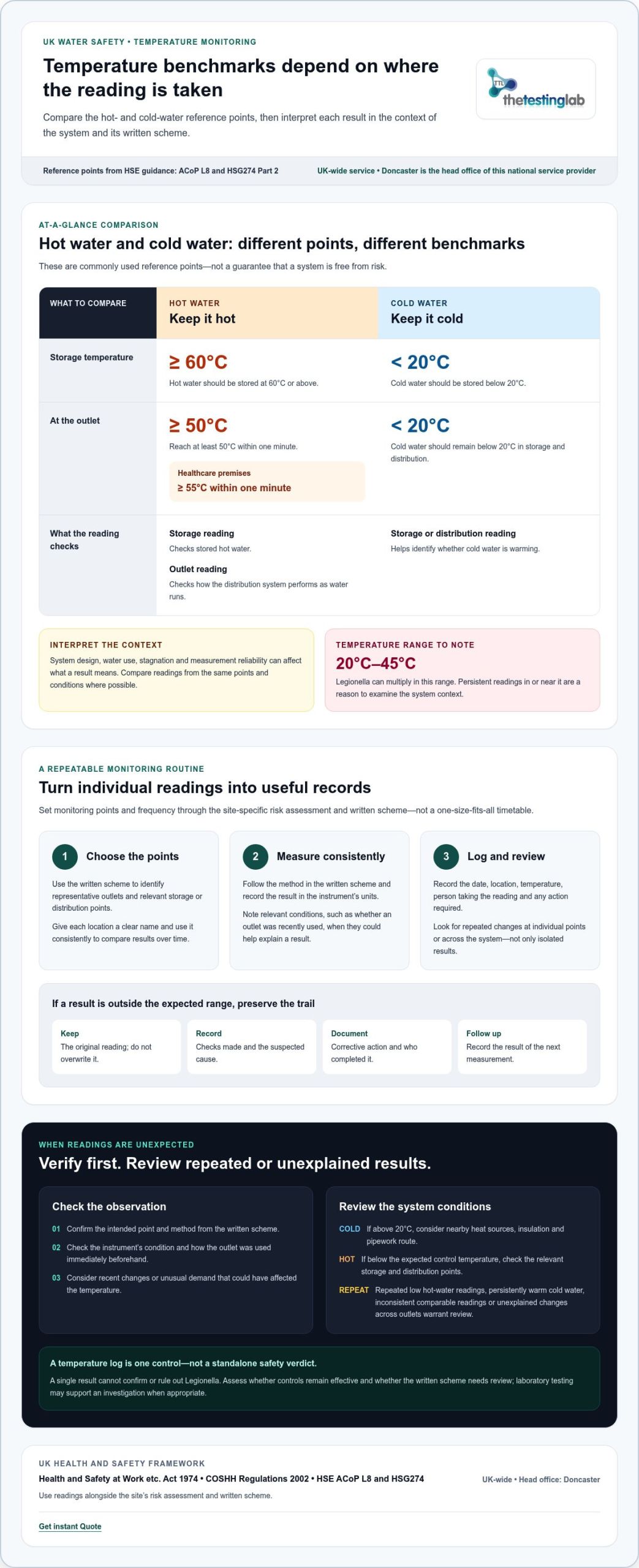
HSE’s HSG274 Part 2 gives the commonly used benchmarks: hot water should be stored at 60°C or above and reach at least 50°C at outlets within one minute, or 55°C in healthcare premises. Cold water should be stored and distributed below 20°C.
These figures apply to different points in the system. A storage-cylinder reading checks stored hot water; an outlet reading checks how the distribution system performs when water runs. Cold-water readings help identify whether stored or distributed water is warming. Record the location and conditions with each result so that you can compare like with like over time. Legionella can multiply between 20°C and 45°C, so persistent readings in or near this range are a reason to examine the system context. For background on the illness and temperature control, see Legionnaires’ disease and temperature control.
Building water temperatures are distinct from environmental monitoring requirements. For example, effluent discharge permit monitoring concerns a separate area of water management, not a substitute for Legionella controls.
How to monitor water temperatures and keep useful records
A reliable monitoring routine turns individual readings into evidence that water controls are working as intended. Under the UK’s health and safety framework, including the Health and Safety at Work etc. Act 1974 and COSHH Regulations 2002, monitoring should support wider risk management. HSE’s ACoP L8 and HSG274 inform the written scheme, which should set suitable monitoring points and frequency for the building and its water-system risks.
- Choose the points. Follow the written scheme to identify representative outlets and relevant storage or distribution points. Give each point a clear name and use it consistently, so you can compare readings from the same locations over time.
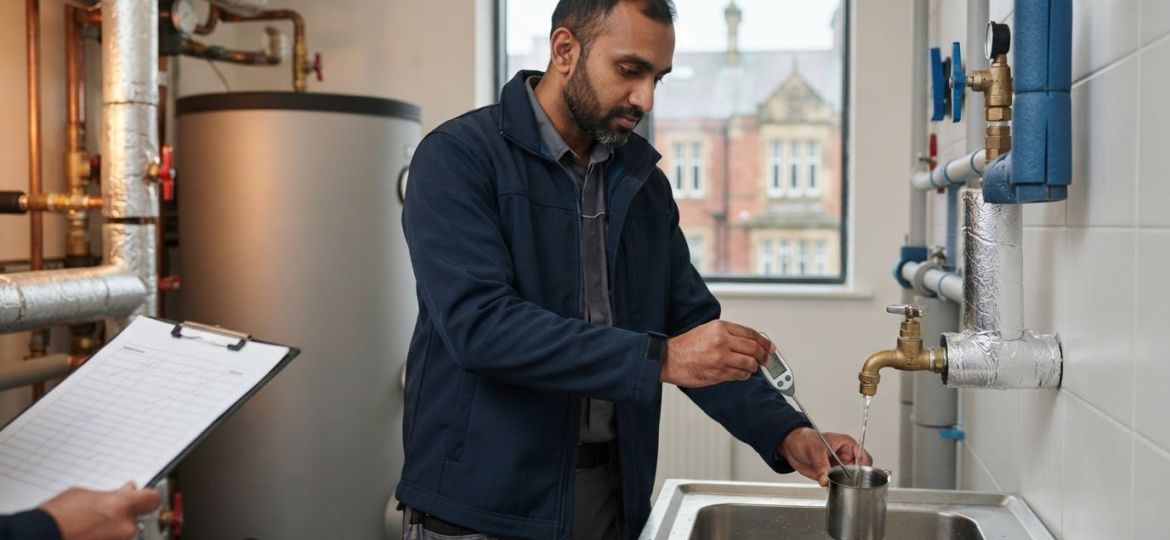
- Measure consistently. Use the method set out in the written scheme and record the result in the units shown by the instrument. Note relevant conditions, such as whether an outlet was recently used, when they could help explain a result.
- Log and review. Record the date, location, temperature, name of the person taking the reading and any action required. Look for repeated changes at individual points or across the system, not just isolated results.
What should a legionella temperature log include?
Consistent records make results easier to compare and follow up. If a reading is outside the expected range, preserve the original result rather than overwriting it. Record the checks made, the suspected cause, corrective action, who completed it and the result of any follow-up measurement. This creates a clear trail from the initial finding to the response and helps responsible personnel decide whether controls or the written scheme need review.
Set monitoring frequency through the site-specific risk assessment and written scheme, not a universal timetable. A Legionella risk assessment helps establish the wider management context. The Testing Lab PLC provides services across the UK, with its head office in Doncaster, and offers Quick Legionella Risk Assessments, Fast Legionella Testing and Water Management Services. For support with assessment or water-management requirements, request a Legionella service quote.
What to do when readings are outside the expected range
An unexpected result is a prompt to check, not a diagnosis. First confirm that the reading was taken at the intended point using the method set out in the written scheme. Check the instrument’s condition, how the outlet was used immediately beforehand, and whether recent changes or unusual demand could have affected the water temperature. Record the original result and your checks so the reason for any decision is clear.
If a cold-water reading is above 20°C, consider whether nearby heat sources, insulation or the route of the pipework could be contributing. If hot water is below its expected control temperature, check the relevant storage and distribution points. Document any corrective action and follow-up readings. A single result cannot confirm or rule out Legionella, so do not treat a temperature log as a substitute for wider assessment.
When should monitoring trigger further investigation?
Repeated low hot-water readings, cold water that remains warm, inconsistent results at comparable points or unexplained changes across several outlets all warrant review. Under the UK framework, including the Health and Safety at Work etc. Act 1974 and COSHH Regulations 2002, responsible personnel should assess whether controls remain effective and whether the written scheme needs updating. A Legionella risk assessment can examine system conditions and control measures. Laboratory testing may also support an investigation when further assessment is appropriate.
This legionella temperature monitoring guide supports a measured response: verify the observation, document what followed, and escalate persistent or unexplained concerns. The Testing Lab PLC provides water-management, assessment and testing services across the UK, with its head office in Doncaster. For support with the next step, request a quote for Legionella services.
Make monitoring part of ongoing water safety
Build a clear response pathway into your water-management arrangements. Staff should know who reviews unusual results and how follow-up is documented. Revisit the system assessment when its use or configuration changes, or when monitoring suggests that established controls may no longer be effective. This connects temperature records to practical decisions instead of treating them as an isolated administrative task.
A structured legionella temperature monitoring guide can help teams build a dependable routine, but persistent concerns may call for wider assessment or laboratory testing. The Testing Lab PLC’s UKAS-accredited laboratory supports water-safety work. The company provides services across the UK, with Doncaster as its head office, and offers Legionella risk assessments, testing and water-management services. Get instant Quote to discuss your water-safety requirements and plan appropriate support.
Frequently Asked Questions
What temperature should hot water be to help control legionella?
HSE guidance in HSG274 Part 2 recommends storing hot water at 60°C or above. At outlets, water should reach at least 50°C within one minute, rising to 55°C in healthcare premises. Consider where the reading is taken: a suitable storage temperature does not prove that every outlet or branch is receiving adequately hot water.
What temperature should cold water be to help prevent legionella?
Cold water should be stored and distributed below 20°C, in line with HSE guidance. A warmer result can prompt checks for heat transfer from nearby pipework, inadequate insulation or seasonal warming, especially if the temperature stays high. It does not confirm Legionella is present, just as a cooler reading alone cannot establish that the system is safe.
How often should legionella temperatures be monitored?
Follow the site’s risk assessment and written scheme. HSG274 commonly advises monthly checks at sentinel outlets and hot-water storage, with cold-water storage tanks checked at least every six months. These are guidance benchmarks, not a substitute for a site-specific schedule. The building’s use, system design and control performance should inform the routine.
What should I do if a water temperature reading is outside the expected range?
First, repeat the measurement using the correct method and confirm the point being checked. Record both readings and relevant conditions, then notify the responsible person. If the result persists or has no clear explanation, review the controls and written scheme. A Legionella risk assessment or water testing may help determine appropriate next steps.

Article by
P J F Thomas
CEO and Founder of TTL plc.
Disclaimer
Items declared are AI generated but do reflect our services. Please get in contact if you have any questions.