
Get instant Quote. Could the right soil data help prevent an unexpected asbestos discovery or avoid sending excavated material down a more costly disposal route? For UK infrastructure teams, soil contamination testing for infrastructure projects supports practical decisions about excavation, reuse and disposal, not just compliance.
Keeping work on programme while meeting environmental requirements means gathering evidence early enough to use it. This guide explains how UK legislation, including the Environmental Protection Act 1990 and the Control of Asbestos Regulations 2012, informs site investigation and waste decisions. It also explains why WM3 waste classification comes before WAC testing, and how analysis can support disposal decisions.
The Testing Lab PLC is an independent, UKAS-accredited testing laboratory headquartered in Doncaster. It provides soil testing alongside environmental and occupational hygiene services. Read on for an overview of the testing process, key regulatory considerations and ways to plan laboratory analysis for projects in locations including Doncaster, Leeds and Manchester.
Key Takeaways
- See how soil contamination testing for infrastructure projects can support compliance with UK legislation and inform planning decisions.
- Understand the difference between WM3 waste classification and WAC testing, and plan them in the right order before disposal.
- Learn how soil analysis, including Loss on Ignition results, can inform waste classification and landfill tax assessments.
- Find out how a UKAS-accredited laboratory headquartered in Doncaster can support soil analysis, including asbestos-in-soil analysis, for projects across the UK.
The Legal Framework for Soil Contamination in UK Infrastructure
Get instant Quote
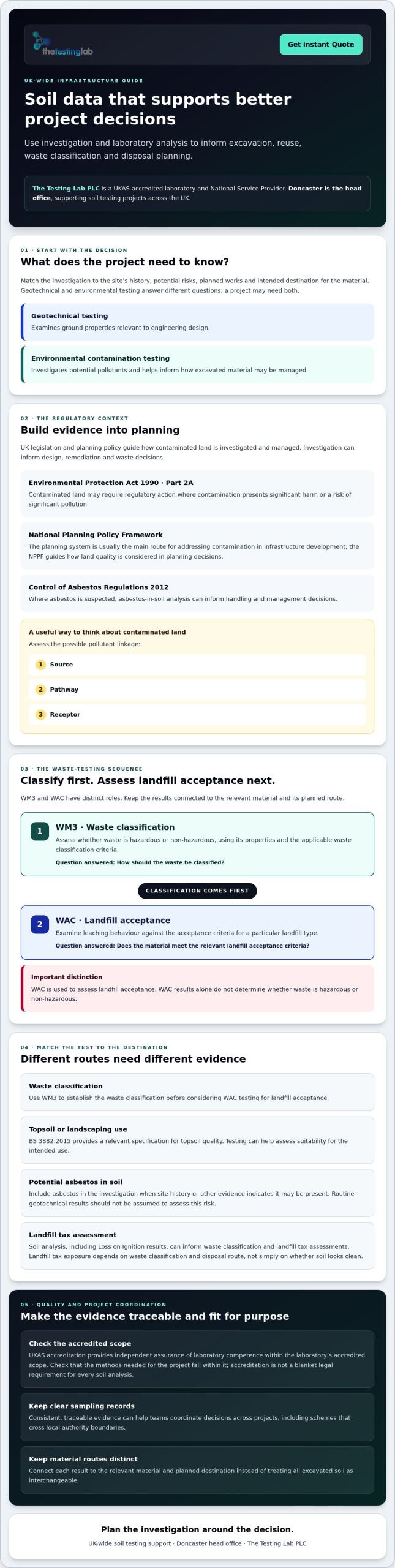
Under Part 2A of the Environmental Protection Act 1990, contaminated land may require regulatory action where contamination presents significant harm or a risk of significant pollution. For infrastructure development, the planning system is usually the main route for addressing contamination. The National Planning Policy Framework (NPPF) guides how planning decisions consider land quality, so investigation should inform design and remediation decisions as well as waste management. The definition of contaminated land is often explained through pollutant linkages: a source, a pathway and a receptor.
For soil contamination testing for infrastructure projects, UKAS accreditation gives independent assurance of laboratory competence within the laboratory’s accredited scope. It is a useful quality benchmark, but it should not be presented as a blanket legal requirement for every soil analysis. Check that the methods needed for the project fall within the laboratory’s accreditation.
Regulatory Compliance and the Role of the National Service Provider
Large transport schemes can cross local authority boundaries, so consistent, traceable evidence can help teams coordinate decisions across a project. The Testing Lab PLC is UKAS-accredited and headquartered in Doncaster. Clear sampling records and appropriate soil characterisation help project teams make informed decisions and manage liability. Where asbestos is suspected, asbestos-in-soil analysis can inform handling and management decisions.
At the waste-classification stage, review the laboratory’s WM3 testing information. Start by matching the investigation to the site’s history, potential risks and planned works. This helps build an evidence trail that can support decisions across infrastructure projects, including those in Carlisle, Chester, Lancaster, Liverpool, Manchester, Preston and Salford.
Critical Laboratory Analysis: Comparing WAC, WM3, and Topsoil Standards
Get instant Quote
Geotechnical testing examines ground properties relevant to engineering design. Environmental contamination testing investigates potential pollutants and how excavated material should be managed. A project may need both, but one does not replace the other. Environmental data helps teams make better-informed decisions about waste classification, reuse and disposal.
WM3 and WAC answer different questions. WM3 is used to assess whether waste is hazardous or non-hazardous, based on its properties and the applicable waste classification criteria. WAC testing examines leaching behaviour against the acceptance criteria for a particular landfill type. WAC is used to assess landfill acceptance, not to classify waste. Establish the classification first; WAC results alone do not determine whether waste is hazardous or non-hazardous.
For details on landfill acceptance analysis, see WAC testing. On brownfield sites, include asbestos in the investigation when site history or other evidence indicates that it may be present. Identifying asbestos in soil can inform handling and management. Do not assume that routine geotechnical results assess this risk.
Choosing the Right Testing Protocol for Your Infrastructure Project
For soil contamination testing for infrastructure projects, begin with the material’s intended destination and the decision the results need to support. Use WM3 to establish waste classification, then consider WAC testing where landfill acceptance needs to be assessed. If material is intended for landscaping or another topsoil use, BS 3882:2015 provides a relevant specification for topsoil quality. Testing can help assess whether the material is suitable for its intended use.
Keep the results distinct and connect them to the relevant material and planned route. This gives teams a clearer record than treating all excavated soil as interchangeable. The Testing Lab PLC is a UKAS-accredited laboratory headquartered in Doncaster, providing soil testing for projects across the UK. For project-specific testing requirements, request a quote for soil analysis.
Budget Optimisation: Reducing Landfill Tax and Avoiding HMRC Fines
Get instant Quote
Landfill tax exposure depends on the waste’s classification and disposal route, not simply on whether soil looks clean. For 1 April 2026 to 31 March 2027, the landfill tax rates are £130.75 per tonne at the standard rate and £8.65 per tonne at the lower rate. The rates are aligned across the UK for this period. Applying the lower rate without meeting its criteria can create tax and compliance risks, so retain evidence that supports the decision.
Loss on Ignition (LOI) testing measures the amount of material lost when a sample is heated. The result can help assess whether waste meets relevant criteria for the lower rate, but LOI alone does not classify waste or guarantee a particular tax treatment. Consider it alongside waste classification and disposal documentation. Correct classification and duty-of-care records remain essential under UK waste requirements.
Mitigating Financial Risks with Specialist Laboratory Analysis
For soil contamination testing for infrastructure projects, plan sampling and laboratory analysis early enough to inform excavation, segregation and disposal decisions. First clarify which materials need testing, their intended routes and what decisions the results must support. Where materials are suitable for reuse, a project team may avoid disposal, subject to relevant environmental and planning requirements. The Testing Lab PLC is headquartered in Doncaster and supports infrastructure projects across the UK.
LOI results are evidence for assessment, not a way to guarantee tax savings. The laboratory’s HMRC LOI testing information can help you understand the analysis to consider. Confirm the required tests and reporting times before scheduling excavation or disposal. This gives the project team a chance to review the evidence before making decisions and can help reduce avoidable delays.
Build Compliance into Your Next Project
Get instant Quote
Good soil decisions start with evidence that matches the task. WM3 classification and WAC landfill acceptance testing answer different questions, while suitable analysis can help assess whether topsoil is appropriate for reuse. LOI results may inform tax assessments, but they need to be considered alongside classification and disposal evidence.
Plan soil investigations early and connect laboratory results to excavation, reuse and disposal decisions. The Testing Lab PLC is a UKAS-accredited laboratory headquartered in Doncaster, with services supporting projects across the UK. Its soil analysis services include testing for waste classification, landfill acceptance and LOI assessment.
Before requesting analysis, identify the materials, the planned work and the decisions the results must support. The Testing Lab PLC supports projects in locations including Carlisle, Chester, Lancaster, Liverpool, Manchester, Preston, Salford, Berwick-upon-Tweed, Durham, Middlesbrough, Newcastle upon Tyne, Sunderland, Bradford, Doncaster, Huddersfield, Hull, Leeds, Sheffield and Wakefield. Discuss your project requirements and request soil testing for your infrastructure project.
Frequently Asked Questions
Get instant Quote
What is the difference between WM3 and WAC soil testing?
WM3 assesses waste properties to determine whether material is hazardous or non-hazardous. WAC testing assesses whether it meets a landfill’s acceptance criteria. The tests are not interchangeable: establish the waste classification before using WAC results to assess landfill suitability. For soil contamination testing for infrastructure projects, match the analysis to the material’s intended route and applicable UK waste requirements.
How much does soil contamination testing cost for UK infrastructure projects?
There is no single price for every project. The scope, number of samples and analyses required affect the quotation. Before requesting one, define the site, the materials to be assessed and the decisions the results need to support. The Testing Lab PLC is a UKAS-accredited laboratory headquartered in Doncaster, serving project locations including Carlisle, Chester, Lancaster, Liverpool, Manchester, Preston, Salford, Berwick-upon-Tweed, Durham, Middlesbrough, Newcastle upon Tyne, Sunderland, Bradford, Huddersfield, Hull, Leeds, Sheffield and Wakefield.
Is asbestos-in-soil testing mandatory for all brownfield infrastructure sites?
No single rule makes asbestos-in-soil testing mandatory at every brownfield site. The need depends on site history, evidence of potential contamination and the investigation required for the project. The Control of Asbestos Regulations 2012 provide the UK framework for managing asbestos risks. Where asbestos is suspected, competent assessment and appropriate analysis can inform safe handling and management decisions.
How can LOI testing reduce my infrastructure project’s landfill tax bill?
Loss on Ignition (LOI) testing measures the mass lost from a sample during heating. It can provide evidence relevant to assessing waste for landfill tax purposes, but it does not automatically establish eligibility for a particular tax rate, classify waste or guarantee savings. Interpret the result alongside the waste classification, disposal route and applicable HMRC requirements, and keep supporting records for the project’s decisions.

Article by
P J F Thomas
CEO and Founder of TTL plc.
Disclaimer
Items declared are AI generated but do reflect our services. Please get in contact if you have any questions.