
Could a microscopic fibre in the ground bring your multi-million pound development to a complete standstill? You’re likely aware that brownfield sites offer immense potential, but the hidden legacy of industrial use often presents a complex logistical challenge. Managing soil contaminants is one of the most critical aspects of site preparation, especially when the risk of HSE fines or confusion over hazardous waste classification looms over your project timeline. Securing reliable asbestos in soil testing UK wide is the only way to mitigate these operational risks before they impact your bottom line.
This guide ensures your project remains on track and legally compliant through expert UKAS accredited laboratory analysis. We’ll detail the precision of gravimetric quantification and fibre counting under the latest HSG248 guidelines. You’ll gain a clear understanding of how accurate data streamlines waste classification, allowing you to manage site safety with the confidence and technical magistery required for modern construction standards. We’ll provide the roadmap you need to transform hidden ground risks into manageable, documented variables.
Key Takeaways
- Understand your “Duty to Manage” under the Control of Asbestos Regulations 2012 and how these legal requirements apply to ground contaminants.
- Learn about the 3-stage UKAS laboratory process, including the use of Polarised Light Microscopy (PLM) to identify specific fibre types like Amosite and Crocidolite.
- Discover how professional asbestos in soil testing UK wide provides the precise quantification data required for accurate hazardous waste classification.
- Explore the strategic role of independent 4-stage clearances and air monitoring in maintaining safety during large-scale soil remediation projects.
The Legal Framework for Asbestos in Soil Testing UK Wide
Asbestos in soil testing UK is the mandatory analytical process used to identify and quantify asbestos fibres within ground materials. It’s a critical component of land redevelopment that goes beyond simple detection. To manage a site safely, you need to understand exactly what is asbestos and how its presence in soil dictates your legal obligations. The Health and Safety Executive (HSE) enforces these standards to ensure that contaminated land doesn’t pose a risk to workers or the public.
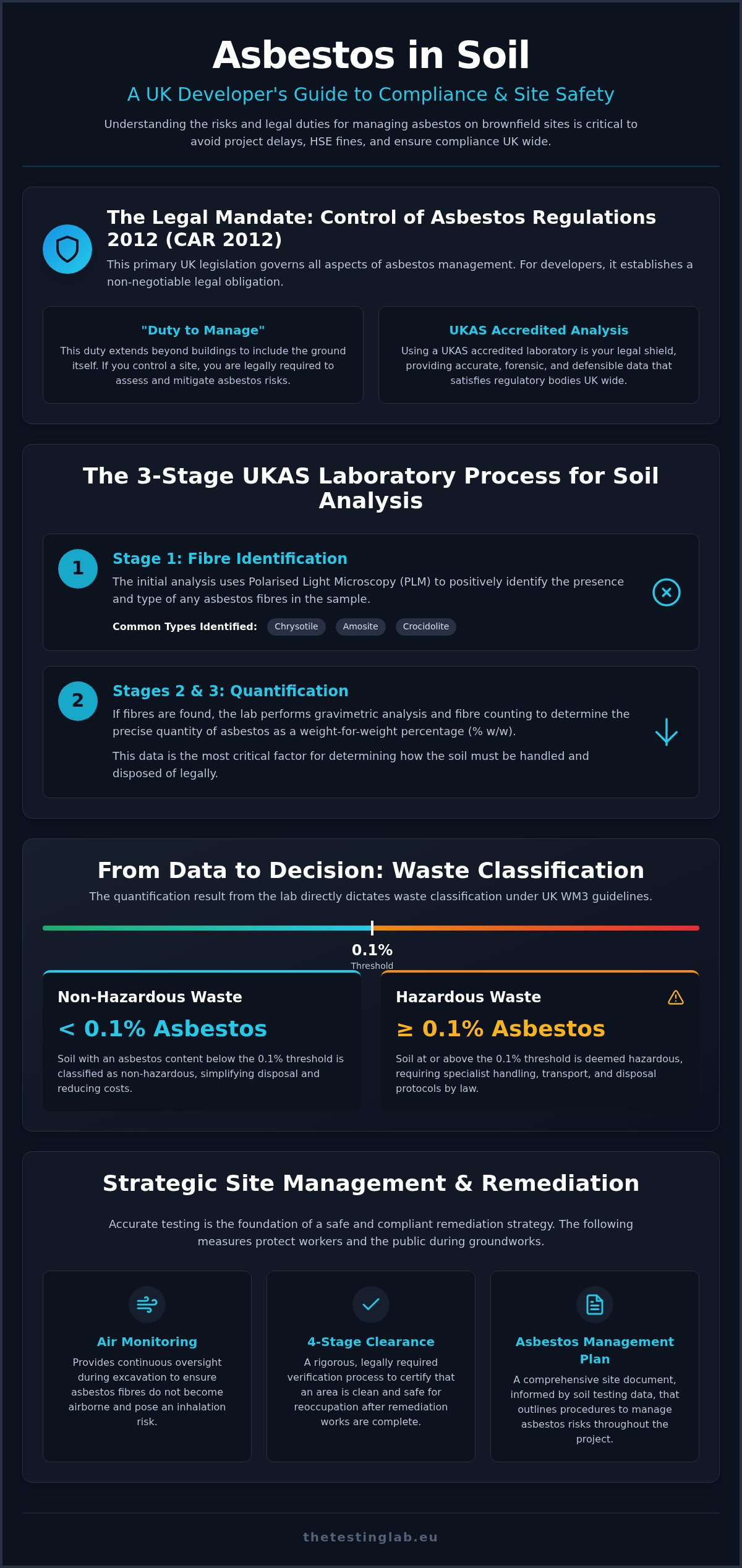
The primary legislative driver is the Control of Asbestos Regulations 2012 (CAR 2012). Under these regulations, the “Duty to Manage” falls on the individual or organisation in control of the premises. This isn’t just about buildings; it extends to the ground itself. If you’re managing a brownfield site, you’re legally required to assess and mitigate the risks. Using a UKAS accredited laboratory provides a vital legal shield. It ensures your results are forensic, accurate, and defensible UK wide, satisfying both local authorities and regulatory bodies.
Understanding CAR 2012 and Contaminated Land Management
Historical industrial sites often contain “free fibres” that aren’t bound within a solid material. These fibres are dangerous because they can easily become airborne during excavation or soil movement. Managing this risk requires a strategic approach to site investigation. If you’re unsure how these regulations apply to your specific project, our asbestos consultancy services provide the legislative clarity needed to move forward safely. Key considerations include:
- Risk Assessment: Evaluating the potential for fibre release during site works.
- Waste Classification: Using quantification data to determine if soil is hazardous or non-hazardous waste.
- Regulatory Compliance: Ensuring all works meet the stringent requirements of CAR-SOIL guidance.
The 3-Stage UKAS Laboratory Process for Soil Analysis
Precision in the laboratory begins long before the sample reaches the microscope. Professional collection of soil samples is the first step, ensuring the material is representative of the site’s actual condition. To maintain the highest standards, asbestos in soil testing UK protocols require a robust chain of custody from the moment of extraction to the point of analysis. This process aligns with the technical requirements set out in the Control of Asbestos Regulations 2012.
Stage 1 involves the identification of asbestos fibre types, such as Chrysotile, Amosite, or Crocidolite, using Polarised Light Microscopy (PLM). If fibres are detected, the analysis moves to Stage 2 and 3: gravimetric analysis and free dispersed fibre quantification. These stages determine the weight percentage (% w/w) of asbestos within the soil matrix. This level of detail is vital for developers who need to understand the exact scale of contamination across their site.
Interpreting Quantitative Analysis and Waste Classification
The data from your laboratory certificate directly informs your waste management strategy. Under WM3 guidelines, the quantification of asbestos determines whether the soil is classified as hazardous or non-hazardous waste. If the asbestos content is above 0.1%, the soil is typically deemed hazardous. However, even at lower levels, you might require WAC testing to confirm the material’s suitability for specific landfill sites.
Reading a certificate of analysis requires attention to the limit of detection and the specific fibre types found. For projects requiring high-volume throughput and technical accuracy, our team provides asbestos in soil testing UK wide to ensure your waste classification is legally sound. This precision prevents costly miscategorisation and ensures your project remains within environmental compliance boundaries.
Strategic Asbestos Management and Remediation UK Wide
Effective site remediation requires more than just excavation. It demands continuous oversight through air monitoring and rigorous 4-stage clearances to ensure no hazardous fibres remain. By positioning ourselves as a strategic partner for asbestos in soils testing, we provide the technical foundation for your land-based Asbestos Management Plan (AMP). This data is essential for maintaining safety during large-scale groundworks. We leverage our UK wide surveying services to provide comprehensive site investigations that identify risks before they become liabilities.
Integrating UKAS accredited data into your Material Management Plan (MMP) is a critical step in modern development. It follows the industry guidance for asbestos in soil established by CL:AIRE. This alignment helps you avoid the severe financial impact of mismanaged contaminants. As an independent PLC, we offer unbiased results that ensure full transparency for stakeholders and regulators alike. Accurate data from the start prevents the “discovery” of contaminants mid-construction, which can lead to project delays costing thousands of pounds.
Integrating Testing into Material Management Plans (MMP)
A well-structured MMP relies on the precision of your initial site data. Our independent status ensures that your waste classification and soil reuse strategies are based on objective, high-quality analysis. This transparency reduces project risk and protects your reputation. If you’re ready to secure your site’s compliance, you can request a specialist soil testing quote today. Our team provides the agility and technical depth needed to support complex asbestos in soil testing UK wide from inception to completion.
Securing Your Project’s Viability through Technical Precision
Managing brownfield risks requires more than a checklist; it demands a forensic understanding of ground contaminants to ensure long-term site safety. By implementing a 3-stage UKAS laboratory process, you move beyond simple identification to precise quantification. This data is the cornerstone of any robust Material Management Plan, protecting your project from the high costs of misclassified waste and regulatory intervention. Reliable asbestos in soil testing UK wide is your primary tool for maintaining transparency with stakeholders and the HSE alike.
As an independent PLC with a nationwide consultant network, we provide CAR 2012 compliant reporting that you can trust. It’s time to remove the technical burden from your shoulders and focus on construction. Request a UKAS Accredited Asbestos in Soil Testing Quote UK Wide today. We’re ready to help you navigate these complex legislative requirements with confidence and clarity.
Frequently Asked Questions
How is soil sampled for asbestos testing UK wide?
Soil is collected using a systematic sampling strategy, such as a grid pattern or targeted trial pits, to ensure the material is representative of the entire site. Each sample is sealed in double-bagged, airtight containers to prevent cross-contamination and fibre release during transit. Our nationwide operative network follows strict protocols to maintain the integrity of the material before it reaches the lab for asbestos in soil testing UK wide.
What are the hazardous waste limits for asbestos in soil?
The threshold for hazardous waste classification is typically 0.1% asbestos by weight (% w/w). If the concentration of fibres or fragments exceeds this limit, the soil must be treated as hazardous waste under WM3 guidelines. Even if the level is below this 0.1% threshold, the soil is still considered “asbestos-containing” and requires specific management strategies to comply with the Control of Asbestos Regulations 2012.
Is UKAS accreditation mandatory for asbestos in soil analysis?
UKAS accreditation to ISO/IEC 17025 is the industry standard for any laboratory performing the identification and quantification of asbestos in ground materials. While mandatory often refers to the legal defensibility of the results, the HSE and local authorities won’t accept data from non-accredited facilities for planning or waste disposal. It ensures your asbestos in soil testing UK data meets the highest technical and quality benchmarks.
How long does the 3-stage asbestos in soil testing process take?
Standard turnaround for the full 3-stage analysis is typically between three and five working days from receipt at our laboratory. This timeframe allows for the meticulous identification of fibre types followed by gravimetric quantification and fibre counting. We understand that construction timelines are often compressed, so expedited reporting options are available for projects requiring urgent results to prevent site delays or machinery downtime.

Article by
P J F Thomas
CEO and Founder of TTL plc.
Disclaimer
Items declared are AI generated but do reflect our services. Please get in contact if you have any questions.