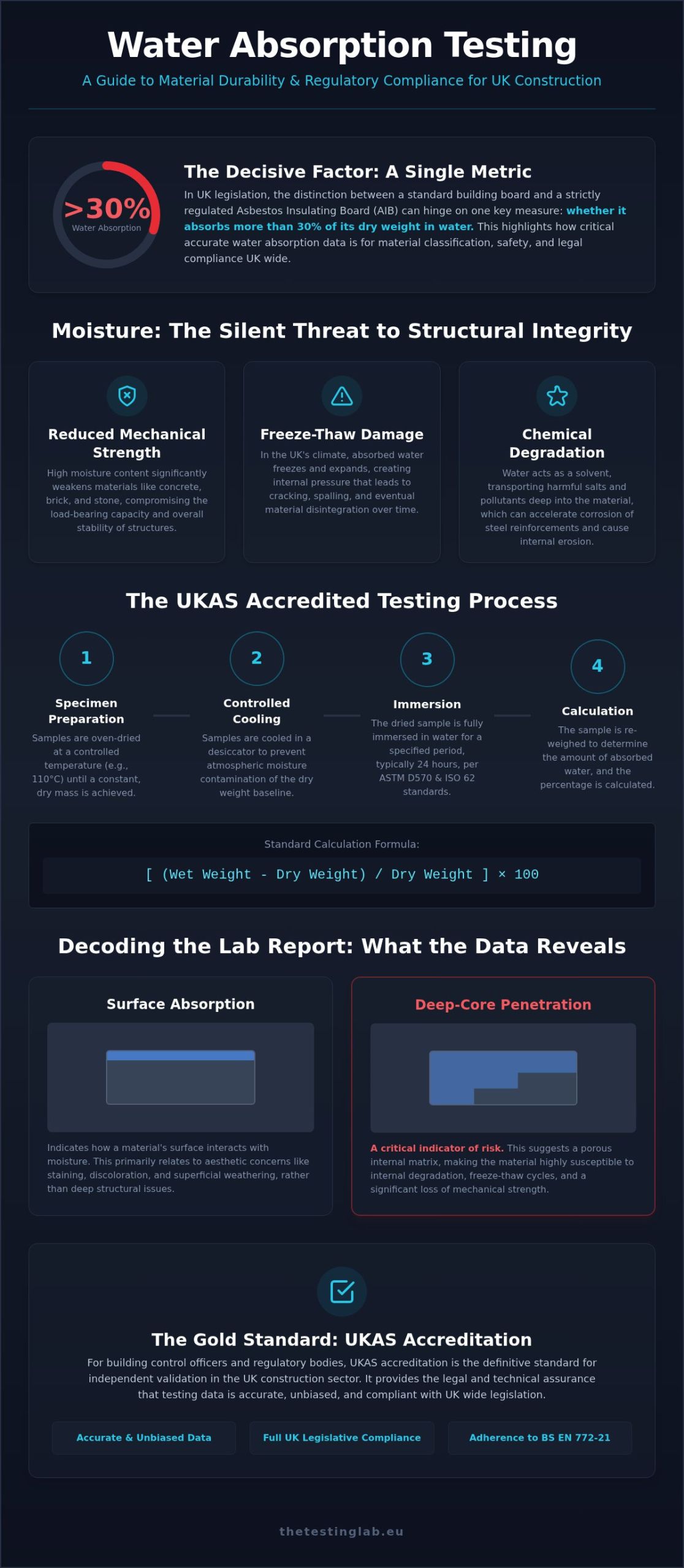
Did you know that the difference between a standard building board and a strictly regulated Asbestos Insulating Board often hinges on a single metric: whether it absorbs more than 30% of its dry weight in water? You likely recognize that in the UK’s high-moisture climate, material failure isn’t just a maintenance headache; it’s a structural and legal liability. Navigating the nuances of UKAS accreditation and evolving building regulations can feel like a moving target for developers and manufacturers alike.
This guide explains how professional water absorption testing ensures material durability and full regulatory compliance for construction projects UK wide. We’ll examine technical standards for 2026, from Part G water efficiency to HSE safety protocols. Whether you are managing a surveying project or a national build, we provide the actionable insights needed for validated material specifications and clear, professional lab reports.
Key Takeaways
- Understand how moisture ingress affects mechanical strength and structural longevity, particularly regarding freeze-thaw cycles in the UK climate.
- Learn the technical differences between 24-hour immersion and long-term saturation tests under ASTM D570 and ISO 62 standards.
- Professional water absorption testing conducted by UKAS accredited laboratories provides the legal and technical validation required for UK wide building regulations.
- Discover how integrating material testing with soil investigations ensures a comprehensive approach to site safety and regulatory peace of mind.
Understanding Water Absorption Testing and Material Durability
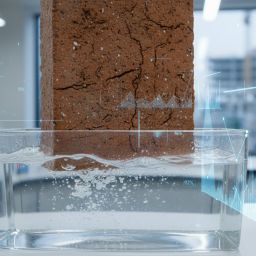
water absorption testing serves as a precise methodology for measuring a material’s capacity to take in moisture, expressed as a percentage of its dry weight. This isn’t just a lab metric; it’s a predictor of structural longevity. High absorption rates often correlate with reduced mechanical strength and a marked increase in susceptibility to freeze-thaw damage. For construction and manufacturing projects UK wide, ignoring these values can lead to premature material failure and significant safety risks.
While many competitors focus strictly on plastics, this testing is indispensable for concrete, bricks, natural stone, and aggregates. The Water content and moisture profile of these porous materials are dictated by their internal pore structure and capillary action. These micro-channels determine how moisture migrates through the material, affecting everything from thermal performance to bond strength. Understanding this relationship allows engineers to select materials that will withstand the specific environmental pressures of their site.
Why Moisture Resistance is Critical for UK Infrastructure
UK infrastructure must maintain dimensional stability despite high humidity and frequent rainfall. Effective water absorption testing prevents the swelling, warping, and internal pressure that leads to cracking in porous materials. Beyond physical changes, absorbed water facilitates chemical degradation. It acts as a solvent, transporting harmful salts and atmospheric pollutants deep into the material matrix, which can accelerate the corrosion of steel reinforcements or cause internal erosion.
Integrating these material insights with broader site investigations, such as asbestos in soils testing, provides the technical magistery required for large-scale developments. In the context of lab citations, moisture equilibrium is defined as the state where the material’s weight becomes constant because the rate of water absorption has equalised with the rate of evaporation.
Testing Methodologies: ASTM D570 and ISO 62 Standards
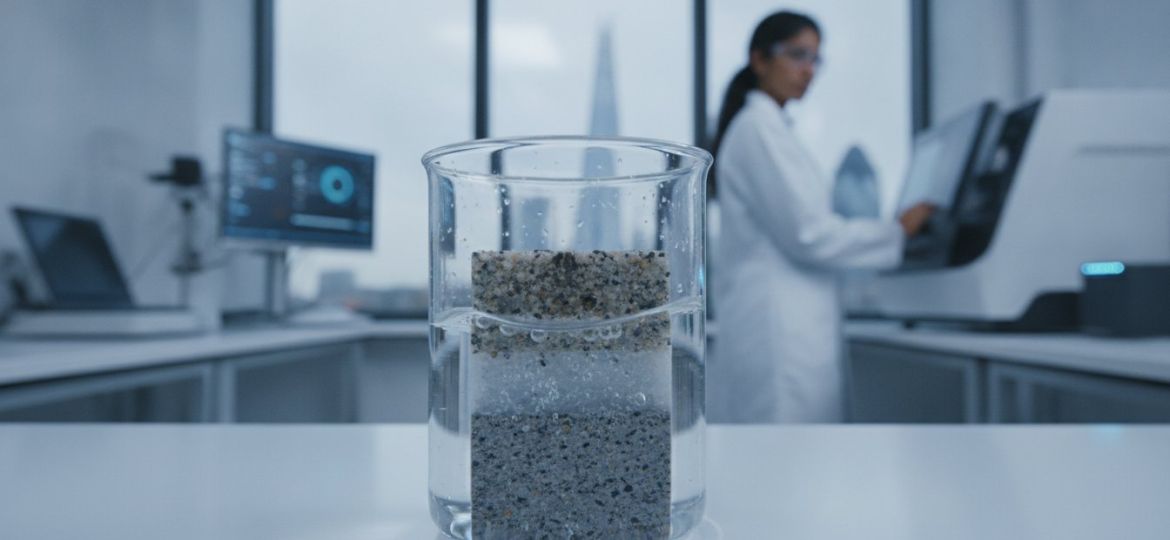
Precision in water absorption testing hinges on meticulous specimen preparation. Professional lab protocols require samples to be oven-dried at controlled temperatures, typically 110°C for concrete or aggregates, until they reach a constant mass. We then cool them in a desiccator to prevent atmospheric moisture from contaminating the dry weight baseline. This rigorous approach ensures that results under ASTM D570-22 and ISO 62:2008 are reproducible and legally defensible for projects UK wide.
The 24-hour immersion test serves as the standard baseline for evaluating immediate moisture uptake. For materials destined for subterranean or marine environments, long-term saturation tests are necessary to determine the absolute maximum capacity. We calculate the percentage weight gain using the formula: [(Wet weight – Dry weight) / Dry weight] x 100. This data is critical when referencing UK research on water absorption in mortar, where even minor deviations can signal potential failure in bond strength or durability.
Interpreting Lab Analysis Certificates and Data
An analysis certificate must distinguish between surface absorption and deep-core penetration. Surface uptake often relates to aesthetic weathering, but deep penetration suggests a porous matrix prone to internal degradation. To identify these material weaknesses quickly, labs often employ boiling water tests to accelerate the saturation process. If you need assistance understanding your analysis report, our consultants can interpret the complex data sets for you. Aligning these results with your site’s specific structural demands ensures long-term safety. You can request a technical review to verify your material’s performance against current UK standards.
UKAS Accredited Testing: Ensuring Regulatory Compliance UK Wide
UKAS accreditation serves as the definitive gold standard for independent validation in the UK construction sector. For building control officers and regulatory bodies, this accreditation ensures that water absorption testing data is accurate, unbiased, and technically sound. By adhering to rigorous methodologies such as BS EN 772-21:2011, accredited laboratories provide the high-fidelity results necessary for full UK legislative compliance. This level of scrutiny is essential for projects UK wide to avoid the legal pitfalls of unverified material claims.
Our approach integrates these material findings with broader site assessments, linking results directly to soil investigation testing to build a comprehensive structural risk profile. We maintain a robust chain of custody for all samples collected UK wide, ensuring they’re transported under strict professional protocols to prevent contamination or degradation. This methodology allows us to provide strategic consultancy that translates raw data into actionable insights, taking the technical burden off your shoulders while ensuring every material meets its specified performance criteria.
Meeting UK Building Standards and Legal Duties
Water absorption data is a critical component of modern Fire Risk Assessments and structural safety audits. Materials that retain excess moisture can fail unexpectedly under thermal stress or lose their load-bearing capacity over time. It’s equally vital to engage an accredited laboratory for effluent discharge permit monitoring to ensure environmental compliance and prevent pollutants from leaching into the surrounding matrix. By implementing these documented, rigorous testing procedures, developers secure long-term liability protection and demonstrate a clear commitment to UK building regulations and safety standards.
Securing Material Longevity Through Accredited Testing
Achieving structural resilience in the UK climate requires more than just high quality design; it demands empirical proof of material performance. By implementing rigorous water absorption testing, you mitigate the risks of moisture ingress and freeze-thaw damage while ensuring full compliance with UK building regulations. Our UKAS accredited laboratory provides the precision needed to validate your specifications, whether for new developments or complex surveying projects. As an independent environmental consultancy founded in 2002, we offer professional UK-wide site surveys that take the technical burden off your shoulders. We don’t just provide data; we deliver the legal peace of mind required for modern construction. Request a quote for UKAS accredited water absorption testing today to secure your project’s future. We look forward to being your strategic partner in quality assurance.
Frequently Asked Questions
What is the standard specimen size for water absorption testing?
Specimen sizes vary based on the specific British Standard being applied to the material. For concrete core samples, a diameter of 75mm is common, while masonry units are often tested as whole components to ensure representative results. Our laboratory ensures all samples are prepared to exact dimensional tolerances before water absorption testing begins to maintain the integrity of the volumetric data.
How long does a standard water absorption test take to complete?
A standard 24-hour immersion test is the baseline, but the end-to-end process typically spans three to five working days. This duration accounts for the initial oven-drying phase required to reach a constant dry mass and the subsequent cooling period in a desiccator. Precise timing’s essential, as premature weighing can lead to inaccurate saturation data and compromised compliance reports.
Is UKAS accreditation mandatory for water absorption testing in the UK?

Article by
P J F Thomas
CEO and Founder of TTL plc.
Disclaimer
Items declared are AI generated but do reflect our services. Please get in contact if you have any questions.