A UKAS accredited lab report is far more than a simple technical summary; it’s the primary legal shield protecting your organization from HSE enforcement and civil liability. When you’re managing complex UK-wide operations, having a UKAS lab report explained in clear, professional terms is essential to avoiding risks you can’t afford to take. You aren’t alone if you’ve felt frustrated by dense jargon or worried that a single misinterpreted figure could lead to a compliance failure. It’s common to feel the weight of responsibility when signing off on safety documentation that feels like a foreign language.
We understand that the pressure to meet statutory requirements often clashes with the reality of deciphering complex analysis certificates. This guide provides a comprehensive framework designed to turn technical confusion into operational confidence. You’ll learn to master critical metrics like the Limit of Detection (LOD) and the latest 2026 standards for uncertainty of measurement. We’ll walk through the essential components of ISO/IEC 17025:2017 compliance and the implications of the latest UKAS publications, giving you the tools to build a precise risk management strategy based on verified, high-quality data.
Key Takeaways
- Identify the technical significance of the UKAS “Royal Crown” symbol and why it is the gold standard for laboratory competence across your UK-wide sites.
- Learn how to verify that your testing methodology aligns with current 2026 standards, ensuring your UKAS lab report explained meets all legal scrutiny.
- Master the interpretation of unique report references and sample IDs to maintain a bulletproof audit trail for regulatory bodies.
- Discover how to integrate laboratory data directly into your risk management frameworks, including ACOP L8 water management and asbestos compliance.
- Understand the strategic value of independent testing in fulfilling your statutory obligations under the Control of Asbestos Regulations 2012.
The Fundamentals of a UKAS Accredited Lab Report
A UKAS lab report explained in its simplest form is a verified certificate of technical competence. It serves as official documentation that an analysis was performed by a laboratory independently audited by the United Kingdom Accreditation Service (UKAS). This body ensures that every aspect of the testing process, from sample handling to final data output, adheres to stringent international standards. For professionals managing hazardous materials UK wide, these reports are the only way to ensure data integrity and regulatory compliance.
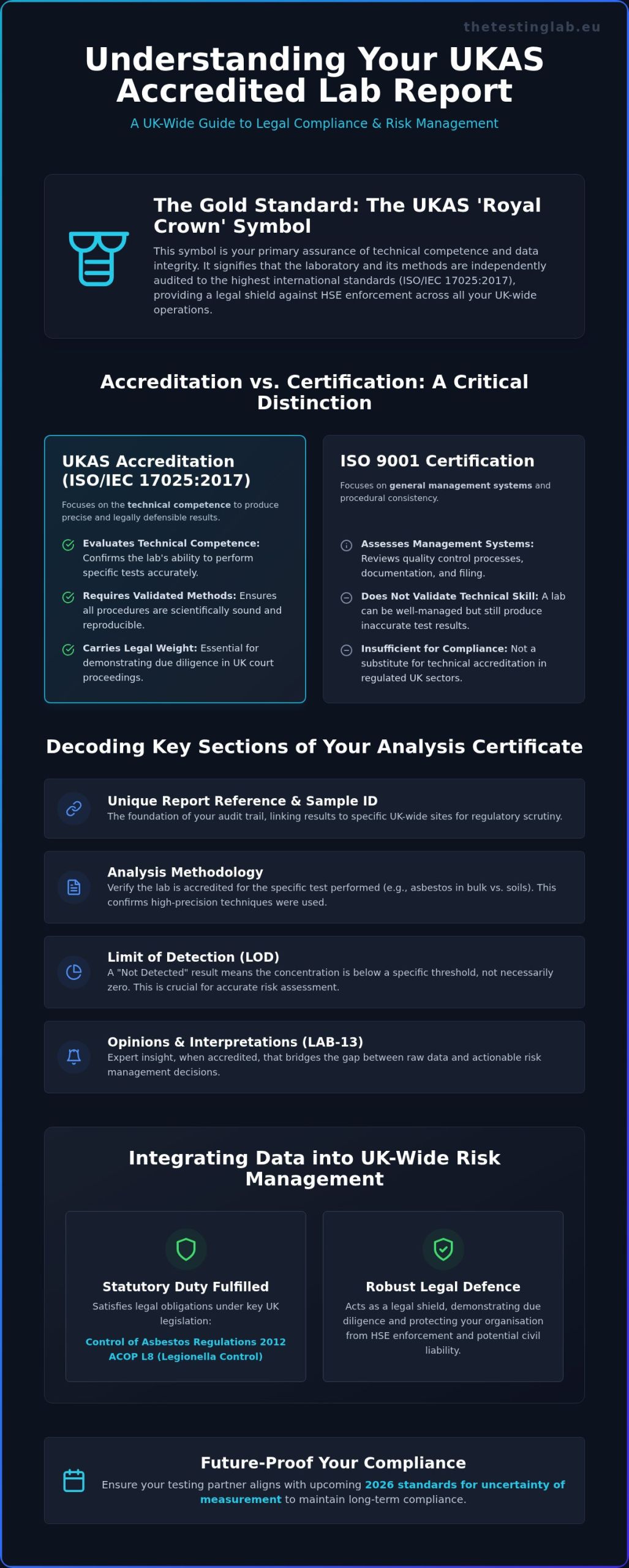
The presence of the UKAS “Royal Crown” symbol on a report is a mark of reliability recognized globally. It signifies that the lab has demonstrated the technical ability to produce precise and accurate results. Non-accredited reports often fail to meet the strict requirements of the HSE or commercial insurance providers. Without this mark, you’re essentially relying on unverified data, which creates a massive vulnerability in your risk management framework. These reports act as a legal shield, proving you’ve exercised due diligence in your safety obligations.
Accreditation vs. Certification: Key Differences for UK Managers
It’s a common mistake to assume that ISO 9001 certification is sufficient for technical testing. While ISO 9001 focuses on general management systems, UKAS accreditation specifically evaluates technical competence. It’s the difference between having a good filing system and actually knowing how to identify asbestos fibres or legionella bacteria accurately. In UK court proceedings, the legal weight of an accredited report is significantly higher because it confirms the method used was scientifically sound and validated.
ISO/IEC 17025: The Gold Standard for Testing Laboratories
The current standard, ISO/IEC 17025:2017, is what separates elite laboratories from the rest. This standard requires rigorous equipment calibration, validated testing methods, and ongoing staff training. It ensures the reproducibility of your test results, meaning the data remains consistent regardless of when or where the sample was processed. Laboratories operating UK wide must undergo a continuous audit cycle to maintain this status, providing you with a strategic partner approach to your asbestos and legionella surveying needs. This level of precision is essential for managing long-term liability and operational safety.
Decoding the Key Sections of Your Lab Analysis Certificate
A UKAS lab report explained involves more than just looking at a final result; it requires a systematic review of the document’s metadata to ensure absolute traceability. Every certificate must feature a unique report reference and sample ID. These identifiers are the foundation of your audit trail, allowing you to link specific results back to exact locations across your UK-wide property portfolio. Without this clear link, the report loses its standing as a legal document during an HSE inspection.
You must also verify the methodology used for analysis. Accreditations are scope-specific, meaning a lab might be accredited for asbestos in bulk materials but not for asbestos in soils. By cross-referencing the methods listed on your report with the UKAS laboratory accreditation standards, you confirm that the data was generated using validated, high-precision techniques. Understanding the units is equally vital. Whether you’re reviewing parts per million (ppm), percentages for bulk materials, or Colony Forming Units (CFU/ml) for water, these metrics dictate your next operational steps.
The Limit of Detection (LOD) is a frequently misunderstood technical detail. If a report states “Not Detected,” it doesn’t always mean the substance is entirely absent. It simply means the concentration is below the laboratory’s calibrated threshold for identification. For high-risk environments, knowing the specific LOD is crucial for accurate risk assessment and ensuring you don’t inadvertently overlook low-level contamination.
Understanding Opinions and Interpretations (LAB-13 Guidance)
Raw data tells you what was found, but interpretations tell you what it means for your site. Under UKAS LAB-13 guidance, laboratories can provide professional insight to help bridge the gap between analysis and action. This is particularly valuable when integrating results into legionella risk assessments. Opinions and Interpretations are valid only when the lab is specifically accredited for them, ensuring that the advice you receive is grounded in technical authority rather than guesswork.
The Critical Importance of Sample Chain of Custody
The validity of your results rests entirely on the importance of sample chain of custody. This documented history tracks the sample from the moment of collection on-site to its arrival at the laboratory. If this chain is broken, the integrity of the sample is compromised, and the UKAS report can be invalidated. Maintaining a secure, logged transition ensures that the material analyzed is exactly what was collected from your facility. If you’re unsure about your current sampling protocols, our team can provide a tailored consultancy review to secure your compliance process.
Legal Compliance and Risk Management Across the UK
Your laboratory documentation is the primary evidence of your adherence to the Control of Asbestos Regulations 2012 (CAR 2012). It isn’t just a technical summary; it’s a legal record that proves you’ve identified and quantified risks accurately. When a UKAS lab report explained in the context of building safety is integrated into your management plan, it provides the empirical data needed to justify your safety protocols. For water systems, this data is equally critical for your ACOP L8 water management plan, where precise CFU/ml counts dictate the level of remedial action required to prevent Legionnaires’ disease.
The data within these reports forms the foundation for professional asbestos consultancy and structural risk assessments. Consultants rely on the accuracy of accredited results to design safe removal specifications or ongoing management strategies. For organisations operating UK wide, maintaining a centralised digital audit trail of these reports is essential. It allows for rapid retrieval during regulatory inspections and ensures that your compliance status is transparent across every site in your portfolio.
Asbestos, Legionella, and Soil Testing Requirements UK-wide
Construction and redevelopment projects face specific challenges regarding asbestos in soils. Regulatory bodies require precise quantification to determine waste classification and safe handling procedures. Similarly, the frequency of Legionella testing in commercial water systems must be based on a site-specific risk assessment, typically occurring quarterly or six-monthly depending on the system’s complexity. All visual assets used to document these findings should be maintained in .jpg or .png format to ensure long-term accessibility and clarity in your digital records.
Partnering with a UKAS Accredited Consultancy
Choosing an independent testing partner is a cornerstone of unbiased safety reporting. Independence removes any conflict of interest, ensuring that your results are based solely on scientific evidence. You can verify a laboratory’s current schedule of accreditation directly on the UKAS website to confirm they’re qualified for your specific testing needs. This verification step is a vital part of your due diligence. Take the next step to secure your UK-wide compliance with professional asbestos and legionella surveying and ensure your risk management framework is built on a foundation of technical authority.
Securing Your Operational Integrity with Technical Precision
Mastering the technical details of your analysis certificate is the final step in closing the gap between raw laboratory data and full regulatory compliance. By ensuring you understand the implications of LOD values and the legal weight of accredited interpretations, you protect your organisation from the risks of non-compliance. Having a UKAS lab report explained in this professional context allows you to manage your UK-wide property portfolio with absolute confidence and engineering-grade accuracy.
As an independent professional consultancy, we provide the technical expertise needed to navigate the complexities of CAR 2012 and ACOP L8 requirements. Our ISO/IEC 17025 compliant laboratory facilities ensure that every result we deliver is precise, reproducible, and legally robust. You don’t have to carry the burden of technical responsibility alone. We’re here to act as your strategic partner, ensuring your safety documentation is always bulletproof.
Take the next step in fortifying your compliance strategy today. Request a professional quote for UK-wide asbestos or legionella testing and let our expert team handle the critical details of your analysis. We look forward to supporting your commitment to safety and excellence.
Frequently Asked Questions
What is the difference between a UKAS accredited report and a standard lab report?
Accreditation confirms technical competence. Standard reports often only cover general management systems like ISO 9001. For UK-wide operations, the UKAS mark is the only evidence the HSE accepts as proof of validated methods. Having your UKAS lab report explained correctly is vital. It confirms the lab’s ability to produce accurate results for the hazardous materials being analyzed.
How do I verify if a laboratory is truly UKAS accredited for a specific test?
Verify the lab’s status. Search their unique four-digit number on the official UKAS website to view their Schedule of Accreditation. This document lists every authorized test, material, and method the laboratory can legally perform. It’s essential to confirm that your specific requirements, such as asbestos in soils or water analysis, are included in their current scope for UK-wide compliance.
What should I do if my lab report shows “Not Detected” for asbestos?
Check the Limit of Detection. A “Not Detected” result doesn’t always mean zero concentration. It means fibres weren’t found within the test’s sensitivity. Having a UKAS lab report explained by a consultant helps you determine if the detection limit was appropriate. This ensures your site safety requirements are fully met and your risk assessment remains legally robust.
Does a UKAS lab report expire, or is it valid indefinitely?
Reports don’t formally expire. However, their validity is limited to the sample taken at that specific time and location. For ongoing compliance, you must update your risk assessments according to CAR 2012 or ACOP L8 statutory timelines. The data remains a permanent record of that sample. It just might not reflect the current status of your building or water system as conditions change.

Article by
P J F Thomas
CEO and Founder of TTL plc.
Disclaimer
Items declared are AI generated but do reflect our services. Please get in contact if you have any questions.