With asbestos-related diseases still accounting for approximately 5,000 deaths per year in the UK, can you afford to misinterpret a single line of your laboratory results? Receiving a technical document filled with terms like Chrysotile or Crocidolite often triggers more questions than it provides answers. Most duty holders feel a sense of unease when faced with the complexities of understanding asbestos analysis report data, especially when legal liability under the Control of Asbestos Regulations (CAR) 2012 is on the line. It’s a significant burden to carry without expert guidance.
We recognize that you need absolute clarity to protect your occupants and your business. This professional guide will show you how to interpret technical lab results, identify specific fibre types, and ensure your UK-wide property portfolio remains fully compliant with the latest health and safety legislation. We’ll move from the confusion of material risk scores to a clear, actionable strategy for management or removal, confirming that your most critical safety processes are in the best possible hands.
Key Takeaways
- Verify the UKAS accreditation logo on your certificate to ensure your data meets the rigorous standards required for UK-wide legislative compliance.
- Master the technical distinctions between fibre types like Chrysotile and Crocidolite to accurately assess the specific health risks present in your property.
- Gain a clear framework for understanding asbestos analysis report structures, including how to verify the chain of custody through sample and lab references.
- Learn how to integrate laboratory findings directly into your Asbestos Management Plan to fulfill your “Duty to Manage” under CAR 2012.
- Identify the appropriate professional response for positive results, ranging from strategic encapsulation to specialist removal and 4-stage clearance.
Anatomy of a UKAS Asbestos Analysis Report
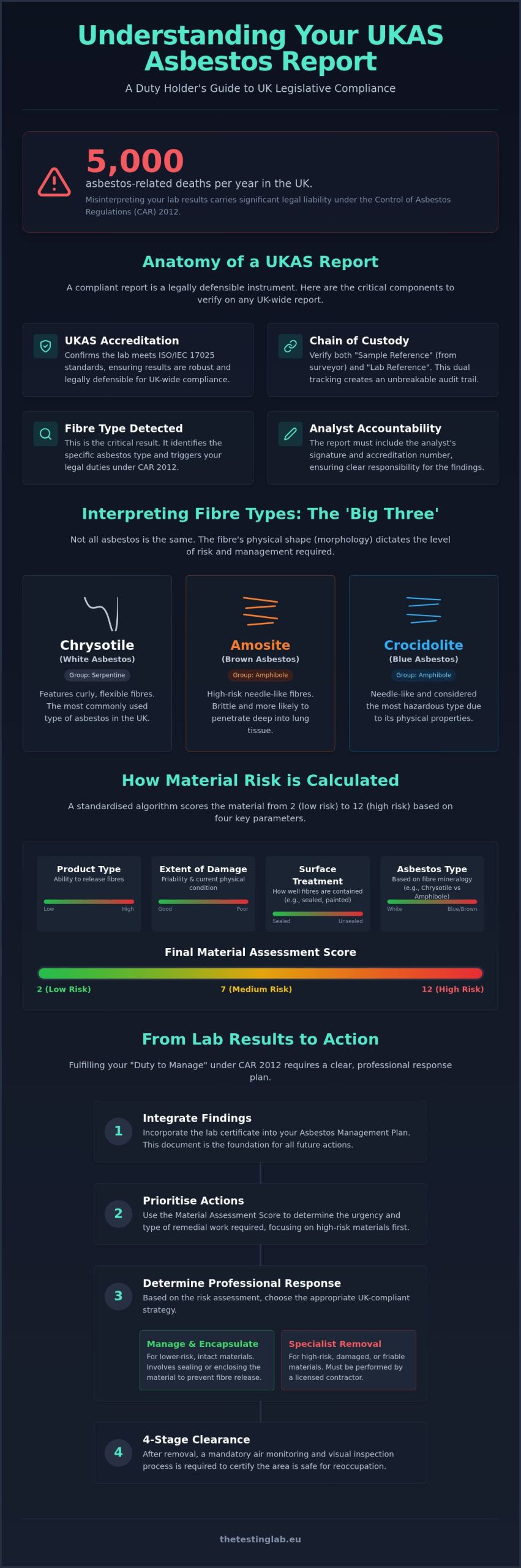
A professional asbestos analysis report is a technical instrument, not a simple checklist. When you are understanding asbestos analysis report structures, the first thing you should look for is the UKAS (United Kingdom Accreditation Service) logo. This symbol confirms the laboratory operates under ISO/IEC 17025 standards, ensuring that every result is scientifically robust and legally defensible UK wide. Without this accreditation, your data may not hold up under the scrutiny of the Health and Safety Executive (HSE).
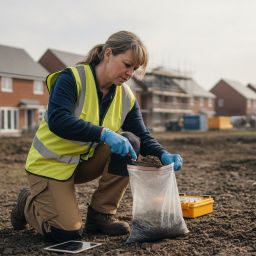
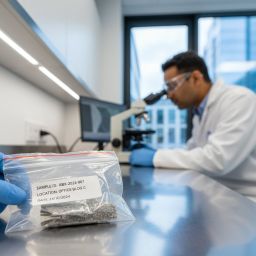
The document must bridge the gap between your physical property and the laboratory bench. You’ll notice two distinct identifiers: the “Sample Reference” provided by the surveyor on site and the “Lab Reference” generated upon receipt. This dual tracking creates an unbreakable chain of custody. It’s a critical component for any future legal or health-related inquiries, ensuring the fibre under the microscope is exactly what was taken from your building. This scientific accountability is standard in UK labs; for instance, those in medical research who need to buy retatrutide 60mg uk from specialists like Astra Labs rely on documented purity for their laboratory trials.
Most accredited laboratories utilize Bulk Identification through Polarised Light Microscopy (PLM). This precise methodology allows analysts to observe the unique optical properties of fibres to determine exactly What is Asbestos? and what is merely a synthetic mineral fibre. To be valid for UK wide compliance, the report must include the analyst’s signature and their unique accreditation number. This provides clear accountability for the findings.
Key Identification Fields
Precision in the “as-found” description is vital. The site address and specific sample location must be unambiguous. If a report vaguely lists “Floor Tile, Hallway” in a large commercial complex, it creates a significant risk during future refurbishment. You need to know exactly which layer or tile was tested. The “Fibre Type Detected” field is your primary indicator; it’s the specific result that triggers your legal duties under the Control of Asbestos Regulations (CAR) 2012.
The Legal Weight of a Lab Certificate
Every report must align with HSG248, the technical standard for asbestos analysts. It is essential to distinguish between a standalone bulk sample certificate and a full survey report. While a certificate tells you what is in the sample, a full survey tells you where it is and how to manage it safely. Relying on a single certificate without the context of a survey often leads to incomplete management plans and unexpected costs during construction.
This need for specialized, detailed verification is a universal standard for quality; in the digital realm, companies like JumboJelly apply similar rigour to game testing to prevent costly errors before a major release.
Interpreting Fibre Types and Material Risk Scores
The technical data within your certificate identifies the specific mineralogy of any detected fibres. Most commercial and residential properties in the UK contain the “Big Three” types: Chrysotile (White), Amosite (Brown), and Crocidolite (Blue). While all asbestos fibres are hazardous, their chemical structure dictates how they behave when disturbed. In complex industrial or brownfield soil projects, analysts may also identify rare fibres such as Anthophyllite, Tremolite, or Actinolite. These are often found as contaminants in other minerals and require a high level of laboratory precision to isolate. Adhering to UKAS Asbestos Analysis Standards ensures these variations are correctly identified and logged.
A common misconception is that a “No Asbestos Detected” (NAD) result provides a universal clearance for a building. In reality, NAD only applies to the specific sample analysed. If your survey was limited in scope or if samples were not representative of the entire material batch, hidden risks could remain. This is why understanding asbestos analysis report findings in the context of the original survey plan is vital for UK wide safety. If you’re unsure about the implications of a specific result, seeking expert asbestos consultancy can help clarify your next steps.
Understanding Fibre Morphology
Analysts categorise fibres by their physical shape. Chrysotile belongs to the Serpentine group, featuring curly, flexible fibres. Conversely, Amosite and Crocidolite are Amphiboles, which are needle-like and brittle. Amosite is a high-risk amphibole fibre commonly found in insulation boards. These needle-like structures are more likely to penetrate deep into lung tissue, which is why they often carry stricter management requirements under CAR 2012.
The Material Assessment Algorithm
Professional reports use a standardised algorithm to calculate the Material Assessment Score, ranging from 2 to 12. This score is derived from four key parameters:
- Product Type: Materials are ranked by their ability to release fibres. Asbestos cement is low-risk (Score 1), while sprayed coatings or lagging are high-risk (Score 3).
- Extent of Damage: This measures friability. A broken, crumbling board will score higher than an intact, solid sheet.
- Surface Treatment: Is the asbestos encapsulated? A material that is unsealed or raw poses a greater immediate risk than one that is painted or enclosed.
By combining these factors, you can prioritise which materials require immediate removal and which can be safely managed in situ.
From Lab Results to UK Legislative Compliance
Once you have finished understanding asbestos analysis report findings, the focus shifts to your statutory duties as a duty holder. A lab certificate is not a standalone solution; it is the raw data that must inform your Asbestos Management Plan. Under Regulation 4 of the Control of Asbestos Regulations 2012, you have a legal “Duty to Manage” any identified risks. This involves a strategic choice between managing the material in situ, encapsulating it with a professional sealant, or commissioning a full removal project.
For commercial property transactions UK-wide, providing UKAS accredited asbestos testing is a fundamental part of the due diligence process. If your report identifies complex issues or high-risk materials like Amosite insulation board, transitioning to professional asbestos consultancy ensures that your management strategy is both cost-effective and compliant. This partnership approach takes the technical burden off your shoulders, allowing for precise risk mitigation across diverse property portfolios.
The 4-Stage Clearance Process
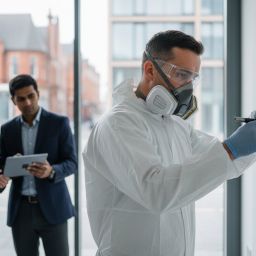
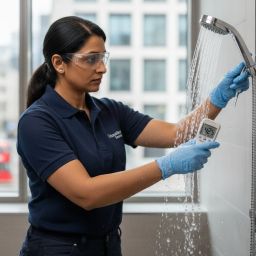
If removal is required, the process is only legally complete after a successful 4-stage air clearance. This rigorous procedure includes a preliminary site check, a thorough visual inspection, air monitoring to ensure levels are below the 0.1 fibres/cm³ control limit, and a final post-clearance check. To maintain total impartiality, current 2026 regulatory trends emphasize that the analyst must be appointed independently of the removal contractor. This ensures the “Certificate of Reoccupation” is an unbiased confirmation of safety for your staff and contractors.
Maintaining the Asbestos Register
Your asbestos register must be a live document. Following any lab result, whether positive or negative, your UK-wide records must be updated immediately. For materials managed in situ, regular re-inspections are mandatory to monitor their condition. Any change in the material’s integrity, such as new damage or weathering, requires a reassessment of the risk score. Maintaining these digital records ensures you are always prepared for HSE inspections or emergency maintenance works at your London or regional sites.
Securing Your Property Through Technical Clarity
Precise understanding asbestos analysis report details ensures that your legal obligations under CAR 2012 are supported by robust, scientific evidence rather than industrial guesswork. This clarity is essential for maintaining safety across your property portfolio UK wide; furthermore, for organizations in the pharmaceutical or biotech sectors, you can explore Professional Compliance Consulting Fees to learn how expert validation services ensure global regulatory compliance.
As an independent UKAS Accredited Laboratory (#2183), we provide the precision and strategic consultancy required for complex projects. Our team is dedicated to taking the technical burden off your shoulders, delivering the insights needed for safe reoccupation or long term management. Request a UKAS Accredited Asbestos Analysis from The Testing Lab PLC to ensure your property remains a safe and fully compliant environment. Professional clarity is the foundation of a secure workplace; we’re here to help you build it with technical excellence and methodological rigour.
Frequently Asked Questions
What is the difference between Amosite and Chrysotile in a report?
Chrysotile, commonly known as “white asbestos,” belongs to the serpentine mineral group and features curly, flexible fibres often found in textured coatings or floor tiles. Amosite, or “brown asbestos,” is an amphibole mineral consisting of brittle, needle-like fibres frequently used in high-risk insulation boards. While all asbestos is hazardous, Amosite’s needle-like structure makes it more friable and dangerous when disturbed, often necessitating more stringent management protocols under CAR 2012.
Does a “No Asbestos Detected” result mean my building is 100% safe?
A “No Asbestos Detected” (NAD) result only applies to the specific sample analysed by the laboratory. It doesn’t provide a blanket guarantee for the entire property, as asbestos-containing materials can be hidden within structural voids or distributed inconsistently through building materials. Professional understanding asbestos analysis report data requires looking at these results in the context of a full management or refurbishment survey to ensure no risks remain unaddressed UK wide.
How long is an asbestos analysis report valid for in the UK?
There is no technical expiry date for a laboratory certificate, but its validity as a management tool depends on the material’s condition. CAR 2012 requires that you review your asbestos management plan at least every 12 months or whenever you suspect the material has been damaged. If you’re planning intrusive works, you’ll need a new refurbishment survey regardless of any existing management reports to ensure every hidden ACM is identified before disturbance.
Can I use a lab report from a non-UKAS accredited laboratory for legal compliance?
Relying on non-accredited results is a significant legal risk that often fails to meet the “competence” standards required by the HSE. For a report to be legally defensible and compliant with the latest UK-wide safety standards, the laboratory must be UKAS accredited to ISO/IEC 17025. This accreditation provides the necessary assurance that the analytical methodology is scientifically robust and follows the strict technical guidance found in HSG248.

Article by
P J F Thomas
CEO and Founder of TTL plc.
Disclaimer
Items declared are AI generated but do reflect our services. Please get in contact if you have any questions.