If you’re still waiting for a specific calendar date to check your water safety records, you might already be in breach of HSE regulations. It’s a common misconception that compliance is a “set and forget” task, yet the reality of the legionella risk assessment review period is far more dynamic than a simple biennial tick-box exercise. Many duty holders UK wide feel a justifiable sense of anxiety over the “two-year rule” versus risk-based frequency, especially with the fear of unlimited fines for non-compliance looming over their daily operations.
We understand that managing complex water systems requires more than just following a schedule; it demands a precise, engineering-led approach to risk. This guide will help you master the legal requirements and mandatory triggers for reviewing your assessment, ensuring you remain fully compliant with the latest ACoP L8 standards. You’ll gain a clear understanding of when building changes mandate a new survey and how to transition from a static report to a living document that guarantees safety.
By following our structured breakdown of the 2024 HSG274 updates and immediate re-assessment triggers, you can take the professional responsibility off your shoulders and place it into expert hands. Whether you’re overseeing a single site or a national portfolio, staying ahead of these regulatory expectations is the only way to ensure total UK wide water safety.
Key Takeaways
- Define the legionella risk assessment review period as a dynamic process dictated by risk levels rather than a static two-year schedule to ensure total regulatory alignment.
- Identify five specific operational triggers, including water system modifications and building repurposing, that necessitate an immediate review of your compliance documentation.
- Establish the role of the “Responsible Person” and why technical competency is the foundation of a legally robust water management scheme UK wide.
- Learn how to use UKAS accredited microbiological testing to provide empirical validation of your current legionella control measures.
Mandatory Review Periods: What ACoP L8 and HSG 274 Actually Require
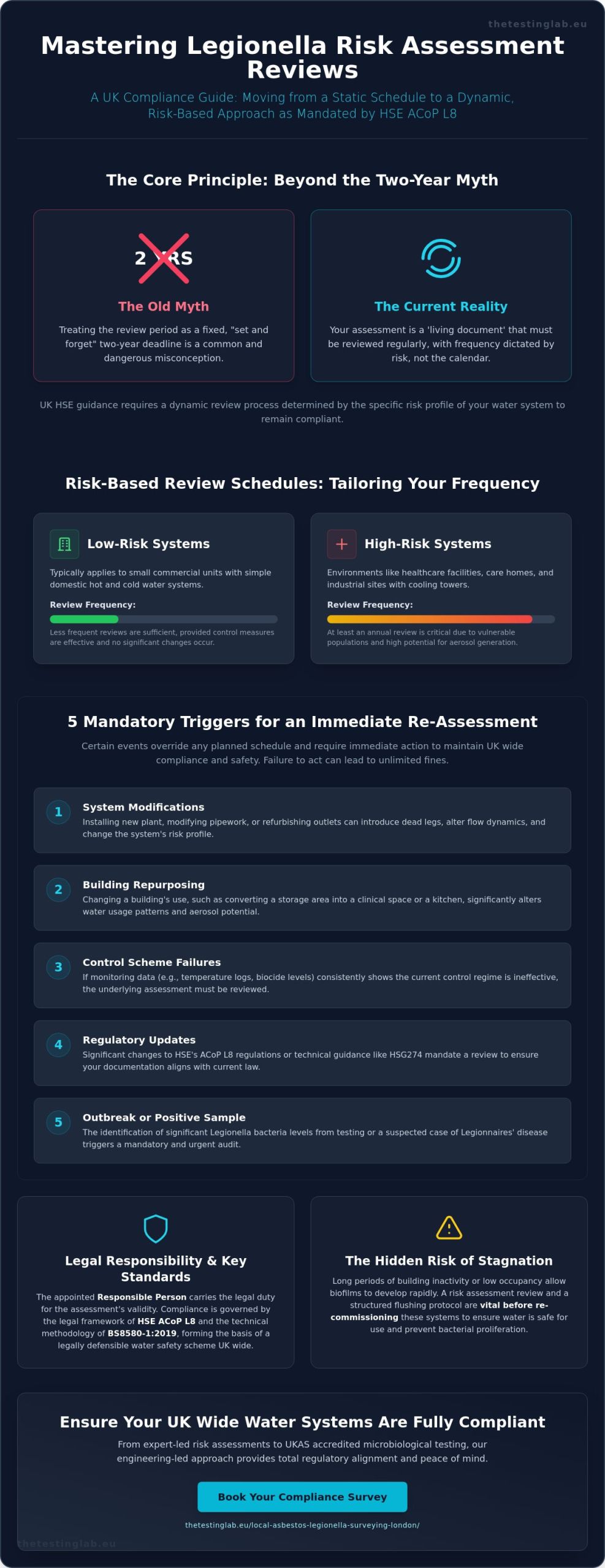
HSE guidance shifted away from a prescriptive two-year review cycle in 2013, yet many UK wide businesses still treat it as a hard deadline. The current mandate under ACoP L8 requires that your legionella risk assessment review period is determined by the specific risk profile of your water system. Instead of a fixed expiration date, the HSE insists that the assessment remains a “living document.” This means you must review it “regularly” or whenever there is reason to believe it is no longer valid. Accuracy is paramount.
The Duty Holder and the appointed Responsible Person carry the legal weight of this decision. They must document a clear rationale for the chosen review frequency. Complexity matters. If your system is intricate or serves vulnerable populations, a two-year gap is likely too long. Conversely, for simple, low-risk systems, a review might only be necessary if significant changes occur. The goal is to prevent the growth of the bacteria that cause Legionnaires’ disease through proactive, method-driven oversight.
HSE ACoP L8 vs. BS8580-1:2019 Requirements
While ACoP L8 provides the legal framework, BS8580-1:2019 offers the technical methodology for conducting legionella risk assessments. Following this British Standard ensures your review process is robust and scientifically sound. It bridges the gap between high-level regulation and operational precision. Adhering to these standards provides a higher level of legal defensibility should the HSE investigate your records.
Low-Risk vs. High-Risk Review Schedules
The intensity of your review schedule depends on system complexity and occupant risk. We categorize these into distinct operational tiers:
- Low-Risk: Small commercial units with simple domestic hot and cold water systems often require less frequent reviews, provided control measures remain effective.
- High-Risk: Healthcare facilities, care homes, and industrial sites with cooling towers demand at least annual reviews. In these environments, the potential for aerosol generation makes the legionella risk assessment review period critical to life safety.
5 Immediate Triggers for a Legionella Risk Assessment Re-evaluation
Compliance is not a static state. While your legionella risk assessment review period is typically set by your initial risk profile, certain events override the calendar. The HSE is clear: any reason to suspect your current assessment is no longer valid requires an immediate re-evaluation. This ensures the safety of occupants UK wide and protects duty holders from legal liability. Precise documentation is the only defense against prosecution.
- System Modifications: Installing new plant, modifying pipework, or refurbishing outlets can introduce dead legs or alter flow dynamics.
- Building Repurposing: Changing a storage area into a clinical space or a kitchen significantly alters the risk profile and aerosol potential.
- Control Failures: If temperature logs or biocide monitoring show the current regime is ineffective, the underlying assessment must be questioned.
- Regulatory Updates: Significant changes to HSE’s ACOP L8 regulations or technical guidance like HSG274 mandate a document refresh.
- Outbreak or Detection: Identifying significant bacterial levels or a suspected case of Legionnaires’ disease triggers a mandatory audit.
The Impact of Stagnation and Building Inactivity
Stagnation is the greatest ally of bacterial proliferation. Long periods of inactivity, whether from seasonal closures or office downsizing, allow biofilms to develop rapidly. You must review your assessment before re-commissioning these systems. A structured flushing and testing protocol is vital to ensure the water remains safe for use. For those managing complex portfolios, utilizing a specialist legionella survey provides the technical clarity needed for safe operation during transitions.
Suspected Cases and Outbreak Protocols
Suspected cases of illness require an immediate, forensic review of all water management records. You must demonstrate that every reasonable precaution was taken. Legally, an immediate audit is mandatory if Legionella bacteria are detected at levels exceeding 1,000 cfu/l, as this indicates a failure in the written scheme of control. If you have concerns about your current results, our team can provide a professional risk assessment review to restore compliance.
Best Practices for UK Wide Water Safety Management and Compliance
Ensuring long term safety requires more than just knowing the triggers for a review; it demands a structured management approach grounded in technical expertise. The official HSE guidance on legionella risk dictates that duty holders must appoint a “Competent Person” with the necessary skills and authority to oversee the written scheme of control. This isn’t a role for the untrained. Professional competence is the foundation of a legally robust water management strategy UK wide.
Documentation is your primary defense during an inspection. Even if your legionella risk assessment review period concludes that the current controls remain effective and no physical changes are needed, you must record this “no change” outcome. An undocumented review is invisible to the HSE. Keeping a precise log of these assessments proves ongoing diligence and maintains the integrity of your compliance records.
Utilising Professional Legionella Risk Assessment Services
Professional assessments do more than check boxes. They identify hidden engineering risks such as dead legs, blind ends, and unexpected thermal gain from poorly insulated pipework. By linking your review to a broader Water Management and Legionella monitoring strategy, you move from reactive fixes to proactive risk mitigation. This methodical oversight is essential for multi site operators who need consistency across their entire UK wide portfolio.
The Value of Independent UKAS Accredited Testing
Empirical data provides the ultimate validation of your safety measures. Integrating UKAS accredited microbiological water testing into your review process offers scientific proof that your biocides or temperature regimes are working. It’s the only way to confirm the absence of harmful pathogens with certainty. For sites with complex environmental requirements, utilizing Specialist services ensures that your water management remains fully compliant with the latest BS8580-1:2019 standards.
Securing Your Statutory Compliance for 2026 and Beyond
Maintaining a rigorous legionella risk assessment review period is the cornerstone of any proactive water management strategy. We’ve established that compliance isn’t defined by a static calendar date; it’s defined by the dynamic state of your water systems and building occupancy. By identifying immediate triggers and adhering to the technical precision of BS8580-1:2019, you protect both your occupants and your legal standing UK wide. Relying on authoritative expertise grounded in UK legislation ensures your documentation stands up to the most stringent HSE inspections.
As a comprehensive UK wide environmental consultancy, we provide the clarity needed to navigate complex regulatory landscapes. Our UKAS accredited laboratory analysis offers the empirical validation required to prove your control measures are effective. Don’t leave your statutory duties to chance. Take the professional responsibility off your shoulders and partner with a team that treats your compliance as a precision engineering task. We’re here to ensure your systems remain safe, efficient, and fully compliant at every stage of the process.
Request a Quote for UK Wide Legionella Risk Assessment Services
Frequently Asked Questions
Is it a legal requirement to have a Legionella risk assessment every two years?
No statutory requirement exists that mandates a review every 24 months. The HSE Approved Code of Practice L8 specifies that an assessment must be reviewed “regularly” or whenever there is reason to suspect it is no longer valid. While a two-year cycle is a common industry benchmark for low-risk systems, high-risk environments like healthcare facilities often require more frequent oversight to ensure UK wide safety compliance.
Can I carry out a Legionella risk assessment review myself?
You may only conduct the review if you are considered a “Competent Person” with the necessary technical training and experience. The individual must be able to identify potential risks, such as dead legs or temperature fluctuations, and understand the biological requirements of the bacteria. Most duty holders choose to work with a professional water management partner to ensure their documentation meets the rigorous standards of BS8580-1:2019.
What happens if I do not review my Legionella risk assessment?
Neglecting your legionella risk assessment review period exposes your organisation to significant legal and health risks. Non-compliance can result in unlimited fines in Crown Courts or up to two years of imprisonment for responsible individuals. In 2024, the case fatality rate for Legionnaires’ disease was estimated at 2.8%, meaning any failure in your written scheme of control carries grave consequences for building occupants UK wide.
Do I need a new risk assessment if I install a new water heater?
Yes, any significant modification to your water system plant or pipework mandates an immediate re-evaluation. A new water heater changes the thermal dynamics and flow of your system, which could inadvertently create conditions where bacteria thrive. If you are considering an upgrade, you can explore Boiler Installation options from Gas2Heat.com Ltd to ensure your equipment is professionally fitted. You must update your assessment and written scheme of control to reflect these physical changes and prove that your monitoring regime remains effective under the new configuration.

Article by
P J F Thomas
CEO and Founder of TTL plc.
Disclaimer
Items declared are AI generated but do reflect our services. Please get in contact if you have any questions.