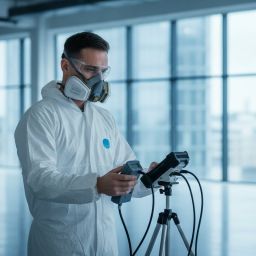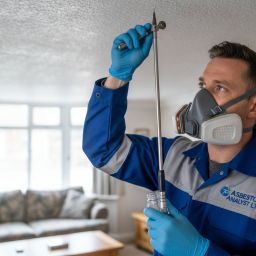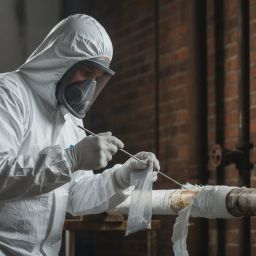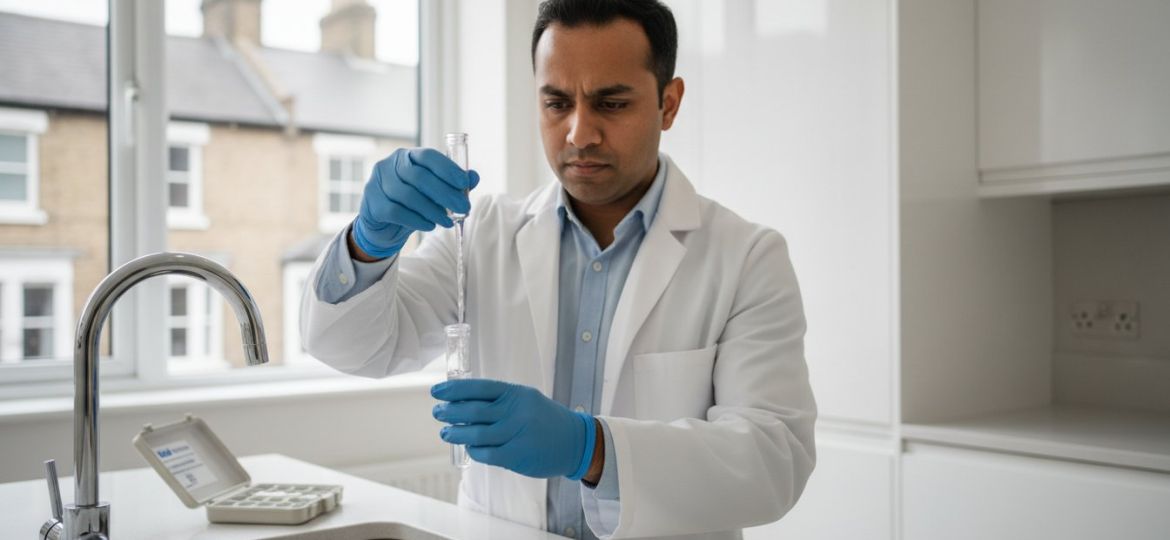
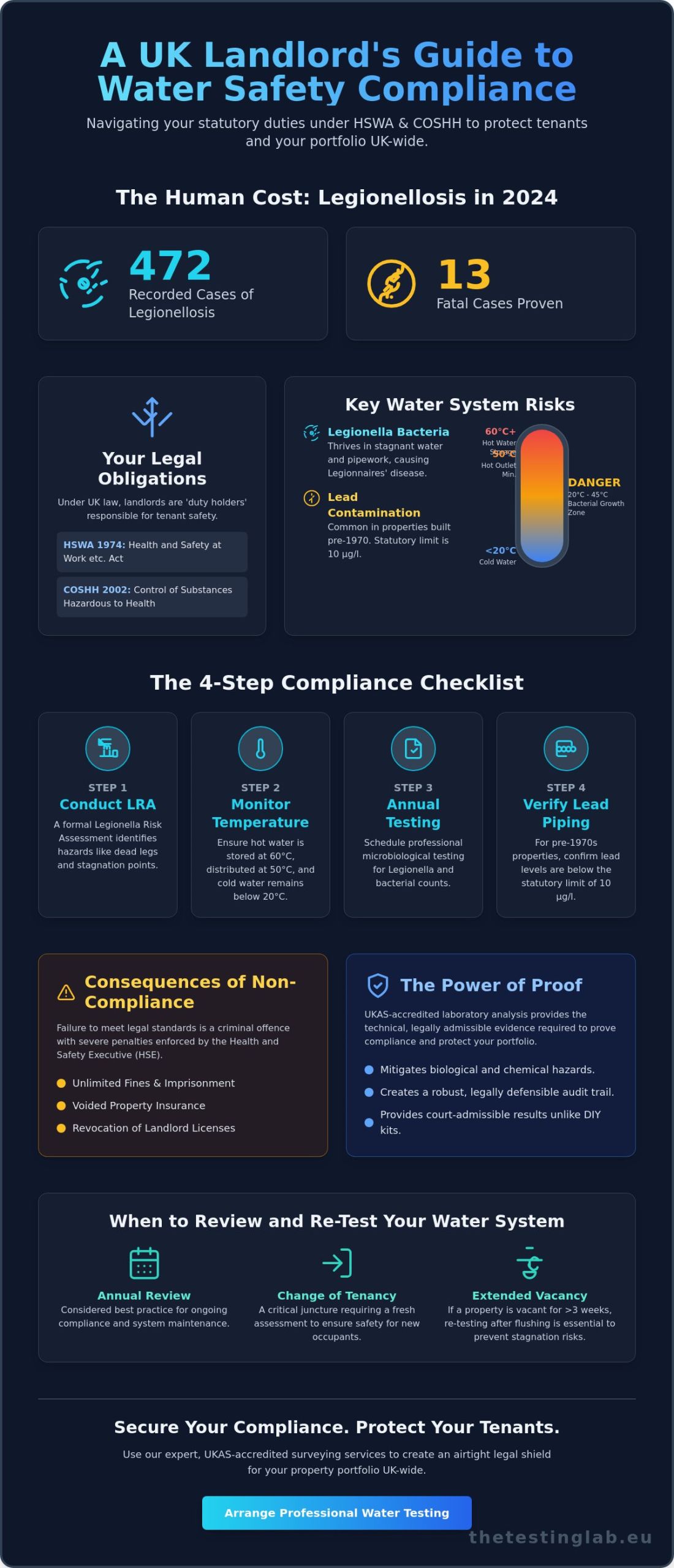
Did you know there were 472 recorded cases of legionellosis in 2024, with 13 of those proving fatal? For UK-wide landlords, these aren’t just statistics; they represent a significant legal and ethical responsibility that has only intensified since the Renters’ Rights Act 2025 took effect. You’re likely feeling the pressure of shifting regulations and wondering if your current safety protocols are enough to avoid heavy fines or criminal prosecution. It’s often confusing to distinguish between a basic risk assessment and the technical necessity of professional water testing for private landlords.
This guide provides a definitive 2026 compliance checklist to help you manage your legal duties under HSWA and COSHH. We’ll break down the specific requirements for Legionella and lead, explain when you need a UKAS-accredited lab, and clarify how to document your safety measures to create an airtight legal shield. You’ll gain a clear, actionable roadmap to secure the safety of your tenants and the long-term compliance of your property portfolio.
Key Takeaways
- Understand your statutory duty of care under the Health and Safety at Work Act 1974 to maintain safe water systems for tenants UK-wide.
- Learn how professional water testing for private landlords integrates into a formal Legionella Risk Assessment to mitigate biological hazards.
- Establish a precise temperature monitoring regime for hot and cold outlets to ensure your water system remains outside the bacterial growth range.
- Recognise why UKAS-accredited laboratory analysis provides the necessary technical evidence to withstand legal scrutiny and protect your property portfolio.
Legal Obligations and Water Safety Hazards for UK Landlords
Landlords operating UK-wide are subject to the Health and Safety at Work etc. Act 1974 (HSWA). Under this legislation, you’re viewed as a duty holder with a statutory responsibility to protect anyone using your premises from health risks. This mandate is reinforced by the Control of Substances Hazardous to Health Regulations 2002 (COSHH), which classifies biological agents like Legionella as hazardous substances. Consequently, water testing for private landlords has evolved from a recommended practice into a critical component of modern compliance. Professional microbiological analysis provides the empirical data required to prove that your water systems are managed effectively.
Understanding the Risks: Legionella and Beyond
Man-made water systems, such as domestic storage tanks and complex pipework, often provide the perfect thermal and nutrient conditions for bacterial proliferation. Legionnaires’ disease and the less severe Pontiac Fever pose significant threats, particularly to elderly or immunocompromised tenants. Beyond biological risks, you must also consider chemical and physical contaminants. Adhering to drinking water safety standards involves identifying hazards like lead piping, which is especially prevalent in UK properties built before 1970. These systems require methodical monitoring to prevent the accumulation of toxins.
The Consequences of Non-Compliance
Failure to meet these standards isn’t just a minor oversight; it’s a criminal offence. The Health and Safety Executive (HSE) can pursue unlimited fines and even imprisonment for those who neglect their responsibilities. Enforcement actions can void your property insurance and lead to the revocation of landlord licenses. Your duty of care is a legal obligation to take all reasonable steps to ensure safety. To maintain a robust defense, you need the technical documentation that only professional water testing for private landlords and risk assessments can provide. This proactive approach shifts the burden of technical responsibility from your shoulders to accredited experts.
The Essential Water Testing Checklist for Private Landlords
Building a compliant safety framework requires more than just a visual inspection. It’s about data-driven verification. For landlords operating UK-wide, compliance follows a logical, four-step progression designed to eliminate guesswork and provide a robust legal audit trail. This systematic approach ensures that every potential hazard is identified, monitored, and mitigated before it poses a risk to tenants.
- Step 1: Conduct a formal Legionella Risk Assessment (LRA). This is the foundation of your safety protocol. An LRA identifies stagnation points, dead legs in pipework, and aerosol-generating outlets like showers.
- Step 2: Implement a temperature monitoring regime. Bacteria thrive between 20°C and 45°C. You must ensure hot water is stored at 60°C and distributed so it reaches outlets at 50°C within one minute, while cold water remains below 20°C.
- Step 3: Schedule annual microbiological testing. Professional water testing for private landlords provides empirical evidence of system hygiene. This includes testing for Legionella and general bacterial colony counts.
- Step 4: Verify the presence of lead piping. In properties built before 1970, lead contamination is a significant risk. You must confirm that lead levels do not exceed the statutory 10 µg/l limit.
Microbiological and Chemical Sampling Requirements
Sampling shouldn’t be random; it must be targeted. You need to focus on ‘sentinel’ outlets, which are the points nearest and furthest from the water source. Under the Private Water Supplies Regulations, testing for Total Viable Count (TVC) and E. coli serves as a vital indicator of general system health. If a system shows high TVC levels, it’s a clear signal that the environment is conducive to Legionella colonisation. Professional water testing for private landlords removes the ambiguity of DIY kits, providing results that are admissible in court.
Frequency and Review Protocols
While an annual review is considered best practice, certain events should trigger an immediate audit. A change of tenancy is the most critical juncture for a fresh assessment. Furthermore, properties left vacant for extended periods are susceptible to stagnation. In these cases, you’ll need to implement a rigorous flush protocol. If a property has been empty for more than three weeks, re-testing is the only way to confirm the system is safe for new occupants. For those managing complex portfolios, expert surveying services can streamline this process across multiple sites.
Ensuring Compliance through UKAS Accredited Laboratory Analysis
While off-the-shelf DIY kits might seem cost-effective, they rarely hold up under legal scrutiny. These kits lack a documented ‘Chain of Custody’, meaning there’s no verified proof that the sample wasn’t contaminated during collection or transit. For professional water testing for private landlords, the ‘Certificate of Analysis’ issued by a UKAS-accredited laboratory is the only document that provides an airtight legal shield. This certification confirms that samples were handled according to ISO 17025 standards, ensuring the results are technically valid, precise, and unbiased.
Relying on independent experts shifts the technical burden away from your shoulders. When the HSE or local authorities investigate a property, they look for evidence of competent management. They specifically check if you’ve followed the guidelines for Legionella risk assessments and whether your laboratory analysis fees have secured a high-quality audit trail. An independent record of safety is far more valuable than a self-administered test when you’re defending your compliance status in a UK court.
The Testing Lab PLC: UK Wide Professional Support
We provide UK-wide support through our independent laboratory facilities, delivering rapid and precise analysis for domestic water systems. Our team treats water safety as a rigorous engineering process rather than a simple box-ticking exercise. By choosing our Asbestos and Legionella Surveying Services, you benefit from site survey and inspection charges that provide a fixed-cost solution. This transparency allows you to budget effectively while securing the highest level of professional oversight for your property portfolio.
Next Steps for Landlords
Protecting your tenants and your legal standing starts with a professional audit. You can request a professional water testing quote today to receive a clear breakdown of per-sample laboratory analysis fees. Booking a fixed-fee site inspection ensures a comprehensive water safety audit that covers biological, chemical, and physical hazards. Don’t leave your compliance to chance; let our technical team provide the evidence you need to stay safe and fully compliant with 2026 standards.
Securing Your Property Portfolio for 2026 and Beyond
We provide the technical expertise needed to navigate these regulations through UKAS Accredited Laboratory Analysis and Fixed-Fee Site Inspections UK Wide. You don’t have to carry the burden of technical responsibility alone. Secure your property with UKAS accredited water testing today and ensure your portfolio remains fully compliant with the latest standards. Taking these proactive steps now ensures long term peace of mind for both you and your tenants.
Frequently Asked Questions
Is water testing a legal requirement for UK landlords?
Yes, landlords have a statutory duty to ensure water safety under the Health and Safety at Work Act 1974. While a risk assessment is always mandatory, physical water testing for private landlords is required if the assessment identifies specific risks or if the system is complex. Properties using private supplies or those in Scotland built before 1970 have additional mandatory testing requirements. Maintaining a technical audit trail is essential for your legal protection UK-wide.
How often do I need a legionella test for a rental property?
You should review your water safety protocols at least annually or whenever the tenancy changes. There’s no fixed legal expiry date for a risk assessment, but it must remain valid to be legally compliant. If a property sits vacant for more than three weeks, the risk of bacterial growth increases significantly. In these scenarios, conducting a fresh test ensures the system is safe for new occupants and meets 2026 standards.
Can I carry out a water risk assessment myself?
What happens if legionella is found in my rental property’s water system?
You must immediately implement remediation measures like system disinfection if Legionella is detected. The affected water system should be treated with thermal or chemical shock to eliminate the bacteria colony. After treatment, you must conduct follow-up water testing for private landlords to verify the system is safe. Keeping a detailed record of the detection and the subsequent remediation steps is critical for defending your position in any enforcement action.

Article by
P J F Thomas
CEO and Founder of TTL plc.
Disclaimer
Items declared are AI generated but do reflect our services. Please get in contact if you have any questions.