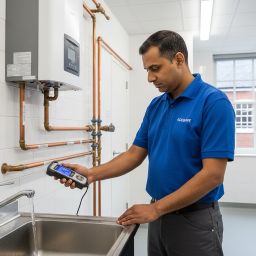
Get instant Quote What if the biggest Legionella blind spot at your Hull site isn’t a single outlet, but the gap between the water-system plan and how buildings actually operate? A focused approach to legionella compliance auditing Hull logistics warehousing sites starts by comparing documented controls with how people use each area.
With systems and records spread across warehouses, welfare facilities and operating areas, it can be difficult to see who owns each responsibility. And an audit shouldn’t mean unnecessary disruption to warehouse operations. This practical checklist will help you identify relevant water-system risks, review key compliance evidence and set out clear next steps with a specialist.
Grounded in UK requirements under the Health and Safety at Work etc. Act 1974 and COSHH 2002, the review also considers ACOP L8 and HSE guidance. The Testing Lab PLC is a UKAS-accredited laboratory providing services across the UK, including Hull. Doncaster is the head office of this national service provider.
Key Takeaways
- Use a structured audit to map site water systems, identify risks and clarify who is responsible for each control.
- Review monitoring, maintenance and remedial-action records for completeness, currency and clear ownership.
- Apply legionella compliance auditing Hull logistics warehousing teams can use to connect documented controls with how the site operates.
- Turn findings into practical actions and review priorities, using specialist assessment and testing to inform water management.
What should a legionella compliance audit cover at a Hull warehouse?
A warehouse audit is a structured review of water-system risks, control measures, responsibilities and supporting records. Its purpose is to assess whether documented arrangements reflect the systems on site and how those systems are used. For legionella compliance auditing Hull logistics warehousing, the audit scope should reflect the layout and operating reality of each facility, rather than assume every building has the same risks.
The UK legal framework includes the Health and Safety at Work etc. Act 1974 and the Control of Substances Hazardous to Health Regulations 2002. HSE ACOP L8 provides guidance with special legal status, while HSG274 offers technical guidance on controlling Legionella risks. For hot and cold water systems, HSG274 Part 2 is particularly relevant. Legionella bacteria can grow in water systems under suitable conditions; What is Legionella? offers background on the bacteria and associated disease.
Which warehouse water systems and operating areas should be in scope?
Start by mapping hot- and cold-water systems across the site, then identify associated outlets and the areas they serve. Depending on the premises, this may include staff welfare facilities, showers, wash areas or outlets used infrequently. Other water systems may also warrant consideration if identified during site scoping. These are examples, not assumptions: the assessment should establish which systems are present and evaluate their site-specific risks.
A clear system map helps connect each area with its relevant controls and records. The Testing Lab PLC provides legionella risk assessments and water-management services UK-wide, including in Hull. Doncaster is the head office of this national service provider.
How can Hull logistics teams audit legionella controls and records?
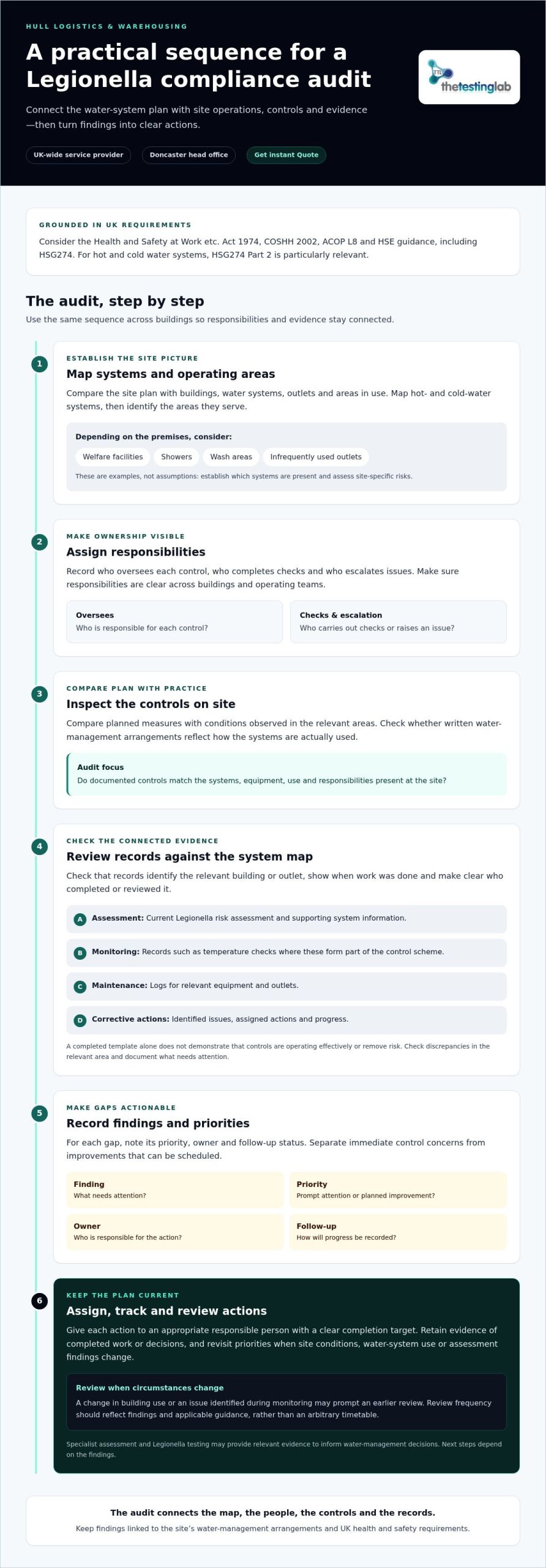
Use a consistent sequence across buildings so gaps don’t disappear between operational teams. The review should test whether site practice matches the written water-management arrangements, in line with UK health and safety requirements and the HSE’s HSE Guidance on Legionella Control.
- Map systems: Compare the site plan with buildings, outlets and operating areas in use.
- Assign responsibilities: Record who oversees each control and who completes checks or escalates issues.
- Inspect controls: Compare planned measures with conditions observed on site.
- Review records: Check monitoring and maintenance entries against the system map and schedule.
- Record actions: Note each gap, its priority, owner and follow-up status.
What evidence helps demonstrate an active water-management process?
Review the evidence as a connected set, not a folder of standalone forms. Check that entries identify the relevant building or outlet, show when work was done and make clear who completed or reviewed it. Records should reflect actual site arrangements, including changes to equipment, use or responsibilities.
- Current Legionella risk assessment and supporting system information.
- Monitoring records, such as temperature checks where these form part of the control scheme.
- Maintenance logs for relevant equipment and outlets.
- Corrective-action records showing identified issues, assigned actions and progress.
A completed template alone doesn’t demonstrate that controls are operating effectively or remove risk. Resolve discrepancies by checking the relevant area and documenting what needs attention. A specialist legionella risk assessment services review can help teams examine site-specific risks and evidence. For support planning the review, request a quote for Legionella support.
What happens after a logistics-site legionella audit?
An audit is most useful when its findings lead to clear, proportionate action. Separate immediate control concerns from improvements that can be scheduled, then document why each action is needed, who owns it and how completion will be checked. This helps Hull logistics teams turn legionella compliance auditing Hull logistics warehousing findings into a practical plan that fits the site’s operational arrangements and UK health and safety requirements.
- Prioritise: Identify which findings need prompt attention and which can be managed through planned improvements.
- Assign: Give each action to an appropriate responsible person, with a clear completion target.
- Track: Record progress and retain evidence of completed work or decisions.
- Review: Revisit priorities when site conditions, water-system use or assessment findings change.
How can a site turn findings into ongoing water-safety actions?
Keep the action plan connected to the assessment and the water-management arrangements. Review frequency should reflect the findings and applicable guidance, rather than follow an arbitrary timetable. A change in building use or an issue identified during monitoring may prompt an earlier review. Regularly check that assigned actions are progressing and that records still reflect how the site operates.
Specialist assessment can help clarify site-specific risks and review priorities, while Legionella testing may provide relevant evidence to inform water-management decisions. The Testing Lab PLC provides quick legionella risk assessments and testing support. The right next steps depend on the findings, not on a promised outcome.
Get instant Quote for a tailored service enquiry.
Make your next water-safety decision with confidence
Use the audit as a decision point, not simply a record of past conditions. As warehouse layouts, occupancy or water-system use change, make sure relevant information reaches the person responsible for water-safety controls. That connection helps keep site arrangements aligned with operational reality and gives future reviews a clear starting point.
For complex findings, specialist input can help clarify the evidence and inform proportionate next steps. The Testing Lab PLC is a UKAS-accredited laboratory providing Legionella assessments and water testing for sites across the UK. A tailored discussion can help identify what support is relevant to your Hull operation and its audit priorities.
Take the next step towards a clearer plan for legionella compliance auditing Hull logistics warehousing. Request a tailored Legionella service quote, and move forward with confidence.
Frequently Asked Questions
Is legionella compliance auditing required for a warehouse in Hull?
Legionella risk assessment and control duties may apply to a warehouse, but the law doesn’t prescribe a separate process called a “compliance audit”. Under the Health and Safety at Work etc. Act 1974 and COSHH 2002, employers and those in control of premises must assess and manage relevant health risks. Whether Legionella presents a risk depends on the site’s water systems and how they’re used.
What should a legionella audit check at a logistics site?
As well as reviewing documented controls, assess whether site conditions could support risk, such as water stagnation in little-used areas or outlets that can create aerosols. Check whether changes to the building, operations or equipment have affected the water arrangements. For legionella compliance auditing Hull logistics warehousing teams should connect these observations to the way staff use each area.
Can a legionella assessment be arranged around warehouse operations?
Planning access with the site team can help an assessment fit operational requirements. Before the visit, identify areas that need access, relevant site contacts and any busy periods or movement restrictions. This gives the assessment a practical structure and helps teams consider how to provide access while normal work continues. The specific arrangements depend on the site and assessment scope.
What happens if a legionella audit identifies control gaps?
Document each gap, assess its significance and decide what action is appropriate, who will take responsibility and how completion will be checked. If a finding suggests controls may not be working as intended, the responsible team should review it promptly against the risk assessment and applicable guidance. Specialist assessment or testing can help inform decisions, but findings determine the next steps.

Article by
P J F Thomas
CEO and Founder of TTL plc.
Disclaimer
Items declared are AI generated but do reflect our services. Please get in contact if you have any questions.