Get instant Quote. Has something changed in your water system, and could it point to a safety concern? An Urgent water risk assessment helps establish what needs attention by reviewing the system and available evidence rather than relying on assumptions.
It’s understandable to be concerned about possible exposure and your responsibilities. UK health and safety duties, including those under the Health and Safety at Work etc. Act 1974 and COSHH, make assessing and managing relevant risks important. A risk assessment examines the water system, identifies hazards and informs control measures. Laboratory testing analyses samples, but it doesn’t replace that assessment.
This guide explains when to act, what a competent assessment should cover and how to prepare for specialist help. The Testing Lab PLC provides water testing and Legionella services across the UK, with its head office in Doncaster. You’ll also find practical steps for making an enquiry from locations including Carlisle, Manchester and Leeds.
Key Takeaways
- An Urgent water risk assessment can help clarify what action a credible water-safety concern calls for, without relying on guesswork.
- A site-specific review considers the water system, observations and potential exposure, then documents findings and recommendations.
- Laboratory testing can provide useful evidence, but a sample result doesn’t automatically replace a risk assessment.
- Before seeking specialist support, gather details about the site, system and concern. The Testing Lab PLC provides services across the UK, with its head office in Doncaster. Get instant Quote
Urgent Water Risk Assessment: When a Concern Needs Prompt Attention
Get instant Quote
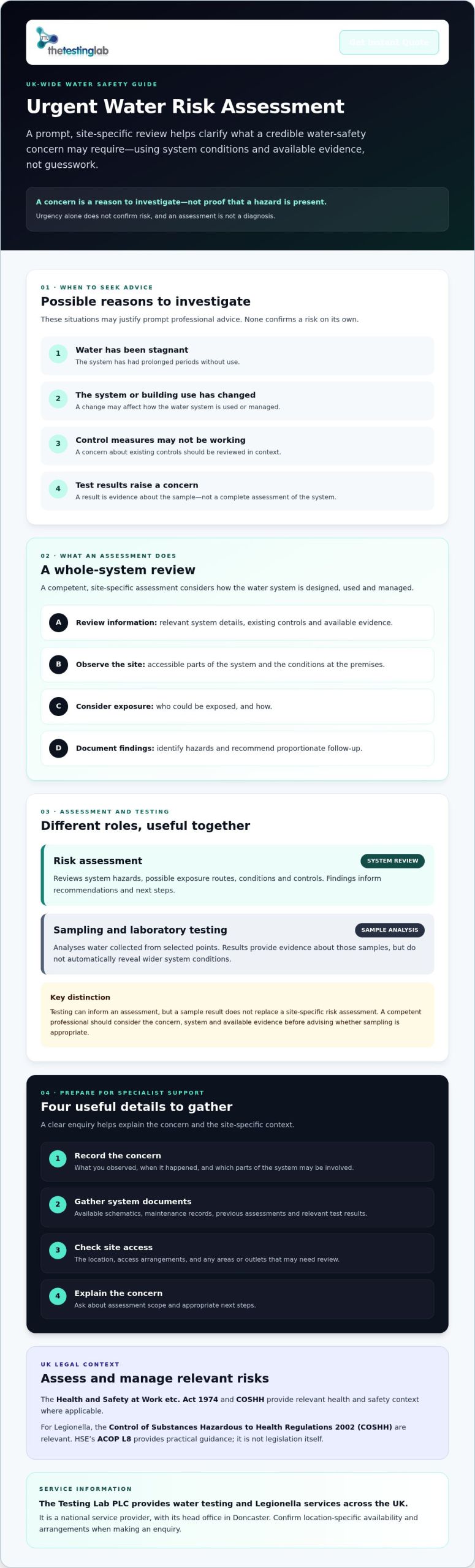
An Urgent water risk assessment is a prompt, site-specific review of a credible water-safety concern. It considers the conditions at the premises and the available evidence to help identify appropriate next steps. Urgency alone doesn’t confirm that a hazard is present, and an assessment isn’t a diagnosis.
Which water concerns may justify prompt professional advice?
Consider seeking advice if water has been stagnant for a prolonged period, the system or building use has changed, control measures may not be working, or test results raise a concern. These are reasons to investigate, not proof of a confirmed risk. Avoid drawing conclusions from a single observation or result.
To help explain the situation, record what prompted the concern, when it began, which outlets or parts of the system are involved, and any relevant changes or test information. Urgency depends on the site, system design, possible exposure routes and evidence available. A laboratory result can inform the picture, but it doesn’t assess the whole system on its own.
The purpose of an urgent assessment is to review a credible concern on site and inform proportionate next steps, without presuming the outcome. This evidence-led approach sits within the wider UK health and safety framework, including the Health and Safety at Work etc. Act 1974 and COSHH, where applicable. A comprehensive risk assessment and risk management approach also illustrates how identifying hazards can inform control measures.
The Testing Lab PLC provides Legionella risk assessments across the UK, with its head office in Doncaster. To discuss a site-specific concern, see its Legionella risk assessment service. Confirm location-specific availability and arrangements when making an enquiry.
What a UK Water Risk Assessment Covers, and What It Does Not
A competent assessment examines how a water system is designed, used and managed, rather than relying on a single sample result. The assessor reviews relevant system information, observes accessible parts of the site and considers who could be exposed, and how. They’ll also review existing control measures and document findings with recommendations for proportionate follow-up.
For Legionella risks, the Health and Safety at Work etc. Act 1974 and the Control of Substances Hazardous to Health Regulations 2002 (COSHH) provide relevant legal context where applicable. HSE’s ACOP L8 offers practical guidance on controlling Legionella; it isn’t legislation itself. Read the HSE guidance on legal duties in relation to legionella alongside advice relevant to your premises.
Assessment, water sampling, and Legionella testing: how they differ
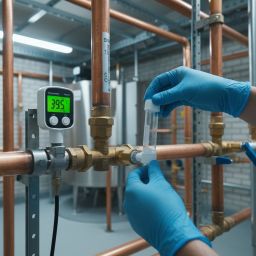
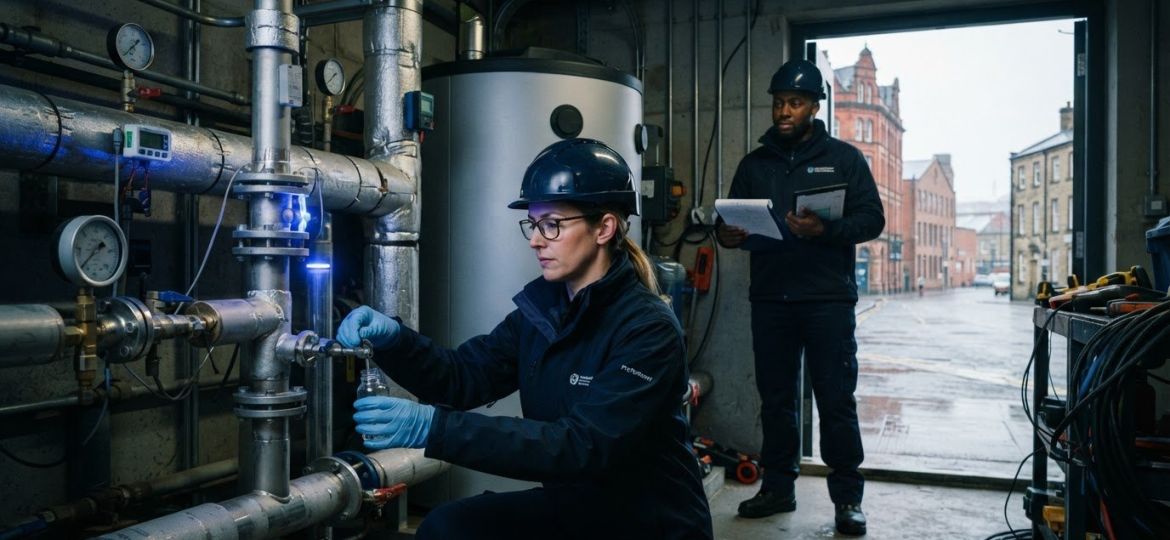
A risk assessment reviews the system’s hazards, exposure routes and controls. Sampling and laboratory testing analyse water taken from selected points, providing evidence about those samples. Testing can inform an assessment, but it doesn’t automatically reveal wider system conditions or replace a site-specific review.
Sampling isn’t necessarily the right first step in every situation. A competent professional should consider the concern, system and available evidence before advising whether sampling is appropriate and how results should be interpreted. An Urgent water risk assessment should clarify both system risks and whether further evidence is needed, rather than treating testing as a stand-alone answer.
The Testing Lab PLC provides Legionella risk assessments UK-wide and is an independent UKAS-accredited testing laboratory, with its head office in Doncaster. It also offers water testing, including Quick Water Testing. Explore its Legionella risk assessment service or request details about support for your site through its water-risk enquiry form.
How to Arrange an Urgent Water Risk Assessment Across the UK
A clear enquiry helps a specialist understand the concern and discuss appropriate support. Before requesting advice, take these practical steps:
- Record the concern: note what you observed, when it happened and which parts of the system may be involved.
- Gather system documents: collect available schematics, maintenance records, previous assessments and relevant test results.
- Check site access: identify the location, access arrangements and any areas or outlets that may need review.
- Request specialist advice: explain the concern and ask about assessment scope and next steps.
What information should you prepare before requesting help?
Include the site location, water system type, reason for concern, relevant records and any existing test results. Note changes such as a period of disuse or system alterations, without trying to diagnose the cause. Ask what the assessment covers, what findings or recommendations will be provided, and whether follow-up testing may be recommended.
The Testing Lab PLC provides water testing and Legionella risk assessment services for customers across the UK. Its service includes locations such as Carlisle, Manchester, Leeds and Doncaster, where its head office is based. When you enquire, give the full site location and confirm the arrangements available for that area.
Share your site location, the scope of concern and how urgent it is to help clarify your enquiry. Request a quote for water-risk support and discuss suitable next steps for your site.
Take the Next Step with Clear, Evidence-Led Advice
An Urgent water risk assessment helps turn a credible concern into a clearer, site-specific plan. Record what you’ve observed, gather system details and existing results, then ask a competent specialist to clarify the assessment scope and recommended actions. Sampling can support the investigation, but it isn’t a substitute for reviewing the system and its controls.
UK health and safety requirements provide important context for managing relevant risks. The Testing Lab PLC provides water testing and Legionella risk assessment services for customers across the UK. It’s an independent UKAS-accredited laboratory, headquartered in Doncaster. Check the accreditation scope relevant to any specific testing service.
Share your location, concern and available information to help frame your enquiry. Get instant Quote and discuss a suitable next step with the team.
Frequently Asked Questions
What is an urgent water risk assessment?
An urgent water risk assessment is a prompt, site-specific review of a credible water-safety concern. A competent assessor considers the system, its condition and use, possible exposure routes, and existing controls before documenting findings and recommended actions. It helps determine appropriate next steps; it doesn’t assume a hazard is confirmed or guarantee a particular outcome.
How quickly can I arrange a water risk assessment?
Timing depends on the concern, site location, scope and provider availability, so no fixed visit time can be promised. Contact the provider with these details and ask what arrangements are possible for your site. The Testing Lab PLC serves UK customers, including Carlisle, Chester, Lancaster, Liverpool, Manchester, Preston, Salford, Berwick-upon-Tweed, Durham, Middlesbrough, Newcastle upon Tyne, Sunderland, Bradford, Doncaster, Huddersfield, Hull, Leeds, Sheffield and Wakefield; its head office is in Doncaster.
Does an urgent water risk assessment include Legionella testing?
Not automatically. An assessment reviews system risks and controls, while Legionella testing analyses water samples. A competent professional can advise whether sampling is appropriate for the circumstances and how results may inform the assessment. If testing is recommended, clarify the proposed sampling scope and how the findings will be interpreted alongside site observations and system information.
What UK rules apply to Legionella risk assessments?
Relevant UK legislation includes the Health and Safety at Work etc. Act 1974 and the Control of Substances Hazardous to Health Regulations 2002 (COSHH), where applicable. HSE’s ACOP L8 provides practical guidance on controlling Legionella, while HSG274 offers technical guidance. ACOP L8 isn’t legislation itself. Check which requirements and guidance apply to your premises and location.

Article by
P J F Thomas
CEO and Founder of TTL plc.
Disclaimer
Items declared are AI generated but do reflect our services. Please get in contact if you have any questions.