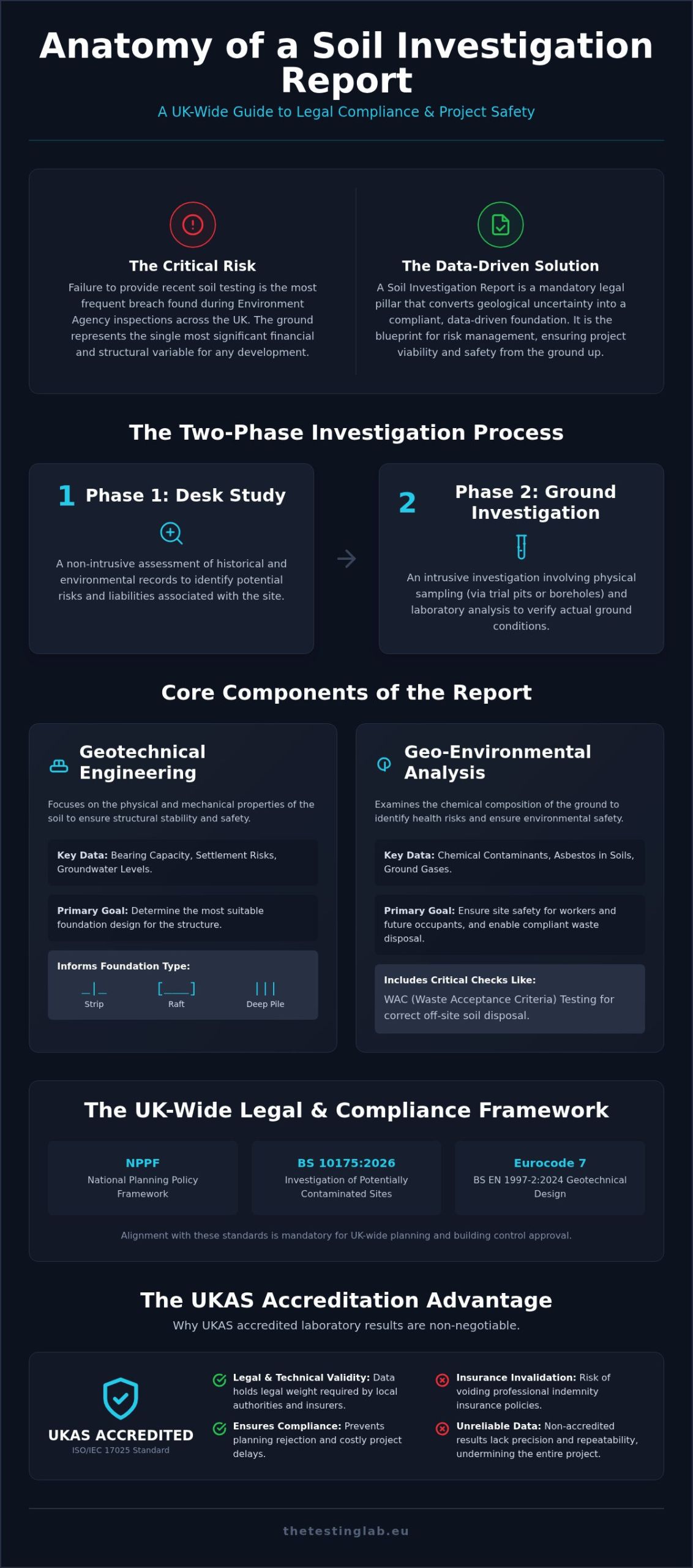
Did you know that failing to provide recent soil testing results is the most frequent breach identified during Environment Agency inspections across England? For any UK-wide development, the ground beneath your feet represents your most significant financial and structural variable. You’re likely asking, what is a soil investigation report and how does it protect your investment? It’s a precise engineering tool that converts geological uncertainty into a compliant, data-driven foundation for your entire project.
We recognize the frustration of distinguishing between Phase 1 and Phase 2 requirements while keeping up with BS 10175:2026 standards. This guide provides a clear roadmap through the legal and structural necessities of modern site investigation. You’ll learn how UKAS-accredited laboratory data ensures regulatory compliance and protects you from the fear of hidden contamination costs. We’ll preview the transition to the latest Eurocode 7 standards, ensuring your project remains technically robust and legally sound.
Key Takeaways
- Understand exactly what is a soil investigation report and why it acts as a mandatory legal pillar for UK planning and building control approval.
- Identify the critical components of a report, from geotechnical bearing capacities to geo-environmental analysis including asbestos in soils testing.
- Learn why UKAS accredited laboratory results are essential for UK-wide compliance, preventing insurance invalidation and costly project delays.
- Gain the technical confidence to mitigate hidden contamination risks and secure the precise data required for safe, efficient foundation design.
Defining the Soil Investigation Report and Its Legal Context
At its core, a soil investigation report is a technical document that quantifies the physical, chemical, and mechanical characteristics of the ground. It’s a blueprint for risk management. For developers, understanding what is a soil investigation report is the first step in converting raw land into a buildable site. This process, often referred to as a Geotechnical investigation, provides the essential data needed to determine foundation depth and identify potential hazards like ground gases or chemical pollutants.
Defining what is a soil investigation report involves more than just looking at dirt; it’s about verifying the site’s chemical and physical viability. The methodology typically moves from a Phase 1 Desk Study to a Phase 2 Ground Investigation. While the first phase assesses historical risk, the second phase uses intrusive sampling to verify reality. This data serves as the technical foundation for safe, cost-effective structural design, removing the guesswork from engineering and preventing expensive mid-project corrections.
The Role of UK Legislation and Planning Requirements
UK planning authorities rely on the National Planning Policy Framework (NPPF) to ensure sites are safe for their intended use. A report is often mandatory to discharge planning conditions related to foundation suitability or potential contamination. UK-wide projects must align with the BS 10175:2026 revision and the second generation of Eurocode 7 (BS EN 1997-2:2024). For those managing complex urban portfolios, linking these results with a comprehensive site survey ensures all regulatory requirements are met. This precision-focused approach secures both the physical structure and the financial investment.
What’s Inside? Breaking Down the Core Components of the Report
A professional report transforms physical samples into actionable engineering intelligence. When asking what is a soil investigation report, you must look beyond simple soil descriptions. It integrates geotechnical parameters such as bearing capacity and settlement risks with groundwater level monitoring. These data points dictate whether your UK-wide project requires strip foundations, raft slabs, or deep piles. Without this precision, structural integrity remains a gamble. Understanding what is a soil investigation report is essential for mitigating these risks early in the design phase.
To maximize the utility of these technical reports, many civil contractors integrate soil data with high-accuracy 3D models. Site Wiz Surveys provides a prime example of how professional 3D survey data can enhance the precision of site preparation and excavation workflows, even on the most complex developments.
The document also serves as a critical environmental shield. It identifies chemical contaminants and provides specialized analysis for asbestos in soils, ensuring site safety for workers and future occupants. If your project involves removing surplus earth, the report must include waste classification data. Utilizing WAC testing ensures you categorize soil correctly for off-site disposal, preventing legal complications at the landfill gate. For complex sites, you can request a technical quote to ensure every component aligns with your specific development goals.
Geotechnical Engineering vs. Geo-environmental Analysis
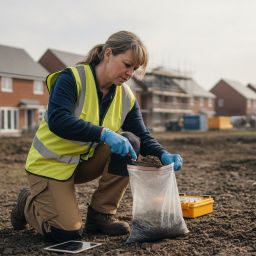
Modern UK compliance requires a dual-track approach. Geotechnical testing focuses on structural strength and load-bearing attributes, while geo-environmental analysis examines chemical safety and health risks. Professionals often follow standards set by the Association of Geotechnical & Geoenvironmental Specialists (AGS) to maintain high technical quality. To gather these samples, engineers use trial pits for shallow assessments or boreholes for deeper strata analysis. This rigorous methodology ensures the final report addresses both the structural stability and the environmental health of the land.
Securing Compliance: Choosing a UKAS Accredited Laboratory
UKAS (United Kingdom Accreditation Service) represents the benchmark for technical competence in soil testing. Without this accreditation, your data lacks the legal weight required by local authorities and insurers. Using non-accredited data often leads to planning rejection or the invalidation of professional indemnity insurance. For developers, understanding what is a soil investigation report means recognizing that the results are only as reliable as the laboratory that produces them. Independent testing ensures unbiased environmental assessments, providing a clear, defensible record of site conditions.
Data integrity is paramount when dealing with sensitive contaminants. UKAS accredited laboratories operate under rigorous ISO/IEC 17025 standards, ensuring that every measurement is precise and repeatable. This level of scrutiny follows the UK guidance on Ground Investigation Reports, which aligns technical findings with the latest British Standards. High-integrity data removes the professional burden from the developer and places it in the hands of qualified specialists.
The Importance of UK-Wide Independent Testing
Consistency is vital for developers managing national portfolios. A UK-wide service ensures that the same high standards apply regardless of site location. This reliability hinges on a robust “Chain of Custody” for samples. From the moment a sample is taken in a trial pit to its arrival at the accredited laboratory, the process must be documented to prevent contamination or loss. To ensure your project meets these strict compliance requirements, you should request a quote from a specialist facility. This proactive step guarantees that what is a soil investigation report for your project remains a tool for success rather than a legal liability.
Securing Your Ground for Future Development
A soil investigation report is more than a regulatory hurdle; it’s a strategic asset that ensures the structural and environmental viability of your site. By integrating geotechnical data with specialized chemical analysis, you eliminate the risks of unforeseen ground conditions. We’ve explored how UKAS accreditation and adherence to the latest 2026 standards protect your project from planning rejections and insurance disputes.
As specialists in asbestos in soils and WAC testing, we provide the technical precision required for complex UK-wide projects. Our UKAS accredited laboratory delivers independent, high-integrity data that serves as a definitive foundation for your engineering decisions. Don’t leave your development to chance. Contact The Testing Lab PLC for UK-wide accredited soil analysis and partner with a team that prioritizes your project’s compliance. We’re ready to help you build with absolute confidence.
Frequently Asked Questions
Is a soil investigation report mandatory for all UK construction?
A soil investigation report is mandatory for any project requiring planning permission or building control approval under the National Planning Policy Framework (NPPF). Local authorities use these documents to verify land stability and ensure the site is safe for its intended use. Structural engineers also require this data to specify foundation depths, making it a functional necessity for most UK-wide developments.
How long is a soil investigation report valid for?
A Phase 1 report is a preliminary desk study that reviews historical data to identify potential hazards. If risks are found, a Phase 2 investigation involves intrusive sampling through boreholes and trial pits. This stage provides the chemical and physical data that defines what is a soil investigation report, allowing for precise foundation design and contamination risk management.
How much does a soil investigation report cost in the UK?
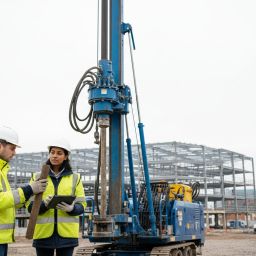
A Phase 1 report is a preliminary desk study that reviews historical data to identify potential hazards. If risks are found, a Phase 2 investigation involves intrusive sampling through boreholes and trial pits. This stage provides the chemical and physical data that defines what is a soil investigation report, allowing for precise foundation design and contamination risk management. For sites requiring specialized machinery to conduct these excavations safely, you can explore Specialized Plant and Equipment Rental to support your ground investigation needs.
How much does a soil investigation report cost in the UK?
Total costs depend on variables like site scale, ground complexity, and the specific laboratory analysis required. Requirements for asbestos in soils testing or WAC testing for waste disposal will influence the project budget. Because every site has unique geological and chemical profiles, developers should obtain a tailored quote from a UKAS accredited laboratory to ensure all compliance needs are met.

Article by
P J F Thomas
CEO and Founder of TTL plc.
Disclaimer
Items declared are AI generated but do reflect our services. Please get in contact if you have any questions.