
In 2026, an asbestos analysis certificate isn’t just a technical report; it’s a critical legal shield that determines your compliance with the Health and Safety Executive’s most rigorous standards. It’s common to feel overwhelmed by the distinction between worker training records and professional laboratory results, especially when the risk of non-compliance carries heavy statutory weight. We understand the pressure of managing multiple sites while ensuring every document stands up to legal scrutiny.
You’ll learn exactly how to secure a legally defensible asbestos analysis certificate that meets all UKAS accreditation requirements for your UK-wide operations. This guide covers the essential steps for obtaining valid results, from initial sampling to understanding your final laboratory report. We’ll ensure your surveying and management plans remain fully compliant with the Control of Asbestos Regulations 2012, giving you total confidence in your documentation.
Key Takeaways
- Understand how the Control of Asbestos Regulations 2012 mandates a valid asbestos analysis certificate to identify hazardous materials before any site work commences.
- Learn the critical role of professional sampling and secure ‘Chain of Custody’ protocols in maintaining the technical integrity of your laboratory reports.
- Verify why UKAS accreditation remains the non-negotiable standard for obtaining legally defensible results that protect your organisation from regulatory penalties.
- Discover the strategic benefits of partnering with an independent laboratory for UK-wide operations to ensure uniform reporting and streamlined compliance auditing.
Defining the Asbestos Analysis Certificate in UK Legislation
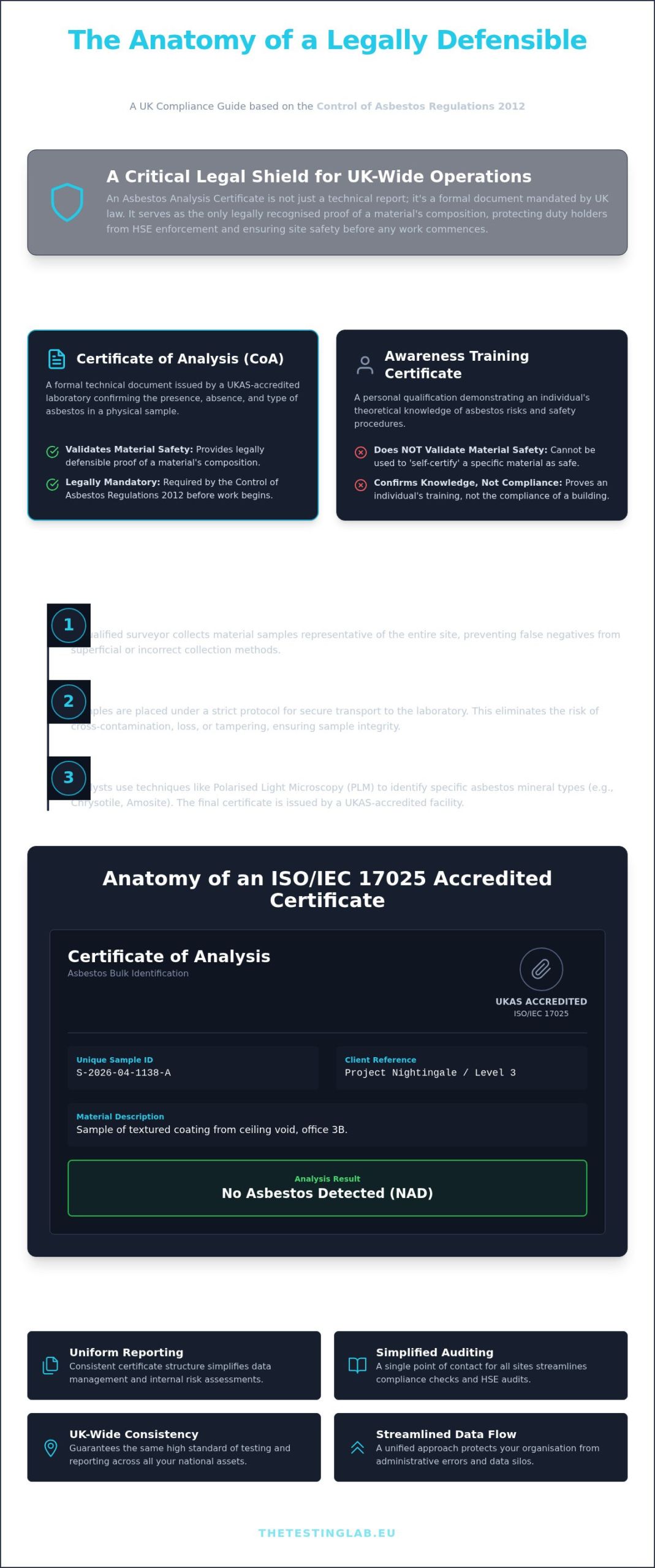
An asbestos analysis certificate, often referred to as a Certificate of Analysis (CoA), is a formal technical document issued by a UKAS-accredited laboratory. It confirms the presence, absence, and specific mineral type of asbestos within a physical sample. Under the Control of Asbestos Regulations 2012, duty holders carry a statutory obligation to identify all asbestos-containing materials (ACMs) before any maintenance or refurbishment work begins. For those seeking a fundamental overview, understanding What is Asbestos? provides necessary context regarding the hazardous nature of these fibres. Crucially, the CoA serves as the only legally recognised proof of material composition in the UK.
Relying on visual assumptions is a high-risk strategy that frequently leads to HSE enforcement and safety failures. This document remains essential for UK-wide compliance, ensuring that safety protocols are based on forensic evidence rather than guesswork. Whether you are managing a single facility or surveying London based portfolios, maintaining a robust portfolio of certificates allows site managers to defend health and safety records during audits. It’s the technical foundation for any safe system of work.
CoA vs. Asbestos Awareness Training Certificates
Confusion often arises between personal qualifications and material reports. Asbestos awareness training certificates prove an individual’s knowledge of risks, yet they don’t validate the safety of a specific building material. Even highly trained staff can’t ‘self-certify’ a material as safe; only a laboratory-issued asbestos analysis certificate provides that certainty. For complex sites, seeking professional asbestos consultancy ensures your documentation meets every legal threshold. This distinction is vital for maintaining a legally defensible management plan across all your assets.
The Technical Process Behind a Valid Asbestos Analysis Report
Obtaining a valid asbestos analysis certificate requires a rigorous three-step methodology. First, a qualified surveyor conducts professional sampling to ensure material collection is representative of the entire site. This prevents false negatives that occur when sampling is superficial. Following collection, samples enter a strict ‘Chain of Custody’ for secure transport. This protocol, aligned with the UK’s official guidance for asbestos analysts, eliminates the risk of cross-contamination or loss before reaching the laboratory.
Inside the laboratory, analysts use Polarised Light Microscopy (PLM) to scrutinise the fibres. This technique identifies specific mineral types, such as Chrysotile (white) or Amosite (brown). To meet HSE guidelines for competency, the final certificate must be issued by a UKAS-accredited facility. Our team provides this level of precision UK wide, ensuring your data is legally robust. If you’re managing complex site portfolios, you can request a technical review to ensure your surveying standards align with current regulations.
Key Components of an ISO/IEC 17025 Accredited Certificate
Every valid report features mandatory fields to ensure traceability. These include a unique sample ID, client reference, and a detailed material description, all set alongside the UKAS ‘owl’ logo. The document must explicitly identify the asbestos type or confirm a ‘No Asbestos Detected’ (NAD) result. This level of detail ensures your asbestos analysis certificate remains a legally defensible asset during HSE inspections. For complex redevelopment projects, specifically involving asbestos in soils, certificates require additional accreditation markers to satisfy environmental regulators. Clear, precise reporting allows you to manage risks without the burden of technical ambiguity.
Choosing a UK Wide Partner for Asbestos Certification
Managing compliance across multiple facilities requires a unified technical approach. For multi-site managers, partnering with a single provider for UK-wide testing ensures uniform reporting and simplifies the auditing process. Independent laboratories, such as The Testing Lab PLC, provide the unbiased results necessary for legal disputes or high-stakes property transactions. When every asbestos analysis certificate follows the same rigorous structure, your internal risk assessments become more efficient. This consistency creates a streamlined data flow that protects your organisation from administrative errors.
Strategic partners must offer more than simple bulk identification. A comprehensive service suite should include air clearance, soil investigation, and water absorption testing to cover every potential risk. We recommend consulting with a leading UK asbestos industry association like ARCA to verify removal standards, though your analytical partner must remain independent to avoid conflicts of interest. To illustrate these complex workflows, we utilise precise .jpg or .png diagrams that map out multi-site management plans with clarity.
Strategic Compliance and Risk Management
A valid certificate serves as the technical foundation for your Asbestos Management Plan (AMP). This is a statutory requirement for all UK commercial properties built before 2000. For those overseeing portfolios in the capital, our London asbestos surveying guide addresses regional nuances while maintaining a consistent UK-wide framework. For a deeper dive into safety standards, refer to our UKAS accredited asbestos testing guide. These resources ensure your asbestos analysis certificate remains a powerful tool for long-term safety and legal defensibility.
Securing Your UK Wide Compliance for 2026
Managing asbestos risks effectively requires more than basic awareness; it demands forensic precision. A valid asbestos analysis certificate serves as your primary legal defence, ensuring every material on your site is identified under strict ISO/IEC 17025 standards. By choosing an independent professional consultancy, you eliminate conflicts of interest and gain a strategic partner dedicated to your long-term safety. Whether you are managing industrial assets or surveying London based commercial properties, uniform reporting across all UK wide sites is essential for seamless auditing.
Our UKAS accredited laboratory is ready to take the burden of professional responsibility off your shoulders. You can request a quote for UK-wide asbestos testing and certification to begin securing your property portfolio today. We look forward to supporting your team with methodical accuracy and technical excellence.
Frequently Asked Questions
Is an asbestos analysis certificate a legal requirement for UK businesses?
Yes, it’s a statutory requirement under the Control of Asbestos Regulations 2012 for any commercial property built before 2000. An asbestos analysis certificate provides the scientific evidence needed to fulfill your “Duty to Manage”. Without this document, you cannot legally verify material safety. This exposure to regulatory risk applies UK wide, making accredited laboratory results the only defensible proof of compliance.
How long is an asbestos analysis certificate valid for?
A certificate of analysis doesn’t technically expire because the material composition remains constant unless disturbed. However, the Health and Safety Executive recommends reviewing your broader asbestos management plan every 12 months. If materials are damaged or building works occur, you’ll need a new asbestos analysis certificate to confirm the current state of the site and maintain your legal standing across all UK wide operations.
Can I take my own samples and send them to a lab for certification?
While you can physically collect samples, we strongly advise against it due to significant health risks and potential legal invalidity. A certificate’s integrity relies on representative sampling by a qualified surveyor. Results from self-collected samples might not be accepted in a court of law or during property transactions. Professional sampling ensures your documentation remains robust and compliant with ISO/IEC 17025 standards.
What should I do if my asbestos analysis certificate shows a positive result?

Article by
P J F Thomas
CEO and Founder of TTL plc.
Disclaimer
Items declared are AI generated but do reflect our services. Please get in contact if you have any questions.