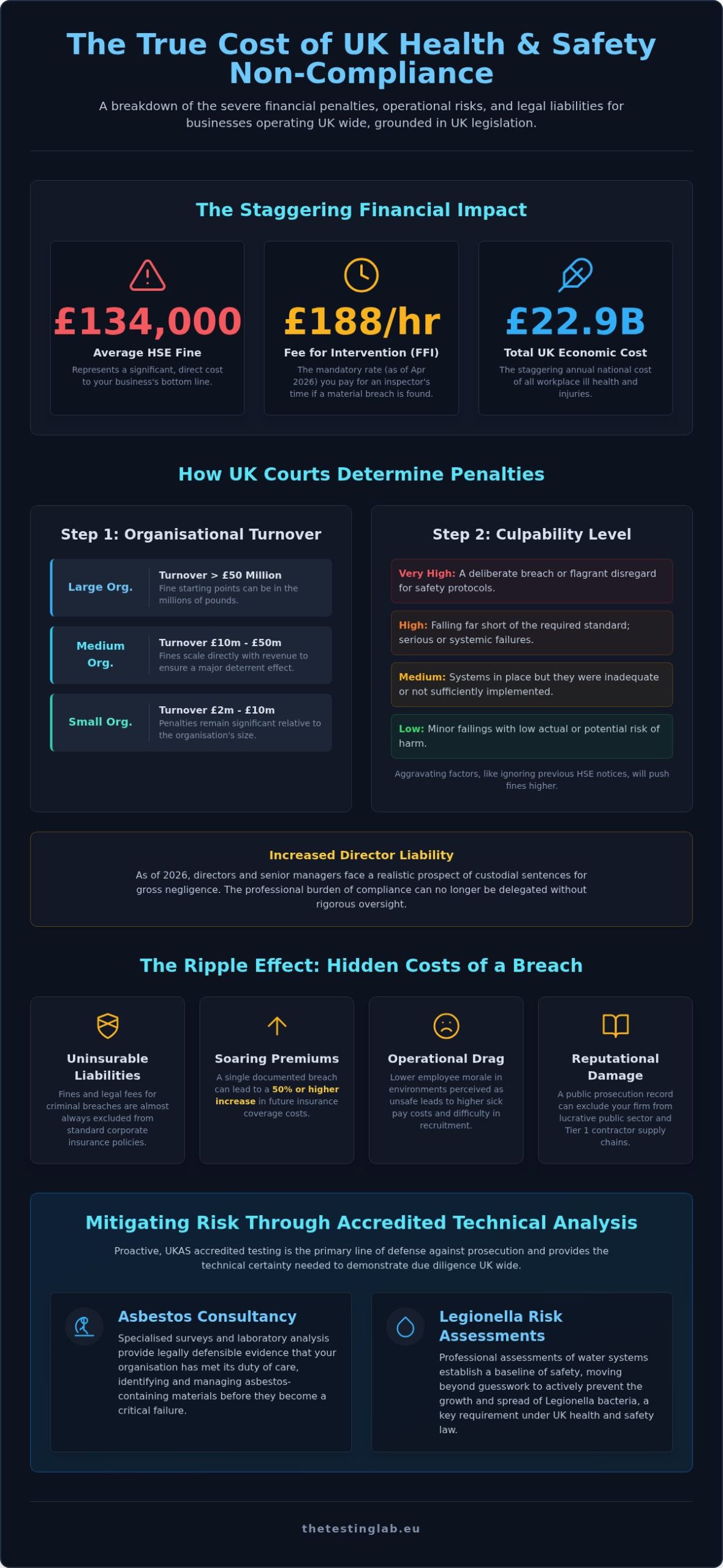
Could a single oversight really cost your business £134,000? With the average HSE fine reaching that level and the Fee for Intervention (FFI) rate now set at £188 per hour as of April 2026, understanding the cost of non-compliance with health and safety regulations UK is no longer optional; it’s a matter of corporate survival. You’re likely concerned about the tightening 2026 sentencing guidelines and how rising insurance premiums are eating into your operational margins. It’s a valid worry when the total economic cost of workplace ill health and injury in the UK has climbed to £22.9 billion.
This guide provides a comprehensive breakdown of these financial and legal impacts, moving beyond simple fines to explore the deep-seated operational risks your firm faces UK wide. We’ll examine the tiered fine structures, the impact of the Building Safety Regulator’s new independence, and how accredited asbestos and legionella testing serves as your primary line of defense against criminal prosecution.
Key Takeaways
- Understand how UK courts leverage the Health and Safety at Work etc. Act 1974 to scale fines based on organisational turnover and culpability levels.
- Calculate the true cost of non-compliance with health and safety regulations UK, including the mandatory £188 per hour Fee for Intervention (FFI) for identified breaches.
- Identify uninsurable operational liabilities and legal fees that standard corporate policies typically exclude after a health and safety incident.
- Learn how UK-wide accredited asbestos consultancy and Legionella risk assessments provide the technical evidence needed to mitigate legal risk and protect business continuity.
Understanding the Legal and Financial Penalties of UK H&S Breaches
Non-compliance isn’t just a failure of process; it’s a breach of statutory duties under the Health and Safety at Work etc. Act 1974. Within the UK health and safety legal framework, the court system uses a formulaic approach to calculate penalties. Since the 2016 guidelines, fines are unlimited and scale directly with an organisation’s annual turnover. Large organisations with turnovers exceeding £50 million can face starting points for fines in the millions of pounds. This ensures the cost of non-compliance with health and safety regulations UK remains a significant deterrent. The Harm Category system evaluates the seriousness of the risk created by a breach, combining the likelihood of harm occurring with the potential severity of that injury or illness.
Sentencing and Director Liability
Courts assess culpability levels across four tiers: Very High, High, Medium, and Low. A “Very High” rating involves a deliberate breach or flagrant disregard for safety protocols. Aggravating factors, such as ignoring previous HSE improvement notices or prioritising profit over protection, will push fines to the upper limits of the sentencing range. As of 2026, the legal landscape has shifted toward increased individual accountability. Directors and senior managers now face a realistic prospect of custodial sentences for gross negligence. This evolution means the professional burden of compliance can no longer be delegated without rigorous oversight. Strategic partners like asbestos consultancy experts provide the technical evidence required to demonstrate that a business has met its duty of care UK wide.
The Hidden Operational and Reputational Costs of Non-Compliance
The headline fines discussed previously represent only the visible peak of a much larger financial liability. For many UK businesses, the immediate drain begins with the Health and Safety Executive (HSE) Fee for Intervention (FFI). As of April 1, 2026, the hourly rate for FFI is £188. This isn’t a fine; it’s a cost recovery mechanism where you pay for the inspector’s time if they identify a material breach. These costs escalate quickly during complex investigations. Recognising that fines and legal fees for criminal breaches are almost always uninsurable is critical. Relying on standard liability policies to absorb the cost of non-compliance with health and safety regulations UK is a high-stakes gamble that often fails, though Justice Legal Practice can assist those who must navigate legal proceedings as litigants in person.
Beyond direct payments, the “ripple effect” on insurance premiums can be devastating. A single documented breach often leads to a 50% or higher increase in future cover costs. This financial burden is compounded by internal friction. Employee morale drops in environments perceived as unsafe, leading to higher sick pay costs and significant difficulty in recruiting skilled staff. Following HSE guidance on legal consequences helps mitigate these risks, but proactive management is the only sustainable way to protect your balance sheet.
Reputational Damage and Supply Chain Exclusion
A public prosecution record is a permanent stain that can exclude your firm from lucrative public sector contracts. Today’s Tier 1 contractors and government bodies demand more than just compliance on paper; they require UKAS accredited proof of safety. Proactive UK wide asbestos and legionella surveying ensures your facility meets these rigorous standards before an inspector arrives. Demonstrating this level of operational excellence protects your reputation and keeps your supply chain opportunities open. If you’re unsure about your current standing, requesting a compliance review from a strategic partner is a logical next step.
Mitigating Risk through Accredited Surveys and Laboratory Analysis
Eliminating the cost of non-compliance with health and safety regulations UK requires more than just a policy document. It demands technical certainty. For high-liability risks, specialized Asbestos consultancy and Legionella risk assessments are essential for establishing a baseline of safety. Relying on guesswork or visual inspections alone often leads to the highest HSE penalties. This is because it demonstrates a clear lack of due diligence during a material breach investigation. A professional asbestos analysis report serves as a primary defense in a due diligence audit by providing empirical evidence of safety. Using 4-stage air clearance and rigorous water management protocols ensures that re-occupation of any site is backed by scientific data. This methodology provides the legal evidence needed to protect your business UK wide.
The Role of UKAS Accreditation in Compliance Assurance
UKAS accreditation represents the “gold standard” of technical competence recognized by the HSE. During an investigation, inspectors prioritize evidence from accredited bodies because it guarantees the accuracy and repeatability of the methodology used. There’s a profound difference between a standard visual survey and an accredited laboratory analysis for complex materials like asbestos in soils. Proactive Legionella monitoring allows businesses to detect pathogens before they reach hazardous levels. This proactive approach effectively eliminates the risk of “High Culpability” findings by demonstrating a data-driven approach to risk management. Precise testing takes the professional responsibility off your shoulders and places it into the hands of experts who understand the engineering requirements of safety.
Securing Your Operational Future through Technical Diligence
Managing the cost of non-compliance with health and safety regulations UK requires a transition from reactive fixes to a methodologically sound, proactive strategy. We’ve explored how unlimited fines and uninsurable operational losses can destabilise even the most robust firms. By choosing to implement UKAS accredited laboratory analysis and rigorous risk assessments, you aren’t just ticking a box; you’re building a legal and technical fortress around your business. Our team acts as your strategic partner, providing expert UK legislation alignment and comprehensive UK wide occupational hygiene services to remove the burden of professional liability from your shoulders.
Don’t wait for an HSE inspection to uncover hidden risks in your portfolio. Protect your business with a UK wide compliance survey from The Testing Lab PLC. Our UKAS accredited independent laboratory ensures every report is grounded in scientific accuracy, giving you the confidence to operate safely across the country.
Frequently Asked Questions
What is the average fine for health and safety non-compliance in the UK?
Can insurance cover health and safety fines?
Standard insurance policies in the UK are legally unable to cover criminal fines or penalties arising from health and safety breaches. While certain policies may assist with the costs of legal representation, the financial penalty itself is an uninsurable liability. This means the organisation must pay the full amount directly from its own capital; this poses a significant threat to business continuity.
What is the HSE Fee for Intervention (FFI) rate for 2026?
Effective from April 1, 2026, the HSE Fee for Intervention (FFI) rate is £188 per hour. This fee is not a fine but a cost recovery charge triggered when an inspector identifies a material breach of the law. It covers the inspector’s time for the entire process, including site visits, writing reports, and any subsequent enforcement actions taken against the firm.
Does a health and safety breach lead to a criminal record for directors?
Directors can indeed face criminal records, heavy fines, and custodial sentences for serious safety failures. The 2026 legal framework places a high degree of personal accountability on senior management. If a breach is attributed to the consent, connivance, or neglect of a director, they can be prosecuted individually alongside the company, potentially leading to disqualification under the Company Directors Disqualification Act.
How does UKAS accreditation protect a business from prosecution?
UKAS accreditation acts as a robust technical defence by proving that your safety data is accurate and reliable. During an HSE investigation, evidence from an accredited partner demonstrates that you have fulfilled your duty of care using the “gold standard” of testing. This level of diligence makes it significantly harder for authorities to prove negligence or high culpability during a formal prosecution.
What are the consequences of failing an asbestos survey?
A failure to act on asbestos survey findings typically results in an immediate Prohibition Notice, halting all operations and causing massive project delays. Beyond the immediate loss of revenue, the business faces substantial fines and the long-term risk of civil claims. Proactive management using accredited laboratory analysis is the only way to prove a site is safe for re-occupation UK wide.

Article by
P J F Thomas
CEO and Founder of TTL plc.
Disclaimer
Items declared are AI generated but do reflect our services. Please get in contact if you have any questions.