Without UKAS-accredited laboratory data, a subsidence insurance claim is often little more than an expensive set of assumptions. It’s understandable why property owners feel overwhelmed by the sudden appearance of structural cracks and the looming threat of property devaluation. Dealing with complex engineering jargon and insurance adjusters only adds to the stress. Professional soil testing for subsidence is the only way to move from guesswork to definitive proof.
This guide explains how precise laboratory analysis provides the forensic evidence required to secure your insurance claim and design a permanent structural fix. We’ll break down the technical standards, such as BS 1377-9: 2025, and show you how a clear technical report creates a reliable roadmap for remediation. Our UK-wide expertise ensures that your property’s stability is backed by rigorous, modern engineering data that stands up to scrutiny.
Key Takeaways
- Learn why visual crack monitoring is insufficient and how scientific sub-surface analysis identifies the precise volume changes causing ground movement.
- Understand the technical distinction between trial pits for foundation exposure and deep borehole logging used to retrieve soil samples from deeper strata.
- Discover how UKAS-accredited soil testing for subsidence provides the forensic evidence required by UK insurers to validate structural claims.
- Identify the legal and financial risks of using non-accredited data, ensuring your technical reports meet the rigorous standards expected by structural engineers.
Understanding Soil Testing for Subsidence: The Foundation of Diagnosis
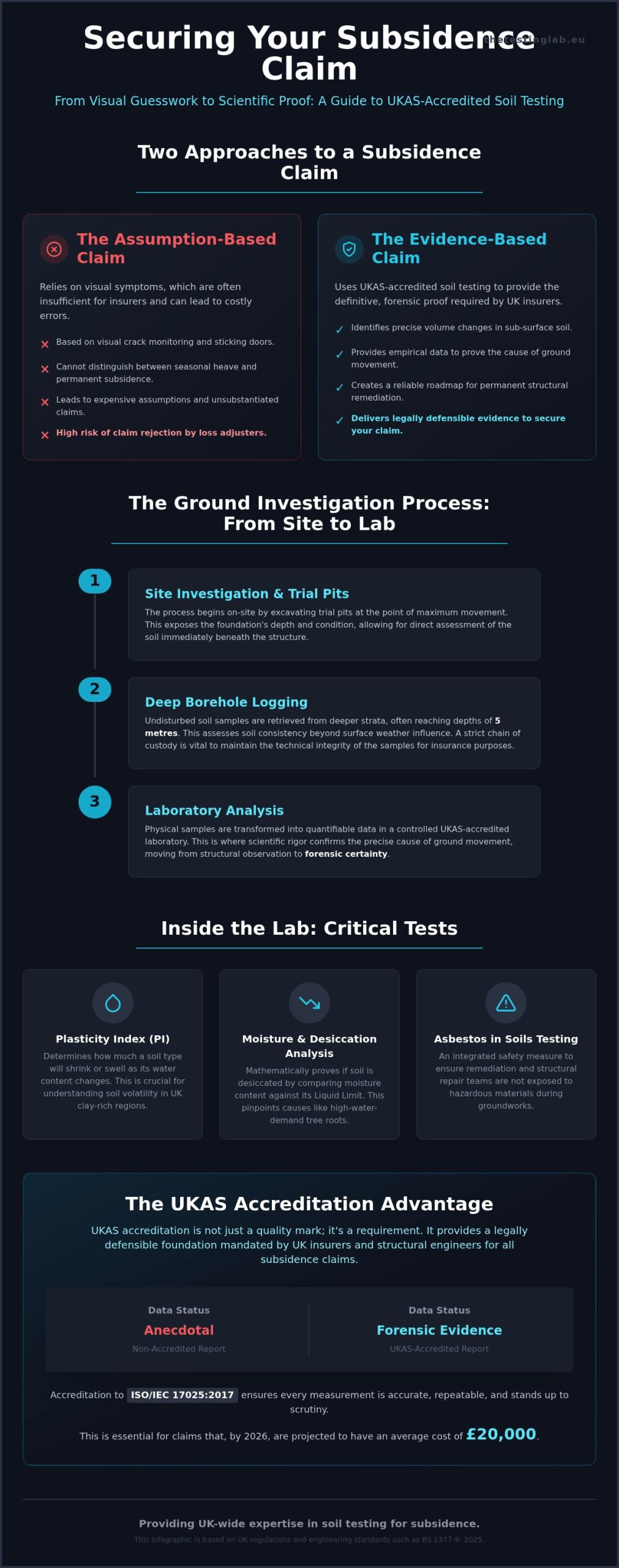
Visual signs like diagonal cracks or sticking doors are merely symptoms of a deeper geological issue. While a surveyor might note these changes, they can’t answer the fundamental question of What is subsidence in a specific case without empirical data. In a professional context, soil testing for subsidence is the scientific analysis of sub-surface conditions to identify volume changes within the ground. It’s a process that moves beyond simply looking at a building and focuses on measuring the soil’s physical properties to establish a baseline of stability. Data replaces doubt.
In the UK, particularly in clay-rich regions, it’s vital to distinguish between seasonal heave and permanent subsidence. Without laboratory results, an insurance loss adjuster has no way to verify if the movement is a valid claim or a temporary environmental shift. UKAS-accredited data provides the forensic weight needed to prove the ground has lost its load-bearing capacity, which is essential for claims often reaching the 2026 average of £20,000. The Testing Lab PLC’s UK-wide expertise ensures these reports meet the highest regulatory standards, providing comprehensive support across all regions.
The Role of Soil Analysis in Determining Causality
Determining why a building is moving requires mapping the Zone of Influence. This area is where external factors, such as high-water-demand tree roots or leaking subterranean drains, fundamentally alter soil moisture levels. Professional testing helps structural engineers differentiate between natural geological settling and anthropogenic causes, such as historic mining or poorly compacted fill material. By analysing moisture content at varying depths, we can pinpoint exactly where the instability originates. Soil testing identifies desiccation as the primary driver of movement in clay-rich areas by measuring the moisture deficit relative to the soil’s plastic limit.
Essential Ground Investigation Methods: From Site to Laboratory
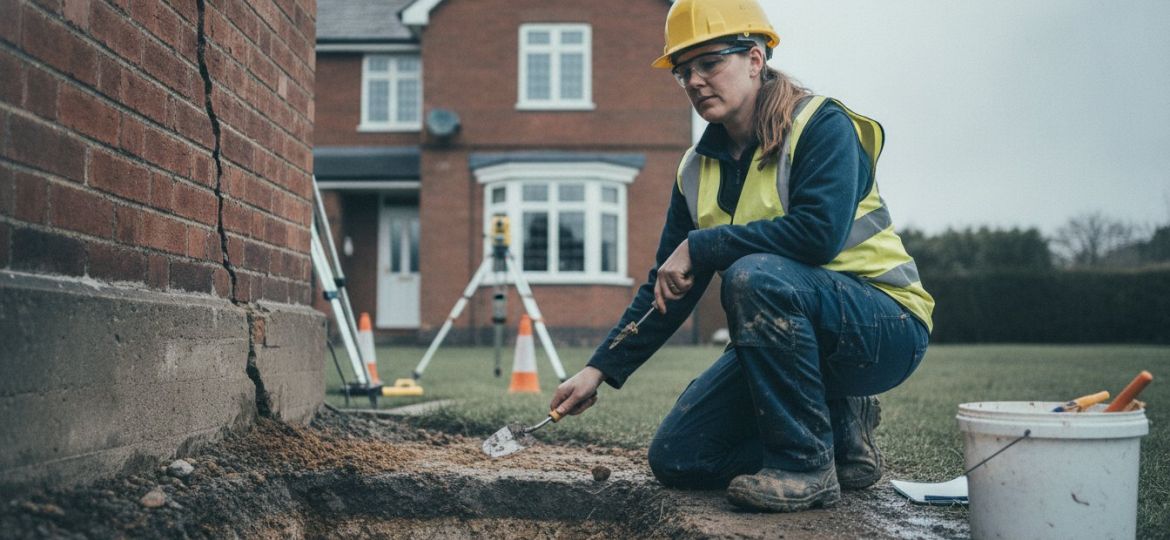
Effective ground investigation begins with a strategic site inspection. Trial pits are excavated at the point of maximum movement to expose the foundation’s depth and condition. This physical evidence, combined with a RICS consumer guide to subsidence, helps property owners understand the initial diagnostic phase. These pits allow for a direct assessment of the soil directly beneath the load-bearing structure.
Borehole logging retrieves undisturbed soil samples from deeper strata, often reaching depths of 5 metres. This allows engineers to assess soil consistency beyond the immediate influence of surface weather. Maintaining a strict chain of custody during sample recovery is vital; without it, the technical integrity of the soil testing for subsidence report may be compromised during an insurance dispute. Professional recovery ensures that moisture profiles remain representative of the ground conditions at the time of extraction.
Laboratory analysis then transforms these physical samples into quantifiable data. This stage is where the “why” behind the movement is finally confirmed through soil testing for subsidence in a controlled environment. By applying scientific rigor to the samples, we move from structural observation to forensic certainty.
Critical Laboratory Tests: Plasticity, Moisture, and Desiccation
Plasticity Index (PI) testing determines how much a specific soil type shrinks or swells as water content fluctuates. By comparing moisture content against the Liquid Limit, we can mathematically prove if soil is desiccated due to aggressive root activity. We also integrate asbestos in soils testing at this stage to ensure remediation teams aren’t exposed to hazardous materials during structural repairs. For those requiring technical precision, our UKAS accredited lab services provide the definitive data needed for remediation design.
Compliance and Insurance: The Value of UKAS Accredited Soil Testing
Insurance companies and structural engineers mandate UKAS-accredited results because they provide a legally defensible foundation for any claim. Technical competence is verified against ISO/IEC 17025:2017, ensuring that every measurement is accurate and repeatable. Without this accreditation, a report is often treated as anecdotal rather than forensic evidence. Using non-accredited data carries significant risks; uncertified reports are frequently rejected during legal disputes or by loss adjusters when evaluating a claim. This aligns with government guidance on land stability, which emphasises the need for robust, high-quality risk assessment. Independent soil testing for subsidence offers an unbiased third-party perspective, removing the professional burden from the property owner while protecting the insurer’s liability.
For older properties where groundworks or trial pits are required, the scope of investigation must expand to meet safety regulations. We recommend engaging a professional asbestos consultancy if you’re dealing with pre-2000 structures. This ensures that any potential contamination in the made ground is identified before remediation begins. It prevents costly project delays and ensures the site remains compliant with UK health and safety legislation during the underpinning or excavation process.
Selecting a Professional Laboratory for UK Wide Investigations
Securing Your Property with Forensic Certainty
Structural movement shouldn’t be a source of ongoing uncertainty. By transitioning from visual observations to empirical laboratory data, you replace fear with forensic proof. This evidence is the only way to satisfy modern insurance requirements and ensure remediation strategies, such as underpinning or root management, are technically sound. Data removes the ambiguity that often leads to rejected claims or insufficient structural fixes.
Professional soil testing for subsidence provides the scientific clarity needed to protect your property’s value. As an independent professional consultancy operating a UKAS accredited laboratory, we deliver the precise results that structural engineers rely on. Our UK wide service coverage ensures that your investigation meets the most rigorous standards of accuracy. Request a UKAS accredited soil testing quote for your project to begin your roadmap to remediation. You can move forward with confidence knowing your property’s stability is backed by expert analysis.
Frequently Asked Questions
What is the most common soil test for subsidence investigation?
The Atterberg Limit test is the industry standard for identifying soil plasticity and potential volume changes. This laboratory analysis determines the moisture content at which clay soil transitions from a solid to a plastic state. It’s a critical component of soil testing for subsidence because it quantifies how much the ground under your foundations is likely to shrink or swell during seasonal changes.
How deep do soil samples need to be taken for an accurate subsidence report?
Soil samples are typically retrieved from depths ranging between 3 and 5 metres using borehole logging techniques. This depth ensures that engineers can assess the strata well below the foundation’s active zone or the reach of deep tree roots. Investigating these deeper layers is essential for identifying desiccation and ensuring the long-term stability of any proposed structural remediation plan.
Will soil testing for subsidence damage my garden or driveway?
Professional ground investigations are designed to be minimally invasive. Trial pits are strategically placed near the foundation and are backfilled immediately after sample recovery. Boreholes require only a small entry point, often less than 150mm in diameter. Our UK-wide teams prioritise site reinstatement to ensure your garden or driveway is returned to a safe and tidy condition once the fieldwork is complete.
How long does it take to get laboratory results for soil plasticity?
Laboratory analysis for soil plasticity typically takes between 5 and 10 working days from the moment samples arrive at our UKAS accredited facility. This timeframe allows for the precise drying and testing procedures required by British Standards. Once the soil testing for subsidence is finalised, we issue a clear technical report that provides the forensic evidence your insurer needs to proceed with your claim.

Article by
P J F Thomas
CEO and Founder of TTL plc.
Disclaimer
Items declared are AI generated but do reflect our services. Please get in contact if you have any questions.