With 472 confirmed cases of Legionellosis recorded in England and Wales in 2024 and a recent cluster investigated in London in March 2026, managing water safety remains a high-stakes operational priority. You likely understand that showerheads represent a significant risk point due to aerosol production, yet the technical specifics of ACOP L8 and HSG274 Part 2 often create confusion. It’s natural to feel concerned about the hidden threat of biofilm or whether your current flushing frequencies are sufficient to maintain UK wide compliance.
This guide provides the technical clarity you need to master how to reduce legionella risk in showers through a structured, engineering-led approach. We’ll outline a definitive maintenance schedule that replaces uncertainty with precise, documented protocols. By following this framework, you can ensure legal peace of mind and significantly lower the risk of an outbreak in your facility. For duty holders looking to integrate these practices into a broader safety strategy, our insights on local asbestos and legionella surveying offer a pillar for long-term health and safety management.
Key Takeaways
- Identify why showers are high-risk outlets and how to manage the critical temperature thresholds between 20°C and 45°C to prevent bacterial growth.
- Master how to reduce legionella risk in showers by implementing rigorous maintenance schedules and documented flushing routines in line with HSG274 Part 2.
- Understand your specific legal obligations under the Health and Safety at Work Act and COSHH to ensure UK wide health and safety compliance.
- Learn the technical requirements for professional Legionella risk assessments and why biennial reviews are essential for a defensible safety record.
Understanding the Risk Profile of Showers in Water Systems
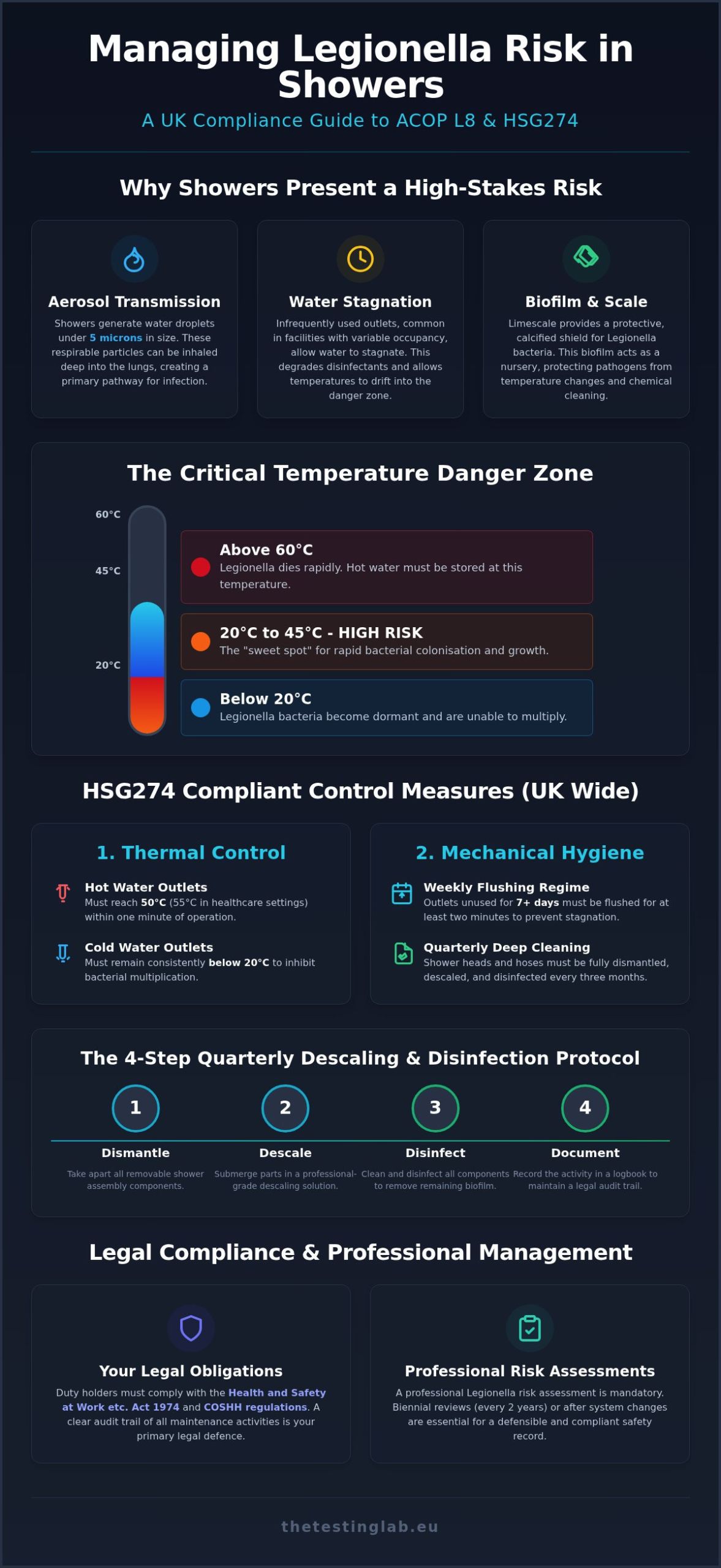
Showers represent one of the most significant risk points in any building’s water system. Unlike standard taps, showers are specifically designed to disperse water into fine droplets. This mechanism is efficient for bathing but creates a primary pathway for infection. When assessing how to reduce legionella risk in showers, it’s vital to understand that the bacteria must be inhaled to cause illness. The “Legionella sweet spot” occurs when water temperatures sit between 20°C and 45°C. This range provides the ideal thermal environment for rapid bacterial colonisation, particularly in systems where water is allowed to stagnate.
A systematic risk profile for showers rests on three pillars: aerosolisation, stagnation, and nutrient availability. Stagnation is a common issue in guest rooms or healthcare wards with low occupancy. It allows the water’s residual disinfectant to degrade while temperatures drift into the danger zone. Nutrients are often supplied by the system’s own components. Many synthetic rubbers and plastics used in shower hoses provide a porous surface that encourages biofilm attachment. This biological layer acts as a nursery for Legionnaires’ disease pathogens, protecting them from temperature spikes and chemical flushes.
The Science of Aerosol Transmission
The technical danger of a shower lies in the diameter of the water droplets it produces. Showers generate aerosols under 5 microns in size. Particles of this magnitude are respirable, meaning they can bypass the upper respiratory tract and settle in the deep lungs, or alveoli. High water pressure and fine spray patterns significantly increase aerosol density. This makes the mechanical configuration of the shower head a critical variable for UK wide health and safety managers. Managing these physical factors is as important as managing the water chemistry itself.
Biofilm and Scale: The Protective Shield for Legionella
Limescale and Legionella share a dangerous symbiotic relationship. Scale buildup creates a rough, calcified surface that provides an anchor for biofilm. These layers are remarkably resilient. Surface-level cleaning or a quick wipe of the showerhead is insufficient to penetrate these deep microbial reservoirs. Effective control requires a methodical descaling process to strip away the protective shield. Integrating these technical checks into a wider local asbestos and legionella surveying protocol ensures that your facility’s environmental risks are managed with engineering-led precision.
Practical Maintenance and Control Strategies for Shower Safety
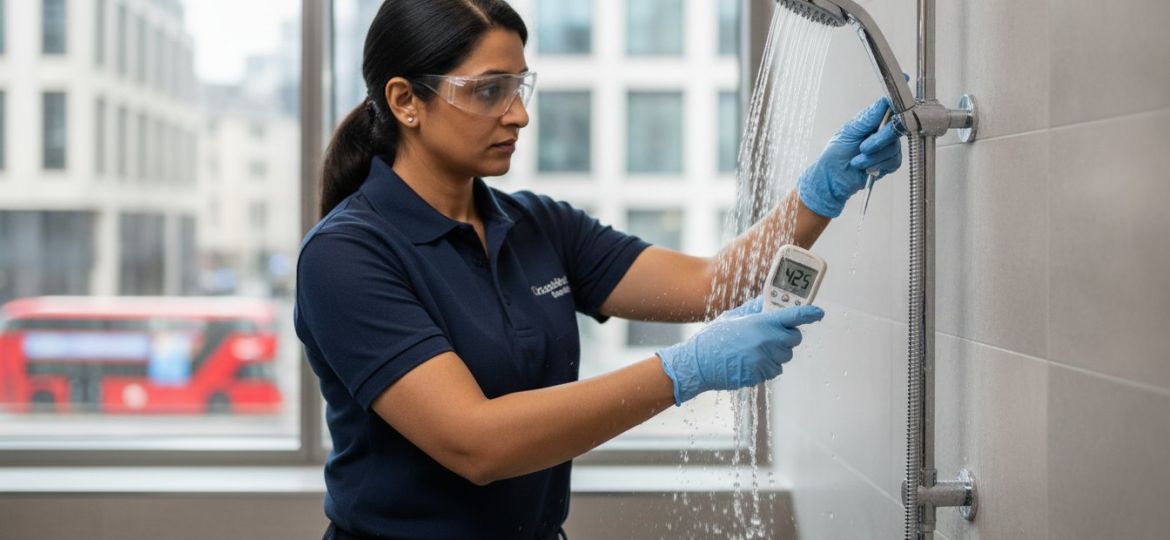
Moving from theoretical risk to operational safety requires a regime that mirrors the precision of HSG274 Part 2. Integrating how to reduce legionella risk in showers into your daily operations requires a dual focus on thermal control and mechanical hygiene. Temperature remains your primary line of defence. Hot water must be stored at 60°C and reach shower outlets at a minimum of 50°C (or 55°C in healthcare settings) within one minute of opening the tap. Conversely, cold water should always remain below 20°C to prevent the thermal conditions that trigger bacterial multiplication.
Maintaining these standards UK wide involves rigorous record-keeping. Documentation isn’t just a administrative task; it’s your primary legal defence in the event of an audit. The HSE guidance on managing legionella emphasises that duty holders must provide a clear audit trail of all maintenance activities. This includes temperature logs, flushing records, and disinfection certificates.
Implementing a Robust Flushing Regime
Stagnation is the catalyst for microbial growth. If a shower isn’t used for more than seven days, the water within the pipework and the head becomes a high-risk reservoir. You must implement a weekly flushing routine for these infrequently used outlets. Each shower should be run for at least two minutes to draw fresh, treated water through the entire length of the system. Utilising a Checklist for ACOP L8 compliance ensures that your site team follows a standardised process that meets UK legislative requirements.
Descaling and Disinfection Protocols
Because scale provides a physical anchor for biofilm, quarterly maintenance is essential. Every three months, site staff should dismantle showerheads and hoses for deep cleaning. The process involves four technical steps:
- Dismantle: Take apart all removable components of the shower assembly.
- Descale: Submerge parts in a professional-grade descaling solution until all visible calcium deposits are removed.
- Disinfect: Immerse the cleaned components in an approved biocide, such as a chlorine-based solution, for the manufacturer’s recommended contact time.
- Rinse: Thoroughly flush with fresh water before reassembling.
If a shower hose shows signs of internal pitting or the plastic is visibly degrading, cleaning is often insufficient. In these cases, replacement is the only engineering-sound option. For complex facilities, booking professional legionella risk assessments can help identify which outlets require more frequent intervention based on local water hardness and usage patterns.
Legislative Compliance and Professional Risk Management
Compliance with UK health and safety law isn’t a suggestion; it’s a statutory requirement. Under the Health and Safety at Work etc. Act 1974 and the Control of Substances Hazardous to Health (COSHH) Regulations 2002, duty holders have a clear legal obligation to manage biological risks. In the context of property management, this involves appointing a “Responsible Person” to oversee water safety UK wide. This individual is tasked with ensuring that all technical controls are not only implemented but rigorously documented to satisfy HSE inspectors.
The Role of UKAS Accredited Laboratory Analysis
Temperature monitoring provides a baseline, but it can’t detect the presence of pathogens within a complex biofilm. A Public Health England study previously identified that a notable percentage of shower systems still harbour bacteria despite standard controls. This is why microbiological water testing is a vital component for high-risk settings like healthcare or social housing. By using a UKAS accredited laboratory, you ensure that sample collection and the chain of custody meet the highest analytical standards, providing definitive proof of system safety.
Legionella Risk Assessments and Water Management Plans
A professional risk assessment is the foundation of any strategy addressing how to reduce legionella risk in showers. These assessments, which should be reviewed every two years or following significant system changes, identify structural flaws like “dead legs” where water cannot circulate. Without this engineering-led overview, even the most frequent flushing regime might fail to reach pockets of stagnant water. We encourage duty holders to book a legionella assessment to formalise their water management plan. This proactive step ensures full alignment with ACOP L8, moving your organisation from a reactive stance to a position of strategic compliance and total legal peace of mind.
Implementing Engineering-Led Standards for Water Safety
Effective water management requires a transition from basic compliance to a system of precision engineering. By maintaining strict thermal thresholds and implementing the quarterly descaling protocols discussed, you directly address the physical environments where bacteria thrive. Mastering how to reduce legionella risk in showers isn’t just a legal necessity under ACOP L8; it’s a fundamental commitment to the safety of every person who enters your facility. UK wide compliance is best achieved when maintenance is treated as a rigorous, documented process rather than a series of isolated tasks.
This systematic approach to documentation is a universal principle of risk management. For example, A Plus Compliance Services helps organizations maintain high standards through professional electrical safety testing, ensuring that all aspects of facility compliance—whether water or electrical—are addressed with precision.
As your strategic partner, we provide the technical expertise needed to manage these complex systems with total confidence. Our UKAS Accredited Testing Laboratory and experienced team offer UK wide Professional Site Surveys to ensure your water management plan remains robust and defensible. Secure your building with a UKAS accredited Legionella risk assessment and gain the Expert ACOP L8 Compliance Support your organisation requires. Taking these proactive steps today creates a safer, more resilient environment for the future.
Frequently Asked Questions
How often should I run a shower to prevent Legionella?
You should flush infrequently used showers for at least two minutes once a week. This practice prevents water stagnation, which is a primary driver of bacterial colonisation. If a shower remains unused for more than seven days, the residual disinfectant in the water degrades. Maintaining this frequency is a simple yet effective method for how to reduce legionella risk in showers within residential or commercial settings.
Is it possible to catch Legionnaires’ disease from a domestic shower?
Yes, catching Legionnaires’ disease from a domestic shower is possible because the infection is transmitted through the inhalation of contaminated aerosols. While the risk is often higher in large-scale commercial systems, domestic showerheads can harbour biofilm and scale. These biological layers protect pathogens from standard water temperatures. Regular descaling and maintaining hot water storage at 60°C are essential for domestic safety.
What are the legal requirements for landlords regarding shower safety in the UK?
Landlords in the UK have a statutory duty under the Health and Safety at Work etc. Act 1974 and COSHH regulations to manage biological risks. This includes identifying and assessing sources of risk, such as showers, and implementing control measures. While a specific certificate isn’t required by law, landlords must maintain records showing how to reduce legionella risk in showers and other outlets to remain compliant.
Can I perform my own Legionella risk assessment for showers?

Article by
P J F Thomas
CEO and Founder of TTL plc.
Disclaimer
Items declared are AI generated but do reflect our services. Please get in contact if you have any questions.