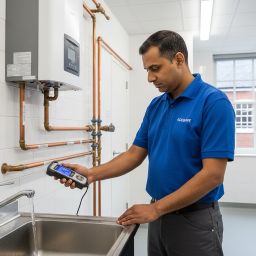
Did you know that asbestos is still present in approximately 300,000 non-domestic buildings across the UK? With over 5,000 asbestos-related deaths occurring annually, the responsibility of property management carries significant weight. You likely feel the pressure of ensuring your premises meet the strict standards of the Control of Asbestos Regulations 2012, especially with the Health and Safety Executive’s recent focus on survey quality and analyst independence. Understanding exactly what is an asbestos management survey is the first step in moving from reactive fear of HSE fines to proactive, strategic compliance. It’s about more than just a checkbox; it’s about protecting your people and your professional reputation.
We recognize that the distinction between survey types can be confusing and the fear of building disturbance often leads to delays. This guide clarifies the legal framework and methodology you need to maintain safety UK wide. We’ll provide a clear roadmap from the initial inspection to a robust management plan. You’ll gain the confidence to choose a competent, UKAS accredited partner and ensure your property remains compliant throughout 2026 and beyond. By the end of this article, you’ll have a forensic understanding of your duties and the technical processes required to mitigate risk effectively.
Key Takeaways
- Learn exactly what is an asbestos management survey and how it fulfills your legal obligations under the Control of Asbestos Regulations 2012.
- Understand the systematic inspection methodology used to identify asbestos-containing materials during normal occupancy without causing building disruption.
- Discover how to transform technical survey data into a functional Asbestos Register and a strategic Management Plan for premises UK wide.
- Gain clarity on how material risk scores and disturbance factors dictate your management priorities and resource allocation.
- Identify why UKAS accredited laboratory testing and independent consultancy are essential for ensuring the forensic accuracy of your compliance records.
Understanding the Asbestos Management Survey: Purpose and Legal Requirements
Establishing what is an asbestos management survey is the first step toward achieving total site safety. It’s a non-intrusive, standard inspection designed to locate and assess asbestos-containing materials (ACMs) that might be disturbed during normal, day-to-day building use. To appreciate the necessity of this process, it helps to understand what asbestos is and why its presence requires forensic-level monitoring. For commercial properties UK wide, this survey provides the technical data needed to protect both occupants and the business’s legal standing.
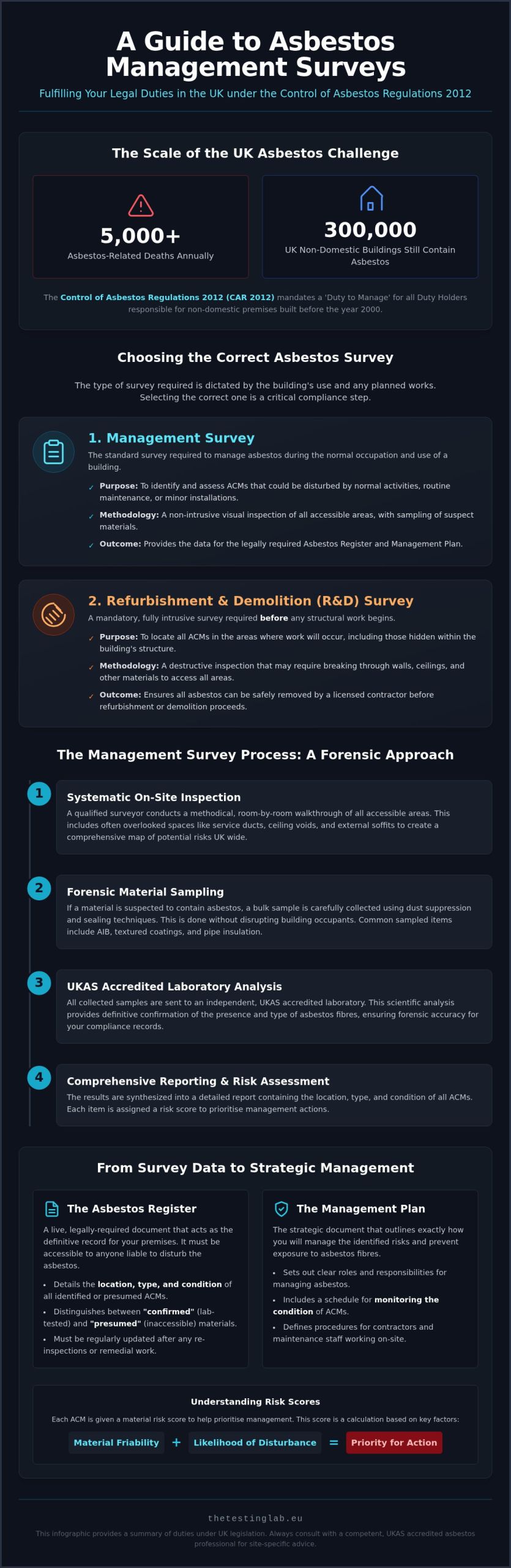
The primary objective of the survey is to generate two critical documents: an Asbestos Register and a long-term Management Plan. These aren’t just administrative files; they’re strategic tools for non-domestic premises. Under the Control of Asbestos Regulations 2012 (CAR 2012), this process is mandatory. The legal burden falls on the Duty Holder, who is the person or organization responsible for the building’s maintenance and safety. Understanding what is an asbestos management survey involves recognizing its role as a live compliance tool rather than a one-time event.
For those managing complex portfolios, it can be beneficial to visit Oxford Environmental Consultants (OEC) to learn more about multi-disciplinary compliance services that cover a wider range of property safety requirements.
The ‘Duty to Manage’ Under CAR 2012
Regulation 4 of CAR 2012 applies to almost all non-domestic buildings constructed before 2000, as these are most likely to contain legacy materials. The Duty Holder’s legal obligation is to prevent exposure to asbestos fibres by identifying, assessing, and managing any risks on-site. This role requires a methodical approach to ensure that every potential hazard is documented and controlled through a transparent, accessible register.
Management Survey vs. Refurbishment and Demolition Surveys
Choosing the correct inspection level is vital for maintaining compliance. A Management Survey is intended for buildings in “normal occupation” where only routine maintenance occurs and the building’s fabric remains largely intact. However, a Management Survey is no longer sufficient when you’re planning structural changes or intrusive works. In those instances, a Refurbishment and Demolition (R&D) survey must be conducted to inspect areas that are usually inaccessible. For more information on tailored compliance, visit our London and UK wide surveying services.
Conducting the Survey: Methodology, Sampling, and Inspection Areas
A rigorous methodology is what separates a superficial check from a legally robust inspection. When defining what is an asbestos management survey in practice, it’s best described as a systematic, room-by-room walkthrough of all accessible areas. Our surveyors apply an engineering mindset to every site, ensuring that often overlooked spaces like ceiling voids, service ducts, and external soffits are thoroughly inspected. This level of detail is essential for identifying materials that might be disturbed during routine maintenance or minor installations.
The sampling protocol follows a strict forensic logic. If a material is suspect, we collect bulk samples of items such as Asbestos Insulating Board (AIB), textured coatings, or pipe insulation for UKAS accredited laboratory analysis. To maintain the highest asbestos training standards, our team ensures that every sample is taken safely, using localized dust suppression and sealing techniques. This precision ensures that the building remains fully functional and safe for occupants throughout the entire process.
Once the on-site work is complete, the data is synthesized into a comprehensive report. This document must include the precise location, material type, and current condition of all ACMs. Crucially, it assigns a risk score to each item, which factors in both the material’s friability and the likelihood of human disturbance. This score provides the technical foundation for your ongoing safety strategy.
Identifying Asbestos-Containing Materials (ACMs)
Management surveys frequently uncover legacy materials like thermoplastic floor tiles, cement flue pipes, and AIB ceiling tiles. In the final register, we distinguish between “confirmed” asbestos, verified via lab testing, and “presumed” asbestos. Presuming the presence of asbestos in inaccessible areas is a vital fail-safe that prevents accidental exposure during future works. It’s a proactive approach that ensures no risk is left unmanaged in premises UK wide.
Ensuring Professional Competence
Professional surveyors must possess the curiosity and technical knowledge to look beyond the obvious. This involves checking behind access hatches, under floor coverings, and within riser cupboards where ACMs were historically used for fireproofing or insulation. If you’re unsure about the current status of your building, you can learn more about UK wide asbestos consultancy services to see how a strategic partner can simplify your compliance journey. For those ready to secure their premises, requesting a technical compliance quote is the next logical step in your management roadmap.
From Survey Report to Management Plan: Ensuring UK Wide Compliance
Risk assessment scores are the engine of this register. We calculate these by evaluating two distinct factors: the material score, based on the type and condition of the asbestos, and the priority score, based on the likelihood of human disturbance. This methodology ensures that your resources are allocated where the risk is highest. By quantifying these variables, we remove the guesswork from your safety protocols, allowing for a precise, engineering-led approach to risk mitigation.
The Importance of UKAS Accreditation in Lab Analysis
Legally defensible asbestos identification relies entirely on forensic precision. Forensic analysis of bulk samples in a UKAS accredited laboratory, specifically ISO/IEC 17025, is the only way to confirm asbestos content with the certainty required by CAR 2012. The Testing Lab PLC operates as an independent consultancy, UKAS No. 1155/0291, providing the high-level technical evidence needed to support your management decisions. You can request a quote for specialist asbestos and legionella surveying to ensure your samples are handled by a strategic partner who understands the weight of professional responsibility.
Maintaining Your Asbestos Management Plan
A Management Plan is only effective if it reflects the current state of the building. Annual re-inspections are essential because the condition of ACMs can degrade over time due to wear, vibration, or environmental changes. When you invest in what is an asbestos management survey, you’re starting a cycle of continuous monitoring. We provide specialist surveying services in London and the UK to help you maintain this cycle, ensuring your documentation remains accurate and your premises stay safe for the long term.
Securing Your Premises: Moving Toward Proactive Asbestos Compliance
Mastering your legal obligations under the Control of Asbestos Regulations 2012 requires more than a casual inspection. It demands a forensic approach that bridges on-site methodology with laboratory precision. By identifying the exact location and condition of ACMs, you transform a technical report into a functional safety tool. Understanding what is an asbestos management survey allows you to move beyond the fear of non-compliance and toward a strategic partnership that protects your occupants UK wide.
The Testing Lab PLC operates as a UKAS Accredited Laboratory (No. 1155), providing the independent professional consultancy you need to manage risk with total confidence. We don’t just identify hazards; we provide the technical roadmap required to maintain your Asbestos Register through regular re-inspections and expert guidance. Our national UK wide coverage ensures that your portfolio remains compliant, regardless of complexity or location.
Take the final step in removing the burden of professional responsibility from your shoulders. Book your UK wide Asbestos Management Survey with our UKAS accredited experts today. Secure your building’s future with methodical, precision-led compliance that puts safety first.
Frequently Asked Questions
Is an asbestos management survey a legal requirement for my building?
Yes, conducting a management survey is a legal requirement for almost all non-domestic buildings constructed before 2000. Under Regulation 4 of the Control of Asbestos Regulations 2012, the Duty Holder must identify the location and condition of any asbestos-containing materials. This process ensures that risks are managed effectively UK wide. Failing to comply can result in significant HSE fines or prosecution, as the law places the burden of safety directly on property managers.
How long does an asbestos management survey report remain valid?
An asbestos survey report doesn’t have a fixed expiration date, but it must be treated as a live document. The HSE recommends that the condition of identified materials be reviewed at least every 12 months to ensure safety. If the building’s use changes or the materials sustain damage, you’ll need an update sooner. Regular re-inspections ensure your Asbestos Register remains accurate and compliant with current safety standards across your premises.
Can I carry out an asbestos management survey myself?
You shouldn’t attempt to carry out a survey yourself unless you possess the specific technical competence and equipment required for safe sampling. To understand what is an asbestos management survey in a legal context, you must recognize the need for UKAS accredited laboratory analysis. Professional surveyors use specialized tools and suppression techniques to prevent fibre release. Using an independent consultancy ensures that your survey is thorough, accurate, and legally defensible.
What happens if asbestos is found during a management survey?
If asbestos is identified, the findings are recorded in your Asbestos Register with a corresponding risk score. Most materials in good condition can be managed in situ through regular monitoring and clear labeling. However, if the material is damaged or likely to be disturbed, your Management Plan may recommend encapsulation or professional removal. This systematic approach allows you to maintain a safe environment UK wide without resorting to unnecessary building closures.

Article by
P J F Thomas
CEO and Founder of TTL plc.
Disclaimer
Items declared are AI generated but do reflect our services. Please get in contact if you have any questions.