
Did you know that misclassifying a single stockpile of soil as hazardous waste can inflate your disposal costs by over 400%? Managing contaminated land is a high-stakes balancing act between legal compliance and project profitability. It’s understandable that many developers feel a sense of uncertainty regarding their CAR 2012 obligations, especially with the stricter enforcement measures introduced in 2026. At The Testing Lab PLC, we act as your strategic partner to remove this professional burden from your shoulders through methodological precision.
Our expert guide ensures you can master the complexities of asbestos in soils testing UK wide by providing a clear framework for UKAS-accredited analysis and quantification. We’ll show you how to achieve full legislative compliance while using accurate waste classification to avoid the high costs of unnecessary hazardous waste disposal. You’ll gain a comprehensive overview of current risk management strategies, from understanding the critical 0.1% hazardous threshold to implementing independent analytical oversight. For those managing complex sites in the capital, our specialist surveying services provide the technical data needed to keep your timelines secure and your sites safe.
Key Takeaways
- Understand your legal obligations under the Control of Asbestos Regulations (CAR) 2012 to ensure your brownfield projects remain fully compliant with UK legislation.
- Discover the technical precision required for asbestos in soils testing UK wide, from initial visual screening to advanced UKAS-accredited quantification methods.
- Learn how to apply WM3 waste classification correctly to distinguish between hazardous and non-hazardous soil, significantly reducing unnecessary disposal costs.
- Implement a robust risk management strategy that leverages independent laboratory data to prevent project delays and provide a legally defensible audit trail.
Understanding Asbestos Contamination in UK Soils
Legacy contamination on UK brownfield sites remains a persistent obstacle for developers and land managers. Asbestos persists in soil because it doesn’t degrade naturally; it’s a permanent fixture unless it’s professionally remediated. Gaining a foundational Understanding Asbestos and its mineral properties is the first step toward effective risk management. Common sources of this contamination include historical on-site burial of waste, poor demolition practices, and the use of contaminated recycled aggregates. Even imported “clean fill” can carry hidden risks. That’s why asbestos in soils testing UK wide has become a non-negotiable standard for site validation and safety.
The primary legal framework governing these risks is the Control of Asbestos Regulations (CAR) 2012. This legislation establishes a clear “Duty to Manage” for those in control of non-domestic premises, and this duty extends to the ground beneath the site. At The Testing Lab PLC, we act as your strategic partner, ensuring your site investigations meet these rigorous legal benchmarks while protecting your project’s commercial viability.
Legislative Requirements for UK Developers
The Health and Safety Executive (HSE) expects a methodical approach to site investigations. Developers must appoint a “Competent Person” to oversee the identification and management of soil-based risks. This individual ensures that potential hazards are identified during the initial desk study and subsequent site walkovers. Failure to identify contamination early often leads to significant project delays and potential prosecution. Utilizing a specialist asbestos consultancy ensures your risk management strategy aligns with current HSE enforcement priorities.
The Difference Between Visible ACMs and Free Fibres
Risk profiles are rarely limited to what you can see. While visible Asbestos Containing Materials (ACMs), such as fragments of cement or insulation board, are obvious hazards, the hidden danger lies in respirable free fibres within the soil matrix. These microscopic fibres are easily disturbed during excavation and can become airborne, posing a severe inhalation risk. Understanding this distinction is vital for accurate risk assessment:
- Visible ACMs: Often found in demolition rubble or historical fill material.
- Free Fibres: Result from the mechanical degradation of ACMs or historical industrial discharge.
- Respirable Risk: Microscopic fibres that pose the highest health risk when soil is handled or moved.
Relying solely on visual inspections is insufficient. A precision-led analytical approach is required to quantify these “invisible” risks and ensure your site remains safe for both workers and the public.
UKAS Accredited Soil Testing and Quantification Methods
Reliability in data is the cornerstone of any remediation strategy. For developers managing sites UK wide, utilizing UKAS accredited asbestos testing is a prerequisite for regulatory acceptance. A non-accredited result carries significant legal risk and can lead to the rejection of waste classification reports by landfill operators. We provide a rigorous three-stage analytical approach that moves from macroscopic identification to microscopic quantification.
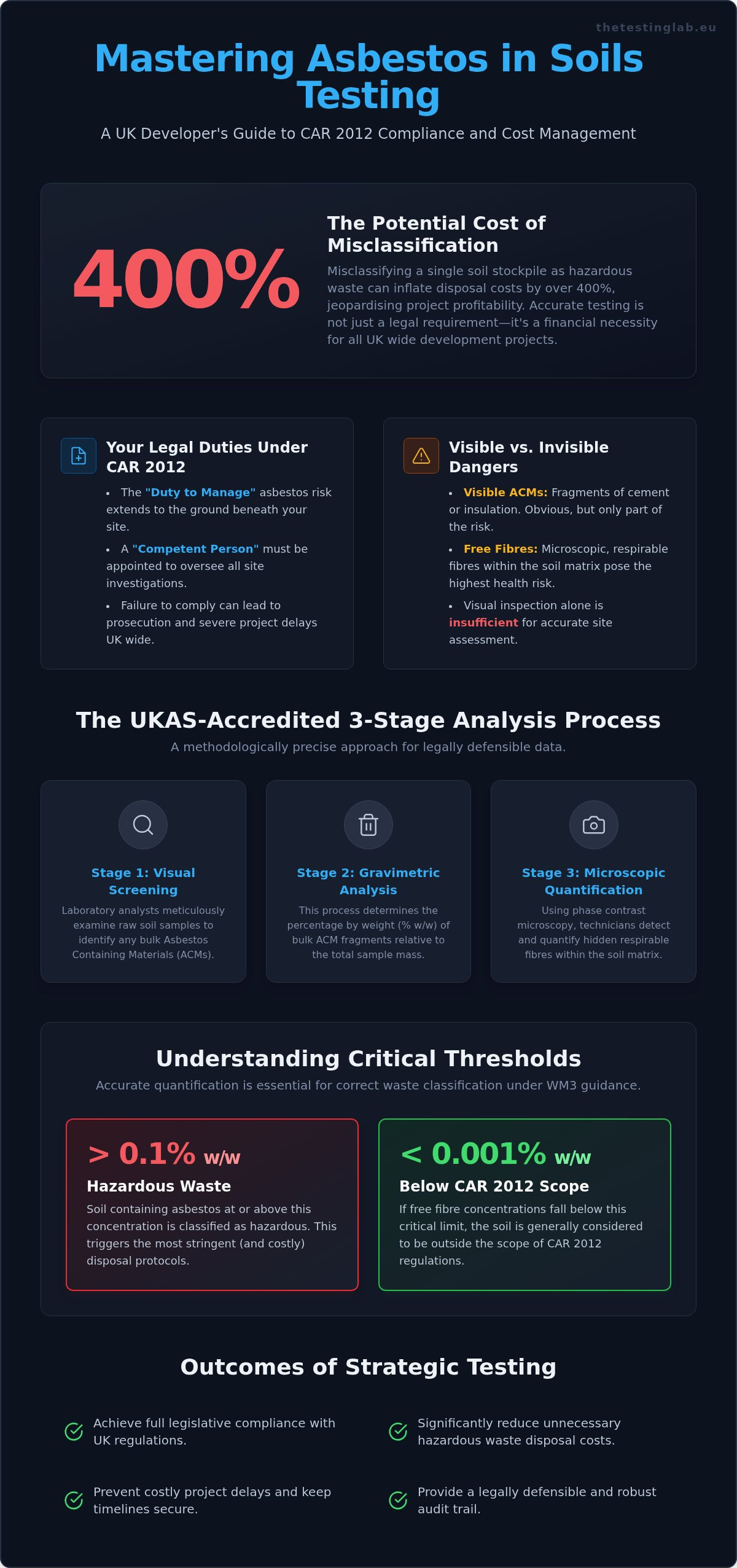
The process begins with meticulous visual screening. Laboratory analysts examine the raw soil to identify bulk asbestos-containing materials (ACMs). Once identified, we perform a gravimetric analysis. This determines the percentage by weight of these bulk fragments relative to the total sample mass. The most critical phase involves the detailed quantification of free dispersed fibres. Using phase contrast microscopy, our technicians detect respirable fibres that would otherwise remain hidden within the soil matrix. This level of precision is essential for compliance with Waste Classification Guidance (WM3).
The Laboratory Analysis Process
Accuracy depends on sample preparation. We dry and homogenise soil samples to ensure a consistent mass balance before testing begins. In asbestos in soils testing UK standards, 0.001% w/w is the critical threshold. If concentrations fall below this limit, the soil is generally considered to be outside the scope of CAR 2012. If you’re unsure how these thresholds affect your specific site, our expert consultancy team at The Testing Lab PLC can provide a clear interpretation of your lab results.
Sampling Strategies for UK-Wide Projects
A false negative can be a multi-million pound mistake. Designing a representative sampling plan is vital for large-scale developments. We help clients move beyond random grab samples toward systematic grid-based strategies that provide a true statistical representation of the land. Maintaining a strict chain of custody from the site to our accredited laboratory ensures that every data point is traceable and legally defensible. This methodical approach eliminates the guesswork, allowing you to manage your project with complete technological confidence.
Waste Classification (WM3) and Managing Contaminated Land
The transition from laboratory data to practical site management is where many developers face their most significant commercial risks. Accurate asbestos in soils testing UK wide doesn’t just satisfy safety protocols; it serves as the definitive evidence base for waste classification. Under the Environment Agency’s technical guidance, WM3 testing is the process that dictates whether your excavated soil is a hazardous burden or a manageable resource.
Precision in quantification directly impacts your bottom line. Without high-resolution data, waste is often over-classified as hazardous by default to avoid regulatory friction. This leads to excessive disposal costs and inflated landfill taxes. By using definitive lab results, you can often justify a non-hazardous classification for soils containing less than 0.1% asbestos. Once classification is confirmed, WAC testing becomes necessary to identify which specific landfill category can accept the material, ensuring a smooth and predictable disposal route.
Hazardous Waste Thresholds
The legal distinction is clear: soil containing 0.1% or more asbestos w/w is legally classified as hazardous waste. However, even if concentrations are lower, the presence of visible asbestos debris can trigger a hazardous classification regardless of the percentage. Precision is equally vital for managing HMRC LOI fines testing. Accurate Loss on Ignition data ensures that your waste is correctly taxed, preventing unexpected financial penalties during the disposal phase.
Remediation and Material Management Plans (MMP)
Strategic land management often involves keeping material on-site through a Material Management Plan. Our test data supports these reuse strategies, allowing for the safe sequestration of lower-risk soils under permanent cover or within specific site zones. This approach requires independent verification to satisfy local authorities and the Environment Agency. As your strategic partner, we provide the final site clearance reports that offer the legal defensibility needed for project sign-off. We take the professional responsibility off your shoulders, allowing you to focus on delivery while we handle the technical precision.
Securing Your Project’s Commercial and Legal Future
Effective risk management on contaminated sites is built on technical precision and a thorough understanding of the 2026 regulatory landscape. By moving beyond simple visual checks and implementing UKAS-accredited quantification, you ensure your site remains safe and your legal audit trail is bulletproof. Precise classification under WM3 guidelines isn’t just a compliance step; it’s a strategic move that prevents the over-classification of waste and protects your project’s margins. Our methodology for asbestos in soils testing UK wide provides the technical certainty needed for complex brownfield developments.
As an independent UKAS accredited laboratory, we offer comprehensive WM3 and WAC testing services coupled with expert consultancy for national compliance. We take the professional responsibility off your shoulders, delivering the data you need to keep your project on track. For those managing assets in the capital, our specialist surveying services provide an additional layer of security. Ready to streamline your site investigations? Request a Quote for UK-Wide Asbestos in Soils Testing today. We’re here to help you turn complex environmental challenges into manageable, successful outcomes.
Frequently Asked Questions
How is asbestos in soil measured and tested in the UK?
Asbestos in soil is measured using a tiered laboratory approach that involves visual screening, gravimetric analysis, and phase contrast microscopy. Analysts first identify bulk fragments before quantifying free fibres to provide a total percentage of asbestos by weight. This rigorous asbestos in soils testing UK wide ensures that even microscopic respirable fibres are accounted for in your risk assessment.
What are the legal limits for asbestos in soil for UK construction sites?
The primary legal threshold for the application of the Control of Asbestos Regulations (CAR) 2012 is 0.001% w/w. If concentrations are at or above this limit, the work is regulated and requires specific control measures. For waste classification, the threshold increases to 0.1% w/w, at which point the soil is legally classified as hazardous waste. Visible asbestos debris can also trigger hazardous classification regardless of the concentration percentage.
Is asbestos-contaminated soil always classified as hazardous waste?
No, asbestos-contaminated soil isn’t automatically hazardous waste; its classification depends on the concentration of asbestos and the presence of visible debris. Soil is classified as hazardous if the concentration of fibres or fragments exceeds 0.1% w/w or if visible asbestos containing materials are found. Accurate quantification is essential to avoid the high costs of over-classifying non-hazardous material as hazardous waste.
What is the difference between Bulk ID and Asbestos Quantification?
Bulk ID is a qualitative test that identifies the specific mineral type of asbestos present, such as chrysotile or amosite, while Asbestos Quantification is a quantitative test that calculates the mass of asbestos as a percentage of the total soil sample. Bulk ID tells you what it is, whereas quantification tells you how much is there. Both are necessary for a complete asbestos in soils testing UK profile to meet WM3 requirements.
How long does UKAS accredited asbestos in soil testing take?
Standard turnaround times for UKAS accredited soil analysis typically range from three to five working days from the moment the samples reach the laboratory. Many facilities offer express services for urgent site investigations where project delays carry high financial penalties. We manage these timelines with precision to ensure your project schedules remain unaffected by analytical bottlenecks.
Can I reuse soil that contains trace amounts of asbestos?
You can often reuse soil containing trace amounts of asbestos provided the activity is managed under a formal Material Management Plan (MMP) and meets the requirements of the CL:AIRE Code of Practice. The reuse must not pose a risk to human health or the environment. It must also be verified by independent testing to ensure concentrations remain below the agreed site specific remediation targets.

Article by
P J F Thomas
CEO and Founder of TTL plc.
Disclaimer
Items declared are AI generated but do reflect our services. Please get in contact if you have any questions.