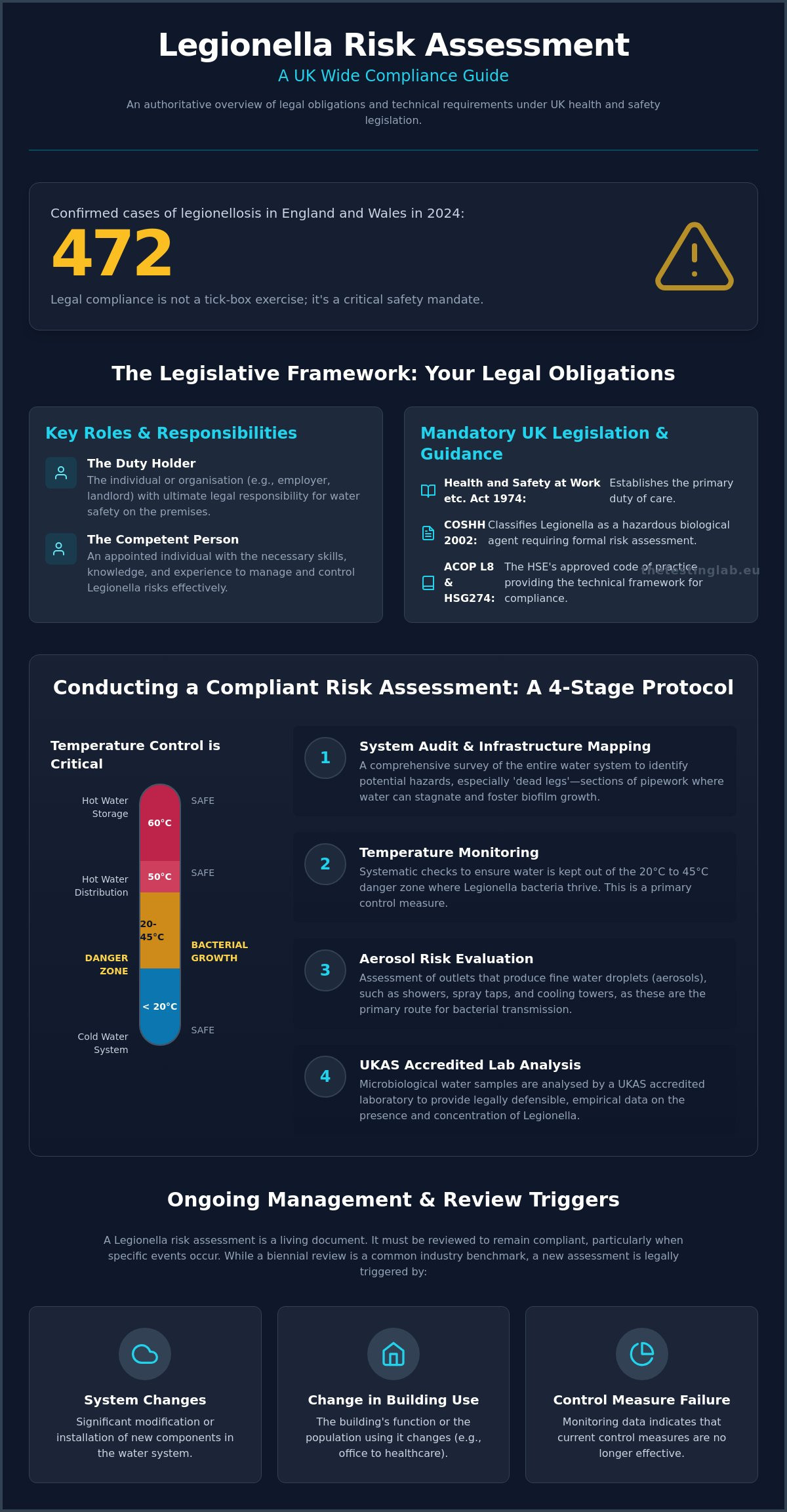
Did you know that 472 confirmed cases of legionellosis were reported in England and Wales in 2024 alone? If you’re treating water safety as a simple tick-box exercise, you’re likely overlooking the specific legionella risk assessment requirements mandated by the Health and Safety at Work etc. Act 1974. It’s a common misconception that a quick water sample is enough to satisfy the law. In reality, legal compliance requires a systematic, lab-backed approach to identify and control potential colonisation within your infrastructure.
We understand that the technicalities of ACOP L8 and the updated March 2024 HSG274 guidance can feel overwhelming. You want to protect your tenants and employees without the constant fear of HSE intervention or prosecution. This guide provides an authoritative roadmap to achieving full compliance UK wide. We’ll clarify exactly how often you need to review your assessments, the role of a competent person, and how to move from operational anxiety to precision-led risk mitigation. By the end of this article, you’ll have a clear framework for managing complex water systems with total confidence.
Key Takeaways
- Identify your legal obligations under the Health and Safety at Work Act 1974 and the critical responsibilities assigned to the ‘Duty Holder’.
- Master the technical methodology for identifying system vulnerabilities, from locating ‘dead legs’ to monitoring the 20°C–45°C bacterial growth danger zone.
- Clarify the mandatory legionella risk assessment requirements regarding review frequencies and when a new assessment is legally triggered by system changes.
- Learn how to streamline compliance by integrating water management with asbestos consultancy during building renovations or structural upgrades.
The Legislative Framework: Mandatory Legionella Risk Assessment Requirements UK Wide
Compliance isn’t a suggestion; it’s a statutory obligation. Under the Health and Safety at Work etc. Act 1974, employers and those in control of premises have a duty to ensure the health and safety of anyone on their site. This responsibility is further clarified by the Control of Substances Hazardous to Health Regulations 2002 (COSHH), which classifies Legionella as a biological hazard. To meet legionella risk assessment requirements, you must identify potential sources of risk and implement a systemic management plan.
The “Duty Holder” is the individual or organisation with the ultimate legal responsibility for water safety. This role usually falls to the employer or the person in control of the premises, such as a landlord or building manager. It’s their job to appoint a “competent person” with the technical knowledge to oversee risk mitigation. These requirements apply to any building with a water system used by people, ranging from small dental practices to sprawling industrial complexes. If your building has a water tap, a shower, or a cooling tower, the law applies to you.
ACOP L8 and the Control of Substances Hazardous to Health
The HSE’s Approved Code of Practice (ACOP L8) provides the technical framework for compliance. It has a special legal status; if you are prosecuted for a health and safety breach and haven’t followed ACOP L8, you must prove you complied with the law in another way. COSHH 2002 requires a formal assessment of the risks posed by Legionnaires’ disease. For higher-risk systems, this includes maintaining a “written scheme of control” that details exactly how the system is monitored and cleaned.
The Legal Consequences of Non-Compliance
Technical Methodology: Conducting a Compliant Legionella Risk Assessment
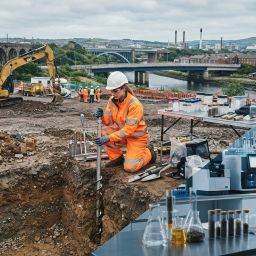
Meeting legionella risk assessment requirements involves a rigorous, multi-stage protocol that goes far beyond a simple walkthrough. It begins with a comprehensive audit of the entire water infrastructure to map every outlet and identify potential ‘dead legs’. For sites with complex layouts, T.M. Drainage can provide CCTV surveys to help accurately map pipework and identify hidden stagnation points. These dead legs are sections where water stagnates, creating the perfect environment for biofilm development and bacterial colonisation. Once the system is mapped, temperature monitoring becomes the next priority. Bacteria thrive in the danger zone between 20°C and 45°C; we ensure hot water is stored at 60°C and distributed at 50°C (or 55°C in healthcare settings), while cold water must remain below 20°C.
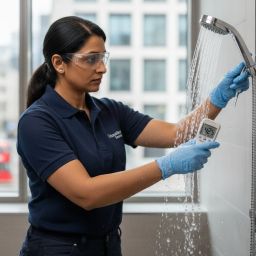
The assessment also evaluates aerosol risks. Devices like showers, spray taps, and cooling towers create fine mists that can be easily inhaled. This is the primary transmission route for the bacteria. To verify that your physical control measures are actually effective, microbiological water testing provides the empirical data needed for a precise risk profile. For peace of much-needed clarity, you can request a technical consultation to audit your specific system’s vulnerabilities.
The Role of UKAS Accredited Laboratory Analysis
Sampling is only as reliable as the laboratory that processes it. To meet stringent legionella risk assessment requirements, samples should be analysed by a UKAS accredited facility. This ensures the use of standardised culture methods to isolate Legionella pneumophila. Scientific precision here is vital. Without this level of lab-backed data, your results may not be legally defensible during an HSE audit or in the event of an outbreak.
Assessing Complex and Industrial Water Systems
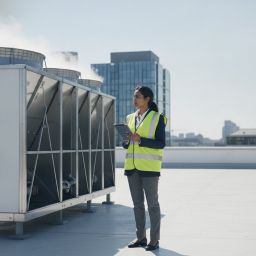
Large-scale commercial sites and industrial plants present unique challenges that domestic checklists simply can’t address. Cooling towers and evaporative condensers require a higher level of scrutiny due to their high aerosol output. A professional report for these systems must include detailed asset registers and schematic diagrams. This documentation is essential for the written scheme of control mandated by the HSE Approved Code of Practice (ACOP) L8. It provides the transparency needed for long-term operational safety UK wide.
Ongoing Management and Integrated Building Compliance
Legionella risk assessment requirements specify that your documentation isn’t a static asset. You must review the assessment if the water system is modified, the building’s use changes, or if monitoring data suggests control measures are failing. While many property managers use a biennial review as an industry benchmark, high-risk environments or those with complex cooling systems require more frequent scrutiny. Under the Control of Substances Hazardous to Health (COSHH) Regulations, you’re legally required to maintain monitoring and maintenance logs for at least five years. This audit trail is your primary defence during regulatory inspections and ensures long-term operational safety.
Holistic Risk Management: Water, Asbestos, and Fire
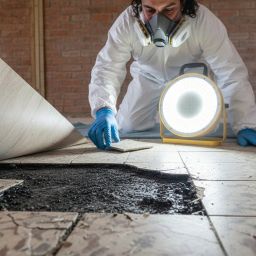
Building safety shouldn’t exist in a vacuum. During renovations, structural changes can inadvertently create dead legs in pipework while simultaneously disturbing hazardous materials. We integrate our asbestos consultancy with water management to ensure that a single project doesn’t solve one risk while creating another. For instance, replacing old lagging on pipes requires an asbestos survey before any water system modifications begin. Using a single accredited partner for these environmental surveys streamlines the compliance process and reduces the risk of conflicting safety protocols.
Selecting a Competent Risk Assessor
The HSE is clear: the Duty Holder must appoint a “competent person” with the necessary skills and knowledge. When vetting a potential partner, use this checklist to ensure they meet professional standards:
- Do they hold professional indemnity insurance specifically for Legionella?
- Are they directly linked to a UKAS accredited laboratory for water analysis?
- Can they provide independent, third-party assessments that avoid the conflicts of interest found in ‘self-checks’?
The Testing Lab PLC acts as a strategic partner UK wide, taking the weight of professional liability off your shoulders. We move beyond simple checklists, providing precise, lab-backed data that ensures your site remains fully compliant with all legionella risk assessment requirements.
Securing Your Infrastructure with Precision-Led Compliance
Managing water safety is a continuous process of technical vigilance. Meeting legionella risk assessment requirements demands more than a cursory glance; it requires a deep understanding of thermal dynamics and aerosol transmission. By identifying system vulnerabilities and maintaining a robust written scheme of control, you protect both your occupants and your professional reputation. Compliance isn’t just about avoiding legal action. It’s about establishing a culture of operational excellence and systemic safety.
If you are also considering structural improvements as part of your facility management, Trade Tech Windows & Doors offers specialist glazing products that meet the high standards required for modern commercial and residential projects.
Since 2002, we’ve acted as independent environmental risk experts, providing authoritative compliance reports UK wide. Our UKAS accredited laboratory testing ensures that every data point we provide is scientifically sound and legally defensible. We take the technical burden off your shoulders, allowing you to focus on your core operations with total peace of mind. Request a Professional Legionella Risk Assessment Quote today to ensure your facility meets the highest standards of safety and regulatory precision. We’re here to help you navigate these complexities with confidence.
Frequently Asked Questions
Is a Legionella risk assessment a legal requirement for all UK landlords?
Yes, conducting a risk assessment is a mandatory legal requirement for all UK landlords, including those in the residential and commercial sectors. Under the Health and Safety at Work etc. Act 1974, you have a duty of care to ensure that tenants are not exposed to health risks. This obligation is further defined by the COSHH regulations, which require you to identify and assess the risk of Legionella in your water systems.
How often does a Legionella risk assessment need to be reviewed UK wide?
There is no longer a fixed two year requirement, but the assessment must be reviewed “regularly” or whenever it’s suspected to be no longer valid. You must trigger a review if there are significant changes to the water system, such as new pipework or changes in building use. If your monitoring data suggests that control measures are failing, an immediate reassessment is necessary to maintain compliance with legionella risk assessment requirements.
What is the difference between Legionella testing and a risk assessment?
A risk assessment is a holistic audit of your management processes and physical infrastructure to identify potential hazards. Legionella testing is the scientific process of taking water samples for analysis in a UKAS accredited laboratory to detect the actual presence of the bacteria. While testing provides empirical data on water quality, the assessment provides the strategic framework for managing the system and preventing colonisation in the first place.
Can I carry out a Legionella risk assessment myself or do I need a professional?
You can perform the assessment yourself if you are a “competent person” with the necessary technical knowledge and experience to identify risks. However, most duty holders lack the engineering expertise to spot complex issues like stagnant dead legs or aerosol risks in cooling towers. Appointing a professional ensures your report is legally defensible and meets the rigorous standards expected by the HSE during an inspection.
What are the ‘danger temperatures’ for Legionella growth in water systems?
The primary danger zone for bacterial proliferation is between 20°C and 45°C. Within this range, Legionella bacteria can multiply rapidly, especially if nutrients like scale or rust are present. To mitigate this risk, you must ensure cold water remains below 20°C and hot water is stored at 60°C. Maintaining these temperature boundaries is a cornerstone of any effective written scheme of control.
How long does a professional Legionella risk assessment take to complete?
The time required depends on the complexity and scale of your water infrastructure. A small domestic property or a simple office unit typically takes between one and two hours for a thorough on-site survey. Large industrial facilities, hospitals, or hotels with cooling towers and hundreds of outlets may require several days to ensure every asset is correctly identified, mapped, and assessed for risk.

Article by
P J F Thomas
CEO and Founder of TTL plc.
Disclaimer
Items declared are AI generated but do reflect our services. Please get in contact if you have any questions.