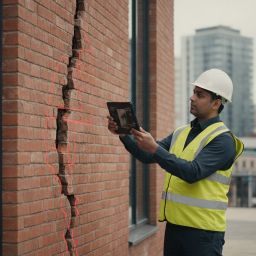
With the UK facing an estimated £16 billion bill for building remediation, the era of passive asset management has officially ended. As of 2026, the Building Safety Regulator operates as a fully independent statutory body, and any failure to declare construction product risks is now a criminal offense. You’re likely grappling with the weight of these new legal responsibilities while trying to identify hidden risks within aging infrastructure. It’s a high-stakes environment where the safety of your occupants and the longevity of your UK-wide assets depend on absolute technical certainty.
This guide provides the clarity you need to master a comprehensive structural integrity assessment. We’ll show you how to align your maintenance cycles with the Building Safety Act 2022 and the new 2026 construction product frameworks. By focusing on UKAS accredited testing and rigorous material analysis, you’ll gain the precise documentation required for insurance and legal defensibility. We’ll walk through the essential steps to identify structural fatigue early, helping you extend the safe operational life of your assets while maintaining total regulatory compliance through a strategic, engineering-led approach.
Key Takeaways
- Align your UK-wide asset management with the Building Safety Act 2022 to meet the mandatory compliance standards for Higher-Risk Buildings.
- Master the transition from visual checks to advanced Non-Destructive Testing (NDT) for a more precise and legally defensible structural integrity assessment.
- Identify hidden risks in aging infrastructure through material-specific evaluations, including concrete strength and water absorption testing.
- Build a resilient Structural Integrity Management System (SIMS) that consolidates environmental monitoring and fire safety data into a single, actionable strategy.
- Secure your operational future by ensuring all laboratory analysis and surveys are conducted by UKAS accredited specialists to guarantee data accuracy.
The Fundamentals of Structural Integrity Assessment & UK Legislation
Structural integrity is the capacity of an asset to operate safely under its intended design loads without suffering catastrophic failure. Within the UK’s regulatory framework, it’s the verified assurance that a structure remains compliant with safety-critical performance standards throughout its entire operational life. Understanding Structural Integrity and Failure is vital for engineers and asset managers. We focus on identifying the primary causes of degradation, such as fatigue, corrosion, and environmental stress. Conducting a routine structural integrity assessment identifies these hidden vulnerabilities before they escalate into costly or dangerous liabilities for your UK-wide assets.
Compliance with the Building Safety Act 2022
The Building Safety Act 2022 has fundamentally shifted the legal landscape for high-rise residential buildings. It mandates the creation of a “Golden Thread” of information, which is a digital record of safety-critical data. If you’re designated as the “Accountable Person,” you hold the legal responsibility for managing structural risks. Since the Building Safety Regulator became an independent body in January 2026, the scrutiny on these records has increased. You must demonstrate that your structural integrity assessment protocols are robust and up to date to meet current legislative standards.
The Role of UKAS Accreditation in Risk Mitigation
Technical precision is the foundation of legal defensibility. UKAS accreditation is the industry benchmark, ensuring that structural and material testing meets the highest standards of accuracy. Relying on UKAS accredited asbestos testing and accredited soil analysis protects your organization from the risks associated with faulty data. When you partner with an accredited consultancy, you ensure that your compliance and safety documentation is grounded in scientific rigor. This approach removes the burden of professional responsibility from your shoulders while securing the long-term health of your infrastructure.
Core Methodologies for Comprehensive Structural Evaluation
Modern engineering demands more than a cursory glance at a building’s facade. Relying solely on visual inspections often leaves critical defects undiscovered until they become catastrophic liabilities. A robust structural integrity assessment now integrates advanced technology to look beneath the surface of the material. Following UK Government Guidance on Structural Assessments ensures your methodology stands up to the heightened regulatory scrutiny seen in 2026.
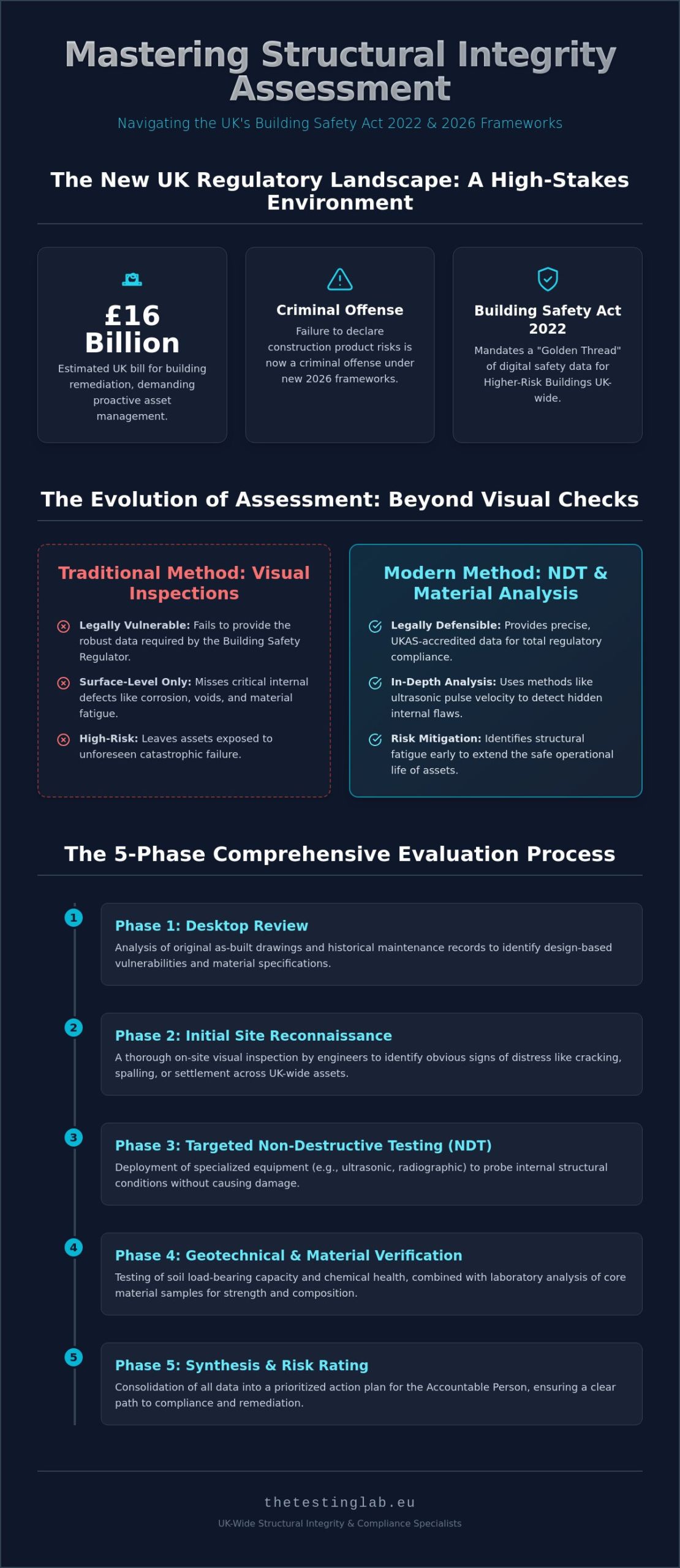
To maintain safety standards across UK-wide portfolios, we implement a standardized five-step evaluation process:
- Phase 1: Desktop Review – Analysis of original as-built drawings and historical maintenance records to identify design-based vulnerabilities.
- Phase 2: Initial Site Reconnaissance – Identifying visible signs of distress like spalling, cracking, or settlement.
- Phase 3: Targeted NDT – Deploying specialized equipment to probe internal conditions without causing damage.
- Phase 4: Geotechnical Verification – Testing the load-bearing capacity and chemical health of the soil supporting the foundations.
- Phase 5: Synthesis & Risk Rating – Consolidating all data into a prioritized action plan for the Accountable Person.
Non-Destructive Testing (NDT) and Material Analysis
NDT allows us to evaluate the internal health of a structure without compromising its stability. Ultrasonic pulse velocity and radiographic methods are essential for detecting voids, cracks, or reinforcement corrosion deep within concrete or steel. This data is critical for material testing, as it verifies that the installed components actually meet the original design specifications. If you’re unsure about the current strength of your materials, our team can provide a detailed technical consultation to determine the best testing suite for your asset.
Geotechnical Site Investigations & Soil Stability
The health of a foundation is inextricably linked to the ground it sits on. Soil stability isn’t just about load-bearing capacity; it’s also about chemical compatibility. For instance, high sulfate levels in soil can lead to aggressive chemical attacks on concrete foundations, leading to premature failure. Additionally, the presence of asbestos in soils can significantly complicate any necessary structural remediation or excavation work. Integrating geotechnical analysis into your assessment ensures that the Golden Thread of safety data covers the asset from the ground up.
Implementing a Structural Integrity Management Strategy
Developing a robust Structural Integrity Management System (SIMS) allows asset managers to transition from reactive repairs to a lifecycle-based safety model. This system centralizes data from every structural integrity assessment, enabling predictive modeling of an asset’s performance under stress. Implementing a rigorous schedule of monitoring and data analysis effectively prevents catastrophic failure while providing the documented evidence required to reduce annual insurance premiums. To understand how specialized maintenance for the roof and chimney contributes to this long-term resilience, you can find out more about the services provided by Atlas Roofing Solutions Ltd. For organizations managing multi-site commercial portfolios, maintaining a consistent standard UK wide is the only way to ensure total compliance across diverse jurisdictions and building ages.
Integrating Environmental and Structural Risks
Structural health isn’t assessed in a vacuum. Often, the presence of hazardous materials restricts the ability to conduct invasive inspections. Engaging a professional asbestos consultancy is a critical first step. It ensures that structural engineers can safely access voids and core samples without risk of exposure. Similarly, there’s a direct synergy between water management and structural health. Persistent leaks that trigger Legionella risks also degrade the chemical integrity of concrete and steel over time. A unified strategy treats these environmental factors as integral components of the building’s structural safety plan.
Selecting an Accredited UK-Wide Assessment Partner
Choosing a partner who understands the 2026 regulatory landscape is vital for legal defensibility. When vetting firms, prioritize those with comprehensive UKAS credentials and a proven track record in both material testing and environmental surveys. Use this checklist for your selection process:
- Current UKAS accreditation for all relevant testing methods.
- Capacity for UK wide service delivery to ensure portfolio consistency.
- Integration of environmental, fire, and structural data into a single report.
- Foundational expertise in both soil investigation and building fabric analysis.
- Clear, transparent documentation that meets the “Golden Thread” requirements.
A strategic partnership relieves you of the technical burden while ensuring your assets remain safe and compliant. If you’re ready to secure your infrastructure, you can request a quote for a comprehensive UK-wide surveying program today. Our team provides the precision and engineering-led insight required to manage your most critical structural risks.
Securing Your Assets for the 2026 Regulatory Landscape
The transition to a more stringent, unified regulatory environment requires a shift in how we perceive asset health. You’ve seen how integrating advanced Non-Destructive Testing with comprehensive soil and asbestos analysis creates a robust “Golden Thread” of safety. This technical rigor isn’t just about avoiding criminal penalties under the new 2026 frameworks; it’s about making informed, engineering-led decisions that extend the operational life of your infrastructure. By prioritizing UKAS accredited data and professional surveying, you ensure every decision is legally defensible and scientifically sound.
As an independent professional consultancy founded in 2002, we take the burden of professional responsibility off your shoulders. Our UKAS accredited laboratory analysis provides the precision needed for definitive safety evaluations across your portfolio UK wide. Our approach remains grounded in UK Health & Safety legislation, ensuring your documentation is ready for any audit or insurance review. Whether you’re managing high-rise residential blocks or a commercial portfolio, we’re here to act as your strategic partner. Contact our UK-wide specialists for a structural integrity assessment to ensure your assets remain safe, compliant, and resilient for years to come.
Frequently Asked Questions
What is a structural integrity assessment?
A structural integrity assessment is a multidisciplinary engineering evaluation designed to verify that an asset can safely support its intended loads without risk of failure. It’s a rigorous process involving material testing, non-destructive evaluation, and data synthesis to ensure total compliance with the Building Safety Act 2022. This process is essential for maintaining safety standards and operational longevity across UK-wide commercial and residential portfolios.
How often should a commercial building undergo a structural survey in the UK?
Frequency depends on the building’s age, use, and risk profile. Higher-Risk Buildings (HRBs) must maintain a Safety Case that often requires annual reviews or five-year deep-dives. For standard commercial assets UK wide, a comprehensive survey every five to ten years is the industry benchmark. You can find more detail on specific requirements through our compliance and surveying resources.
What is the difference between a visual inspection and a structural integrity assessment?
A visual inspection only identifies surface-level distress like cracking or spalling, whereas a structural integrity assessment uses scientific methods to probe internal conditions. This advanced assessment incorporates UKAS accredited material testing, such as water absorption and concrete strength analysis. It provides the technical certainty required for legal defensibility, identifying hidden internal flaws that a basic visual walkthrough would inevitably miss.
Can asbestos affect the structural integrity of a building?
Yes, asbestos impacts structural health both directly and indirectly. Asbestos-containing materials were frequently used as structural fireproofing for steel frames; their degradation compromises the building’s fire resistance during an incident. Additionally, discovering asbestos in soils during a geotechnical investigation can significantly complicate foundation repairs. Managing these environmental risks through specialized consultancy is vital to ensuring the long-term safety and compliance of any structure.

Article by
P J F Thomas
CEO and Founder of TTL plc.
Disclaimer
Items declared are AI generated but do reflect our services. Please get in contact if you have any questions.