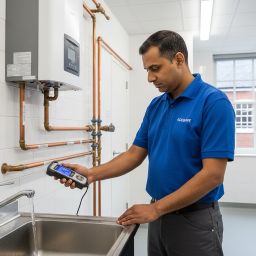
As of June 2026, a single overlooked water outlet could trigger an immediate £7,000 fine under the updated Housing Health and Safety Rating System. While many property owners believe a simple visual check suffices, the landlord legionella testing legal requirement across the UK wide rental sector demands a far more rigorous, evidence-based approach. It’s understandable if you’re feeling overwhelmed by the technicalities of the Health and Safety at Work etc. Act 1974 or the complexities of COSHH 2002. Identifying a truly competent person to manage these risks is often the difference between a safe property and a major legal liability.
You likely recognize that tenant safety is paramount, but the fear of prosecution for non-compliance can make managing a portfolio feel like a legal minefield. We’ll help you navigate these obligations by explaining the critical difference between a standard risk assessment and accredited laboratory testing. This guide provides a clear roadmap for securing the documentation needed to protect your business and your residents. You’ll gain a thorough understanding of how the May 2026 Renters’ Rights Act has shifted the landscape, ensuring your water management systems meet the highest professional standards of precision and safety.
Key Takeaways
- Understand how the Health and Safety at Work etc Act 1974 and COSHH 2002 establish a mandatory duty of care for all UK wide landlords.
- Navigate the landlord legionella testing legal requirement to determine whether your property needs a standard risk assessment or advanced laboratory sampling.
- Learn to distinguish between visual inspections and UKAS-accredited testing to ensure your compliance strategy is both scientifically sound and legally defensible.
- Discover the essential components of a professional water management plan, including the statutory requirement to maintain records for five years.
- Identify the specific technical competencies required to manage water safety risks effectively and protect your tenants from biological hazards.
Understanding the Landlord Legionella Testing Legal Requirement in the UK
Compliance isn’t a suggestion; it’s a statutory obligation that demands a methodical approach. The primary framework for the landlord legionella testing legal requirement sits within the Health and Safety at Work etc Act 1974 (HSWA) and the Control of Substances Hazardous to Health (COSHH) Regulations 2002. These laws dictate that anyone who provides residential accommodation has a legal duty of care to ensure the safety of their tenants. This responsibility isn’t limited to large-scale commercial entities; it applies to every individual landlord operating UK wide.
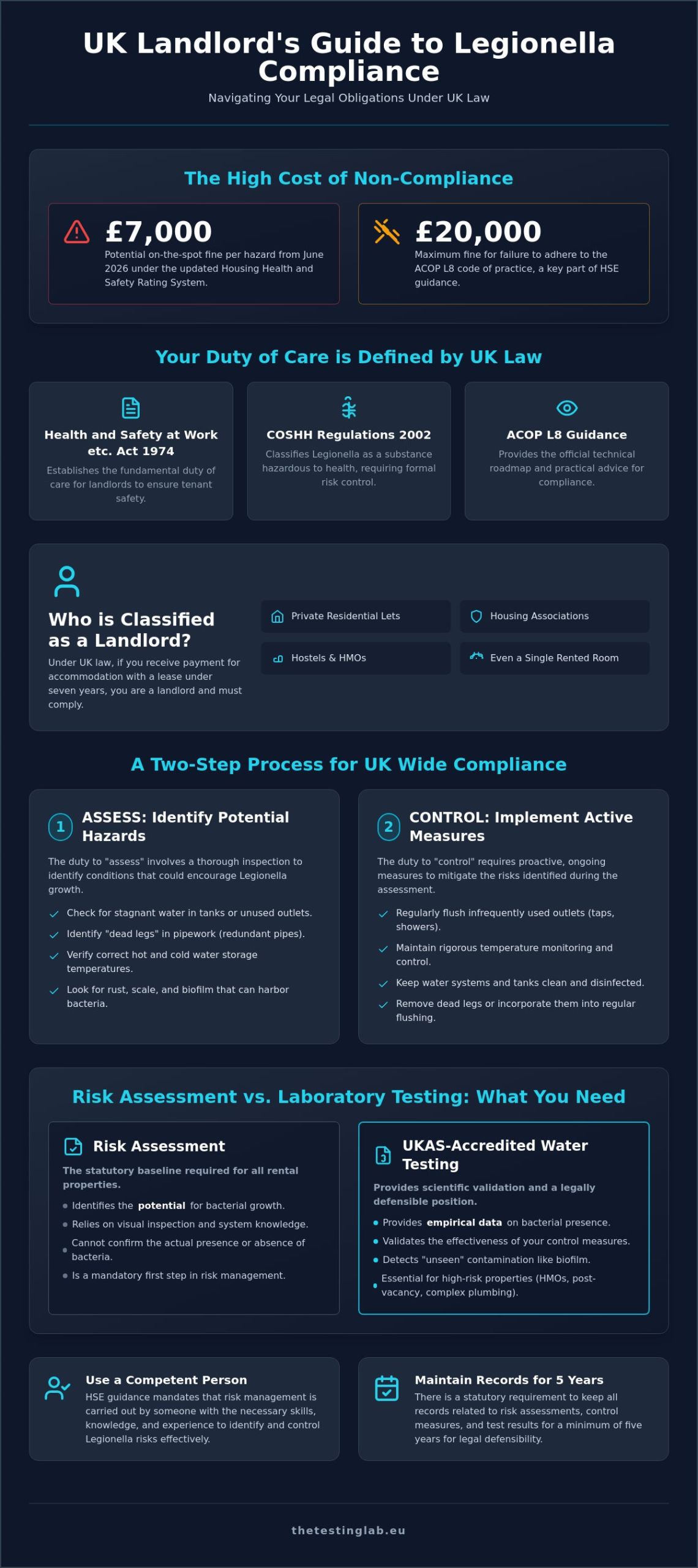
Before diving into the technical specifics, understanding What is Legionella? is vital for recognizing why the Health and Safety Executive (HSE) prioritizes this biological risk. The Approved Code of Practice L8 (ACOP L8) provides the technical roadmap for compliance, bridging the gap between high-level legislation and daily operations. Failing to follow this code doesn’t just invite risk; it exposes landlords to fines of up to £20,000. Furthermore, as of June 23, 2026, local councils can now issue on-the-spot fines of £7,000 for each Category One hazard identified, making precision in your water management systems more critical than ever.
Who is Classified as a Landlord Under UK Law?
Under Section 11 of the Landlord and Tenant Act 1985, any lease under seven years places the burden of water safety squarely on the landlord. This definition covers a broad spectrum of housing providers, including residential private lets, housing associations, and hostels. It’s a common misconception that small-scale arrangements are exempt. In reality, even renting out a single room within your own home triggers these legal requirements. If you receive payment for accommodation, you’re a landlord in the eyes of the law and must manage the associated risks.
The Core Duty: Assessing and Controlling Risk
The law distinguishes between the duty to “assess” and the duty to “control.” Assessing involves identifying potential hazards like stagnant water, dead legs in pipework, or incorrect storage temperatures. Controlling requires active, ongoing measures, such as regular flushing of outlets or rigorous temperature monitoring. According to HSE guidelines, a competent person is someone with the necessary skills, knowledge, and experience to manage the specific risks associated with the property’s water system.
For property owners operating UK wide, maintaining a consistent, documented methodology is essential for a legally defensible position. Relying on guesswork isn’t an option when faced with potential prosecution. For specialized support in high-density areas, utilizing professional surveying and risk management ensures that your technical obligations are met with engineering-grade precision, removing the weight of professional liability from your shoulders.
Legionella Risk Assessment vs. Water Sampling: What Do You Actually Need?
Many property owners mistakenly assume that a visual check satisfies the landlord legionella testing legal requirement. While a risk assessment is the statutory baseline, it doesn’t confirm the absence of bacteria; it only identifies the potential for growth. Microbiological testing provides the empirical data needed to validate your control measures. As highlighted in the official HSE guidance for landlords, the goal is effective risk management, and for many UK wide properties, scientific validation is the only way to achieve absolute certainty. Relying solely on a walkthrough can leave you vulnerable to “unseen” contamination, such as biofilm or internal scale, which harbor bacteria even in systems that appear clean.
When is Professional Laboratory Testing Recommended?
Visual inspections can’t see through pipe walls or into the depths of cold water storage tanks. Professional sampling becomes essential when dealing with high-risk factors like long pipe runs or redundant “dead legs” where water stagnates. Houses in Multiple Occupation (HMOs) and larger residential blocks present higher complexity, increasing the likelihood of bacterial growth. It’s also vital to conduct Legionella risk assessments and water management after any period of vacancy, as stagnant water is the primary breeding ground for pathogens.
The Benefits of UKAS Accredited Laboratory Analysis
Precision is the hallmark of a legally defensible compliance strategy. Utilizing a UKAS accredited laboratory ensures that your water samples are analyzed according to rigorous international standards. A Certificate of Analysis acts as definitive proof of your due diligence, providing a level of security that a simple checklist cannot match. This scientific methodology allows for the specific identification of Legionella pneumophila, distinguishing it from other water-borne pathogens to ensure targeted remediation if required. If you’re uncertain about the current state of your system, requesting a professional compliance review can help you identify exactly where testing is necessary.
Implementing a Water Management Plan: Professional Compliance Strategies
Establishing a water management plan is the final step in fulfilling the landlord legionella testing legal requirement. A static risk assessment is only a snapshot in time; true safety requires a dynamic, system-wide approach to risk reduction. This involves moving beyond identifying hazards to implementing a rigorous schedule of monitoring and maintenance. Following the HSE guidance on Legionella ensures that your management plan isn’t just a document, but a functional tool for protecting your tenants. Precision in these workflows is what builds a legally defensible position for property owners operating UK wide.
Documentation is the backbone of compliance. You must keep all records of assessments, monitoring results, and maintenance for at least five years. This includes temperature logs, flushing records, and any remedial actions taken. Clear communication with tenants is equally vital. They should be instructed on basic safety measures, such as regularly cleaning showerheads and reporting any issues with water temperatures. By engaging tenants as active participants in water safety, you create a comprehensive safety net for the property.
Practical Steps for Risk Minimisation
Effective management focuses on disrupting the conditions that allow bacteria to thrive. Key operational protocols include:
- Temperature Control: Ensure hot water is stored at 60°C or higher and distributed so it reaches outlets at 50°C within one minute. Cold water must remain below 20°C.
- Stagnation Management: Implement flushing protocols for any vacant periods between tenancies. Outlets should be run for several minutes at least weekly to prevent water from sitting in pipework.
- Asset Maintenance: Schedule quarterly descaling of showerheads and annual visual inspections of cold water storage tanks to check for debris or signs of corrosion.
Securing Your Compliance with The Testing Lab PLC
Managing complex portfolios across the UK wide rental market requires a strategic partner. We offer specialized legionella risk assessment services that go beyond surface-level checks, providing the engineering-grade data needed for total compliance. By utilizing independent, accredited experts, you remove the burden of professional responsibility from your own shoulders and ensure your documentation meets the highest standards. You can request a quote for legionella specialists today to ensure your water management systems are robust, transparent, and fully compliant with 2026 regulations.
Securing Future-Proof Compliance for Your Property Portfolio
Managing a UK wide rental portfolio requires more than just reactive maintenance; it demands a proactive, engineering-led approach to water safety. Precision is non-negotiable. You’ve seen how the Health and Safety at Work etc Act 1974 and the updated 2026 hazard fines make rigorous monitoring essential. By distinguishing between a basic visual check and high-accuracy microbiological sampling, you protect your tenants from biological risks while insulating yourself from legal liability. Adhering to the landlord legionella testing legal requirement isn’t just a hurdle to clear; it’s a commitment to operational excellence.
For landlords looking to extend this level of care to their entire estate, you might discover Aiker Wills and Trusts to explore how professional legal document preparation can secure your property assets for the future.
The Testing Lab PLC provides the technical expertise needed to bridge the gap between complex legislation and practical property management. Our independent professional assessments are delivered UK-wide, ensuring full compliance with ACOP L8 and COSHH standards. When you utilize our UKAS Accredited Laboratory Analysis, you gain definitive, scientifically validated evidence of safety that a simple checklist cannot provide. Don’t leave your compliance to chance. Secure your property’s compliance with professional Legionella risk assessments and let us take the weight of professional responsibility off your shoulders. With the right systems in place, you can manage your assets with absolute confidence.
Frequently Asked Questions
Is a Legionella risk assessment a legal requirement for UK landlords?
Yes, conducting a risk assessment is a mandatory legal obligation for all landlords. This duty is established under the Health and Safety at Work etc. Act 1974 and the Control of Substances Hazardous to Health (COSHH) Regulations 2002. You’re required to identify and assess potential sources of exposure to Legionella bacteria to ensure your tenants remain safe within your property.
How often should a landlord carry out a Legionella risk assessment?
Legislation doesn’t specify a fixed expiration date, but best practice dictates a review every one to two years. You should also conduct a new assessment if there are significant changes to the water system, the building’s use, or if monitoring results indicate a problem. Regular reviews help maintain a robust safety record and ensure your control measures stay effective as the system ages.
Can a landlord carry out their own Legionella risk assessment?
You can perform the assessment yourself if you’re a competent person with the necessary technical knowledge and experience. However, many property owners find that meeting the landlord legionella testing legal requirement is more efficiently handled by specialists. Professional assessors provide a level of scientific accuracy and documented evidence that’s difficult to replicate without specialized training and equipment.
What happens if a tenant contracts Legionnaires’ disease in my property?
If a tenant contracts the disease due to your negligence, the legal consequences are severe. Landlords can face fines of up to £20,000 for failing to manage risks properly. In serious cases involving significant health impact or fatality, you could face unlimited fines and potential imprisonment. Local councils can also issue on-the-spot fines of £7,000 for each Category One hazard identified during inspections.
Do I need a formal Legionella certificate for every new tenancy?
There’s no law that requires a specific “Legionella test certificate” for every new tenancy. Your primary landlord legionella testing legal requirement is the ongoing assessment and control of risks. While a certificate isn’t mandatory, you must maintain clear records of your risk assessments and the control measures you’ve implemented. These documents serve as your primary defense if your compliance is ever challenged by authorities.
Is water sampling mandatory for domestic rental properties?
Water sampling isn’t mandatory for every domestic rental property; it’s a risk-based requirement. For most standard UK wide rentals with simple water systems, a thorough visual risk assessment and temperature monitoring are sufficient. Sampling is typically only necessary if the assessment identifies specific high-risk factors, such as complex pipework, stagnant water areas, or if the occupants are particularly vulnerable to infection.

Article by
P J F Thomas
CEO and Founder of TTL plc.
Disclaimer
Items declared are AI generated but do reflect our services. Please get in contact if you have any questions.