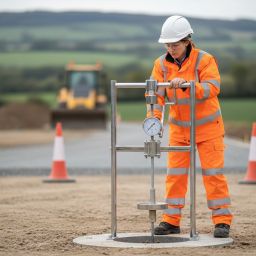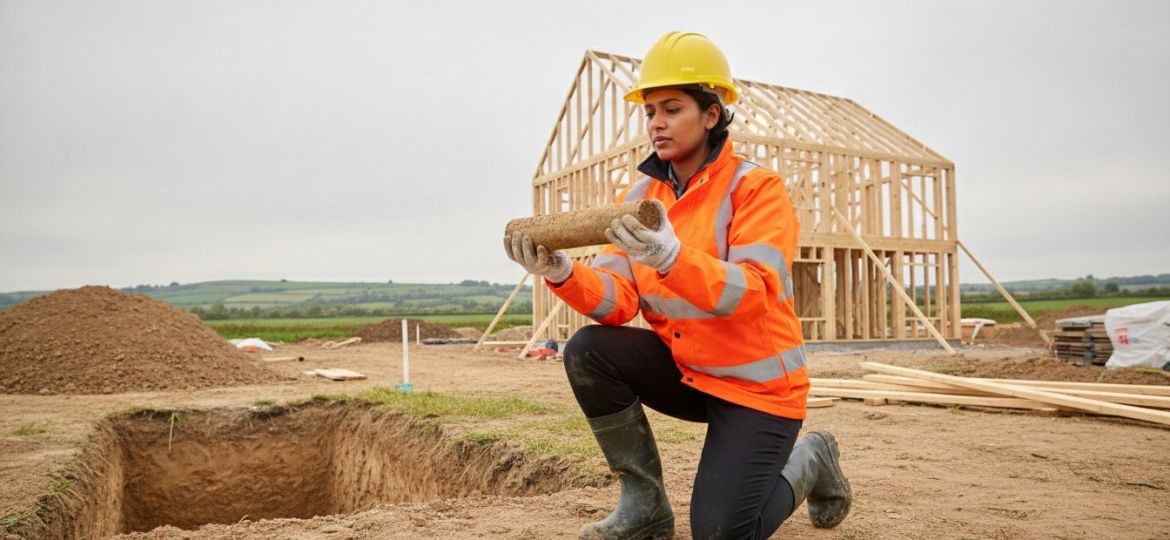
Did you know that 115,350 new homes were registered in 2025 alone, representing an 11% increase that puts immense pressure on available UK land? As a developer or self-builder, you’ve likely felt the anxiety of ground conditions; the fear that a hidden pocket of soft clay or forgotten contamination might lead to foundation failure. Investing in comprehensive soil testing for new build foundations isn’t just a technical hurdle. It’s the only way to protect your project from the catastrophic costs of subsidence and regulatory non-compliance.
We understand that meeting Building Regulations Part A and the evolving NHBC Standards 2026 feels like a moving target. This guide demonstrates how professional soil analysis ensures structural stability and full regulatory compliance UK wide. By leveraging precise geotechnical data, you can secure a definitive foundation design from your structural engineer and establish an accurate groundworks budget. We’ll examine the technicalities of BS 8004 and the impact of the Building Safety Act 2022, ensuring your site meets every standard from environmental safety to load-bearing capacity.
Key Takeaways
- Understand why professional soil testing for new build foundations is a mandatory requirement under Building Regulations Part A to ensure structural integrity UK wide.
- Identify the most appropriate investigation method for your site, comparing cost-effective trial pits with high-precision borehole analysis for deeper foundations.
- Learn how UKAS-accredited laboratory testing provides the necessary legal defensibility and technical accuracy for your structural engineer’s final design.
- Discover how Waste Acceptance Criteria (WAC) assessments prevent hidden costs by streamlining the disposal of excavated materials during groundworks.
- Gain the technical clarity needed to manage operational risks and ensure your project remains fully compliant with the latest NHBC standards.
The Necessity of Soil Testing for New Build Foundations
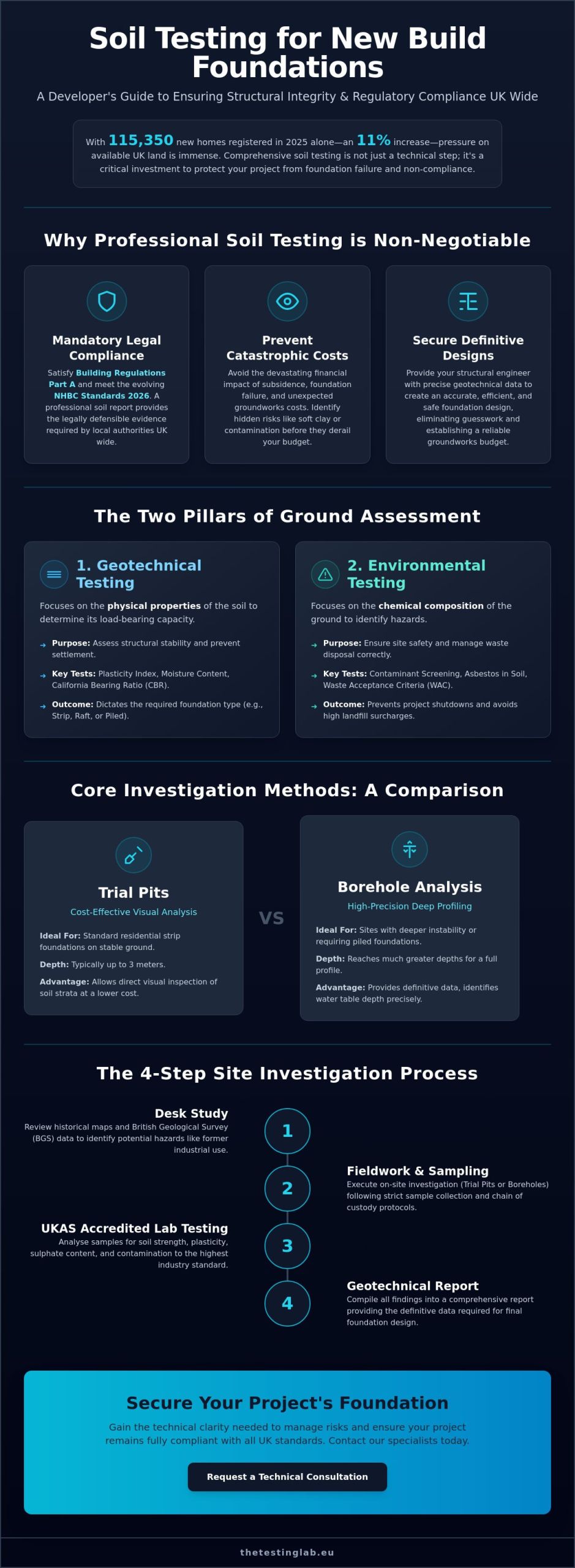
Soil testing for new build foundations is a rigorous, multi-disciplinary assessment. It evaluates both the physical load-bearing capacity and the chemical composition of the ground. By employing various Geotechnical investigation methods, engineers determine how the earth will behave under the weight of a structure. This data is critical UK wide to prevent foundation settlement or catastrophic failure. It bridges the gap between raw earth and a safe, habitable building.
Compliance with Building Regulations Part A
Building Regulations Part A establishes a legal requirement for “adequate” foundation design based on specific ground conditions. This isn’t a suggestion; it’s a mandatory compliance step. A professional soil report provides the evidence needed to satisfy local authority building control and secure NHBC or LABC warranties. The NHBC Standards 2026 specifically reinforce the need for thorough reporting on clay soils and potential contaminants to manage seasonal movement. For complex sites, especially those requiring specialist surveying, these reports are the only way to prove your design is legally defensible.
Geotechnical vs. Environmental Testing
Many developers mistakenly separate these two disciplines, which often doubles mobilisation costs. Geotechnical testing focuses on physical parameters like the plasticity index, moisture content, and the California Bearing Ratio (CBR). These values dictate whether your site requires standard strip foundations, a raft foundation, or deep piles. Conversely, environmental testing assesses contamination levels and Waste Acceptance Criteria (WAC) for disposal.
Hidden risks can derail a budget instantly. For instance, asbestos in soils testing is a vital safeguard that prevents total project shutdowns. Identifying hazardous materials early protects your workforce and ensures you don’t face unexpected landfill surcharges. By integrating these assessments into your initial soil testing for new build foundations, you ensure both structural integrity and environmental safety from day one.
Core Methods for Foundation Soil Analysis
Selecting the right technique for soil testing for new build foundations depends on the complexity of the site and the proposed structure. For standard residential strip foundations on stable ground, trial pits are often the most cost-effective solution. These excavations allow a geotechnical engineer to visually inspect the soil strata and collect samples at depths typically up to 3 meters. However, if the site suggests deeper instability or requires piled foundations, borehole testing becomes a necessity. Boreholes reach much greater depths, providing a vertical profile of the ground and identifying the exact depth of the water table.
While in-situ tests like the Standard Penetration Test (SPT) offer immediate feedback, laboratory analysis provides the definitive data required for structural calculations. This precision ensures your project aligns with UK building regulations for foundations. Whether your project is in a rural setting or requires specific London surveying and compliance standards, the methodology remains consistent UK wide. Data must be verifiable, repeatable, and legally defensible to satisfy both insurers and local authorities.
The Site Investigation Process
Every investigation begins with a comprehensive desk study. We review historical maps and British Geological Survey (BGS) data to identify potential hazards like former industrial use or natural voids. Following this, fieldwork execution must follow strict sample collection protocols. Maintaining a clear chain of custody ensures that the soil samples reaching the lab are representative of the site’s true conditions. If you’re unsure which method suits your specific plot, you can request a technical consultation to clarify your requirements.
Laboratory Testing Protocols
The value of soil testing for new build foundations lies in the accuracy of the lab results. UKAS accredited analysis is the gold standard, testing for soil strength, plasticity, and sulfate content. High sulfate levels can lead to concrete degradation, making this test non-negotiable for foundation longevity. Additionally, topsoil testing to BS 3882:2015 should be integrated into your plan. This ensures the site remains fertile and safe for final landscaping, confirming that the ground isn’t just structurally sound, but environmentally fit for purpose.
Accreditation and Legal Compliance for Groundworks
Rigorous soil testing for new build foundations provides more than just technical data; it offers a legal shield for developers and contractors. For professional construction companies like willmacgroup.com, these reports are vital for ensuring structural integrity in both residential and commercial projects. UKAS accreditation represents the gold standard in this field, ensuring that every laboratory result is accurate, repeatable, and legally defensible in UK courts or planning offices. Using a non-accredited facility introduces significant operational risk, as local authorities and warranty providers often reject data that doesn’t meet these specific quality benchmarks. By standardising these protocols UK wide, we help our partners maintain consistent quality across diverse portfolios, regardless of local geological variances.
Waste Acceptance Criteria (WAC) and Soil Disposal
Effective groundworks management requires a clear strategy for material disposal. Professional WAC testing is essential to determine whether excavated soil is classified as inert, non-hazardous, or hazardous. Misclassifying soil isn’t just a regulatory failure; it’s a financial disaster. Incorrectly identifying hazardous soil as inert can lead to massive fines and backdated landfill tax charges. Conversely, over-classifying soil results in unnecessary disposal fees that can erode project margins. Precise chemical analysis ensures you only pay for the exact level of disposal required.
Final Reporting and Structural Design
The transition from raw lab data to a viable structural design is the most critical phase of the pre-construction process. A structural engineer needs a comprehensive soil certificate that clearly defines safe bearing pressure and settlement limits. This reporting must align with current Health and Safety Executive (HSE) guidelines to ensure the safety of the workforce during the excavation phase.
If your foundation excavation takes place near a neighbouring property, it is also essential to manage your legal responsibilities; to navigate these requirements, check out Christopher Anthony Surveyors for specialist party wall advice.
Securing UKAS accredited soil testing for new build foundations is the only way to satisfy the stringent requirements of UK insurers and the Building Safety Act 2022. Our final reports provide the technical clarity needed for a definitive foundation specification, ensuring your project meets all statutory compliance standards. This methodology removes the professional responsibility from your shoulders, placing it firmly in the hands of qualified specialists who understand the nuances of UK legislation.
Securing Your Project’s Future with Technical Precision
Professional soil investigation is the bedrock of both structural safety and financial predictability. We’ve explored how integrating geotechnical analysis with environmental screening, such as asbestos in soils testing, eliminates hidden operational risks. This dual approach ensures your site meets Building Regulations Part A and the NHBC Standards 2026 without the need for multiple mobilisations. By identifying ground conditions early, you avoid the common pitfalls of foundation failure and unforeseen excavation costs.
Comprehensive soil testing for new build foundations is a strategic investment that protects your project from subsidence and regulatory delays. Our UKAS Accredited Laboratory provides the precision your structural engineer requires to finalise designs UK wide. We bridge the gap between complex geotechnical data and actionable site management strategies, leveraging our expertise in both geotechnical and environmental testing to streamline your delivery timeline. We’re here to take the technical burden off your shoulders, ensuring every compliance box is checked with scientific accuracy.
Ready to secure your site and finalise your groundworks budget? Request a UKAS accredited soil testing quote for your new build to partner with our expert team. Let’s build your project on a foundation of certainty and professional excellence.
Frequently Asked Questions
Is soil testing mandatory for all new build foundations in the UK?
Soil testing for new build foundations is mandatory under Building Regulations Approved Document A (Structure). Local authority building control and warranty providers like the NHBC require technical evidence that the foundation design is suitable for the specific ground conditions. Without a professional report, you cannot demonstrate compliance with UK wide safety standards or ensure the long term structural integrity of the building.
How much does a typical soil survey for a new build foundation cost?
The cost of a soil survey varies based on the site’s historical use, size; and the complexity of the required testing. Factors such as the depth of boreholes and the number of samples required for UKAS accredited analysis will influence the final price. We recommend requesting a site-specific quote to ensure your groundworks budget is accurate and reflects the actual geological risks present on your plot.
Can I use a soil test from a neighbouring property for my planning application?
You cannot use a soil test from a neighbouring property because geological conditions can vary significantly over just a few meters. Even if a nearby site is stable, your specific plot might contain localized soft spots, high sulfate levels, or historical contamination. Building Control and structural engineers require site-specific data to ensure the foundation design is legally defensible and structurally sound.
What happens if asbestos is found in the soil during foundation testing?
If asbestos is detected, work must stop immediately to prevent the release of airborne fibres. A specialist consultancy will conduct further sampling to determine the extent of the contamination and provide a remediation strategy. Proper management, including specialist surveying and compliance, ensures site safety and adherence to Health and Safety Executive guidelines for groundworks.
How long does it take to get laboratory results for soil analysis?
Laboratory results typically take between five and ten working days from the point of sample delivery. Complex chemical analysis or specialised geotechnical tests may require additional time to ensure precision. We prioritise transparency in our reporting timelines, providing the technical data your structural engineer needs for soil testing for new build foundations without causing unnecessary delays to your construction schedule.
What is the difference between a Phase 1 and Phase 2 soil investigation?
A Phase 1 investigation is a preliminary desk study that reviews historical maps and geological data to identify potential risks. A Phase 2 investigation involves physical site work, such as trial pits or boreholes, to collect soil samples for empirical laboratory testing. Phase 2 provides the concrete data required for foundation design and environmental compliance, moving from theoretical risk to verified evidence.

Article by
P J F Thomas
CEO and Founder of TTL plc.
Disclaimer
Items declared are AI generated but do reflect our services. Please get in contact if you have any questions.