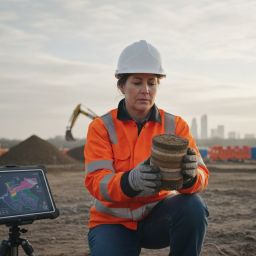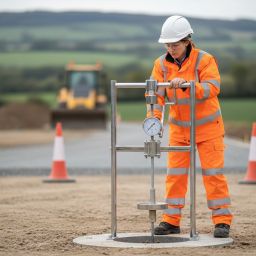
A single miscalculation in ground bearing capacity doesn’t just delay a project; it risks a catastrophic plant failure that UK health and safety regulators won’t overlook. We understand that for site managers and engineers working UK wide, the pressure to deliver accurate stability data is immense. It’s common to feel uncertain about whether a 300mm or 600mm plate is appropriate for your specific load, or how to bridge the gap between CBR results and actual subgrade performance.
This guide ensures you’ll master the plate bearing test for ground strength by providing a definitive roadmap through the latest technical requirements. You’ll gain the confidence to interpret complex data for precise design parameters while maintaining strict compliance with UK legislation and the most recent engineering standards.
We’ll examine the critical updates in BS 1377-9:2025 and the current co-existence period of BS EN 1997-2:2024. From understanding reaction loads to integrating results into a comprehensive ground model, this overview prepares you for the highest levels of operational excellence. For broader compliance needs, including site safety and environmental risks, you can also explore our resources on local asbestos and legionella surveying to keep your project fully protected.
Key Takeaways
- Understand the critical transition between BS 1377-9:1990 and the updated BS 1377-9:2025 standards to ensure your site documentation remains legally robust.
- Learn why the plate bearing test for ground strength is the superior choice for validating working platforms for heavy plant machinery compared to traditional CBR methods.
- Identify the essential site requirements, including the 14-tonne minimum reaction load, needed to execute a precise and compliant in-situ test UK wide.
- Discover how to interpret complex settlement data to create a comprehensive Ground Model that aligns with the latest Eurocode 7 requirements.
- Master the technical distinctions between plate sizes to accurately calculate the ultimate bearing capacity for piling rigs and mobile cranes.
Engineering Ground Stability: What is a Plate Bearing Test?
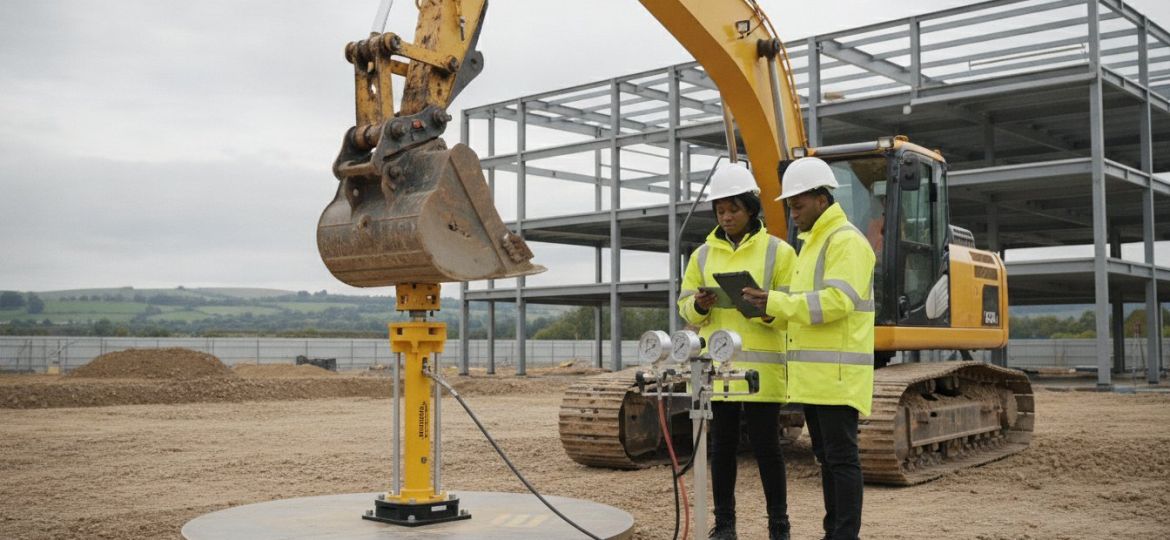
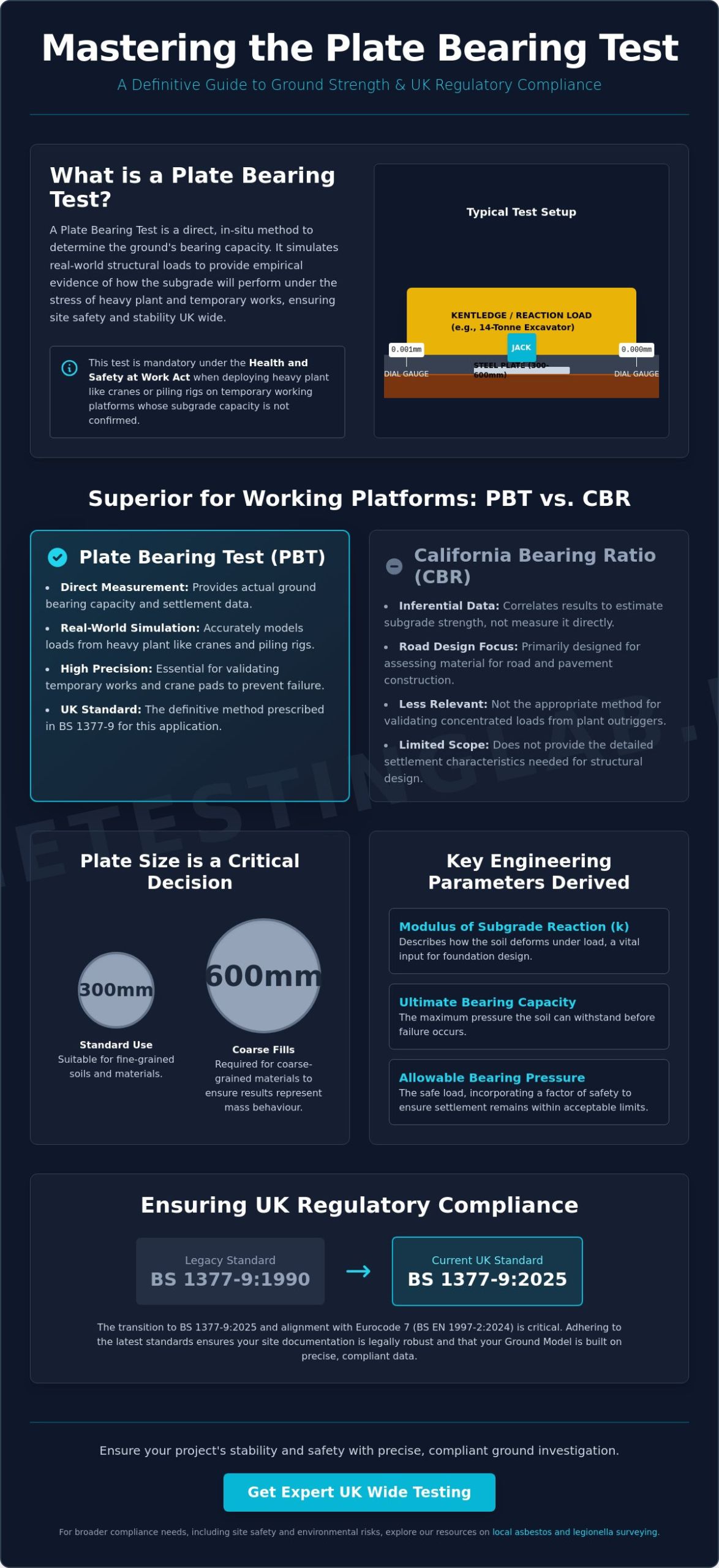
A plate bearing test for ground strength is a direct in-situ measurement of the soil’s ability to support specific vertical loads. The process involves applying incremental pressure to a circular steel plate of a known diameter, typically ranging from 300mm to 600mm, using a heavy vehicle or excavator as a reaction load. By monitoring the resulting settlement against the applied pressure, engineers can determine the ground bearing capacity with high precision. This data is vital for the safe deployment of heavy plant machinery, such as piling rigs and mobile cranes, where subgrade failure can lead to catastrophic site accidents.
The science behind the test is simple yet effective. It replicates real-world structural loads by simulating the footprint of foundation elements or plant outriggers. This method is used UK wide to validate working platforms, crane pads, stanchion bases, and various temporary structures. It moves beyond theoretical models to provide empirical evidence of how the ground behaves under specific stress levels, ensuring that the soil won’t yield unexpectedly during critical operations.
When is a Plate Load Test Mandatory?
Legal compliance is a primary driver for these tests. Under the Health and Safety at Work Act, contractors have a statutory duty to ensure a safe working environment. The Temporary Works Coordinator (TWC) often mandates this test to verify that temporary structures or heavy machinery won’t sink or tip. For any crane pad supporting a load that exceeds the known safe limit of the subgrade, a plate bearing test becomes a non-negotiable safety necessity.
The Engineering Parameters Derived
The test yields data that is essential for robust foundation design. Engineers use the results to calculate the Modulus of Subgrade Reaction (k), which describes how the soil will deform under a given load. We also distinguish between the ultimate bearing capacity, where the soil fails, and the allowable bearing pressure, which incorporates a factor of safety. Identifying these soil deformation characteristics ensures that settlement remains within acceptable limits. If ground conditions appear compromised, integrating these results with asbestos in soils testing provides a complete profile for both structural and environmental safety.
The Plate Bearing Test Procedure: Standards and Site Requirements
Execution of a plate bearing test for ground strength requires strict adherence to established protocols to guarantee valid results. While BS 1377-9:1990 has long served as the industry benchmark, the recent transition to BS 1377-9:2025 reflects the evolving precision required in modern civil engineering. A successful test sequence begins with meticulous site preparation. Site managers must ensure the test surface is perfectly level and cleared of any loose debris or standing water, as uneven bedding leads to skewed settlement readings. If you’re unsure about the readiness of your site, our team offers expert soil investigation testing to guide your preparation.
Once the surface is prepared, the engineer positions the circular steel plate and hydraulic jack assembly directly beneath the kentledge. This setup relies on the incremental application of load, where the hydraulic system exerts pressure against the reaction mass. Settlement is tracked using high-precision calibrated dial gauges, typically placed at three points around the plate to account for any tilting. Each load increment is held until the rate of settlement stabilizes, providing a clear picture of how the subgrade reacts to sustained pressure.
Plate Size and Kentledge Selection
Selecting the correct plate size is a technical decision, not a logistical one. Diameters usually range from 300mm to 600mm and must be matched to the grain size of the material. Coarse-grained fills require larger plates to ensure the results represent the mass behavior of the soil rather than individual particles. The kentledge itself must provide a reaction force that significantly exceeds the maximum intended test load. Common choices for this UK wide include 14-tonne tracked excavators or loaded dumpers, which provide the necessary stability for higher pressure increments.
Interpreting the Load-Settlement Curve
The final data is plotted as a load-settlement curve, which reveals the ground’s performance limits. We look for a distinct “knee” in the curve that indicates the point of failure or excessive settlement. Analyzing the unloading phase is equally critical; it measures the elastic recovery of the ground, showing if the deformation is permanent or temporary. This detailed analysis is vital for complex Plate Bearing Test applications like crane outrigger pads. If your site contains unknown fill materials, combining these results with Specialist soil investigation and WAC testing ensures you meet both structural and environmental compliance standards.
Interpreting Results and Ensuring UK Regulatory Compliance
Engineers often face a choice between CBR testing and a plate bearing test for ground strength. While CBR is useful for thin pavement designs, it’s often inadequate for heavy plant working platforms. CBR tests measure a tiny area, which can lead to misleading results in coarse-grained soils where large aggregates dominate. The plate bearing test provides a more representative analysis by stressing a larger volume of soil. This makes it the superior method for validating the stability of piling rigs and crane pads UK wide.
Relying solely on physical strength data carries significant risk. Ground stability must be viewed alongside chemical soil analysis to ensure comprehensive site safety. For instance, integrating your structural data with asbestos in soils testing is vital. It protects operatives during excavation and prevents the legal repercussions of disturbing hidden contaminants. Professional site management requires this dual focus on both mechanical performance and environmental compliance.
The Role of the UKAS Accredited Laboratory
Using a non-accredited provider for ground testing is a gamble with your professional indemnity insurance. UKAS accreditation ensures that equipment calibration and testing methodologies align strictly with BS 1377-9:1990. This accreditation provides a clear chain of custody for your safety data, which is essential if a structural failure ever leads to a legal dispute. To manage your wider site risks effectively, you can learn more about our UKAS accredited surveying services for asbestos and water safety.
Reporting and Documentation for Site Audits
A compliant test report is your primary defense during an HSE inspection or a local authority building control audit. Your documentation should clearly detail:
- The specific plate diameter and reaction load (kentledge) utilized.
- A complete load-settlement curve showing incremental stages.
- Calculated values for the Modulus of Subgrade Reaction.
- The GPS coordinates of each test location.
Precise reporting turns raw data into a strategic asset for your project. It removes the burden of professional liability from your shoulders by proving that the ground meets the required design parameters. When you’re ready to secure your site foundations with high-precision data, request a quote for specialist soil and ground testing from our expert team.
Securing Your Foundations with Precision Data
Validating ground stability is a critical milestone that bridges the gap between engineering design and site safety. By selecting a plate bearing test for ground strength, you’ve chosen a method that provides empirical evidence rather than theoretical assumptions. We’ve explored how proper site preparation, adherence to the updated BS 1377 standards, and a focus on UKAS accreditation are the pillars of a successful ground investigation strategy.
True site safety goes beyond mechanical resistance. Integrating physical load data with chemical insights, such as asbestos in soils testing, ensures your project remains compliant with UK wide health and safety regulations. As a strategic partner, we provide the technical expertise and independent laboratory validation needed to protect your professional indemnity and site operatives. Our specialist team handles everything from initial surveys to comprehensive chemical analysis, taking the burden of technical responsibility off your shoulders.
Don’t leave your structural stability to chance. Get a quote for UKAS accredited soil and ground strength testing today and move forward with the confidence that your project is built on solid, verified ground.
Frequently Asked Questions
How does a plate bearing test differ from a CBR test?
The primary difference lies in the scale of the area being tested and the engineering parameters derived. While a California Bearing Ratio (CBR) test measures the resistance of a small localized point, a plate bearing test for ground strength assesses a much larger surface area. This makes it far more reliable for coarse-grained soils and working platforms where large aggregates would make a standard CBR plunger test inaccurate.
What size plate should be used for a plate load test for ground strength?
Plate diameters typically range from 300mm to 600mm, with the choice dictated by the grain size of the material and the nature of the expected load. For granular fills and sub-bases UK wide, we generally recommend a 600mm plate. This ensures the pressure is distributed across a representative sample of the soil matrix rather than being influenced by individual large stones or localized voids.
What is the required kentledge for a standard plate bearing test?
A minimum reaction load of a 14-tonne tracked excavator is usually required to provide sufficient kentledge for a standard test. The reaction mass must be heavy enough to counteract the force of the hydraulic jack without shifting or lifting. Using an inadequate reaction load prevents the system from reaching the required pressure increments, which can compromise the validity of the final settlement data.
How long does a plate bearing test take to complete on-site?
A single test following the latest BS 1377-9:2025 standards typically takes between 1.5 and 2 hours to complete from initial setup to final unloading. Our engineering teams are highly efficient; we can often conduct 4 to 5 separate tests during a single site shift. This allows for rapid data collection across multiple locations, helping you maintain your project timeline without sacrificing the accuracy of your ground stability records.

Article by
P J F Thomas
CEO and Founder of TTL plc.
Disclaimer
Items declared are AI generated but do reflect our services. Please get in contact if you have any questions.