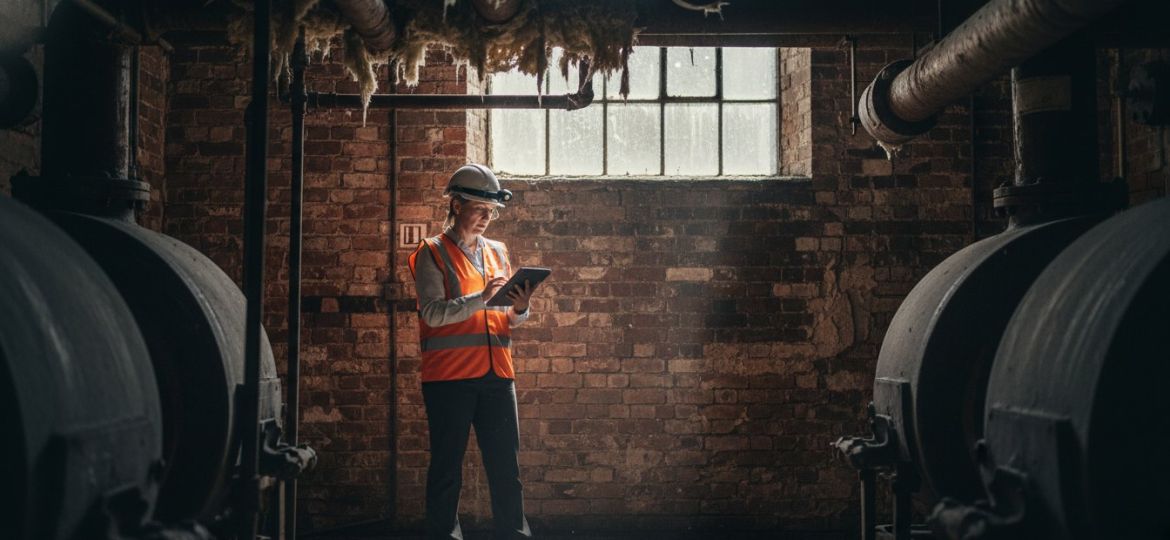
Even decades after the total ban in 1999, asbestos remains the single greatest cause of work-related deaths in the UK, claiming over 5,000 lives every year. If you manage or own property, you likely feel the weight of responsibility that comes with maintaining older structures. It’s natural to worry about hidden liabilities or the potential for unexpected costs during a routine refurbishment. Understanding exactly what makes a building high risk for asbestos is the first step toward a robust safety strategy that protects both your tenants and your professional reputation.
This guide provides a technical breakdown of the structural and historical factors that determine risk levels across UK wide portfolios. We’ll examine how material friability and building age dictate your legal obligations under the Control of Asbestos Regulations 2012. You’ll gain a clear framework for identifying high-risk scenarios, from industrial insulation to decorative coatings. We also highlight when it’s necessary to engage expert surveying and testing services to ensure your compliance is grounded in precision rather than guesswork.
Key Takeaways
- Identify why structures built or refurbished before the UK’s total ban in 1999 are automatically categorized as potential risks under current legislation.
- Understand what makes a building high risk for asbestos by evaluating the friability of materials, such as the difference between easily crumbled pipe lagging and bonded cement.
- Recognize how specific building use-cases, including industrial plants, schools, and hospitals, elevate the priority level for asbestos management and safety inspections.
- Clarify your legal “Duty to Manage” under the Control of Asbestos Regulations 2012 to ensure your UK wide property portfolio remains compliant and safe.
- Determine the critical points when your risk assessment requires the precision of UKAS accredited consultancy and professional laboratory testing.
The Primary Risk Factor: Building Age and Construction Era
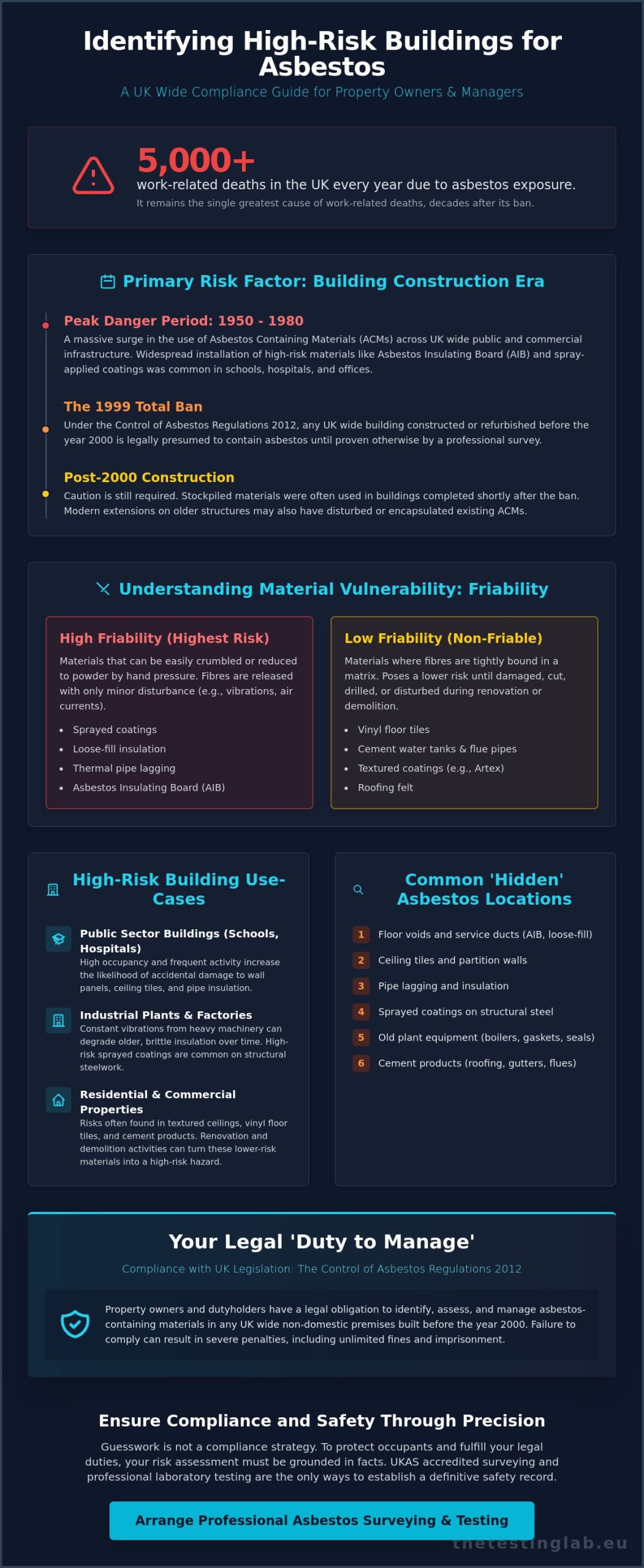
A building’s construction date is the most reliable indicator of potential hazard. In the UK wide context, any structure built or extensively renovated before the total ban in November 1999 is legally presumed to contain Asbestos until proven otherwise. This regulatory threshold exists because, for most of the 20th century, these minerals were prized for their fire resistance and tensile strength. When assessing what makes a building high risk for asbestos, experts look first at the era of construction to determine the likely density and type of materials present.
The peak danger period spans from 1950 to 1980. During these three decades, the UK saw a massive surge in the use of Asbestos Containing Materials (ACMs) in both public and commercial infrastructure. This era was defined by the widespread installation of high-risk materials like Asbestos Insulating Board (AIB) and spray-applied coatings. Industry data indicates that a significant majority of schools, hospitals, and office blocks from this period still house these legacy materials within their structural fabric.
Why the 1999 Ban Isn’t a Guarantee of Safety
Stockpiled materials were frequently used in buildings completed shortly after the 1999 ban came into effect. It’s also possible for modern extensions to contain asbestos if they were built onto older structures where existing ACMs were disturbed or “built-in” to the new work. If you manage a property from the early 2000s, verifying the supply chain history is a vital part of your compliance strategy.
Common High-Risk Materials Found in Older UK Properties
Understanding the specific type of material is essential for accurate risk management. While Chrysotile (White) is the most common, the presence of Amosite (Brown) or Crocidolite (Blue) significantly increases the risk profile due to their needle-like fibres. These materials often hide in areas that aren’t immediately visible during a standard walkthrough:
- Floor voids and service ducts: Often lined with AIB or loose-fill insulation.
- Ceiling tiles and partition walls: Common in 1960s and 70s office fit-outs.
- Old plant equipment: Gaskets and seals in boilers often contain high concentrations of fibres.
For buildings in these categories, professional surveying and testing is the only way to establish a definitive safety record and ensure full legal compliance.
Structural Vulnerability: Friability and Building Use-Cases
The technical term “friability” is central to understanding what makes a building high risk for asbestos. It refers to the ease with which a material can be crumbled or reduced to powder by hand pressure, subsequently releasing microscopic fibres into the atmosphere. High-friability materials, such as thermal pipe lagging, loose-fill insulation, and sprayed coatings, represent the most significant threat. These materials lack a strong bonding agent, meaning even minor air currents or structural vibrations can liberate hazardous particles. For a detailed technical overview of these material properties, Asbestos: general information serves as an authoritative legislative reference.
A building’s specific use-case also dictates its risk profile across a UK wide portfolio. Public sector buildings like schools and hospitals are often classified as high risk due to the high volume of occupants and the likelihood of accidental damage to wall panels or ceiling tiles. Industrial plants face different challenges; heavy machinery creates constant vibration that can cause older, brittle insulation to degrade over time. If your facility operates under these conditions, engaging Specialist asbestos consultancy services is a proactive step toward maintaining a safe operational environment.
Industrial vs. Residential Risk Profiles
The Danger of ‘Hidden’ Asbestos in Structural Voids
Asbestos was frequently utilized for fireproofing in lift shafts, service risers, and ceiling voids where it remains out of sight. These hidden areas pose a severe hazard to maintenance staff and external contractors during routine electrical or plumbing works. To mitigate this, a Comprehensive asbestos surveying in London and UK-wide should be conducted to map every structural void before any intrusive activity begins. This ensures that hidden liabilities don’t become active safety breaches.
Managing Legal Liability: Compliance with UK Legislation
The Control of Asbestos Regulations 2012 (CAR 2012) dictates how asbestos is managed across all non-domestic premises UK wide. Under this legislation, the ‘Duty Holder’ is typically the owner of the building or the person responsible for its maintenance through a contract or tenancy. Determining what makes a building high risk for asbestos often starts with the legal presumption that any structure pre-dating 2000 contains ACMs until proven otherwise. This “presumption of presence” is the safest legal baseline, ensuring that no hazardous materials are disturbed before a professional assessment is completed.
Every commercial property must have a written Asbestos Management Plan (AMP). This document isn’t just a filing requirement; it’s a live strategy that outlines how risks are monitored and controlled. Failing to maintain an accurate AMP can lead to significant legal liability, especially since Cancer and construction: Asbestos remains a primary focus for HSE enforcement. For those managing complex portfolios, securing UKAS accredited lab testing for asbestos is the only way to transform these legal presumptions into actionable data.
The Role of UKAS Accredited Surveys
There are two primary survey types used to manage high-risk structures. A Management Survey is designed for normal daily occupancy to ensure ACMs aren’t damaged. However, if you’re planning any intrusive work, a Refurbishment and Demolition (R&D) Survey is mandatory. Independent laboratory analysis is the only scientifically valid method to confirm whether a material is hazardous or safe, removing the professional risk from the Duty Holder’s shoulders.
Steps to Mitigate High-Risk Building Status
Mitigation begins with a thorough site survey conducted by a UKAS accredited consultancy to identify the exact location and condition of all ACMs. If materials are found to be in poor condition, or if they must be disturbed for maintenance, strict air monitoring and 4-stage clearances are required to ensure the area is safe for re-entry. The ‘Duty to Manage’ is a continuous legal obligation that requires regular inspections and updates to your management plan rather than a one-time check.
Securing Your Property Portfolio Against Structural Liabilities
Managing a commercial or public building requires a methodical approach to safety that prioritizes legislative compliance. The era of construction and the physical condition of materials are the most critical factors in identifying these hazards. Understanding what makes a building high risk for asbestos allows you to move from reactive repairs to a proactive management strategy. Whether you’re dealing with high-friability insulation in an industrial plant or hidden AIB in a 1970s office block, your legal “Duty to Manage” remains a continuous requirement across your UK wide operations.
Precision is the only way to eliminate uncertainty. Our team provides UKAS accredited laboratory analysis and independent consultancy to ensure you meet every regulatory standard. We specialize in 4-stage air clearance and asbestos in soil testing, providing the technical confidence needed to protect your tenants and your business. Take the first step toward a compliant and safe environment today.
Request a UKAS accredited asbestos survey for your building to secure expert oversight for your next project.
Frequently Asked Questions
Is a building built in 2005 at risk for asbestos?
Buildings constructed in 2005 are generally considered low risk because the UK wide ban on all asbestos types was fully implemented in late 1999. You should still exercise caution if the project involved refurbishing an older structure or used salvaged plant equipment. It’s best practice to verify the construction history to ensure no legacy materials were introduced during the build phase.
What is the most dangerous type of asbestos found in UK buildings?
Crocidolite (blue asbestos) and Amosite (brown asbestos) are technically the most hazardous due to their sharp, needle-like fibres that easily penetrate lung tissue. While Chrysotile (white) is more common, these amphibole types are critical factors in what makes a building high risk for asbestos because of their high friability. Any presence of these materials requires immediate, specialized management under the Control of Asbestos Regulations 2012.
Do I need an asbestos survey for a residential property?
You don’t legally require a management survey for a private domestic home under the Duty to Manage. However, if you’re planning refurbishment or demolition work, a survey is essential to protect contractors and residents from exposure. For multi-occupancy residential buildings, the Duty Holder must maintain a risk assessment for all common areas like hallways and boiler rooms to ensure UK wide compliance.
What happens if I ignore asbestos in a high-risk building?
Ignoring asbestos leads to severe legal and financial consequences, including unlimited fines and potential imprisonment for Duty Holders. If the HSE intervenes due to non-compliance, they charge a Fee for Intervention (FFI) of £188 per hour as of April 2026. Beyond the legal liability, disturbing materials in a high-risk building creates a life-threatening environment for occupants and results in significantly higher decontamination and clearance costs.

Article by
P J F Thomas
CEO and Founder of TTL plc.
Disclaimer
Items declared are AI generated but do reflect our services. Please get in contact if you have any questions.