A £600,000 fine issued to a UK firm in May 2025 proves that the Health and Safety Executive doesn’t wait for a public health crisis to penalize non-compliance. When a lab report confirms the presence of bacteria, the immediate pressure to protect occupants and your professional reputation is intense. You’re likely questioning what happens if legionella is detected and whether you’re legally required to shut down your operations immediately. It’s a high-stakes scenario, but reacting with engineering precision is the only way to move from uncertainty to safety.
This guide provides the mandatory roadmap for remediation according to the updated ACOP L8 (May 2026) and HSG274 standards. You’ll gain clarity on interpreting CFU/L thresholds, executing emergency disinfections, and securing the five-year audit trail necessary for UK wide compliance. We’ll show you how to handle results exceeding 1,000 CFU/L and how professional Legionella risk assessments and water management can shift the burden of responsibility off your shoulders. We’ll bridge the gap between technical data and actionable safety protocols to ensure your water systems remain within legal limits.
Key Takeaways
- Interpret CFU/L thresholds accurately to distinguish between minor colonization and high-risk levels requiring immediate intervention.
- Implement essential isolation protocols and safety signage to protect building occupants from aerosol exposure the moment a risk is identified.
- Evaluate the technical requirements for thermal and chemical disinfection to ensure remediation meets the rigorous ACOP L8 standards.
- Understand the specific legal roadmap of what happens if legionella is detected to safeguard your organization against HSE prosecution and unlimited fines.
- Define the mandatory responsibilities of the Duty Holder and Responsible Person to maintain a compliant, five-year audit trail UK wide.
Immediate Response Protocols and Action Levels in the UK
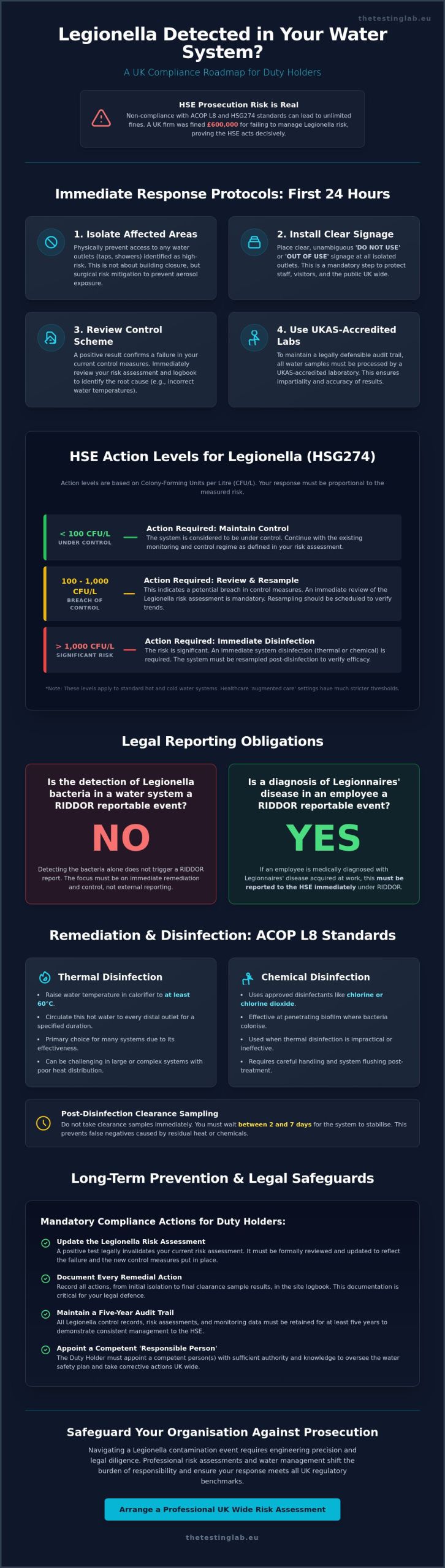
The moment a lab report confirms colonization, the priority shifts from routine maintenance to incident management. Understanding what happens if legionella is detected starts with immediate physical containment. You must isolate affected outlets and install clear ‘out of use’ signage to prevent any potential aerosol inhalation by staff or visitors. This isn’t about closing the entire building; it’s about surgical precision in risk mitigation. Managing what happens if legionella is detected requires a calm, methodical approach based on verified data rather than speculation.
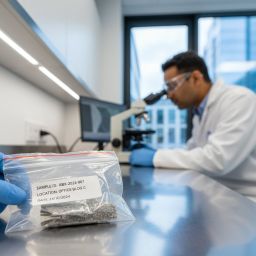
Every sample must be processed by a UKAS-accredited laboratory to maintain a legally defensible chain of custody. If the results indicate a failure, you must immediately review your current control regime. You need to ask why the system allowed growth. Did the hot water storage drop below 60°C? Was the cold water distribution exceeding 20°C? Identifying these technical failures is the first step in professional Legionella risk assessments and water management.
HSE Action Levels for Hot and Cold Water Systems
The HSG274 Part 2 guidance defines clear thresholds for action. CFU/L is the standard measurement for Legionella concentration in UK water samples. For general UK wide commercial sites, a result under 100 CFU/L suggests the system is under control. Results between 100 and 1,000 CFU/L indicate a breach in control measures, requiring a review of the Legionella risk assessment and resampling. If the count exceeds 1,000 CFU/L, the risk is significant. You must perform an immediate system disinfection and resample to verify the efficacy of the treatment. This differs from healthcare ‘augmented care’ settings, where any detection over 100 CFU/L triggers more aggressive clinical protocols.
When to Report: RIDDOR and Health Protection Teams
Legal clarity is essential for any Duty Holder. The detection of Legionella bacteria in a water system is not a RIDDOR reportable event. However, if a medical professional diagnoses an employee with Legionnaires’ disease, this must be reported to the HSE immediately under RIDDOR. When communicating with tenants or employees, stick to the facts of the remediation plan. Transparent, professional updates prevent panic while demonstrating that the Duty Holder is taking the necessary steps to ensure safety.
Remediation and Disinfection: Meeting ACOP L8 Standards
Effective remediation requires more than just a quick flush of the pipes. When considering what happens if legionella is detected, the ACOP L8 framework mandates a structured disinfection response. Thermal disinfection is often the primary choice. This involves raising the water temperature in the calorifier to at least 60°C and ensuring this heat reaches every distal outlet for a set duration. If the system’s architecture makes heat distribution difficult, chemical shock treatments using chlorine or chlorine dioxide are utilized to penetrate the biofilm where bacteria colonize. Following any disinfection, you shouldn’t take clearance samples immediately. Waiting between two and seven days allows the system to return to its normal operating state, ensuring that results aren’t skewed by residual chemicals or temporary heat spikes.
Updating the Legionella Risk Assessment
A positive detection serves as a technical signal that your existing controls have failed. Legally, this invalidates your current documentation and necessitates a mandatory review. You must investigate the root cause, such as identifying “dead legs” where stagnant water allows bacteria to thrive. Documenting every remedial action in your site logbook is critical for maintaining a compliant audit trail. To ensure your remediation plan meets all legal benchmarks, utilizing professional Legionella risk assessment services provides the engineering oversight needed to close the loop on contamination. This process aligns with the latest UK government guidance on Legionnaires’ disease, ensuring your response stands up to regulatory scrutiny.
The Role of UKAS Accredited Analysis in Clearance
Objectivity is the cornerstone of legal safety. Clearance samples must be analyzed by an independent, UKAS-accredited laboratory to avoid any conflict of interest between the remediation team and the testing body. UK wide standards for sample transportation and incubation ensure that the data you receive is accurate and representative of the system’s true state. Understanding what happens if legionella is detected means recognizing that a ‘clear’ result is only as valid as the methodology used to obtain it. If you’re looking for a strategic partner to manage this process, you can consult with our specialists to restore operational confidence.
Long-term Prevention and Legal Safeguards for UK Businesses
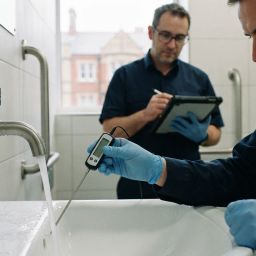
Preventing the recurrence of colonization is as vital as the initial response. Knowing what happens if legionella is detected helps you refine your long-term strategy, moving from crisis management to operational excellence. A robust monitoring regime is the foundation of this approach. It’s not enough to react to failures; you must implement monthly temperature checks at sentinel outlets and ensure quarterly showerhead descaling is performed UK wide to eliminate potential breeding grounds. These tasks aren’t just administrative burdens, they’re precise engineering controls that keep your water system within safe parameters.
The Duty Holder carries the ultimate legal weight for compliance. It’s their responsibility to ensure that the “Responsible Person” is competent and that all staff involved in water maintenance are properly trained. For organizations managing complex water systems across multiple UK-wide sites, leveraging professional consultancy is a strategic move. It takes the technical pressure off your internal teams and ensures that your records meet the highest standards of scrutiny during an HSE inspection. Professional oversight ensures that what happens if legionella is detected in the future is a managed event rather than a legal crisis.
Continuous Monitoring vs. Reactive Testing
Relying on sampling alone is a flawed control strategy. The HSE ACOP L8 guidance emphasizes that testing is a verification tool, not a substitute for active maintenance. Modern facilities are increasingly adopting remote temperature monitoring technology. These systems provide real-time data, allowing you to identify thermal fluctuations and potential risks before bacteria have the opportunity to multiply. This proactive stance is far more effective than waiting for a positive lab result to trigger action.
Establishing a Defensible Position
A comprehensive water management plan is your primary defense against prosecution. UK law requires ‘reasonably practicable’ steps to be taken, evidenced by a professional risk assessment. By maintaining a clear, five-year audit trail of all monitoring and remedial actions, you demonstrate a commitment to occupant safety and regulatory compliance. This documentation is what separates a responsible Duty Holder from one facing unlimited fines and criminal charges. For expert analysis and UKAS-accredited testing, visit The Testing Lab PLC to secure your facility’s future.
Securing Your Water Systems and Regulatory Compliance
Managing water safety is a continuous process of engineering precision and rigorous documentation. While the initial discovery of bacteria can be stressful, understanding what happens if legionella is detected allows you to transition from reactive panic to methodical remediation. By following the updated ACOP L8 and HSG274 standards, you ensure that every thermal flush or chemical shock is backed by technical logic and legal necessity. The goal is to move beyond simple detection toward a robust, UK wide management strategy that prioritizes the safety of every building occupant.
Protecting your organization from HSE prosecution requires more than just a site logbook. It demands a strategic partnership with experts who provide UKAS Accredited Laboratory Analysis and expert UK-wide consultancy. We take the professional responsibility off your shoulders, ensuring your systems remain fully compliant and your audit trail remains bulletproof. Don’t leave your legal standing to chance when precision testing and expert oversight are available.
Secure your building with a professional UK-wide Legionella Risk Assessment and gain the peace of mind that comes with industry-leading expertise. We’re here to help you maintain a safe, compliant environment for the long term.
Frequently Asked Questions
Do I have to close my business if Legionella is detected?
You aren’t usually required to close your entire business premises if Legionella is detected in your water system. UK wide health and safety protocols focus on the isolation of specific risk areas rather than total building closure. You must prevent aerosol production by turning off showers or spray taps and installing “out of use” signage. This targeted approach allows your business to remain operational while you execute the mandatory remediation and disinfection steps required by law.
How long does it take to get Legionella test results back from the lab?
What is the legal difference between Legionella bacteria and Legionnaires’ disease?
Legionella is the biological hazard found in water, whereas Legionnaires’ disease is the resulting clinical pneumonia caused by inhaling contaminated droplets. From a legal standpoint, detecting the bacteria requires immediate remedial action to restore control. However, a diagnosed case of the disease is a reportable event under RIDDOR. Knowing what happens if legionella is detected allows you to manage the risk effectively, preventing a technical failure from becoming a serious health and safety prosecution.
Can I carry out Legionella disinfection myself or do I need a specialist?
You may carry out disinfection yourself if the person responsible is technically competent and has received adequate training. UK legislation doesn’t mandate the use of a third-party contractor, but it does demand that the work meets ACOP L8 standards. Most Duty Holders choose specialists for complex systems to ensure that chemical dosages or thermal levels are maintained precisely. This professional oversight provides a defensible audit trail and ensures the safety of all occupants UK wide.

Article by
P J F Thomas
CEO and Founder of TTL plc.
Disclaimer
Items declared are AI generated but do reflect our services. Please get in contact if you have any questions.