
With over 5,000 asbestos-related deaths occurring annually in the UK, the Health and Safety Executive has intensified its enforcement, recently issuing combined fines of £88,300 to two companies for failing to manage these critical risks. You likely understand that the Control of Asbestos Regulations 2012 (CAR 2012) aren’t just a suggestion, but the complexity of maintaining a compliant management plan across UK-wide operations can feel overwhelming. The fear of unlimited fines or a 12-month suspended sentence, like the one recently handed to a site manager for clearance failures, is a heavy burden for any duty holder to carry.
This guide will show you exactly how to avoid HSE fines for asbestos by mastering the technical requirements of CAR 2012 and implementing a system that stands up to the most rigorous inspections. We’ll break down the vital distinction between a standard survey and a robust management plan, while outlining the steps to secure your site against improvement and prohibition notices. By integrating professional asbestos surveying and management into your workflows, you can shift from reactive panic to proactive, methodical compliance. We’ll explore the precise technical steps necessary to shield your operations and ensure your documentation meets the latest 2026 standards for analytical independence and surveyor competence.
Key Takeaways
- Identify your legal “duty to manage” obligations under CAR 2012 to maintain compliance across all UK wide premises.
- Implement a technical roadmap for how to avoid HSE fines for asbestos by establishing a documented and proactive management system.
- Learn why choosing the wrong survey type can lead to immediate prohibition notices during site works.
- Use UKAS accredited consultancy and laboratory testing to ensure your data is robust enough for any HSE inspection.
- Shift from outdated, static PDF reports to a dynamic Asbestos Register that evolves with your building’s operational changes.
The Legal Landscape: Why the HSE Issues Fines for Asbestos Breaches
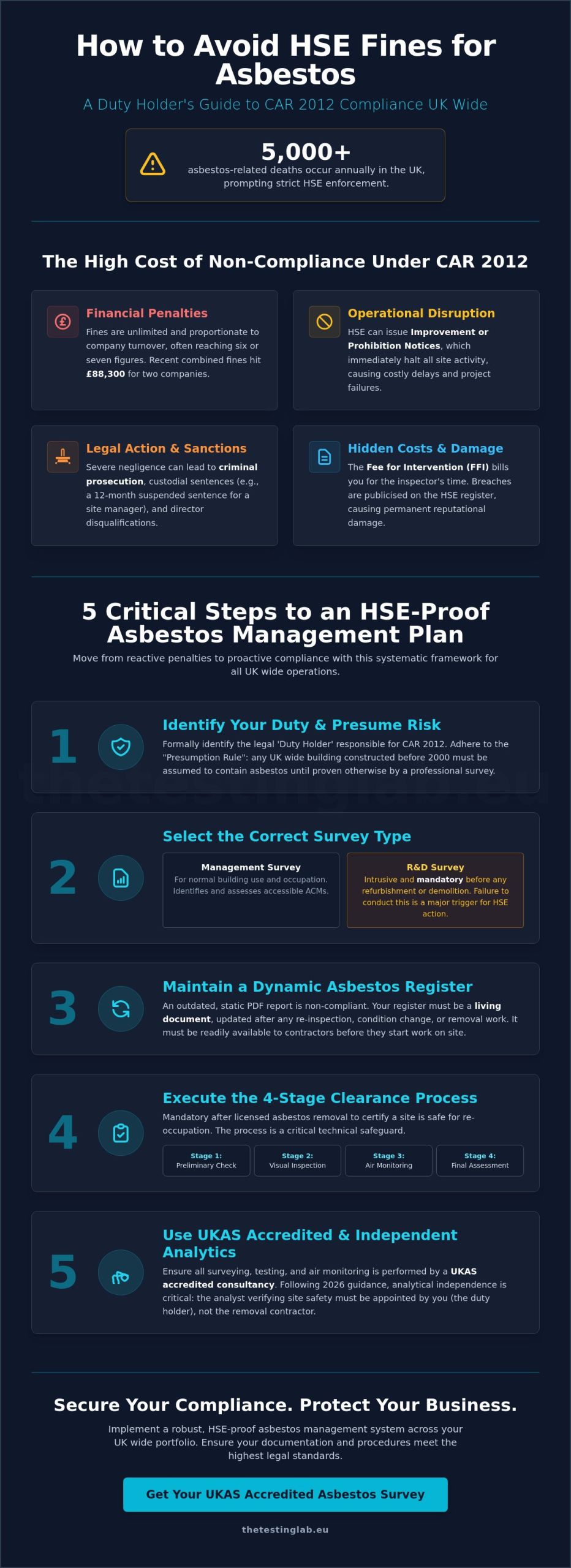
The Control of Asbestos Regulations (CAR) 2012 remains the primary legislative framework governing UK wide operations. Under Regulation 4, the “Duty to Manage” requires duty holders to identify, assess, and manage the risks from asbestos containing materials (ACMs). This isn’t a one-time task; it’s a continuous technical process. Understanding the specific mechanics of this legislation is the first step in learning how to avoid HSE fines for asbestos. While global asbestos regulations vary, the UK approach is particularly stringent regarding documentation. For instance, the “Presumption Rule” mandates that any building constructed before 2000 must be assumed to contain asbestos unless a professional survey proves its absence.
If an inspector identifies a material breach, the HSE utilizes a clear enforcement hierarchy. This begins with verbal or written advice for minor technical gaps. However, if the risk is significant, they’ll issue an Improvement Notice or a Prohibition Notice, which immediately halts all site activity. For severe or repeated negligence, the HSE will pursue criminal prosecution. Throughout this process, businesses are subject to the Fee for Intervention (FFI). This means you’re billed for the inspector’s time spent identifying and rectifying the breach, which can escalate costs before a formal fine is even issued.
Common Triggers for HSE Inspections
The Cost of Non-Compliance in 2026
Current UK wide sentencing guidelines ensure that fines are proportionate to a company’s annual turnover. This means large-scale operations face substantial liabilities for serious breaches, often reaching six or seven figures. Beyond financial penalties, the reputational damage is permanent. Every enforcement notice is published on the HSE’s public register, which can disqualify your firm from future tenders and erode stakeholder trust. Implementing a strategic asbestos management system is the only way to mitigate these operational risks effectively.
5 Critical Steps to Building an HSE-Proof Asbestos Management Plan
Once identified, materials must be recorded in a living Asbestos Register. An HSE inspector will not accept a static PDF from five years ago as valid evidence of management. Your register must be a dynamic document, updated whenever the condition of a material changes or removal work occurs. Every entry needs a priority code, which scores the asbestos containing material (ACM) based on its current condition and the likelihood of human disturbance. This data-driven approach allows you to allocate resources where they’re most needed for safety.
The most critical technical safeguard is the 4-stage clearance process. This involves a preliminary site check, a thorough visual inspection, air monitoring to the legal control limit of 0.1 f/cm³, and a final post-work assessment. Following 2026 guidance, analytical independence is non-negotiable. The analyst verifying the site’s safety must be appointed directly by the duty holder, not the removal contractor, to ensure an unbiased safety check.
Implementing an Effective Management Plan
Success depends on clear accountability. The designated ‘Duty Holder’ must be explicitly identified, as they carry the legal weight for CAR 2012 compliance. Regular re-inspections, typically every 6 to 12 months, are essential to monitor material degradation and prevent accidental exposure. If you’re unsure about your current status, engaging Asbestos Consultancy Services can provide the technical clarity needed to bridge compliance gaps.
Contractor Management and Data Sharing
Your asbestos register should function as a ‘permit to work’ system. Before any external tradesperson begins work, they must sign off on the register to confirm they’ve reviewed the ACM locations. Don’t fall into the ‘hidden asbestos’ trap; ensure your surveys include old industrial machinery and plant rooms, which are often overlooked in standard building inspections. Establishing professional asbestos management protocols ensures that every contractor on your site remains protected and informed.
Beyond the Survey: How UKAS Accredited Testing Safeguards Your Business
While surveys locate materials, laboratory testing provides the scientific certainty required for a legal defense. This technical verification is a cornerstone of how to avoid HSE fines for asbestos. HSE inspectors prioritize data from laboratories accredited by the United Kingdom Accreditation Service (UKAS) to ISO/IEC 17025 standards. This accreditation ensures that fiber counting and air monitoring are performed with the precision necessary to prove that exposure remained below the legal control limit of 0.1 fibres per cubic centimetre.
The Importance of Laboratory Precision
Relying on DIY sampling kits or non-accredited analysis introduces a catastrophic failure point into your management system. Professional bulk sample analysis identifies the specific fiber type, whether chrysotile, amosite, or crocidolite, allowing for accurate risk scoring. A UKAS certificate of analysis acts as definitive legal evidence in a court of law, demonstrating that the duty holder exercised due diligence through UKAS Accredited Asbestos Testing.
Specialist Testing for Soil and Water
The HSE is increasingly focusing on land remediation and brownfield developments UK wide. Asbestos in soils poses a unique challenge for construction projects, requiring specialist quantification to determine if the ground is hazardous. By utilizing Asbestos in Soils Analysis, developers can safely manage waste classification and site safety, providing a final layer of protection in how to avoid HSE fines for asbestos. Additional techniques like water absorption testing and XRD analysis offer deeper insights into the material’s composition, ensuring that complex structural assessments are based on empirical data rather than assumptions. This level of technical rigor removes the professional burden from your shoulders and places it in the hands of accredited experts.
Securing Your Operational Future Through Technical Rigor
Compliance is not a fixed destination but a continuous standard of operational excellence. You’ve seen that protecting your organization involves more than just identifying materials. It requires a commitment to independent verification and the maintenance of a live, data-driven asbestos register. By prioritizing UKAS-accredited laboratory data and adhering to 4-stage clearance protocols, you transform legal obligations into a robust shield for your business.
Mastering how to avoid HSE fines for asbestos ensures your UK wide operations remain resilient against tightening enforcement trends. We provide the precision needed to navigate these complexities, offering everything from expert site surveys and inspections to specialized soil testing. Secure your UK-wide compliance with a professional Asbestos Consultancy from The Testing Lab PLC. As an independent asbestos consultancy with a UKAS accredited laboratory, we take the technical burden off your shoulders. You can move forward with the confidence that your compliance is in expert hands.
Frequently Asked Questions
What is the maximum fine the HSE can issue for asbestos breaches?
There is no upper limit on fines for health and safety breaches in the UK. Courts determine fines based on the level of culpability and the risk of harm, often linking the amount to the company’s annual turnover. In a recent 2026 case, two companies were collectively fined £88,300, but larger organizations have faced multi-million pound penalties for systemic failures. This financial risk makes it imperative to understand the technical nuances of CAR 2012.
Do I need an asbestos survey if my building was built after 2000?
Generally, buildings constructed after the year 2000 don’t require an asbestos management survey because the use of asbestos was banned in the UK in 1999. However, duty holders should still maintain documentation proving the construction date. If you’re managing UK wide portfolios with mixed-age assets, it’s vital to verify each building’s history to ensure you don’t inadvertently overlook older extensions or plant machinery that might contain ACMs.
Is an asbestos management plan the same as an asbestos survey?
No, an asbestos survey is a diagnostic report that identifies the location and condition of materials, while a management plan is a live strategy for controlling identified risks. The survey provides the data, but the management plan dictates how you’ll protect occupants and contractors. Understanding this distinction is a key part of how to avoid HSE fines for asbestos, as inspectors expect to see a documented process for managing ACMs, not just a static report.
How often should I review my asbestos management plan to remain compliant?
You should review your asbestos management plan at least every 12 months, or sooner if there’s reason to believe it’s no longer valid. Reviews are mandatory following any structural changes to the building, damage to known ACMs, or if materials are removed. Regular re-inspections are the most effective way to demonstrate proactive compliance and ensure your UK wide operations meet the technical standards required by CAR 2012.

Article by
P J F Thomas
CEO and Founder of TTL plc.
Disclaimer
Items declared are AI generated but do reflect our services. Please get in contact if you have any questions.