Get instant Quote What does a Legionella certificate show, and can it prove your water system is safe? The useful evidence is usually a site-specific risk assessment report. There is no standard HSE-recognised “Legionella certificate”. Under the Health and Safety at Work etc. Act 1974 and the Control of Substances Hazardous to Health Regulations 2002 (COSHH), the report can help show how risks have been assessed and controlled, but it is not a blanket guarantee.
This guide explains what to look for in a report, what a test result cannot prove, and how to turn findings and recommendations into practical next steps.
The Testing Lab PLC provides Legionella risk assessments and testing as a UK-wide national service provider, with its head office in Doncaster. Its services support structured water-risk management for sites across the UK.
Key Takeaways
- What does a legionella certificate show? Its value depends on the site-specific assessment and findings behind it, not the certificate label alone.
- Check that the report identifies the premises and water systems assessed, states its date and scope, and records hazards, people potentially exposed and existing controls.
- Use the findings to prioritise recommended actions, assign responsibility and retain records as part of water-risk management under applicable UK legislation and HSE guidance.
- A report or test result does not guarantee ongoing safety. Review the assessment if risks or relevant site conditions change.
What does a Legionella certificate show, and is it an official document?
A document labelled “Legionella certificate” is not, by that title alone, a universal certificate prescribed or recognised by the Health and Safety Executive (HSE). Its value comes from the work and findings it records. Under applicable UK health and safety duties, including the Health and Safety at Work etc. Act 1974 and COSHH, relevant dutyholders must assess and control risks. HSE’s Approved Code of Practice L8 provides guidance on managing Legionella risks.
So, what does a legionella certificate show? That depends on the document’s purpose and scope. A completion record may confirm that specified work was carried out, but it is not a substitute for a detailed assessment of the premises and water system. A site-specific Legionella risk assessment records findings that can inform a structured approach to managing water-system risks.
Certificate, risk assessment and test result: what is the difference?
These documents answer different questions:
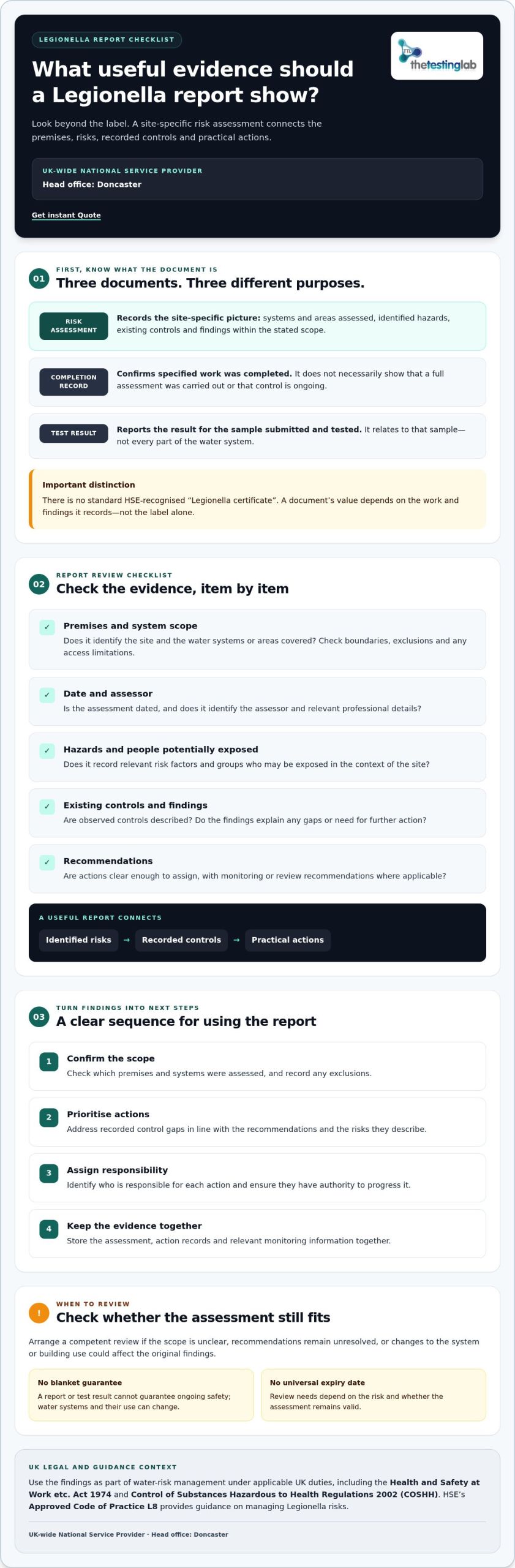
- Risk assessment: records the system and areas assessed, identified hazards, existing controls and findings within the stated scope.
- Completion record: confirms that specified work or a service was completed. It evidences that work, but not necessarily a full assessment or ongoing control.
- Laboratory test result: reports the finding for the sample submitted and tested. It relates to that sample, not every part of the water system.
Legionella bacteria can present a health risk, so read any evidence in context. A single sample or certificate cannot guarantee continuing control because water systems and their use can change after the recorded work. Before relying on a document, check what was assessed, when it was assessed and which findings or parts of the system it covers.
What should a Legionella certificate or assessment report contain?
A useful report should make it clear what was assessed, what the assessor found and what needs attention. The level of detail depends on the premises, the complexity of the water system and the agreed assessment scope. HSE’s guidance on Legionella provides the UK reference point for assessing and controlling risks. The report should set out its own scope and findings rather than rely on generic assurances.
Use this checklist to review the evidence:
- Premises and system scope: Does the report identify the site and the water systems or areas covered? Look for boundaries and exclusions so you can see what was not assessed.
- Date and assessor: Is the assessment dated, and does it identify the assessor and relevant professional details?
- Hazards and people exposed: Does it record potential risk factors and groups who may be exposed in the context of the site?
- Existing controls and findings: Does it describe the controls observed and explain whether the findings point to gaps or further action?
- Recommendations: Are the actions clear enough to assign, with monitoring or review recommendations where applicable?
Which details make the evidence site-specific and actionable?
Compare the report’s stated scope with the actual premises. A general reference to “the building’s water system” gives less detail than identifying the systems or outlets assessed and recording any access limitations. Check that each recommendation relates to a finding in the report, and that monitoring or review advice reflects the risks identified.
Useful evidence connects identified risks with recorded controls and practical actions. This helps the person responsible for managing risks decide what to address and keep a clear record of the assessment. A site-specific Legionella risk assessment can provide structured evidence for water-risk management. The Testing Lab PLC provides Legionella risk assessments and testing, including quick water testing. Request a Legionella risk assessment quote to discuss your assessment needs.
How should you use the findings and decide on next steps?
A report is a working record, not a guarantee that controls will remain effective indefinitely. Use its findings as part of ongoing Legionella risk management under applicable UK duties, including the Health and Safety at Work etc. Act 1974 and COSHH. HSE’s Approved Code of Practice L8 provides guidance on controlling the risk.
Turn the findings into a practical action sequence:
- Check the scope: Confirm which premises and systems were assessed, and record any exclusions.
- Prioritise actions: Address recorded control gaps in line with the recommendations and the risks they describe.
- Assign responsibility: Identify the person responsible for each action and ensure they have the authority to progress it.
- Keep the evidence: Store the assessment, action records and relevant monitoring information together.
When does the document point to further assessment or action?
Arrange a competent review if the report’s scope is unclear, recommendations remain unresolved, or changes to the system or building use could affect the original findings. Do not assume a certificate has a universal expiry date. Review needs depend on the risk and whether the assessment remains valid. The Legionella Control Association’s industry guidance can provide additional context. Apply it alongside relevant HSE guidance and the specific circumstances of the site.
If you are unsure what does a legionella certificate show for your premises, check whether its recorded findings still reflect current conditions. A Legionella risk assessment can provide structured evidence to inform water-risk management. Request a quote for an assessment to discuss your next steps.
Make your next water-safety decision with confidence
A report is most useful when it informs practical decisions. Keep it connected to your ongoing water-safety processes, and revisit its recommendations if the system or the way the premises are used changes. That is the practical meaning of what does a legionella certificate show: it records defined work and findings, not a guarantee about future conditions.
If you need clear, site-specific evidence to support your next steps, Get instant Quote for a Legionella risk assessment. The Testing Lab PLC provides UK-wide services, with its head office in Doncaster, supporting premises in Carlisle, Chester, Lancaster, Liverpool, Manchester, Preston, Salford, Berwick-upon-Tweed, Durham, Middlesbrough, Newcastle upon Tyne, Sunderland, Bradford, Doncaster, Huddersfield, Hull, Leeds, Sheffield and Wakefield.
Frequently Asked Questions
How long is a Legionella certificate valid?
A risk assessment does not have a universal fixed validity period. Review it when circumstances could make its findings unreliable, such as alterations to pipework, a change in building use, prolonged low occupancy or signs that controls are not working. Follow the review arrangements for the premises and applicable HSE guidance rather than relying only on a date printed on a certificate.
Can a negative Legionella water test prove that a building is risk-free?
No. A negative result describes the sample tested, not every outlet or condition across the building. Sampling location and timing matter, and water-system conditions can change after a test. That is why what does a legionella certificate show cannot be answered by a negative sample alone. Use the result alongside risk-assessment findings and ongoing control records.
Can a landlord carry out a Legionella risk assessment themselves?
A landlord can assess a straightforward domestic system if they have the knowledge, training and experience to identify risks and manage controls. The duty is to assess and control risk, not automatically to obtain an external report. This applies to rental homes in Carlisle, Chester, Lancaster, Liverpool, Manchester, Preston, Salford, Berwick-upon-Tweed, Durham, Middlesbrough, Newcastle upon Tyne, Sunderland, Bradford, Doncaster, Huddersfield, Hull, Leeds, Sheffield and Wakefield.
Does a Legionella risk assessment have to be submitted to the CQC?
Not routinely for every premises. The Care Quality Commission may require risk-assessment evidence in specific registration or regulatory contexts, depending on the service and application. Follow the instructions for the relevant CQC process and provide evidence in the format requested. A report kept for managing water-system risks is not automatically a document that must be submitted to the CQC.

Article by
P J F Thomas
CEO and Founder of TTL plc.
Disclaimer
Items declared are AI generated but do reflect our services. Please get in contact if you have any questions.