Your commercial lease might state that the landlord is responsible for structural maintenance, yet the Health and Safety Executive (HSE) could still hold you criminally liable for any mismanagement of hazardous materials. It’s a common misconception that legal responsibility ends where the tenancy agreement begins. Achieving absolute asbestos compliance for commercial tenants is a rigorous, statutory requirement that demands more than just a cursory glance at old paperwork. Across the UK wide commercial sector, failing to identify your specific “Dutyholder” status can lead to severe penalties, including heavy fines or even custodial sentences.
We understand that interpreting the intersection of property law and the Control of Asbestos Regulations 2012 feels overwhelming, especially when technical survey data seems like a foreign language. You’re likely looking for a way to protect your staff and your business without getting bogged down in complex jargon. This guide provides a clear framework to manage your obligations with precision. We’ll break down the latest 2026 compliance trends, offer an actionable checklist for your premises, and explain how leveraging UKAS accredited testing services removes the burden of professional liability from your shoulders.
Key Takeaways
- Identify your “Dutyholder” status under Regulation 4 of the CAR 2012 to understand why occupancy triggers legal responsibility UK wide.
- Master the essential steps for asbestos compliance for commercial tenants to mitigate the risk of HSE intervention and criminal liability.
- Learn to differentiate between Management and Refurbishment surveys to maintain a precision-based Asbestos Register for your site.
- Understand the critical role of UKAS accredited lab analysis in providing scientifically valid identification that visual inspections cannot offer.
- Discover how professional asbestos consultancy serves as a strategic partner to manage technical risks and fulfill your statutory obligations.
Understanding the “Duty to Manage” for Commercial Tenants
Regulation 4 of the Control of Asbestos Regulations (CAR) 2012 is the definitive legislative framework for managing asbestos in non-domestic buildings. It places a strict legal obligation on the “Dutyholder” to identify, assess, and manage any asbestos-containing materials (ACMs). For many businesses, asbestos compliance for commercial tenants begins the moment they sign a lease, as occupancy often transitions the legal burden from the landlord to the tenant. This statutory requirement remains active UK wide, regardless of whether a building is bustling with employees or sitting derelict. Even owners of vacant properties must maintain a management plan to protect visiting contractors or emergency services; to ensure your premises are always accessible for such visits, you can explore Emergency Door Opening services from Leicestershire Locksmiths Limited.
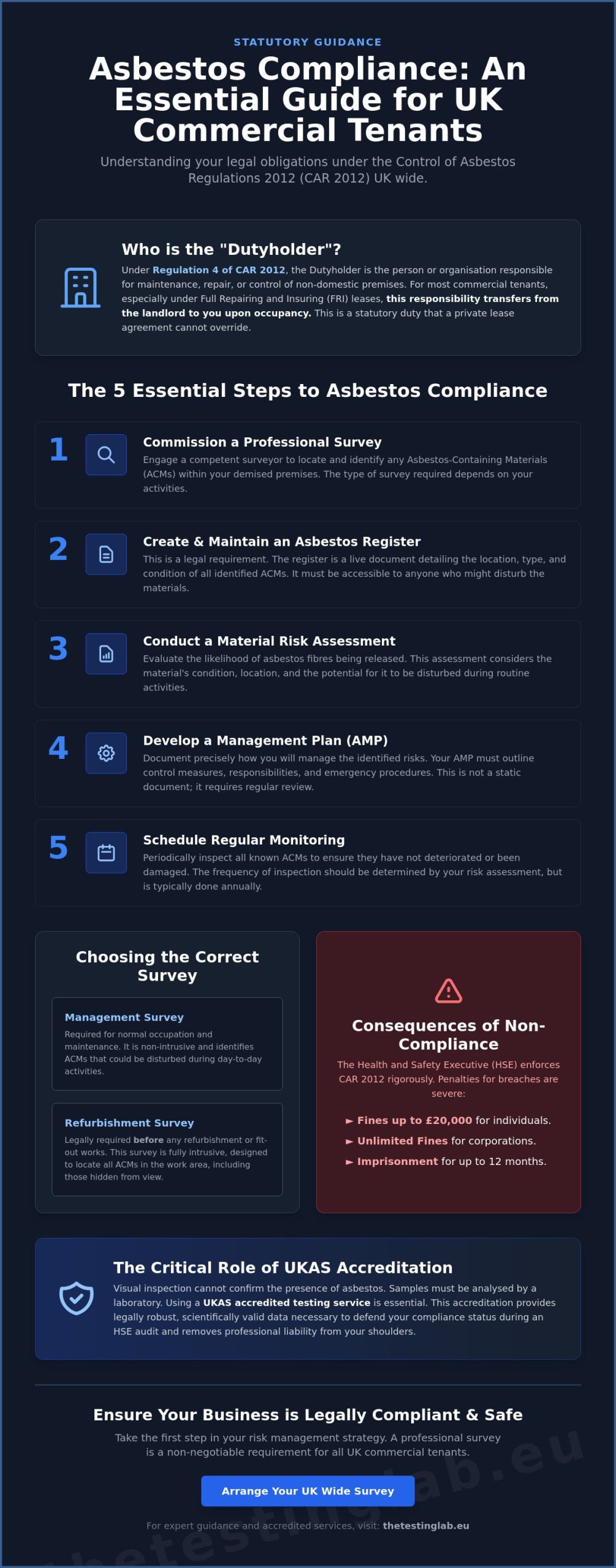
Under Regulation 4 of the Control of Asbestos Regulations (CAR) 2012, the Dutyholder is defined as the person or organisation that has clear responsibility for the maintenance or repair of non-domestic premises, or who has control over the building’s access. While a lease is a private contract, it doesn’t override statutory health and safety law. If the law says you’re responsible for the air your employees breathe, a landlord’s verbal promise won’t protect you from a Health and Safety Executive (HSE) investigation.
The Role of the Tenancy Agreement
Most commercial leases in the UK are “Full Repairing and Insuring” (FRI) agreements. These contracts typically transfer all maintenance and repair responsibilities to the tenant. In these scenarios, the tenant becomes the primary Dutyholder. In multi-occupancy buildings, the division of responsibility is more nuanced. Landlords usually manage common areas like lobbies and stairwells, while tenants are responsible for their specific demised areas. You must review your lease terms carefully to confirm where your liability starts. A lack of clarity in a contract doesn’t absolve you from understanding asbestos risks and acting accordingly to protect occupants.
Consequences of Non-Compliance
The HSE enforces these regulations with significant weight because asbestos remains a major health hazard. For individuals or small businesses, failing to adhere to asbestos compliance for commercial tenants can result in fines of up to £20,000 or imprisonment for up to 12 months. Serious breaches, especially those involving corporate entities, can lead to unlimited fines and severe reputational damage. Compliance isn’t a box-ticking exercise; it’s a critical safety protocol. To ensure your premises meet these standards, visiting a specialist asbestos and legionella surveying resource is a logical first step in your risk management strategy.
Asbestos Compliance Checklist: 5 Essential Steps for Tenants
Maintaining asbestos compliance for commercial tenants is a continuous process that extends far beyond an initial inspection. It requires a systematic approach to identify hazards and implement controls that protect everyone on-site. Following these five steps ensures your business meets its statutory obligations UK wide while minimizing operational risks.
- Step 1: Professional Survey. Commission a survey to locate any asbestos-containing materials (ACMs) within your demised area.
- Step 2: Asbestos Register. Create a centralized record detailing the location, type, and condition of all identified asbestos.
- Step 3: Material Risk Assessment. Evaluate the likelihood of fiber release based on the material’s current state and its vulnerability to disturbance.
- Step 4: Management Plan (AMP). Document how you intend to manage the risks, including who is responsible for oversight.
- Step 5: Regular Monitoring. Schedule periodic inspections to ensure ACMs haven’t deteriorated over time.
Commissioning the Right Asbestos Survey
You must select the correct survey type based on your current business activities. A Management Survey is standard for daily operations; its purpose is to locate ACMs that could be damaged during normal occupancy. However, if you’re planning a shop fit-out or office partitioning, a Refurbishment Survey is legally required before work begins. This is more intrusive and targets areas that are usually inaccessible. To ensure your data is legally robust, always utilize UKAS accredited asbestos testing. This validation provides the technical certainty needed to defend your compliance status during an HSE audit.
Developing a Living Management Plan
An Asbestos Management Plan isn’t a static document to be filed away. It’s a living protocol that must be shared with employees, visiting contractors, and maintenance teams. Every person who might disturb the building’s fabric needs to see your Asbestos Register first. Your plan should also include clear emergency procedures. If a ceiling tile containing asbestos is accidentally broken, your staff must know how to evacuate the area and seal it off immediately. For businesses managing multiple sites, consulting a specialist in asbestos and legionella surveying can help standardize these safety workflows across your entire portfolio.
Mitigating Risk through UKAS Accredited Lab Analysis
A visual inspection provides a preliminary assessment, but it cannot confirm the presence or concentration of microscopic fibres. For absolute certainty, bulk identification through a laboratory is the only method to ensure asbestos compliance for commercial tenants. Relying on “presumed” asbestos often leads to unnecessary costs or, worse, dangerous exposure during minor repairs. Engaging a professional asbestos consultancy shifts the technical burden from your management team to qualified experts who use high-resolution microscopy to identify specific fibre types. This scientific approach is essential for maintaining safety standards across your premises UK wide.
The Importance of UKAS Accreditation
HSE inspectors and commercial insurers require evidence that is legally defensible. A survey without UKAS accredited lab results is technically incomplete. During asbestos sample analysis, technicians examine the morphology of fibres to provide a definitive result. Your certificate of analysis should clearly state the sample location, the material type, and the accreditation number of the laboratory. This precision removes the guesswork, allowing you to manage your premises with data-driven confidence rather than speculation. It’s the difference between a simple observation and a verified safety record.
Professional Consultancy as a Strategic Partner
The Testing Lab PLC acts as a strategic partner to help you discharge your legal duties UK wide. We don’t just provide raw data; we provide solutions that integrate your environmental safety requirements. Many of our clients choose to combine their asbestos management with Legionella risk assessment services to create a unified safety framework. This holistic approach ensures that all building-related risks are monitored under a single, rigorous standard of quality, reducing the administrative load on your business.
Maintaining high standards across all building services is a hallmark of professional facility management. For organizations seeking to complement their safety protocols with sustainable infrastructure, Eco Light Services delivers a managed Lighting-as-a-Service solution that prioritizes performance and compliance.
Once you’ve identified the risks, transitioning from basic compliance to total safety often involves professional air monitoring. This process ensures that the air remains below the statutory control limit of 0.1 fibres per cubic centimetre. To secure your business and protect your workforce, you can request a fixed-fee site survey today. This proactive step provides the technical foundation for a safe, compliant, and legally robust commercial environment.
Securing Your Statutory Compliance in 2026 and Beyond
Maintaining asbestos compliance for commercial tenants is a continuous obligation that requires technical precision and legal foresight. By identifying your Dutyholder status and moving beyond basic visual inspections, you protect both your workforce and your corporate reputation. As we move through 2026, the emphasis on independent verification and high-quality data has never been higher. Relying on scientifically robust surveys ensures that your business remains on the right side of the Health and Safety Executive.
Our team provides the strategic partnership you need to manage these risks effectively. With our UKAS Accredited Laboratory and Independent 4-Stage Air Clearance Specialists, we offer UK wide coverage for commercial tenants seeking absolute certainty. Don’t leave your legal standing to chance or vague lease clauses. Take the final step toward a safe, fully documented premises today.
Request a UKAS Accredited Asbestos Survey for Your Commercial Premises. We’re ready to help you build a safer, more compliant workspace.
Frequently Asked Questions
Is a commercial tenant always responsible for asbestos surveys?
Legal responsibility follows the maintenance and repair obligations defined in your tenancy agreement. If you occupy a building under a Full Repairing and Insuring (FRI) lease, you’re almost certainly the primary Dutyholder for your demised area. In multi-let premises, the landlord usually manages the common parts, while the tenant assumes responsibility for the internal space they control.
What happens if I disturb asbestos during an office refurbishment?
You must stop work immediately, evacuate the area, and seal it off to prevent the spread of airborne fibres. Disturbance is a critical incident that requires an emergency assessment by a UKAS accredited professional to determine the extent of contamination. Maintaining asbestos compliance for commercial tenants means having these emergency protocols documented and understood by all staff before any structural work begins.
How often should an asbestos management plan be reviewed by a tenant?
You should review your asbestos management plan at least every 12 months to ensure all information remains accurate. An immediate review is also mandatory if there’s a change in the building’s use, structural alterations are planned, or if you suspect the condition of identified materials has deteriorated. This proactive cycle of monitoring is a core requirement for businesses operating UK wide.
Can I use a landlord’s old asbestos survey for my own compliance?
You can use an existing survey only if it’s still accurate, covers your specific area of occupation, and was conducted by a competent surveyor. However, older surveys often lack the technical depth required for modern safety standards or may not be suitable for planned refurbishment works. To guarantee asbestos compliance for commercial tenants, commissioning a fresh assessment with UKAS accredited lab data is the most reliable way to discharge your legal duties.

Article by
P J F Thomas
CEO and Founder of TTL plc.
Disclaimer
Items declared are AI generated but do reflect our services. Please get in contact if you have any questions.