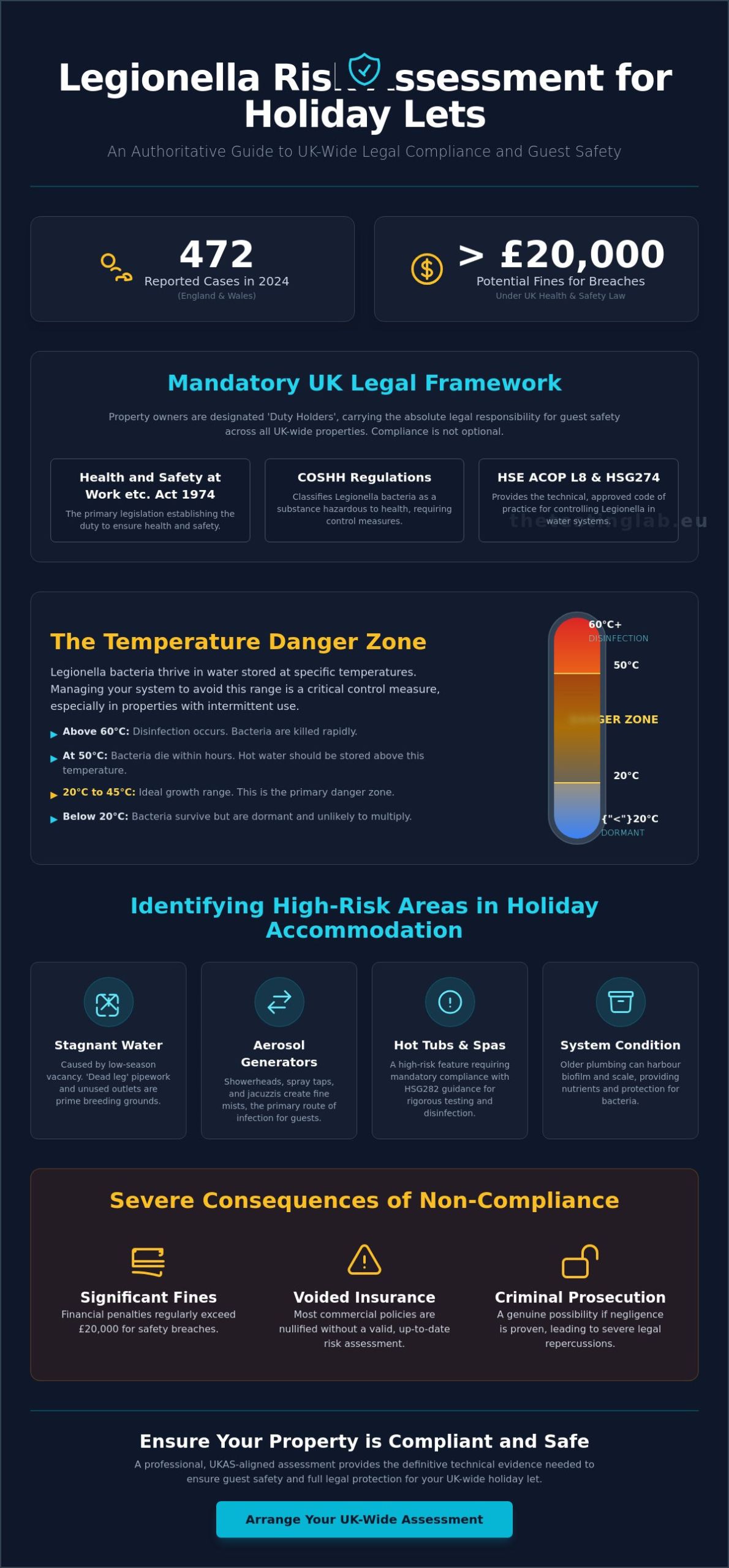
With 472 reported cases of Legionnaires’ disease in England and Wales in 2024, the technical reality of water safety has never been more critical for property owners. For those managing short-term rentals, a legionella risk assessment for holiday lets isn’t just an administrative box to tick; it’s a vital safeguard against fines that can exceed £20,000 and the serious health risks associated with stagnant water. You’re likely familiar with the anxiety that comes from managing vacant periods or the confusion surrounding different landlord regulations across the UK.
It’s understandable to feel overwhelmed by the technicalities of the Health and Safety at Work etc. Act 1974, but ensuring your rental meets UK-wide standards doesn’t have to be a source of stress. This authoritative 2026 guide provides the precision you need to manage your water systems with confidence, moving from regulatory uncertainty to a state of total compliance. We’ll examine the latest legal obligations, provide an actionable maintenance checklist for your properties, and show you how a scientific approach to risk management protects both your guests and your business.
Key Takeaways
- Learn the systematic approach required for a legionella risk assessment for holiday lets to meet mandatory COSHH and Health and Safety at Work Act 1974 standards.
- Pinpoint high-risk zones in your property, focusing on stagnant water hazards that escalate during low-season vacancy periods.
- Master critical temperature control boundaries to prevent water systems from becoming breeding grounds for bacteria between 20°C and 45°C.
- Determine when your specific water system requires professional UK-wide oversight rather than a basic DIY assessment.
- Understand how UKAS-aligned laboratory analysis provides the definitive technical evidence needed to ensure guest safety and legal protection.
Legionella Legal Requirements for Holiday Lets in the UK
A legionella risk assessment for holiday lets is a specialized technical audit designed to map out every component of a water system. It’s a systematic evaluation required to identify conditions that promote the growth of Legionella pneumophila. Under the Health and Safety at Work Act 1974 and the Control of Substances Hazardous to Health (COSHH) Regulations, property owners are designated as ‘Duty Holders’. This role carries the absolute legal weight of ensuring guest safety for properties UK wide. You can access specialized support for these requirements through our local legionella surveying services, which provide the technical precision needed for full compliance.
Holiday lets present a unique risk profile compared to standard domestic tenancies. Intermittent occupancy leads to stagnant water in pipes, creating the perfect environment for bacterial colonization during vacant weeks. Understanding Legionnaires’ Disease and how it spreads through aerosolized water droplets is essential for any Duty Holder. You aren’t just managing a building; you’re managing a biological risk environment that requires methodical oversight.
The ACOP L8 and HSG274 Standards
The Health and Safety Executive (HSE) provides the Approved Code of Practice (ACOP L8) as the primary regulatory benchmark. For residential holiday accommodation, HSG274 Part 2 dictates the specific technical controls for hot and cold water systems. As of 2026, the standard for compliance requires clear, documented proof of these assessments to satisfy local authorities and mandatory licensing schemes. A verbal agreement or a simple walkthrough isn’t enough to meet these rigorous engineering standards. Every assessment must be recorded and accessible.
Consequences of Non-Compliance
Identifying High-Risk Areas in Holiday Accommodation
Aerosol generators are the delivery mechanism for infection. Showerheads, spray taps, and even decorative fountains create fine mists that guests can inhale. In traditional holiday cottages, older plumbing systems often harbour biofilm and scale. These deposits provide both nutrients and protection for bacteria, making them difficult to eradicate through simple flushing alone. Utilizing specialized Legionella risk assessment services can help map these vulnerabilities before guests arrive.
Legionella Risks in Hot Tubs and Spas
Managing Vacant Properties
The ‘dead leg’ problem occurs when unused pipework creates pockets of stagnant water that don’t get cleared by normal tap usage. For properties empty for more than a week, flushing protocols are essential. You should run all outlets for several minutes to refresh the system. Following the Legionella Legal Requirements for Holiday Lets ensures these operational risks are documented and mitigated. If you’re managing multiple units, a strategic approach to water management is the only way to guarantee consistency across your portfolio.
Professional Assessment vs. DIY: Ensuring UK-Wide Safety
While the HSE guidance on Legionella for landlords states that a simple assessment can be performed by a competent person, the technical complexity of modern holiday lets often demands professional oversight. Properties featuring complex plumbing architectures, guest hot tubs, or large storage tanks present risks that a basic DIY walkthrough might overlook. A professional legionella risk assessment for holiday lets provides a precise, forensic evaluation of your water systems. This ensures your property meets the highest safety standards UK wide. Our team provides specialized legionella surveying to ensure every technical detail is covered.
A significant advantage of choosing a professional partner is the integration of UKAS-aligned laboratory analysis. While many competitors focus solely on visual inspections, empirical data from accredited lab testing provides the ultimate layer of safety. This scientific approach is critical for commercial rentals where guest turnover is constant. If a health claim occurs, a professional report acts as a superior legal defense. It provides documented proof that you’ve fulfilled your duty of care with technical diligence. The Testing Lab PLC serves as a strategic partner in this process, removing the weight of professional liability from your shoulders.
What to Expect During a Professional Survey
A professional survey is a methodical process. Technicians perform a physical inspection of all water outlets, cold water storage tanks, and heaters. They conduct temperature profiling to identify thermal danger zones and areas of stagnation. The result is a detailed report that prioritizes remedial actions based on a systematic risk matrix. This allows you to address the most critical issues first, ensuring efficient resource allocation for your maintenance budget.
Maintaining Your Compliance Record
Keeping accurate records is a non-negotiable part of UK safety legislation. You must retain all assessment documentation and monitoring logs for at least five years. A re-assessment is necessary if there are significant changes to the plumbing system, if the building’s use changes, or if control measures appear to be failing. To secure your property’s safety profile, you can Request a quote for a professional Legionella survey. This proactive step ensures your compliance record remains impeccable and your guests stay protected.
Securing Your Rental’s Future and Guest Safety
Mastering Legionella compliance means moving beyond a simple checklist to a systematic water management strategy. You now understand the legal necessity of identifying thermal danger zones and the importance of professional oversight for complex holiday amenities like hot tubs. A professional legionella risk assessment for holiday lets is the cornerstone of this protective framework, ensuring your business remains resilient against health risks and legal liabilities. It’s about shifting from reactive maintenance to a state of proactive, documented safety.
Protecting your reputation requires the technical precision of UKAS accredited laboratory testing and authoritative compliance reporting. We provide comprehensive national coverage UK wide, acting as your strategic partner to take the weight of professional responsibility off your shoulders. Our methodology ensures that every point of your water system is accounted for, from traditional cottage plumbing to modern spa facilities. This level of detail provides the robust legal defense necessary in the current regulatory climate.
Book your UK-wide Legionella risk assessment with The Testing Lab PLC and gain the peace of mind that comes with expert water management. Your commitment to safety today ensures a thriving, compliant rental business for years to come.
Frequently Asked Questions
Is a Legionella risk assessment a legal requirement for holiday lets?
Yes, it is a mandatory legal requirement for all short-term rental properties in the UK. This obligation falls under the Health and Safety at Work etc. Act 1974 and the Control of Substances Hazardous to Health (COSHH) Regulations. Duty holders must ensure that a legionella risk assessment for holiday lets is conducted to identify and manage potential bacterial growth. Failure to comply can result in substantial fines exceeding £20,000 and potential criminal prosecution.
How often should I carry out a Legionella risk assessment on my holiday cottage?
You should review your assessment regularly to ensure the documented control measures remain effective. While the Health and Safety Executive (HSE) doesn’t specify a fixed timeframe, industry best practice suggests a full review every two years. Immediate re-assessments are necessary if you modify the plumbing system, change the building’s use, or if monitoring results indicate the current regime is failing. This proactive approach maintains safety standards UK wide.
Can I perform the Legionella risk assessment myself as the property owner?
You can legally carry out the assessment yourself if you are “competent” to do so. Competence is defined by having the necessary skills, knowledge, and experience to identify and manage the specific risks in your water system. However, many holiday rentals feature complex amenities like hot tubs or large storage tanks that require technical expertise. Professional oversight is often preferred to ensure a robust legal defense and total technical accuracy.
What are the specific Legionella rules for holiday lets with hot tubs?
Properties featuring hot tubs must comply with the HSG282 guidance for commercial spa pools. These installations are high-risk because they operate at ideal bacterial growth temperatures and generate significant aerosols. Compliance requires daily water quality checks, documented disinfection procedures, and regular microbiological testing. A legionella risk assessment for holiday lets with these features must be significantly more detailed than those for properties with standard domestic plumbing.
What should be included in a holiday let Legionella risk assessment report?
A compliant report must include a detailed schematic or description of the water system, identifying all potential risk areas like dead legs or cold water tanks. It should outline specific control measures, such as temperature monitoring and flushing regimes. The document must also provide a prioritized list of remedial actions and a clear schedule for ongoing monitoring. This technical evidence is vital for satisfying insurance requirements and local authority safety audits.
Do I need to test the water for Legionella if my holiday let is on a mains supply?
While the risk assessment itself is a mandatory requirement for all properties, laboratory water sampling isn’t always necessary for simple systems on a mains supply. Sampling becomes a requirement if the assessment identifies high-risk areas or if temperature controls aren’t consistently met. If your property has been vacant for extended periods or features complex plumbing, empirical testing provides the technical verification needed to ensure the water is safe for guest use.

Article by
P J F Thomas
CEO and Founder of TTL plc.
Disclaimer
Items declared are AI generated but do reflect our services. Please get in contact if you have any questions.