Most property managers assume a legionella risk assessment is simply a form to fill in and file away. It isn’t. In 2026, UK regulations demand a genuinely systematic, evidence-based approach, and the gap between a tick-box exercise and a legally defensible assessment can expose your organisation to serious enforcement action.
If you’re feeling uncertain about where your duties begin and end, you’re not alone. The Health and Safety at Work Act 1974, the Control of Substances Hazardous to Health Regulations, and the HSE’s Approved Code of Practice L8 create overlapping obligations that can be genuinely difficult to interpret without specialist knowledge. That confusion is understandable, but it’s also a risk you can’t afford to leave unresolved.
This guide gives you a practical, authoritative legionella risk assessment checklist UK property owners and duty holders can rely on. We’ll walk through every stage of a compliant assessment, from identifying at-risk water systems to documenting your control measures in a format that stands up to inspection. Whether you’re approaching this for the first time or reviewing an existing programme, you’ll leave with a clear, structured plan and the confidence to act on it.
Key Takeaways
- Legionella bacteria pose a serious and legally recognised health risk in UK buildings — understanding where and how it proliferates is the foundation of any compliant water management programme.
- Using a structured legionella risk assessment checklist UK duty holders can rely on ensures your water systems are evaluated systematically, not just superficially documented.
- UK regulations in 2026 — spanning the Health and Safety at Work Act 1974, COSHH, and HSE ACoP L8 — create specific, enforceable obligations that go well beyond a one-off inspection.
- Integrating your legionella assessment with other building safety protocols, such as fire and asbestos risk assessments, produces a more defensible and operationally coherent safety management framework.
- A UKAS accredited assessment not only satisfies regulatory scrutiny but provides the independent evidential weight that protects your organisation if enforcement action is ever taken.
Understanding Legionella: Risks and Regulations in the UK
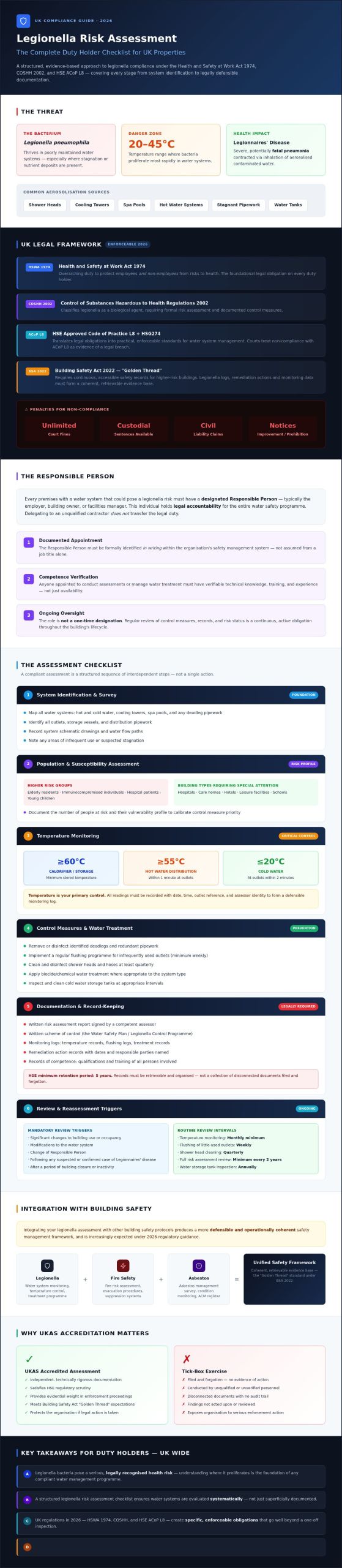
Legionella pneumophila is a waterborne bacterium that thrives in poorly maintained water systems, particularly where temperatures fall between 20°C and 45°C and stagnation or nutrient deposits are present. When contaminated water is aerosolised — through shower heads, cooling towers, or spa pools — and inhaled, it can cause Legionnaires’ disease: a severe, potentially fatal form of pneumonia. Pontiac fever, a milder flu-like illness, is also attributed to legionella exposure. The Health and Safety Executive (HSE) reports that Legionnaires’ disease cases in England and Wales are predominantly linked to identifiable water systems, making prevention a matter of direct duty holder accountability rather than chance.
The UK’s legal framework is layered but coherent once you understand how the instruments interact. The Health and Safety at Work Act 1974 establishes the overarching duty to protect employees and non-employees from risks to health. The Control of Substances Hazardous to Health Regulations 2002 (COSHH) classifies legionella as a biological agent, requiring formal risk assessment and control. HSE’s Approved Code of Practice L8 and the accompanying Technical Guidance HSG274 translate these obligations into practical, enforceable standards for water system management. Together, they form the regulatory spine that any legionella risk assessment checklist UK duty holders use must address.
Non-compliance carries real consequences. The HSE can issue Improvement Notices, Prohibition Notices, and prosecute under the Health and Safety at Work Act. Unlimited fines and custodial sentences are available to courts in serious cases. Civil liability claims following an outbreak can compound enforcement penalties significantly.
The Role of the Responsible Person
Every premises with a water system that could pose a legionella risk must have a designated Responsible Person. This individual, typically the employer, building owner, or facilities manager, holds legal accountability for ensuring a written risk assessment is conducted, a control scheme is implemented, and records are maintained. Critically, the Responsible Person doesn’t need to perform the assessment personally, but they must appoint someone with demonstrable competence to do so. Delegating to an unqualified contractor doesn’t transfer the legal duty; it compounds the risk if something goes wrong.
- Documented appointment: The Responsible Person should be formally identified in writing within the organisation’s safety management system.
- Competence verification: Anyone appointed to conduct assessments or manage water treatment must have the technical knowledge, training, and experience to do so effectively.
- Ongoing oversight: The role isn’t a one-time designation. Regular review of control measures, records, and risk status is an active, continuous obligation.
2026 Updates to Legionella Regulations
The regulatory direction in 2026 continues to emphasise structured documentation and accountability chains. Duty holders are increasingly expected to demonstrate not just that assessments were completed, but that findings were acted upon and reviewed at appropriate intervals. The Building Safety Act 2022’s influence on higher-risk buildings has reinforced expectations around the ‘Golden Thread’, which refers to the continuous, accessible record of safety-critical information about a building that must be maintained and updated throughout its lifecycle. For water safety, this means legionella risk records, remediation actions, and monitoring logs must form part of a coherent, retrievable evidence base, not a collection of disconnected documents filed and forgotten. A UKAS accredited assessment, such as those provided by The Testing Lab, produces the kind of independent, technically rigorous documentation that satisfies this evolving standard.
Using a structured legionella risk assessment checklist UK framework is no longer optional best practice; it’s the baseline expectation regulators and courts apply when scrutinising whether a duty holder has met their obligations.
The Comprehensive Legionella Risk Assessment Checklist
A compliant assessment isn’t a single action; it’s a structured sequence of interdependent steps, each building on the last. What separates a legally defensible programme from a paper exercise is the rigour applied at every stage. The following legionella risk assessment checklist UK duty holders can use in 2026 reflects the systematic methodology demanded by HSE ACoP L8 and HSG274.
Identifying Water Systems and Risks
Start by producing a comprehensive schematic of every water system on the premises. This isn’t limited to obvious sources. A thorough inventory must capture:
- Hot and cold water storage tanks, including any that are infrequently used or recently installed
- Cooling towers and evaporative condensers, which represent the highest-risk category under HSG274 Part 1
- Showers, spray taps, and thermostatic mixing valves, particularly in high-occupancy or healthcare settings
- Dead legs and infrequently used outlets, where stagnation creates ideal conditions for bacterial proliferation
- Spa pools, fountains, and humidifiers, which aerosolise water and carry direct inhalation risk
- Water features and irrigation systems accessible to the public or building occupants
For each system identified, assess the specific conditions that could support legionella growth: water temperature ranges, stagnation risk, the presence of biofilm-promoting materials, and the proximity of vulnerable populations such as elderly residents, immunocompromised individuals, or patients in clinical environments. Vulnerability profiling at this stage determines the priority order for control measures.
Documentation and Staff Training
Every finding must be recorded in a written risk assessment that includes the date of assessment, the identity and competence credentials of the assessor, a description of each water system evaluated, the risk rating assigned, and the control measures implemented or recommended. This isn’t optional documentation; it’s a statutory requirement under COSHH and the foundation of any enforcement defence.
Risk assessments must be reviewed whenever there’s reason to believe they’re no longer valid: after significant changes to the water system, following an outbreak, or at the intervals your control scheme specifies. A static document filed and forgotten doesn’t satisfy the ongoing obligation regulators expect.
Staff training is frequently underestimated as a control measure. Facilities personnel, maintenance contractors, and building managers should all understand how to recognise early warning signs, carry out temperature monitoring correctly, report anomalies, and follow the site’s written control scheme. Training records must be retained as part of the evidence base. A well-trained team is often the earliest detection mechanism available before a problem escalates into a reportable incident.
If you’re building or reviewing a water management programme and want independent, technically rigorous support, The Testing Lab’s UKAS accredited legionella risk assessments provide the structured, evidence-based documentation your programme needs to stand up to regulatory scrutiny.
Integrating Legionella Assessments with Other Health and Safety Protocols
Building safety doesn’t operate in silos. A legionella risk assessment conducted in isolation from your fire safety strategy, asbestos management plan, or structural risk records produces a fragmented evidence base that’s harder to act on and harder to defend. The most operationally coherent programmes treat water safety as one layer within a unified building safety management framework, where findings from each discipline inform and strengthen the others.
Consider the practical overlap: asbestos surveys frequently identify disturbed or deteriorating pipe lagging in plant rooms and roof voids, the same spaces where cold water storage tanks and hot water distribution systems are located. A fire risk assessment may flag compartmentation issues that affect ventilation patterns around cooling systems. When these assessments are conducted and reviewed in coordination, gaps that would otherwise go undetected become visible. That cross-disciplinary visibility is precisely what regulators expect under the Building Safety Act’s Golden Thread requirements for higher-risk buildings.
Integrating your legionella risk assessment checklist UK programme with other safety evaluations also produces more efficient scheduling, consolidated documentation, and clearer accountability chains. Instead of managing three separate review cycles with three separate contractors, a coordinated approach means remediation priorities can be ranked across risk types, resources allocated proportionally, and a single coherent safety record maintained for the building.
When to Seek Professional Guidance
Professional involvement is warranted whenever a water system’s complexity exceeds the competence available in-house, when a previous assessment hasn’t been reviewed in over two years, or when building use has changed significantly. It’s also advisable when you’re consolidating legionella records with other safety documentation for the first time. An independent assessor brings the methodological rigour and technical objectivity that internal reviews can rarely replicate, and their involvement creates a clear audit trail separating operational management from compliance verification. The Testing Lab’s asbestos consultancy and legionella services are designed to work in conjunction, giving duty holders a single, technically consistent source for their core environmental risk assessments.
The Role of Accredited Testing Laboratories
UKAS accreditation isn’t a marketing credential; it’s a technical standard. It means an independent body has verified that the laboratory’s assessment methodology, equipment calibration, and reporting processes meet defined criteria for competence and impartiality. For duty holders, that verification matters enormously when an assessment is scrutinised by the HSE or presented as evidence in legal proceedings. UKAS accredited services provide the independent, technically verified documentation that gives businesses a legally defensible foundation if enforcement action is ever taken.
Choosing accredited support for your legionella risk assessment checklist UK programme isn’t simply about satisfying a regulatory checkbox. It’s about building a safety management system that holds together under scrutiny, protects building occupants, and demonstrates the kind of systematic, evidence-based thinking that separates genuine compliance from paperwork.
Your Next Step Toward a Fully Compliant Water Safety Programme
A robust legionella risk assessment checklist UK duty holders can rely on isn’t built in a single afternoon. It requires systematic water system identification, rigorous documentation, trained personnel, and integration with your wider building safety framework. Get those elements right, and you have a programme that genuinely protects occupants and withstands regulatory scrutiny. Neglect any one of them, and the gaps become liabilities.
The regulatory expectations in 2026 are clear: evidence-based assessments, maintained records, and demonstrable action on findings. UKAS accredited, independent verification is the standard that separates a defensible compliance programme from paperwork that won’t hold up when it matters most.
The Testing Lab PLC combines accredited laboratory status with specialist expertise in legionella and environmental risk, giving duty holders a technically rigorous, independently verified foundation for their water safety obligations.
Don’t leave your compliance programme to chance. Request a Legionella Risk Assessment Quote today and take the first confident step toward a water management programme you can stand behind.
Frequently Asked Questions
What are the legal requirements for a legionella risk assessment in the UK?
UK duty holders are legally required to assess and control legionella risks under the Health and Safety at Work Act 1974, the Control of Substances Hazardous to Health Regulations 2002 (COSHH), and HSE’s Approved Code of Practice L8. These instruments collectively require a written risk assessment, a documented control scheme, and maintained records. The assessment must be carried out by a competent person, and the Responsible Person retains legal accountability regardless of who conducts it.
Failure to comply can result in HSE Improvement or Prohibition Notices, unlimited fines, and in serious cases, custodial sentences. Civil liability following a confirmed outbreak compounds those penalties further.
How often should legionella risk assessments be conducted?
There’s no single fixed interval prescribed by regulation, but HSE guidance makes clear that assessments must be reviewed whenever they may no longer be valid. In practice, most water safety professionals recommend a full reassessment every two years as a baseline, with more frequent reviews triggered by significant changes to water systems, building use, occupancy profile, or following any incident involving suspected legionella contamination.
Any legionella risk assessment checklist UK duty holders maintain should include a scheduled review date and clear criteria for early reassessment. A static document that isn’t revisited doesn’t satisfy the ongoing obligation regulators apply.
Can I perform a legionella risk assessment myself?
Technically, yes, but only if you can demonstrate genuine competence. HSE guidance is explicit that the assessor must have sufficient technical knowledge, training, and practical experience to identify risks accurately and recommend appropriate controls. In most commercial, residential, or public-facing premises, that standard isn’t met by an internal review alone, particularly for complex water systems like cooling towers or large hot and cold water distribution networks.
Where competence is genuinely in doubt, appointing an independent, UKAS accredited assessor is the more defensible approach. It creates a clear audit trail, separates operational management from compliance verification, and produces documentation that holds up under regulatory scrutiny.
What steps should be taken if legionella is detected in water systems?
Detection requires immediate, structured action. Isolate and restrict access to the affected system where safe to do so, notify your Responsible Person, and engage a competent water treatment specialist without delay. Depending on the setting and scale of contamination, you may also have reporting obligations under RIDDOR if a confirmed case of Legionnaires’ disease is linked to your premises. Remediation typically involves disinfection, temperature correction, and a thorough review of your control scheme to identify the failure point.
Once remediation is complete, your risk assessment must be reviewed and updated to reflect what changed, what was found, and what corrective measures were implemented. Retaining a clear chronological record of every action taken is essential, both for regulatory purposes and to demonstrate that your response was proportionate and systematic.

Article by
P J F Thomas
CEO and Founder of TTL plc.
Disclaimer
Items declared are AI generated but do reflect our services. Please get in contact if you have any questions.