Is your initial site budget a genuine saving, or is it actually a high-interest loan against your project’s future? With construction costs projected by RICS to rise by 6.6% through 2026, it’s understandable why developers seek early efficiencies. However, the risks of inadequate site investigation extend far beyond simple timeline shifts. They represent a fundamental threat to your legal standing and financial viability. In a regulatory climate where the Health and Safety Executive charges a Fee for Intervention of £188 per hour, overlooking ground conditions isn’t just a technical oversight; it’s a significant liability.
You probably feel the pressure of tightening margins and the fear of HSE intervention, especially given that construction fatalities reached 35 in the 2024/2025 period. This guide provides a clear justification for a thorough UK-wide investigation budget. You’ll learn how to navigate the requirements of the new Building Safety Regulator, established in January 2026, and protect your development from unforeseen remediation costs. By leveraging professional soil analysis and asbestos consultancy, you can mitigate structural and environmental hazards before they become insurmountable. We’ll show you how to transform site analysis from a box-ticking exercise into a strategic asset for project success.
Key Takeaways
- Identify why unforeseen ground conditions remain the leading cause of project delays and learn to prevent budget overruns through precise subsurface analysis.
- Clarify your legal obligations under CDM 2015 to ensure your UK-wide projects meet the stringent pre-construction information standards required by the HSE.
- Evaluate the critical risks of inadequate site investigation, including the physical, chemical, and biological hazards that can compromise structural integrity.
- Master the multidisciplinary approach to risk mitigation by integrating comprehensive desk studies with targeted UKAS-accredited laboratory soil testing.
- Protect your development’s future by implementing professional asbestos consultancy and Legionella risk assessments to manage long-term environmental liabilities.
The Financial and Operational Impact of Unforeseen Ground Conditions
Cost Overruns and Project Delays
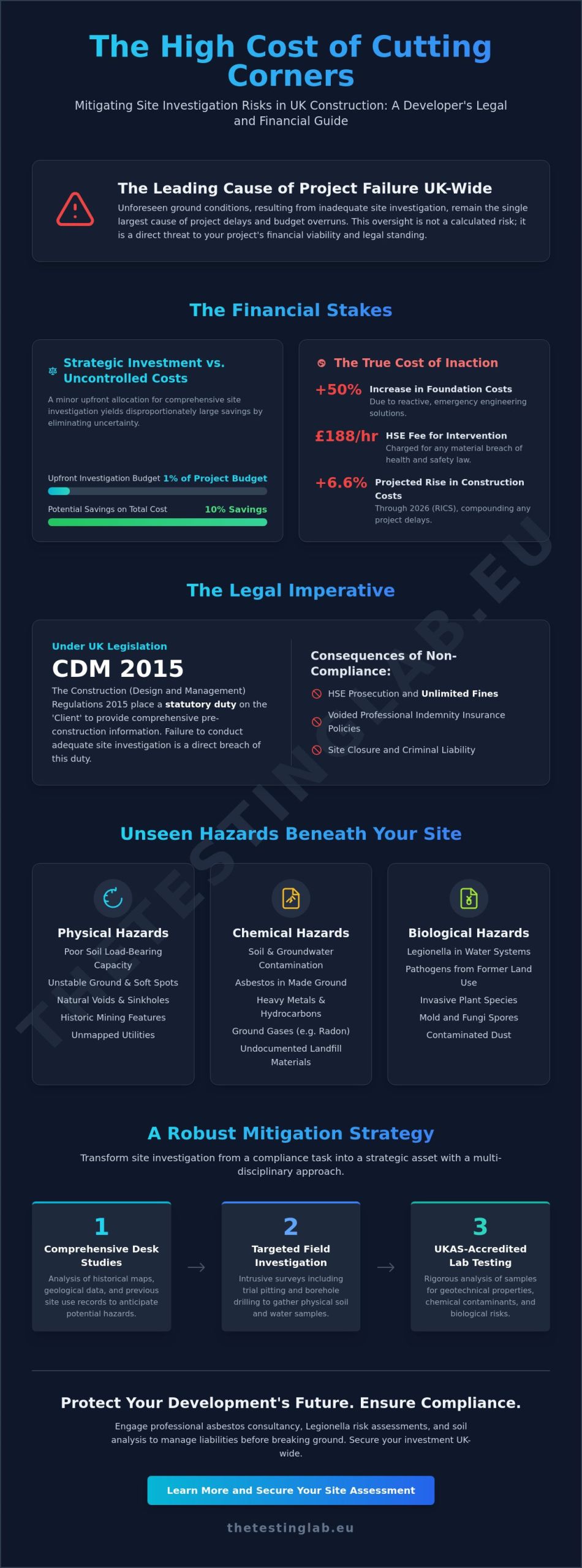
Hidden geotechnical features, such as natural voids or historic mining features, can halt a project for months. These delays often occur when the risks of inadequate site investigation are ignored in favour of rapid site commencement. By employing comprehensive Geotechnical investigation methods, teams can identify these anomalies before they become critical failures. The cost of emergency redesigns is astronomical compared to the upfront investment in professional surveys. Strategic logic dictates that allocating 1% of the total project budget to site investigation can save 10% on total construction costs by eliminating the uncertainty that leads to expensive variations.
Structural Failure and Long-term Remediation
The impact of poor soil load-bearing analysis extends far beyond the initial handover. Inaccurate data affects building longevity and significantly increases insurance premiums. Identifying sinkholes and seismic risks through field exploration and UKAS-accredited laboratory testing is a non-negotiable step for any professional developer. Beyond physical stability, chemical hazards must be identified early to avoid long-term remediation liabilities. Failing to account for these factors through rigorous testing, including specialised asbestos consultancy where brownfield risks exist, creates a legacy of structural and environmental risk that can devalue a site permanently.
Legal Liability and Regulatory Non-Compliance in the UK
UK-wide developers are bound by the Construction (Design and Management) Regulations 2015 (CDM 2015). This legislation places a clear burden on the ‘Client’ to ensure that all pre-construction information is comprehensive and accurate. When you overlook the risks of inadequate site investigation, you are essentially breaching your statutory duties. The Health and Safety Executive (HSE) remains vigilant on this front; they even provide specific HSE guidance on temporary works failures which cites insufficient ground analysis as a primary cause of site accidents. Failing to deliver this data isn’t just a project management flaw; it’s a criminal risk that can lead to prosecution and unlimited fines.
Your professional indemnity insurance is another area of significant concern. Most policies require developers to act with reasonable skill and care, which includes following professional recommendations for site surveys. If you ignore these expert warnings to save on upfront costs, your insurer may refuse to cover claims related to foundation failure or environmental contamination. This leaves your business directly liable for remediation costs that often reach six or seven figures, potentially bankrupting a project before it’s even completed.
The HSE Framework and CDM 2015 Compliance
Compliance isn’t just about safety; it’s about project continuity. Failing to identify hazardous materials before breaking ground can lead to immediate HSE intervention and site closure. By integrating asbestos consultancy services into your initial planning, you provide the necessary pre-construction information to keep contractors safe and regulators satisfied. This proactive approach is the only way to avoid the risks of inadequate site investigation while maintaining your legal standing in the UK construction sector.
Environmental Liability: Asbestos in Soils and Waste Classification
Incorrectly classifying waste soil under WM3 guidance is a major financial trap. If you fail to detect asbestos in soils, you risk mismanaging landfill disposal and incurring significant HMRC LOI fines. Professional HMRC LOI fines testing ensures that your waste streams are legally compliant and tax-efficient. For developers managing multiple UK-wide sites, this level of precision is essential to avoid unexpected tax liabilities. If you’re unsure about your site’s current status, getting a professional assessment is the most reliable way to mitigate these legal and environmental risks.
Implementing a Robust Site Investigation Strategy for Risk Mitigation
A robust strategy begins with a comprehensive desk study, followed by targeted field sampling and UKAS-accredited laboratory analysis. To fully address the risks of inadequate site investigation, developers must adopt a multidisciplinary approach that encompasses geotechnical, chemical, and biological assessments. UKAS accreditation is the gold standard for site investigation data accuracy in the UK. Beyond the initial build, regular monitoring of groundwater and soil gas prevents long-term occupational hygiene issues for future building occupants. This methodical progression ensures that every decision is backed by empirical evidence rather than optimistic assumptions.
The Role of UKAS Accredited Laboratory Analysis
Raw data is essentially useless without a verified chain of custody and accredited validation. For developers managing projects UK wide, the necessity of WAC (Waste Acceptance Criteria) testing is paramount for planning off-site soil disposal and avoiding landfill surcharges. This level of technical precision is central to our pillar page for London and UK-wide surveying, which serves as a benchmark for compliant development. Without this validation, your project remains vulnerable to regulatory challenges and unforeseen environmental liabilities that could have been identified during the sampling phase.
From Desk Study to 4-Stage Clearance
A phased approach allows for budget flexibility while maintaining safety at every milestone. While many focus solely on ground stability, a truly robust strategy addresses hidden pathogens that often go unnoticed during standard surveys. Integrating Legionella risk assessments into site redevelopment and water management is vital for preventing post-construction health crises. By combining these biological checks with fire risk assessments and 4-stage asbestos clearance during the structural survey phase, you effectively eliminate the risks of inadequate site investigation. This integrated methodology doesn’t just protect the workforce; it secures the long-term operational viability of the asset.
Securing Project Viability through Precision Analysis
Whether you’re navigating London or UK-wide surveying requirements, professional oversight is your best defense against unforeseen ground conditions. Our national UK-wide service coverage provides the strategic partnership needed to take the weight of professional responsibility off your shoulders. Don’t leave your project’s safety and financial health to chance.
Request a UK-wide site investigation quote from our UKAS accredited specialists to secure your project’s future. Taking this proactive step allows you to build with confidence, knowing your site is safe, compliant, and ready for development.
Frequently Asked Questions
What are the most common risks of inadequate site investigation in the UK?
The most common risks include unforeseen ground conditions such as sinkholes, chemical contamination, and unmapped utilities. These issues lead to structural instability and massive budget overruns. For UK-wide developers, ignoring these hazards often results in project delays that exceed several months. Precise geotechnical and chemical analysis is the only way to transform these unknown variables into manageable engineering data that protects your investment.
How does CDM 2015 affect my responsibility for site investigation?
CDM 2015 mandates that the Client is responsible for providing comprehensive pre-construction information to all designers and contractors. If you fail to do this, you’re in material breach of health and safety law. The risks of inadequate site investigation include being charged the HSE Fee for Intervention, which is £188 per hour as of April 2026. This legal framework ensures safety is prioritized from the earliest design stages.
Can I use a preliminary desk study as my final site investigation report?
No, a preliminary desk study is merely the foundational step of a multi-phased investigation strategy. It identifies historical usage and potential hazards but cannot quantify current soil strength or contamination levels. You must follow a desk study with intrusive field sampling and UKAS-accredited laboratory analysis to confirm the site’s safety. Relying on paper records alone leaves you vulnerable to physical hazards that only physical testing can reveal.
What happens if asbestos is found in the soil after construction has started?
Finding asbestos post-commencement triggers an immediate work stoppage and mandatory site closure under the Control of Asbestos Regulations. You’ll need to engage a UKAS accredited consultancy to perform emergency soil testing and air clearance. This reactive approach is significantly more expensive than proactive UK-wide surveying. It often results in prolonged project shutdowns and potential HSE prosecution for failing to identify the hazard during the planning phase.

Article by
P J F Thomas
CEO and Founder of TTL plc.
Disclaimer
Items declared are AI generated but do reflect our services. Please get in contact if you have any questions.