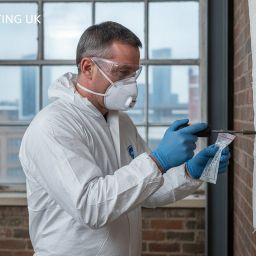
A demolition survey isn’t a mere box-ticking exercise; it’s a destructive forensic investigation where missing a single square inch of material can lead to catastrophic project failure or criminal prosecution. You likely understand that managing a site UK wide involves balancing tight deadlines with the heavy burden of the Control of Asbestos Regulations 2012. It’s stressful to think that undiscovered asbestos could halt your machinery and drain your budget overnight. This guide will help you master the specific asbestos demolition survey requirements needed to maintain total regulatory compliance and ensure site safety in 2026. We’ll break down the technical standards of HSG264, the necessity of UKAS accreditation, and how to transition from a forensic survey to a safe demolition without delays. From understanding the role of a specialist asbestos consultancy to managing the new digital consignment notes for waste, you’ll gain the clarity needed to protect your team and your bottom line.
Key Takeaways
- Identify the legal mandate for Refurbishment and Demolition (R&D) surveys under CAR 2012 for all UK buildings constructed before 2000.
- Master the technical asbestos demolition survey requirements, specifically the necessity for destructive access to structural voids and total building vacancy.
- Confirm why UKAS accreditation to ISO 17020 is the non-negotiable standard for ensuring technical competence and legal defensibility.
- Learn how to leverage integrated consultancy and 4-stage air clearance to ensure a seamless, compliant transition to demolition UK wide.
Legal Framework: UK Asbestos Demolition Survey Requirements
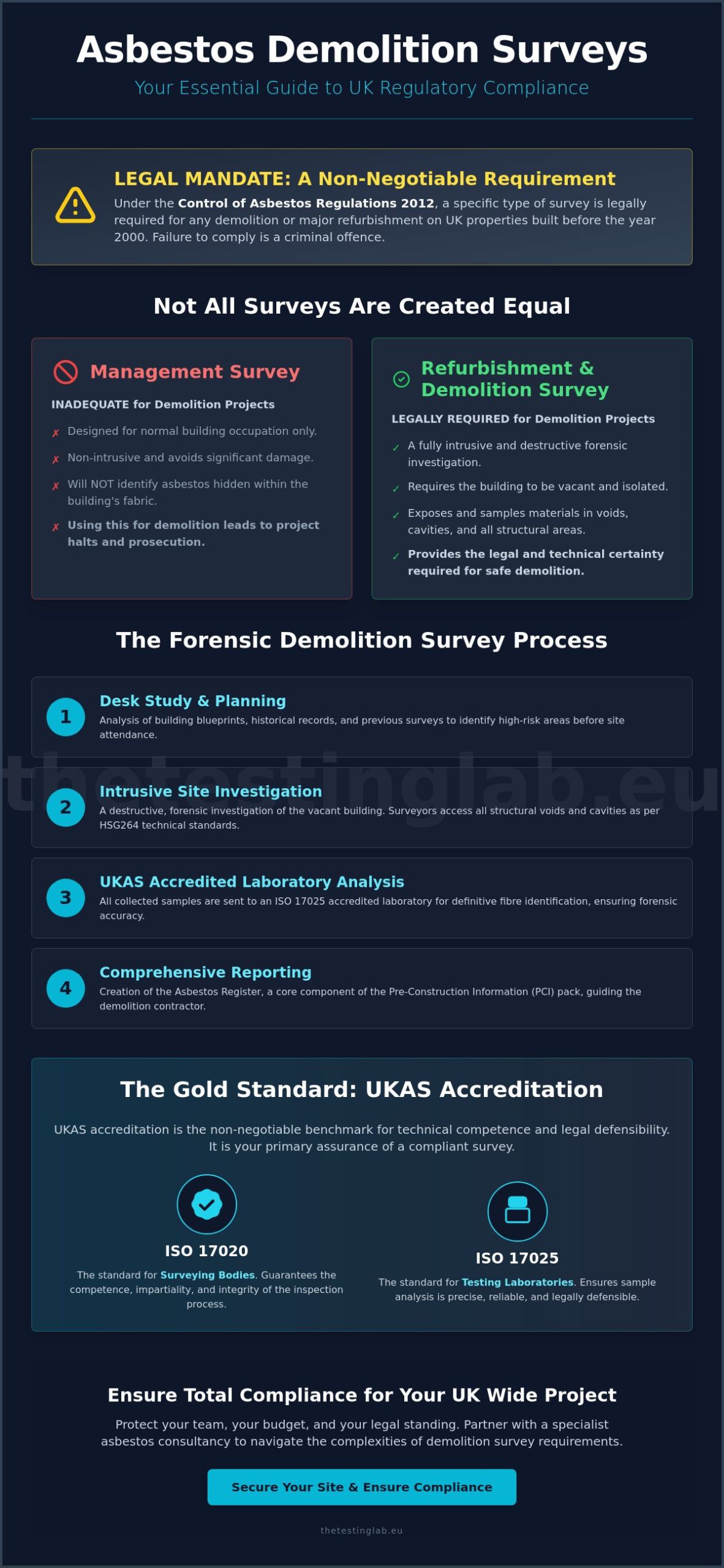
Compliance isn’t optional for any project involving structures built before 2000. Under the UK Asbestos Regulations, specifically the Control of Asbestos Regulations 2012 (CAR 2012), you’re legally bound to identify hazardous materials before a single brick is moved. While a Management Survey suffices for day to day building occupation, it’s entirely inadequate for structural changes. You need a Refurbishment and Demolition (R&D) survey. This is a fully intrusive, destructive investigation designed to find asbestos hidden within the fabric of the building that a standard survey would miss.
A critical oversight in many UK wide projects is failing to align the survey with the Construction (Design and Management) Regulations 2015 (CDM 2015). Your asbestos demolition survey requirements dictate that the results must form a core part of the Pre-Construction Information (PCI). Without this data, the Principal Designer and Principal Contractor cannot fulfill their health and safety duties. Relying on a “presumption of asbestos” is a high risk strategy that won’t protect you in court; the law demands evidence based certainty before demolition begins.
The Legal Trigger for an R&D Survey
Regulatory Standards: HSG264 and Beyond
The Health and Safety Executive (HSE) sets the technical benchmark through HSG264, “Asbestos: The Survey Guide.” This document outlines exactly how surveys must be conducted to be legally valid. Navigating these complexities requires a strategic partner who understands the engineering behind the architecture. Our asbestos consultancy services ensure your project meets these rigorous standards from the initial scoping phase through to final site clearance.
Technical Standards for Refurbishment and Demolition Surveys
Demolition surveys aren’t just visual inspections; they’re aggressive, forensic engineering tasks. Unlike management surveys that assess materials during normal occupation, the asbestos demolition survey requirements demand a fully intrusive approach. This means surveyors must gain access to every structural void, cavity wall, and sub-floor. Achieving this level of detail requires destructive techniques, such as lifting floorboards or breaking into solid partitions, to ensure no hazardous material remains hidden. Following RICS best practice for asbestos surveys ensures that your project’s scope covers these high-risk areas before any heavy machinery arrives on site.
Safety management during this phase is paramount. The building must be vacant, as the intrusive nature of the work often releases dust or requires the isolation of utilities. UK wide, HSE standards dictate that sampling protocols must be representative and exhaustive. A surveyor doesn’t just take one sample; they must satisfy UKAS standards by sampling every unique material type across the entire structure. This data then forms the Asbestos Register, which becomes the primary technical specification for your demolition contractor. If you’re planning a complex project, you can request a technical quote to ensure your site meets these rigorous benchmarks.
Step-by-Step: The Demolition Survey Process
The process begins with a detailed desk study, where we analyze historical blueprints and previous management surveys to identify high-risk structural points. On-site, our team uses aggressive investigation techniques, utilizing specialized tools to uncover ACMs hidden within the building’s fabric. According to HSG264, a refurbishment and demolition survey must be fully intrusive and involve destructive inspection to penetrate all parts of the building structure as far as is reasonably practicable.
Laboratory Analysis and Reporting
Once samples are collected, they must undergo rigorous analysis to confirm fibre types. Precise identification is only possible through UKAS accredited asbestos testing at an ISO 17025 laboratory. This level of forensic accuracy is what prevents project delays and ensures that your demolition specification is legally defensible and technically sound.
Ensuring Compliance: Selecting a Competent UKAS Partner
Selecting a surveying partner is a decision that carries significant technical and legal weight. For any project UK wide, verifying UKAS accreditation to ISO 17020 is the non-negotiable standard for technical competence. This accreditation isn’t just a badge; it’s your assurance that the surveyor possesses the forensic expertise to meet asbestos demolition survey requirements without leaving your project exposed to hidden risks. A strategic partner does more than identify materials; they translate complex data into an actionable asbestos management plan that guides your demolition team safely.
The true value of a professional consultancy lies in integrated service delivery. When one partner handles the initial survey, laboratory analysis, and eventual 4-stage air clearance, the risk of “discovery delays” during the demolition phase is drastically reduced. Unplanned asbestos finds can halt a site for weeks, causing spiralling costs and missed deadlines. By using a partner with an engineering mindset, you ensure that the survey data is precise enough to form a definitive removal specification, removing the burden of professional liability from your shoulders.
Why Independence Matters in Testing
Speed and impartiality are the cornerstones of effective risk management. Utilizing an independent laboratory accredited to ISO 17025 prevents conflicts of interest and ensures that sample results are returned with the forensic accuracy required for high-stakes demolition. This independence is particularly vital in complex urban projects where timelines are compressed. For developers and site managers operating in the capital, our London asbestos and legionella surveying services provide the rapid, reliable data needed to keep projects moving.
Post-Survey Actions: Next Steps for Site Managers
Once you receive the survey report, the focus shifts to execution. You must review the findings to identify high-risk ACMs, such as asbestos insulation board or spray coatings, which legally require a licensed contractor for removal. The survey isn’t just a document; it’s a structural blueprint for safe site preparation. Use the data to isolate work areas and update your health and safety files before any mechanical demolition begins. To secure a technically robust assessment for your next project, you can request a quote for UK wide asbestos surveys and ensure total regulatory alignment.
Securing Your Project with Legislative Precision
Mastering the technical and legal complexities of building demolition requires more than just compliance; it demands a forensic approach to risk management. You’ve seen how the transition from management surveys to fully intrusive investigations is a mandatory safeguard under the Control of Asbestos Regulations 2012. By prioritizing UKAS accredited precision, you ensure that every structural void is accounted for, preventing the discovery delays that frequently derail projects UK wide. Meeting the specific asbestos demolition survey requirements is the only way to protect your team and your commercial interests from the severe penalties of non-compliance.
Our team operates as your strategic partner, taking the weight of professional liability off your shoulders through meticulous consultancy and rapid, independent laboratory analysis. We maintain dual accreditation to ISO 17020 and ISO 17025, ensuring that every sample is identified with absolute scientific certainty. When you’re ready to move from planning to execution with total confidence, contact The Testing Lab PLC for UK wide asbestos consultancy and accredited surveys. It’s time to build your project on a foundation of safety and methodological excellence.
Frequently Asked Questions
Is an asbestos survey a legal requirement before demolition in the UK?
Yes, conducting an asbestos survey is a mandatory legal requirement under Regulation 5 of the Control of Asbestos Regulations 2012. You cannot start demolition work on any building constructed before 2000 without first identifying all asbestos containing materials. Failing to secure a Refurbishment and Demolition survey before structural disturbance begins can lead to immediate site closure and criminal prosecution for duty holders.
What is the difference between a management survey and a demolition survey?
A management survey is a standard, non-intrusive inspection designed to manage asbestos during the normal occupation of a building. A demolition survey is a forensic, fully intrusive investigation that requires destructive access to all structural voids, cavities, and sub-floors. While management surveys focus on surface materials, demolition surveys aim to locate every hidden ACM within the building fabric to ensure total site safety.
Can I use a management survey for demolition work if it was done recently?
No, you cannot use a management survey to satisfy asbestos demolition survey requirements, regardless of how recently it was completed. Management surveys aren’t intrusive enough to uncover materials hidden behind walls or under floors. Relying on an outdated or incorrect survey type is a breach of CAR 2012 and creates a significant risk of accidental fibre release during the demolition phase.
Who is qualified to carry out an asbestos refurbishment and demolition survey?
The HSE recommends using surveyors accredited by UKAS to the ISO 17020 standard for all R&D surveys. A qualified surveyor must possess the technical competence to perform destructive inspections safely and the forensic expertise to identify diverse fibre types. Choosing an accredited consultancy ensures that your survey meets the technical benchmarks of HSG264 and is legally defensible across projects UK wide.
How long does an asbestos demolition survey take to complete?
The timeline varies based on the structure’s size, its complexity, and the degree of destructive access needed. A residential property might be surveyed in a single day, but complex industrial sites often require several weeks of intensive site work. Once the physical investigation is complete, independent laboratory analysis of collected samples typically requires an additional 24 to 48 hours for precise identification.
What happens if asbestos is found during the demolition survey?
If asbestos is identified, it must be documented in the Asbestos Register and removed by a competent contractor before demolition starts. High-risk materials often require a licensed removal specialist and a 14-day notification period to the HSE. After removal, the site must undergo a 4-stage clearance process to ensure the atmosphere is safe for the demolition crew to begin their work.

Article by
P J F Thomas
CEO and Founder of TTL plc.
Disclaimer
Items declared are AI generated but do reflect our services. Please get in contact if you have any questions.