With 472 reported cases of Legionnaires’ disease in 2024 alone, the risk to your business operations is far from theoretical. It’s understandable if you feel overwhelmed by the shifting frequency of mandatory inspections or the fear of heavy HSE penalties. Implementing a reliable commercial legionella testing UK regime across your portfolio requires more than just a box-ticking approach; it demands a precision-engineered strategy for managing water safety UK wide.
This guide will help you master the complexities of current legislation and discover how to implement a robust, UKAS-accredited water safety system for your property. We’ll explore the latest BS 7592:2022 standards and ACOP L8 requirements to ensure your water management process is both compliant and streamlined. By the end, you’ll have the professional clarity needed to protect your tenants and remove the weight of legal liability from your shoulders.
Key Takeaways
- Grasp the interplay between HSWA 1974 and COSHH to establish a legally defensible water safety framework for your premises.
- Master the sampling protocols required for commercial legionella testing UK to ensure every laboratory result meets rigorous BS 7592 standards.
- Implement a proactive, UK-wide management strategy that replaces reactive testing with documented, data-driven oversight across multiple locations.
- Leverage UKAS-accredited laboratory analysis to effectively transfer professional risk and guarantee the safety of your employees and tenants.
UK Legal Requirements for Commercial Legionella Control
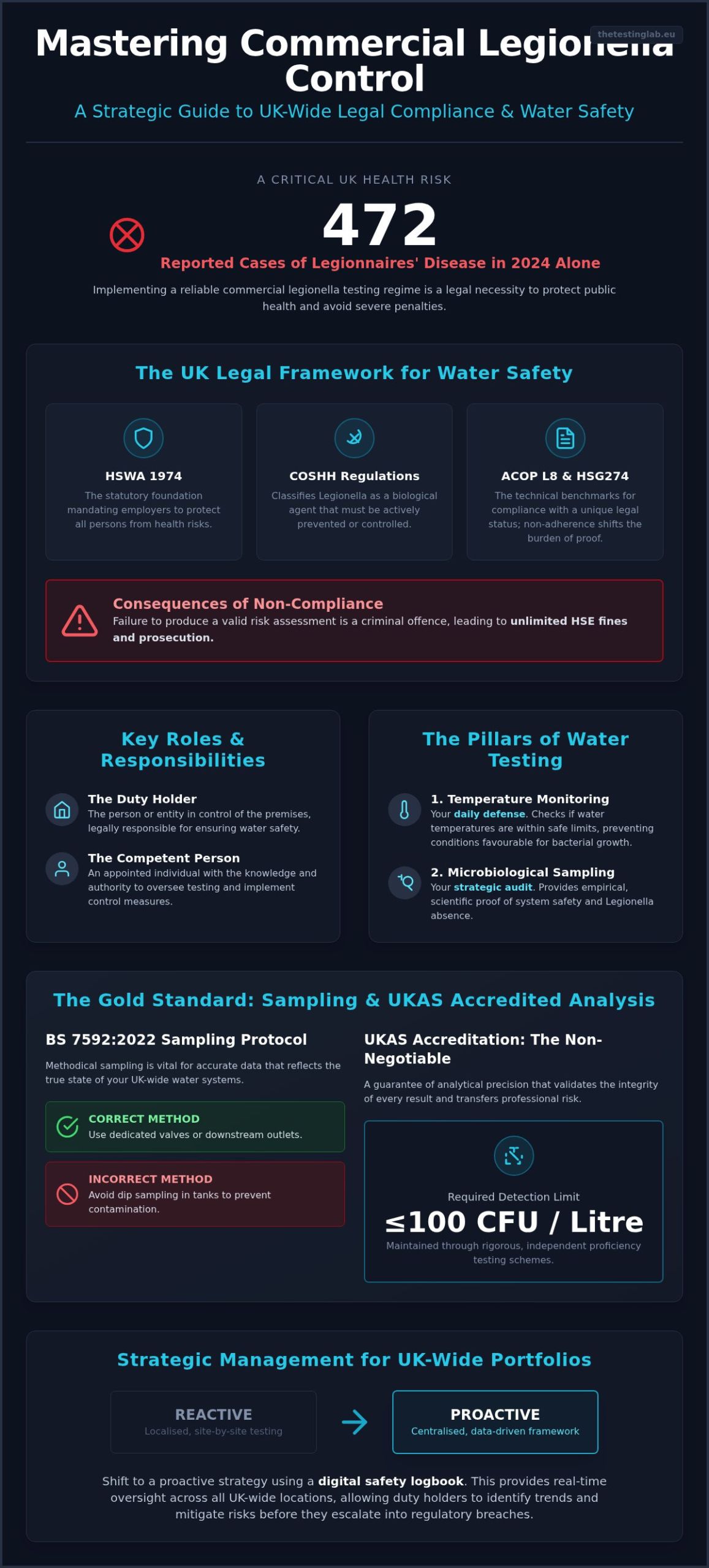
The Health and Safety at Work etc Act 1974 (HSWA) acts as the statutory foundation for all commercial legionella testing UK protocols. It mandates that employers and those in control of premises protect both employees and the public from health risks. This obligation is further defined by the COSHH Regulations, which treat Legionella as a biological agent that must be prevented or controlled. To implement a defensible safety strategy, duty holders must understand What is Legionnaires’ disease? and the specific conditions that allow it to colonise man-made systems.
ACOP L8 and the HSG274 guidance series are the technical benchmarks for UK wide compliance. These aren’t merely suggestions; ACOP L8 holds a unique legal status where the burden of proof can shift. If your organisation faces prosecution, failing to follow these guidelines makes it significantly harder to prove that you’ve met your statutory obligations. Precision in following these standards is what separates a strategic safety partner from a simple service provider.
Identifying the Duty Holder and the Responsible Person
In commercial properties, the ‘Duty Holder’ is the person in control of the premises. This role requires appointing a ‘Competent Person’ with the knowledge to oversee commercial legionella testing UK and the authority to implement controls. Failing to produce a valid risk assessment is a criminal offence. It can lead to unlimited HSE fines and prosecution, making a documented water management system a legal necessity rather than an option for any national portfolio.
Sampling Protocols and Accredited Laboratory Analysis
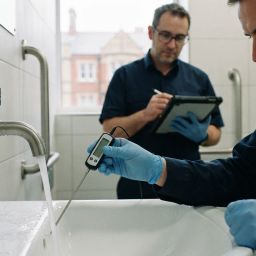
Compliance with BS 7592:2022 is the technical methodology required for effective commercial legionella testing UK. While routine temperature monitoring checks if conditions are favourable for bacterial growth, microbiological testing provides empirical proof of system safety. It’s a critical distinction. Temperature checks are your daily defense; sampling is your strategic audit. Adhering to UK Legal Requirements for Legionella Control means knowing when to trigger these samples, such as when temperature controls fail or when high-risk individuals are exposed to the water system.
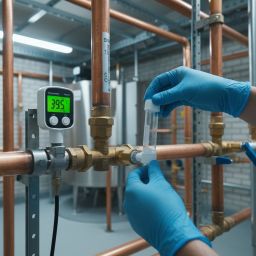
Accuracy in sampling is vital. The BS 7592:2022 standard advises against dip sampling in potable tanks to prevent contamination. Instead, we use dedicated valves or downstream outlets. This methodical approach ensures that data reflects the true state of the water system across your UK wide portfolio, providing a clear audit trail for HSE inspectors. If you require expert guidance, our specialists can assist with legionella surveying UK wide to ensure your documentation is beyond reproach.
The Significance of UKAS Accreditation in Water Microbiology
UKAS accreditation isn’t just a badge. It’s a guarantee of analytical precision. Accredited labs must maintain a detection limit of no more than 100 colony-forming units (CFU) per litre. This level of sensitivity is maintained through rigorous proficiency testing schemes that benchmark lab performance against national standards. UKAS accreditation is non-negotiable for commercial legionella testing UK because it validates the integrity of the results. By choosing accredited experts, you transfer the burden of professional responsibility. You can access comprehensive Legionella risk assessment services to determine exactly where and when sampling is required. For businesses managing complex sites, this data-driven approach is the only way to achieve absolute certainty in compliance.
Strategic Water Management for UK-Wide Commercial Portfolios
Managing water safety across multiple national locations requires a shift from localised, reactive testing to a centralised, data-driven framework. A digital safety logbook provides real-time oversight, ensuring that every site adheres to the same rigorous commercial legionella testing UK standards. This approach allows duty holders to identify trends, such as recurring temperature issues in specific building types, before they escalate into health risks or regulatory breaches. By following the best practices established by the Water Management Society, organisations can transform a mandatory obligation into a streamlined operational asset.
Choosing The Testing Lab PLC as your strategic partner removes the burden of professional liability from your internal teams. Our UK wide laboratory network provides the technical magistery needed to maintain compliance across complex industrial or corporate portfolios. We don’t just provide results; we provide the precision-engineered data required to justify your sampling regime and protect your reputation. Our focus remains on methodological accuracy that stands up to the closest HSE scrutiny.
Integrating Legionella Monitoring into Corporate ESG and Safety Goals
Modern corporate governance treats water safety as a critical ESG metric. Effective commercial legionella testing UK protocols protect brand equity by preventing high-profile health incidents. Many of our partners find that streamlining compliance through integrated asbestos and legionella consultancy reduces administrative friction and lowers overall operational risk. This holistic approach ensures that all hazardous substance monitoring is handled by a single, UKAS-accredited expert team. To secure your portfolio and ensure full legal alignment for the 2026 period, you can request a UK-wide compliance quote today.
Future-Proofing Your Commercial Water Safety Strategy
Transitioning from reactive monitoring to a precision-engineered safety framework is the only way to meet 2026 standards. By aligning your operations with ACOP L8 and leveraging UKAS-accredited laboratory data, you eliminate the ambiguity of professional liability. Effective commercial legionella testing UK protocols ensure that every site across your national portfolio remains legally defensible and operationally sound.
As a strategic partner for complex risk management, we provide the UK-wide site survey and inspection coverage required to protect your brand and your people. Secure your UK-wide commercial legionella compliance with The Testing Lab PLC and benefit from our specialised microbiological water testing facilities. Take the first step toward a documented, worry-free compliance regime today.
Frequently Asked Questions
Is Legionella testing a legal requirement for all UK businesses?
All UK employers and landlords have a statutory duty to assess and manage legionella risks under the Health and Safety at Work etc Act 1974. While routine microbiological sampling isn’t mandatory for every simple system, a documented risk assessment is a strict legal requirement. This assessment dictates the necessity of commercial legionella testing UK wide to ensure your premises remain compliant with ACOP L8.
How often should commercial water systems be tested for Legionella?
Testing frequency is determined by your site-specific risk assessment rather than a universal schedule. High-risk systems like cooling towers or evaporative condensers require commercial legionella testing UK wide at least quarterly. For other systems, sampling is necessary when temperature controls fail, the system is altered, or when protecting high-risk individuals. Regular monitoring ensures your water management strategy remains proactive and defensible.
Can I carry out a Legionella risk assessment myself?
You can legally perform an assessment if you’re a “competent person” with the necessary skills and technical knowledge. However, for complex commercial properties, the HSE emphasizes that the assessor must understand the intricate mechanics of water systems. Most duty holders appoint a strategic partner like The Testing Lab PLC to ensure the assessment meets BS 7592:2022 standards and removes professional liability.
What should I do if Legionella bacteria are detected in my commercial system?
If bacteria are detected, you must immediately implement your written control scheme’s emergency protocols. For cooling towers, levels exceeding 1,000 CFU/L trigger a mandatory “Stop and Assess” protocol. This involves system disinfection, a full investigation into the failure of control measures, and follow-up sampling. Documenting every step is vital for demonstrating compliance during an HSE audit and protecting tenants across your UK wide portfolio.

Article by
P J F Thomas
CEO and Founder of TTL plc.
Disclaimer
Items declared are AI generated but do reflect our services. Please get in contact if you have any questions.