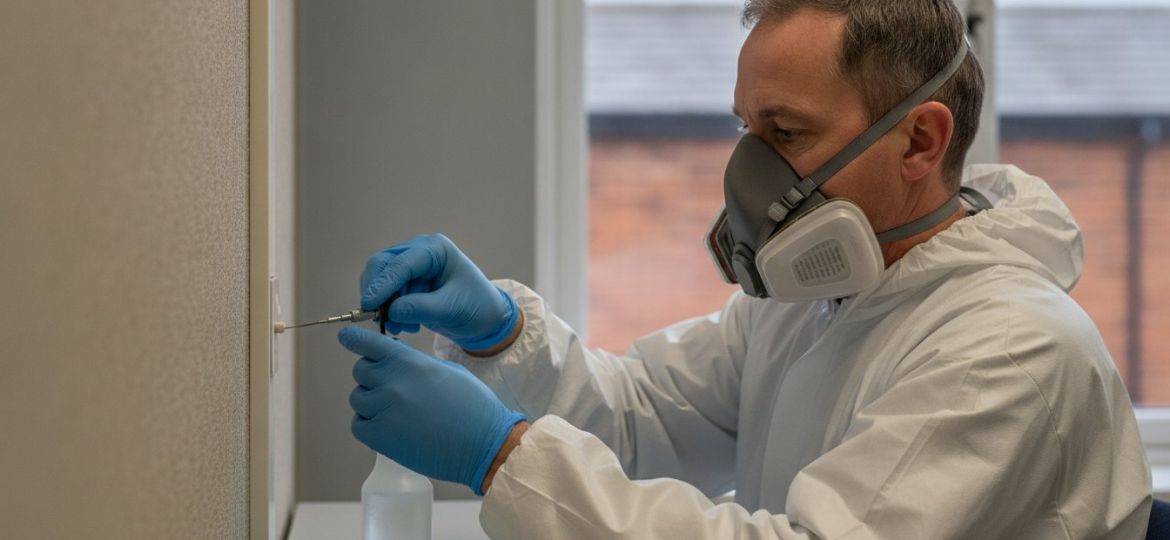
Did you know that asbestos remains the leading cause of work-related deaths in Great Britain, claiming over 5,000 lives every year? It’s understandable why the complexity of HSG248 regulations and the fear of accidental exposure keep many duty holders awake at night. You want to protect your team and your business from the severe legal risks of non-compliance. This guide helps you master the rigorous asbestos sampling procedure HSE expects, ensuring every step meets UKAS standards for absolute accuracy.
By adopting a precision engineering mindset, you can transform a high-risk task into a controlled, compliant process. We’ll examine the technical requirements of the current UK-wide regulatory landscape, from site preparation to the final laboratory analysis. Whether you require an asbestos survey or bulk sampling, you’ll gain the clarity needed to ensure your site remains safe and your documentation stands up to any HSE inspection.
Key Takeaways
- Navigate the complexities of the “Duty to Manage” by aligning your site protocols with current HSE HSG264 and HSG248 standards.
- Execute a precise asbestos sampling procedure HSE compliant approach, focusing on the critical wetting method to ensure a safe work environment.
- Secure legally defensible data through UKAS-accredited laboratory testing and high-precision Polarised Light Microscopy (PLM) analysis.
- Protect your organisation from professional liability with a UK-wide strategic partnership that places technical excellence at the heart of every survey.
HSE Requirements for Asbestos Sampling and Management
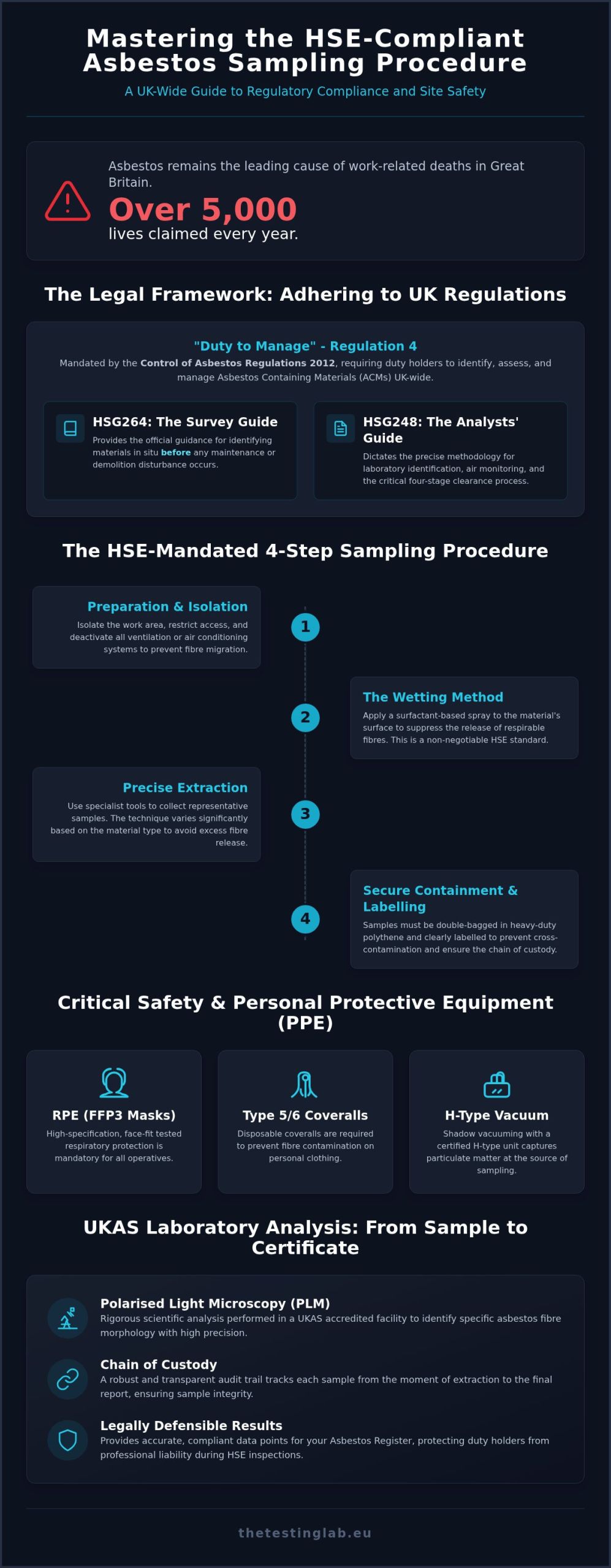
The Health and Safety Executive (HSE) strictly regulates asbestos management across the UK through the Control of Asbestos Regulations 2012. Central to this framework is the “Duty to Manage” under Regulation 4, which mandates that duty holders identify and assess the risk of Asbestos Containing Materials (ACMs). Understanding what is asbestos and its historical use in construction is the first step toward effective risk profiling. An asbestos sampling procedure HSE expects must be systematic, ensuring every suspected material is accounted for to prevent accidental exposure.
Precision is vital during the collection phase. Sampling must be representative of the material to ensure accurate risk profiling across the entire site, as subtle variations in material composition can change the risk category. We strongly recommend professional sampling UK wide to avoid the severe risks of fibre release during DIY attempts. The HSE’s planned 14,000 proactive inspections for 2025/2026 underline the importance of getting this right. By choosing an asbestos consultancy, you ensure that high-precision methodology replaces guesswork, removing the burden of professional liability from your shoulders.
The Legal Framework: HSG264 vs HSG248
HSG264 provides the “Survey Guide” for identifying materials in situ before any maintenance or demolition disturbance occurs. Conversely, HSG248, or the “Analysts’ Guide,” dictates the precise methodology for laboratory identification, air monitoring, and the crucial four-stage clearance process. UKAS accreditation is the gold standard for HSE compliance in 2026 because it guarantees that every sample is handled within a rigorous, audited chain of custody by technically competent specialists.
The Step-by-Step Asbestos Sampling Procedure
Executing a rigorous asbestos sampling procedure HSE mandates begins with meticulous preparation before any material is disturbed on sites UK wide. You must first isolate the work area, restrict access, and ensure all ventilation systems or air conditioning units are deactivated to prevent fibre migration. Following the technical protocols outlined in HSE’s Asbestos: The survey guide, the “Wetting Method” is a non-negotiable standard. This involves applying a surfactant-based spray to the material’s surface, which penetrates the matrix to suppress the release of respirable fibres during the extraction process.
The extraction technique varies significantly based on the specific material being tested. For textured coatings, you’ll need to collect samples from multiple points to account for non-homogeneity within the application. In contrast, sampling high-risk pipe insulation requires precision tools to avoid damaging the integrity of the lagging. Once the sample is secured, it must be double-bagged in heavy-duty polythene and clearly labeled. This protocol prevents cross-contamination and ensures the sample remains a valid piece of evidence throughout the analytical phase.
Essential PPE and Safety Equipment
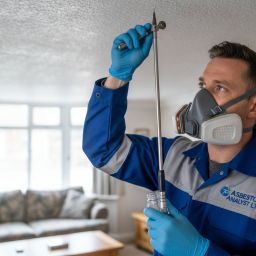
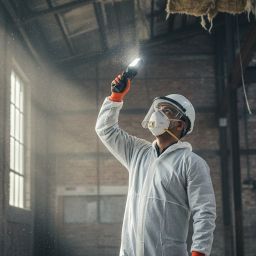
Personal safety during the asbestos sampling procedure HSE is paramount. Operatives must be equipped with high-specification Respiratory Protective Equipment (RPE), such as FFP3 masks that have undergone face-fit testing. Additionally, disposable Type 5/6 coveralls are required to prevent fibres from clinging to clothing. A critical technical detail is the use of shadow vacuuming. By using a certified H-type vacuum held directly adjacent to the sampling point, you capture particulate matter at the source. If you’re managing a complex project, our Asbestos Consultancy Services UK offer a comprehensive way to manage these operational risks while maintaining full compliance.
UKAS Laboratory Analysis and Interpreting Results
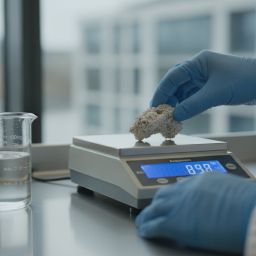
The transition from on-site collection to laboratory analysis is the most critical link in the asbestos sampling procedure HSE mandates. Once samples reach our UKAS accredited facility, they undergo rigorous Polarised Light Microscopy (PLM) to identify specific fibre morphology. This scientific precision ensures that the results aren’t just opinions but legally defensible data points. A robust “Chain of Custody” tracks the sample from the moment of extraction to the final report, providing a transparent audit trail that protects duty holders during any subsequent HSE inspections. It’s this level of detail that removes the professional liability from your shoulders and places it in the hands of technical specialists.
While bulk sampling deals with building materials, asbestos in soils testing requires more complex quantification techniques to assess contamination levels in ground samples accurately. Integrating these findings into your master Asbestos Register is essential for maintaining UK-wide safety standards and legal compliance. This register must be a live, dynamic document. It should be updated immediately upon receipt of lab results to reflect the current risk profile of your premises, ensuring contractors and staff stay informed of any hazards.
Decoding the Asbestos Analysis Certificate
Your certificate will specify the asbestos type identified: Chrysotile (White), Amosite (Brown), or Crocidolite (Blue). Understanding these classifications is vital. Different types may trigger different management or removal protocols under the Control of Asbestos Regulations 2012. If the report states “No Asbestos Detected” (NAD), it confirms that the specific sample contained no fibres within the detection limits of PLM. This allows your project timeline to proceed with confidence and safety. For high-precision results and expert guidance, our UKAS Accredited Lab Services provide the technical certainty your compliance strategy requires.
Securing Your Site with Technical Excellence
Mastering the asbestos sampling procedure HSE mandates is about more than just following a checklist; it’s about integrating on-site safety with high-precision laboratory results. You’ve seen how the “Duty to Manage” and the technical “Wetting Method” form a vital barrier against accidental exposure. By aligning your site protocols with HSG248 standards, you ensure that every sample remains legally defensible and scientifically accurate. As a UKAS Accredited Testing Laboratory and independent professional consultancy, we provide the technical certainty needed to navigate these complex regulations safely.
Ready to protect your facility? Request a UKAS Accredited Asbestos Survey & Sampling Quote today. We provide UK wide coverage for the commercial and industrial sectors, taking the weight of professional liability off your shoulders. Your compliance journey starts with precision and ends with total peace of mind.
Frequently Asked Questions
Can I take an asbestos sample myself under HSE guidelines?
Taking samples yourself is highly discouraged by the HSE because of the significant risk of accidental fibre release. For commercial duty holders, the legal “Duty to Manage” implies that a competent professional should execute the asbestos sampling procedure HSE standards require. Professional surveyors possess the specialized equipment and training to prevent contamination and ensure results are legally defensible.
What is the required PPE for asbestos sampling in the UK?
Minimum PPE requirements include a face-fit tested FFP3 respirator and disposable Type 5/6 coveralls with elasticated cuffs. You also need single-use nitrile gloves and safety boots without laces to prevent fibre entrapment. Following the correct asbestos sampling procedure HSE guidelines ensures that all PPE is treated as hazardous waste after use, protecting you and the wider site environment.
How long does it take to get asbestos sampling results back from a UKAS lab?
Standard UKAS-accredited laboratory analysis usually provides results within 24 to 48 hours of sample receipt. For time-critical projects, many facilities offer expedited same-day reporting to minimize site downtime. This speed doesn’t compromise the high-precision engineering approach, as every sample still undergoes rigorous Polarised Light Microscopy (PLM) to confirm the specific fibre type and concentration.
What happens if a sample tests positive for asbestos?
A positive result requires you to immediately update your site’s Asbestos Register and conduct a formal risk assessment. You must decide whether to manage the material in situ, encapsulate it, or arrange for its removal by a licensed specialist. This decision-making process is a core part of your legal compliance, ensuring that all occupants remain safe from potential exposure risks.

Article by
P J F Thomas
CEO and Founder of TTL plc.
Disclaimer
Items declared are AI generated but do reflect our services. Please get in contact if you have any questions.