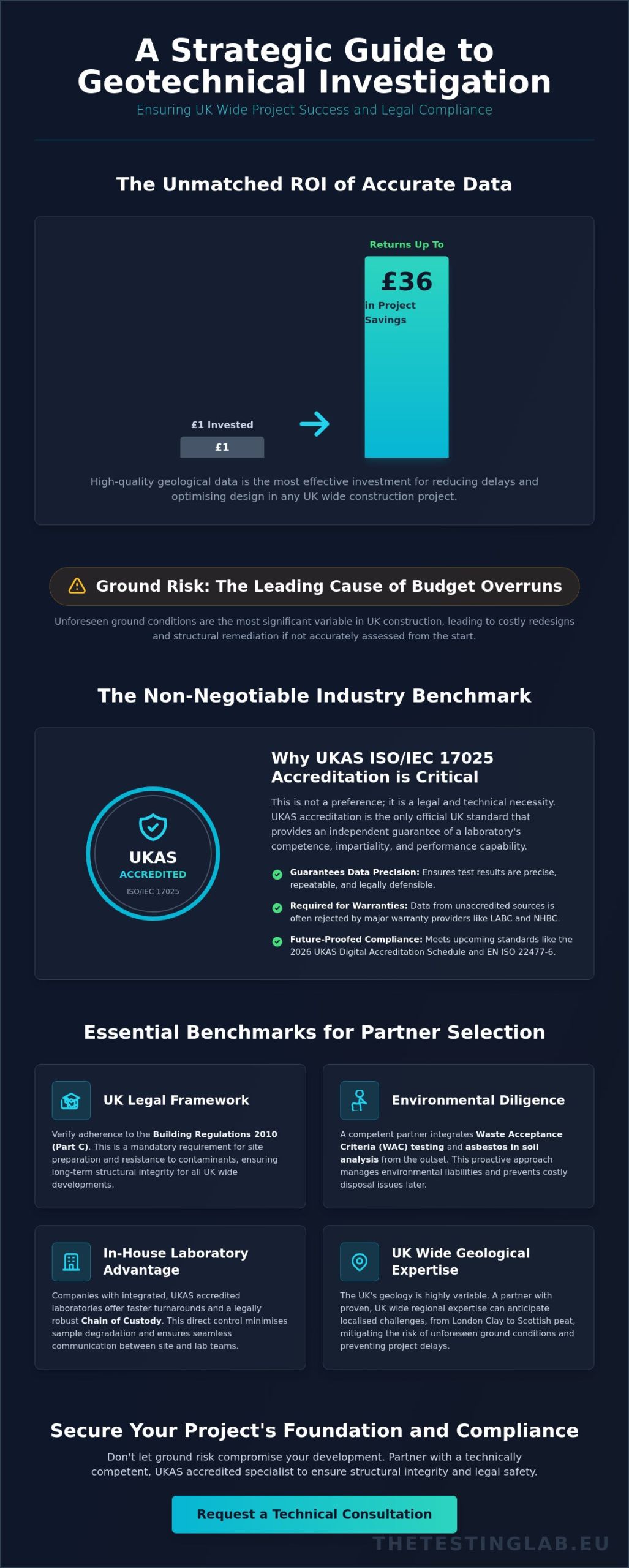
Did you know that every £1 invested in high-quality geological data can return up to £36 in project savings through reduced delays and optimized design? Ground conditions remain the most significant variable in any UK construction project. It’s understandable to feel concerned about unforeseen soil issues or the intricate maze of UK building regulations that can quickly drain a budget. When you’re choosing a geotechnical investigation company, you’re not simply hiring a service provider. You’re selecting a strategic partner responsible for the structural integrity and legal safety of your development.
We understand that managing UK wide compliance, from the latest ISO/IEC 17025 standards to the new EN ISO 22477-6:2026 requirements, often feels complex. This guide outlines the essential benchmarks for identifying a technically competent partner who can handle everything from accredited soil testing to contaminated land liabilities. You’ll learn how the 2026 Geotechnical Data Bill and the new UKAS Digital Accreditation Schedule impact your selection process. We’ll provide a clear framework for securing a stable foundation design and actionable reporting that keeps your project on track, safe, and fully compliant.
Key Takeaways
- Understand how adhering to the Building Regulations 2010 and Part C ensures structural integrity across UK wide developments.
- Learn why verifying ISO/IEC 17025 UKAS accreditation is the most critical step when choosing a geotechnical investigation company to guarantee data precision.
- Discover how regional geological expertise mitigates the risk of unforeseen ground conditions and prevents costly project delays.
- Identify the strategic benefits of integrating Waste Acceptance Criteria (WAC) testing and asbestos in soil analysis to manage environmental liabilities early.
- See how the 2026 updates to EN ISO 22477-6 and the UKAS Digital Accreditation Schedule streamline technical reporting and compliance.
Why Selection Accuracy Defines Project Success in the UK
Choosing a geotechnical investigation company requires a focus on technical precision rather than just the lowest quote. A comprehensive Geotechnical investigation overview highlights the scientific necessity of assessing soil, rock, and groundwater before any structural work begins. This isn’t just best practice; it’s a legal requirement under the Building Regulations 2010. Approved Document Part C specifically requires sites to be prepared to resist moisture and contaminants, ensuring the long-term safety of the structure and its inhabitants.
Ground risk is the leading cause of budget overruns in UK construction. Without an accurate subsurface profile, project managers face unforeseen soil conditions that necessitate expensive redesigns or structural remediations during the build phase. We treat every project as a strategic partnership. Our goal is to provide the technical confidence you need to proceed, taking the burden of professional liability off your team. A high-quality investigation removes the weight of professional responsibility from your shoulders by providing the data needed for technical certainty, ensuring you don’t encounter expensive surprises during the excavation phase.
The Legal and Financial Consequences of Inadequate Data
Inadequate data often results in the rejection of LABC or NHBC warranties, which can stop a development in its tracks. Designers who base their calculations on unaccredited data are vulnerable to professional negligence claims if structural issues or contamination liabilities emerge later. It’s a simple risk-reward calculation. The investment in a thorough UK wide investigation is insignificant compared to the potential costs of foundation failure or legal battles over land contamination. Ensuring your site meets all safety standards, including those covered in our local asbestos and legionella surveying guide, is the only way to protect your professional reputation and your project’s financial health.
Essential Benchmarks: Evaluating Technical Competence and UKAS Accreditation
Technical competence isn’t a subjective trait; it’s a measurable standard governed by strict international protocols. When choosing a geotechnical investigation company, your first verification step must be their UKAS accreditation status to the ISO/IEC 17025 standard. This accreditation isn’t just a badge. It’s a rigorous assessment of a laboratory’s ability to produce precise, repeatable, and technically valid data. For projects involving asbestos in soils testing or complex chemical analysis, unaccredited data simply won’t suffice for UK wide regulatory submissions.
The legal weight of these standards is significant. Major insurers and warranty providers like the NHBC and LABC often require that all laboratory testing is performed by UKAS accredited facilities. Relying on a company that merely “works to” these standards without formal accreditation leaves your project vulnerable to data rejection. Effective Managing geotechnical risk requires this level of technical certainty to satisfy both building control and professional indemnity requirements.
Why UKAS Accreditation is the Industry Benchmark
In-House Laboratory vs. Brokerage Models
Direct laboratory control offers a distinct advantage over brokerage models. When the site engineers and lab analysts work within the same technical framework, turnaround times are faster and the risk of sample degradation during transit is minimized. This direct line of communication ensures that any anomalies in the soil samples are identified and addressed immediately. A critical component of this process is the “Chain of Custody,” which we define as the documented trail of sample handling, from the moment of extraction to the final report, essential for legal and legislative compliance.
- Regional Expertise: Ensure the partner understands the specific geological challenges of different UK regions.
- Insurance Coverage: Verify that professional indemnity insurance specifically includes geotechnical and environmental advice.
- Accreditation Scope: Check that the specific tests your project requires are listed on the company’s UKAS schedule.
Strategic Integration: The Advantage of UK-Wide Accredited Laboratory Support
Efficiency in construction often hinges on how well you manage overlapping risks. When choosing a geotechnical investigation company, look for a partner that bridges the gap between structural soil analysis and environmental contamination testing. Integrating geotechnical investigations with WAC (Waste Acceptance Criteria) testing ensures that soil disposal costs are managed from the outset. Identifying asbestos in soils during the initial groundworks is equally critical; missing this can lead to immediate site shutdowns and severe legal liabilities under UK wide health and safety protocols.
A fragmented approach where one firm handles drilling and another handles lab analysis often results in communication breakdowns. By selecting The Testing Lab PLC, you benefit from a multi-disciplinary consultancy that understands the interplay between soil mechanics and chemical composition. This unified model provides consistent reporting formats and a single point of professional accountability, regardless of where your project is located in the UK. We act as your strategic partner, ensuring that every data point serves the dual purpose of structural integrity and environmental compliance.
Holistic Site Assessments: Geotechnical Meets Geo-Environmental
Integrated testing significantly streamlines the Phase 2 Site Investigation process. It allows for the simultaneous assessment of load-bearing capacities and hazardous waste classification. Utilizing WM3 testing is essential for determining if excavated materials are hazardous before they leave the site, preventing unexpected landfill surcharges. We also employ advanced techniques like XRD analysis and XRF analysis to provide deeper insights into mineralogical soil composition, which informs both foundation design and long-term site safety.
Streamlining Compliance Across the UK
Managing multiple vendors for asbestos, legionella, and soil testing is an administrative burden that introduces risk. A single accredited consultancy ensures that all data sets are compatible and meet the same high standards of UKAS precision. Digital reporting and clear laboratory analysis certificates are tools that accelerate the planning approval process by providing local authorities with undeniable technical evidence. Ready to secure your site’s future? Request a comprehensive quote for your UK-wide project and let our experts take the weight of technical compliance off your shoulders.
Advancing Your Development with Technical Certainty
Success in UK construction relies on more than just excavation; it’s about the technical confidence provided by high-quality data. We’ve explored how UKAS accreditation to ISO/IEC 17025 serves as the non-negotiable benchmark for laboratory accuracy. By integrating geotechnical analysis with environmental assessments like WAC testing and asbestos in soils analysis, you effectively mitigate ground risk and avoid budget overruns. Adhering to the Building Regulations 2010 Part C isn’t just a legal checkbox. It’s the foundation of structural integrity and long-term liability protection.
When you’re choosing a geotechnical investigation company, you’re looking for a partner that takes the weight of professional responsibility off your shoulders. As an independent UK-wide consultancy, we provide the specialized reporting and technical clarity needed for complex developments. Our UKAS accredited laboratory ensures your site data is impartial, repeatable, and ready for regulatory submission. Don’t leave your project’s compliance to chance. Contact The Testing Lab PLC for UK-wide Geotechnical and Environmental Compliance and let’s ensure your project stands on solid ground.
Frequently Asked Questions
What is the difference between a geotechnical and a geo-environmental investigation?
A geotechnical investigation focuses on the physical and mechanical properties of soil and rock to inform foundation design and structural stability. In contrast, a geo-environmental investigation assesses the chemical health of the ground, identifying contaminants that could impact human health or the environment. Combining these two disciplines provides a holistic view of the site, ensuring both structural safety and environmental compliance.
Why should I insist on a UKAS accredited company for soil testing?
UKAS accreditation to the ISO/IEC 17025 standard provides an independent guarantee that a laboratory’s results are technically valid and repeatable. When choosing a geotechnical investigation company, this accreditation ensures that your data will be accepted by building control officers and warranty providers like the NHBC. It effectively mitigates the risk of project delays caused by rejected or inaccurate ground data.
How long does a standard geotechnical investigation report take to complete?
The timeline for a full report usually spans three to six weeks after the site works are finished. This duration accounts for the mandatory laboratory testing phases, such as moisture content analysis or triaxial testing, followed by detailed engineering interpretation. Using a company with an in-house laboratory can often streamline this process by removing the delays associated with third-party sample transportation across the UK.
Does a geotechnical investigation cover asbestos in the soil?
Asbestos testing isn’t a default component of geotechnical work but it’s essential for any brownfield development. You should ensure your provider integrates asbestos in soils analysis into their scope to prevent accidental exposure and site shutdowns. Our UK wide consultancy specifically includes these specialist tests to help developers meet their legal obligations under the Control of Asbestos Regulations 2012.

Article by
P J F Thomas
CEO and Founder of TTL plc.
Disclaimer
Items declared are AI generated but do reflect our services. Please get in contact if you have any questions.