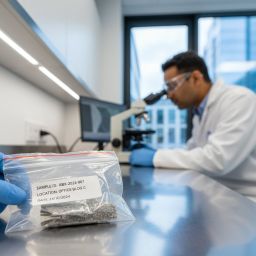
Did you know that approximately 5,000 people in the UK lose their lives to asbestos-related diseases every year? It’s a sobering figure that underscores why professional asbestos sample analysis UK wide is a non-negotiable requirement for any Duty Holder. You’re likely feeling the pressure of the Control of Asbestos Regulations 2012 (CAR 2012) and the fear that a single disturbed fibre could halt your project or endanger your team. We understand you need more than just a test kit. You need the certainty that your site is compliant and your people are safe.
Professional asbestos analysis is a precision engineering process, and it’s the cornerstone of your site safety. This guide provides the expert insights you need to handle these complexities with confidence. You’ll learn how UKAS accredited laboratory analysis to ISO/IEC 17025 standards protects your legal standing and exactly what to do if a sample returns a positive result. We’ll break down the technical requirements of local asbestos and legionella surveying to ensure you receive a clear certificate of analysis without the typical project delays. From understanding current HSE enforcement trends to securing fast, accurate results, we’re here to help you secure total legal peace of mind.
Key Takeaways
- Understand how the Control of Asbestos Regulations 2012 (CAR 2012) mandates rigorous compliance for duty holders UK wide to ensure site safety and legal protection.
- Discover the scientific precision behind asbestos sample analysis UK wide, utilizing Polarized Light Microscopy (PLM) to accurately identify hazardous fibres within bulk materials.
- Learn the critical advantages of professional on-site surveyor sampling over mail-in kits to mitigate the risk of fibre disturbance and ensure representative results.
- Explore specialist laboratory capabilities, including asbestos in soils and water absorption testing, which are vital for complex land remediation and construction projects.
- Secure legal peace of mind by integrating professional asbestos surveying into your management plan to prevent costly project delays.
Asbestos Sample Analysis & Legal Compliance in the UK
Professional asbestos sample analysis UK wide is a precision engineering process, not a simple visual inspection. It involves the scientific identification of hazardous fibres within bulk materials using Polarized Light Microscopy (PLM). This method allows analysts to distinguish between different asbestos fibre types, such as chrysotile, amosite, and crocidolite, by observing their unique optical properties. Before commissioning a survey, it helps to understand a comprehensive overview of asbestos and its historical use in UK construction to grasp why these microscopic details matter for your safety.
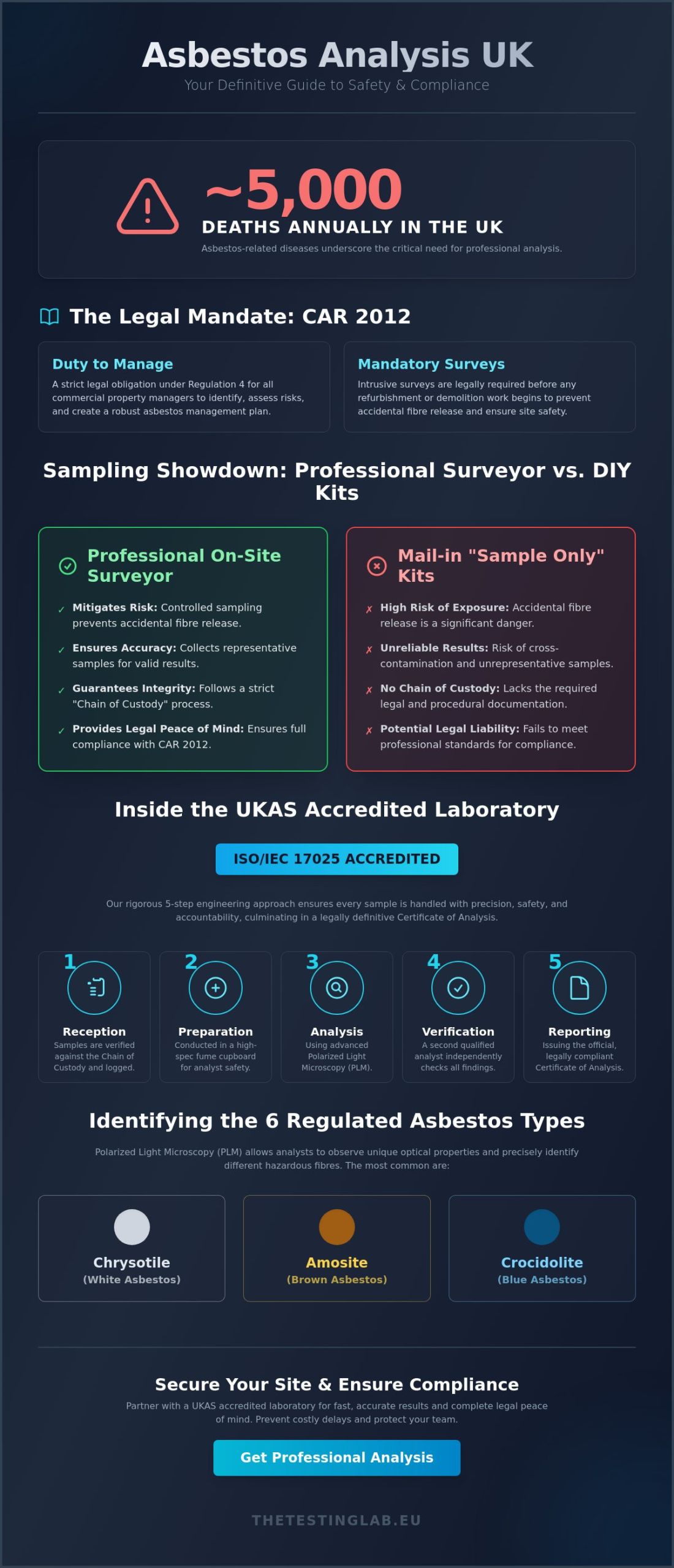
The Control of Asbestos Regulations 2012 (CAR 2012) provides the legal framework for managing these materials across all UK premises. While domestic homeowners often seek testing to protect their families during renovations, commercial property managers face a much stricter “Duty to Manage” under Regulation 4. This legal obligation requires duty holders to identify asbestos, assess the risks, and create a robust management plan. Partnering with a specialist asbestos consultancy ensures that your compliance strategy is grounded in technical accuracy rather than guesswork.
The Role of the UKAS Accredited Laboratory
Accreditation by the United Kingdom Accreditation Service (UKAS) is the non-negotiable gold standard for laboratory testing. It provides independent verification that a lab possesses the technical competence and impartiality required to produce valid results. Professional laboratories operate under the ISO/IEC 17025 standard, which governs everything from equipment calibration to analyst proficiency. The Certificate of Analysis is the definitive legal document for property safety files.
CAR 2012: Why Professional Testing is Mandatory
Choosing to “presume” a material contains asbestos might seem cautious, but it often leads to unnecessary and inflated removal costs. Confirmed laboratory analysis provides a more cost-effective strategy by identifying exactly where the risk lies. With an estimated 1.5 million buildings in the UK still containing asbestos, the law requires intrusive surveys before any refurbishment or demolition work begins. Using a professional asbestos surveying service ensures these inspections are conducted safely, preventing the accidental release of fibres that could lead to severe health risks and legal liabilities.
The Process of Professional Bulk Sample Identification
While mail-in “Sample Only” kits are available, they often bypass the most critical safety protocol: controlled collection. Professional on-site sampling UK wide removes the risk of accidental fibre release, particularly when dealing with friable materials like Asbestos Insulation Board (AIB). Unlike DIY methods, a professional surveyor follows a strict “Chain of Custody” process. This ensures every sample is uniquely identified, logged, and tracked from the moment of extraction to the final laboratory report, preventing any risk of cross-contamination or lost data.
The laboratory workflow for asbestos sample analysis UK wide follows a rigorous 5-step engineering approach. It begins with Reception, where samples are verified against the chain of custody. Next is Preparation, conducted within a high-specification fume cupboard to ensure analyst safety. The Analysis phase uses advanced microscopy, followed by Verification, where a second qualified analyst checks the findings. Finally, Reporting delivers the official results. This methodical structure is essential because, as noted in the Official UK government guidance, even minor exposure to disturbed fibres carries significant long-term health risks.
How Samples are Analysed in the Lab
Our analysts use a combination of stereomicroscopy and Polarized Light Microscopy (PLM) to examine the material matrix. By applying specific refractive index liquids, we can identify the six regulated asbestos types based on their unique optical signatures. This precision allows us to distinguish between common types like Chrysotile (white), Amosite (brown), and Crocidolite (blue), even when they’re embedded in complex building materials or textured coatings.
Understanding Your Asbestos Analysis Report
Your report will primarily indicate either a “Positive” result or “No Asbestos Detected” (NAD). A positive result will specify the fibre type and the material’s condition, which are the two most important factors in your subsequent risk assessment. If you’re unsure how these results affect your project timeline, you can learn more about professional asbestos consultancy to determine your next steps. For immediate assistance with your site requirements, you can request a professional quote to ensure your project remains on track and compliant.
Specialist Asbestos Testing: Soils, Water, and Consultancy
Many laboratories across the country refuse to process complex matrices like soil, leaving developers and land investigators in a difficult position. At The Testing Lab PLC, we provide comprehensive asbestos sample analysis UK wide for more than just standard building materials. Identifying asbestos in soil is a critical requirement for brownfield remediation and safe land development. Unlike standard bulk materials, contaminated ground requires a highly specialized approach to ensure both environmental compliance and site safety. We act as your strategic partner, taking the technical burden of quality assurance off your shoulders.
We also conduct water absorption testing to help you identify specific types of cement-based products. This diagnostic tool is vital for distinguishing between asbestos cement and other high-density materials, ensuring your waste classification is accurate and cost-effective. These specialist results aren’t just isolated data points. They’re seamlessly integrated into your broader Asbestos Management Plan (AMP) to help you fulfill your legal duty to manage asbestos effectively and without technical ambiguity.
Asbestos in Soils and Brownfield Remediation
Historic industrial practices often led to the burial of asbestos waste, creating a legacy of risk for modern developers. Our specialist testing for asbestos in soils allows construction teams to navigate land remediation without the fear of hidden liabilities. We offer both qualitative identification to confirm the presence of fibres and quantitative gravimetric analysis to determine the exact percentage of asbestos by weight. This precision is essential for determining waste disposal routes and ensuring the safety of groundworks teams UK wide.
From Lab Results to Site Safety: Next Steps
Receiving your lab report is only one stage of the compliance journey. If analysis confirms the presence of asbestos, you need a clear path forward. The transition from testing to 4-stage clearance and air monitoring is critical if removal work becomes necessary. We guide you through a logical workflow: Test, Report, Consult, and Comply. This methodical approach ensures you’re never left wondering about the next technical step. You can secure your UK wide compliance with a professional quote today to ensure your project remains safe, legal, and on schedule.
Securing Your Site with Professional Precision
Navigating the complexities of the Control of Asbestos Regulations 2012 requires more than just a checklist; it demands technical magistery. We’ve explored how asbestos sample analysis UK wide serves as the foundation for your management plan, from the initial identification of fibres to the integration of results into a robust safety file. By utilizing our UKAS Accredited Laboratory (ISO 17025), you ensure that your data is legally defensible and scientifically accurate. Whether you’re dealing with standard building materials or require specialist soil and water analysis, our independent UK wide consultancy is here to remove the burden of quality assurance from your project.
Don’t let regulatory uncertainty lead to costly delays or health risks on your site. Our team is ready to provide the clarity and precision your project deserves, acting as a strategic partner in your environmental compliance. Request a UK wide asbestos analysis or survey quote today to secure your site’s future. We’re here to ensure your transition from testing to compliance is seamless, professional, and entirely stress-free.
Frequently Asked Questions
How long does asbestos sample analysis take in a UKAS lab?
Standard turnaround for asbestos sample analysis in a UKAS accredited lab is typically 24 to 48 hours. Many laboratories offer same-day or emergency services for urgent project requirements. While a base fee applies for standard reporting, fast-track results can add a premium of 25% to 50%. This rapid response helps project managers UK wide avoid costly downtime while maintaining strict compliance with safety regulations.
Can I take an asbestos sample myself for analysis?
You can take a sample yourself, but the HSE strongly advises against DIY sampling due to the risk of fibre release. Disturbing materials like insulation board without specialized equipment can lead to significant exposure. Professional surveyors ensure that asbestos sample analysis UK wide is performed under controlled conditions. They use specific suppression techniques and PPE to protect the building’s occupants and ensure the sample is valid for legal records.
What is the difference between a DIY kit and a professional asbestos survey?
A DIY kit is a reactive tool for a single material, while a professional survey is a proactive management strategy for an entire building. Accredited surveyors operate under ISO/IEC 17020 standards to identify the location and condition of all hazardous materials. This process provides the comprehensive documentation needed to satisfy the “Duty to Manage” under CAR 2012. It offers legal protection and site-wide safety that a simple mail-in test can’t match.
What should I do if my asbestos sample analysis comes back positive?
You must immediately restrict access to the area and update your site’s asbestos register if an asbestos sample analysis UK returns a positive result. The next phase involves a risk assessment to decide if the material should be managed in situ or removed. If removal is necessary, you’ll need to follow strict legal protocols. This often includes air monitoring and four-stage clearance testing to ensure the environment is safe for re-occupation UK wide.

Article by
P J F Thomas
CEO and Founder of TTL plc.
Disclaimer
Items declared are AI generated but do reflect our services. Please get in contact if you have any questions.