
What if the survey designed to protect your facility is actually the weak link exposing you to a £20,000 fine or an indefinite site shutdown? It’s a sobering thought for any dutyholder, especially since the Health and Safety Executive (HSE) recorded 5,000 asbestos-related deaths in 2024. You likely feel that staying on top of the Control of Asbestos Regulations (CAR 2012) across multiple UK wide sites is an exhausting game of catch-up. We understand that coordinating a consistent industrial management asbestos survey strategy is complex, particularly when project delays and laboratory accuracy are on the line.
Our guide empowers you to master these complexities by providing a precision-led roadmap for 2026. You’ll learn how to secure legally defensible results and streamline your dutyholder responsibilities without the typical friction of multi-site management. We’re going to examine the technical nuances of laboratory analysis, the specific requirements for refurbishment surveys, and the exact steps needed to maintain total compliance across every square inch of your UK portfolio.
Key Takeaways
- Identify your specific legal obligations under Regulation 4 of CAR 2012 to accurately define dutyholder responsibilities for industrial tenancies UK-wide.
- Learn to differentiate between HSG264 survey types to ensure you commission the correct industrial management asbestos survey for normal occupancy or refurbishment.
- Understand why UKAS accreditation (ISO 17025) is the essential benchmark for technical precision in bulk sampling and laboratory fibre identification.
- Master the transition from raw survey data to an actionable asbestos management plan, including priority risk scoring and statutory re-inspection cycles.
- Discover the strategic advantages of a laboratory-first approach to simplify your compliance journey and ensure high-precision quality assurance.
Understanding the Duty to Manage Asbestos in Industrial Buildings
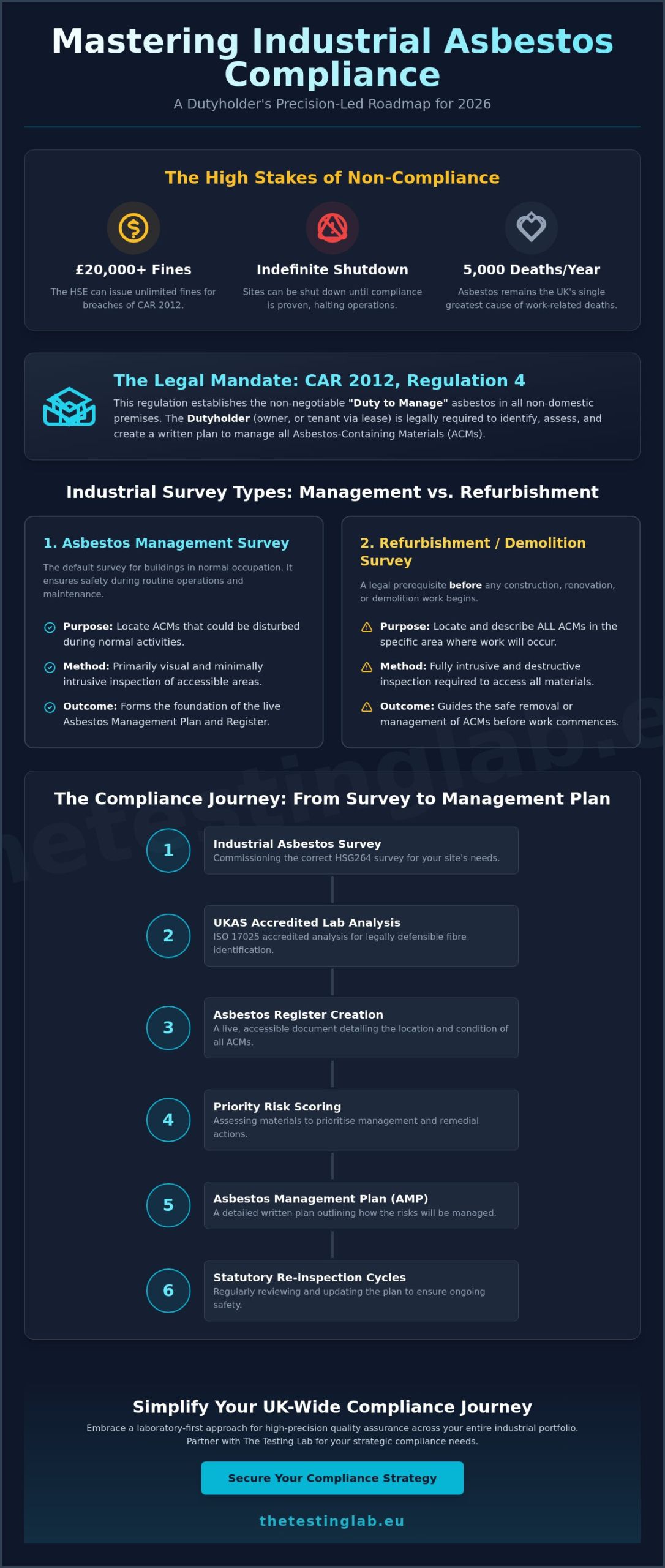
Managing asbestos in industrial settings isn’t just a safety protocol; it’s a legal mandate that demands engineering precision. Under Regulation 4 of the Control of Asbestos Regulations 2012, the responsibility to identify and manage these materials rests on specific individuals. For owners and managers across the UK, conducting a thorough industrial management asbestos survey serves as the foundation for this compliance journey. This process ensures that every asbestos-containing material (ACM) is documented, assessed, and monitored to prevent accidental exposure during routine operations or maintenance.
The Control of Asbestos Regulations 2012 (CAR 2012)
Regulation 4 establishes a rigorous framework for all non-domestic premises, including factories, warehouses, and manufacturing plants. The Dutyholder is the person with clear responsibility for maintenance. This role often falls to the freeholder, but in many industrial tenancies, the lease agreement transfers this responsibility to the tenant. CAR 2012 requires the Dutyholder to determine the location and condition of ACMs and to create a written plan to manage the associated risks. In industrial estates, this duty extends to common areas like shared loading bays, boiler rooms, and service corridors. Understanding these asbestos regulations is vital for anyone overseeing UK-wide operations, as the Health and Safety Executive (HSE) enforces these rules strictly.
The asbestos register is the most critical tool in this process. It acts as a live document that must be accessible to any contractor or employee who might disturb the fabric of the building. Failing to maintain an accurate register or neglecting the industrial management asbestos survey can lead to severe consequences. Legal penalties often include unlimited fines, and in cases of gross negligence, Dutyholders have faced prison sentences of up to 24 months. Beyond the legal risks, the health implications are absolute; asbestos remains the single greatest cause of work-related deaths in the UK, accounting for approximately 5,000 fatalities annually.
Industrial vs. Commercial: Unique Compliance Challenges
Industrial sites present hurdles that standard commercial offices rarely face. The sheer scale and complexity of factories often mean ACMs are hidden within complex plant machinery, large-scale pipework, or vast industrial roofing systems. High-vibration environments, common in manufacturing hubs, can accelerate the degradation of asbestos-based gaskets or insulation, significantly increasing the risk of fibre release. High-heat zones around furnaces or industrial boilers also require specialised assessment techniques to ensure the integrity of the materials.
Maintaining consistency across a multi-site industrial portfolio is essential for corporate governance. For complex portfolios, seeking asbestos consultancy provides the strategic oversight needed to mitigate long-term liability. We approach these challenges with a laboratory-level mindset, ensuring that every survey reflects the actual environmental stressors of the site. A robust management strategy ensures the asbestos register remains a reliable asset, protecting both the workforce and the business’s bottom line.
Types of Industrial Asbestos Surveys: Management vs. Refurbishment
Selecting the correct survey type isn’t just a preference; it’s a legal necessity under HSG264. For most UK wide facilities, an industrial management asbestos survey acts as the baseline for safety. It’s designed to locate Asbestos Containing Materials (ACMs) that might be disturbed during daily operations. This differs fundamentally from R&D surveys, which are intrusive by nature and required before any physical alterations occur. Understanding these triggers ensures your site remains compliant without overspending on unnecessary procedures.
The Asbestos Management Survey
Its primary purpose is to ensure no one is accidentally exposed during routine work or maintenance. Inspectors focus on accessible areas like service ducts, plant rooms, and ceiling voids. Under the Control of Asbestos Regulations 2012, this data must form the basis of a live Asbestos Management Plan. This document isn’t static; it requires regular reviews to reflect the current condition of materials. Common ACMs found during these inspections include:
- Asbestos Insulating Board (AIB): Often found in ceiling tiles and partition walls.
- Pipe Lagging: Thermal insulation on industrial boiler systems.
- Asbestos Cement: Corrugated roof sheets and drainage pipes.
The Refurbishment and Demolition (R&D) Survey
If you’re planning structural changes, a Management Survey won’t suffice. The Refurbishment and Demolition (R&D) survey is mandatory before work begins. It’s fully intrusive. Surveyors must access the building fabric, often breaking into walls or lifting floor slabs. In an industrial context, this means identifying ACMs hidden behind heavy machinery or within complex HVAC systems. This process prevents contractors from unknowingly drilling into dangerous fibres. Failing to commission this survey before a 2026 plant upgrade could lead to immediate HSE intervention and site closure.
Surveying Operational Industrial Sites
Conducting an industrial management asbestos survey in an active factory requires precision. We schedule inspections around production shifts to avoid costly downtime. Safety is the priority. Surveyors often need specialist access equipment for high-level ceiling voids or must work within permit-to-work systems in hazardous zones. Accurate results depend on reaching these difficult areas without compromising the facility’s output. Ensuring every void is checked prevents future “hidden” discoveries that can derail maintenance budgets. If you’re unsure which survey your site needs, our team can provide expert asbestos consultancy to clarify your obligations.
The Critical Role of UKAS Accredited Laboratory Analysis
High-stakes environments like factories and warehouses require more than just a visual inspection. A robust industrial management asbestos survey relies on the scientific precision of laboratory results to provide a definitive risk profile. UKAS accreditation to ISO 17025 isn’t just a badge. It’s a guarantee that the laboratory operates with technical competence and produces valid, reproducible results. Without this accreditation, your compliance framework lacks legal standing in the UK and could fail to protect you during an HSE inspection.
Using an independent laboratory is a strategic choice for industrial site managers. It ensures there’s no conflict of interest between the person identifying the hazard and the contractor who might profit from its removal. This transparency is vital for maintaining an unbiased asbestos register. When you receive a certificate of analysis from a UKAS accredited facility, you’re getting data backed by rigorous proficiency testing and annual audits. This level of certainty is the foundation of any effective industrial management asbestos survey.
Bulk Sample Analysis and HSG248 Standards
Laboratory technicians follow a rigorous protocol to identify hazardous fibres within building materials. The process begins with stereo-microscopy to scan the sample, followed by Polarised Light Microscopy (PLM) to confirm the specific mineral type. Analysts look for the unique optical signatures of Chrysotile, Amosite, and Crocidolite. They check for properties like pleochroism and dispersion staining to ensure 100% accuracy in identification. This methodology is strictly defined by the Health and Safety Executive. Specifically, HSG248 governs the methods used in UKAS accredited labs to ensure consistency across the UK. For complex industrial sites, asbestos consultancy services help translate these technical findings into a practical management plan. This approach aligns with the core principles found in Asbestos: The Survey Guide, ensuring every sample is handled with scientific integrity.
Asbestos in Soils: A Growing Industrial Concern
Industrial brownfield sites across the UK often hide legacy contamination that standard building surveys miss. Identifying asbestos in soil is significantly more complex than testing a piece of pipe insulation. Fibres in soil are often degraded, weathered, or obscured by organic matter. This requires specialized gravimetric analysis and quantification techniques to determine the exact percentage of asbestos by weight. Precise asbestos in soils testing is mandatory for waste classification and protecting ground workers during site redevelopments. It prevents the costly mistake of misidentifying hazardous waste as inert. Inaccurate soil testing can lead to severe legal penalties under the Environmental Protection Act 1990 and unexpected project delays that can cost thousands of pounds per day in plant hire and labor.
Implementing an Effective Asbestos Management Plan
Translating the raw data from an industrial management asbestos survey into a functional safety strategy is the core requirement of Regulation 4 compliance. It’s not enough to simply identify the location of hazardous materials; duty holders must establish a living document that dictates how these risks are controlled daily across their UK wide estates. A definitive industrial management asbestos survey provides the data, but the management plan provides the protection. This process moves beyond identification into active risk mitigation, ensuring that every occupant and contractor remains protected from accidental exposure.
Priority Scoring and Risk Assessments
Risk management begins with a dual-stage algorithm. The Material Assessment (MA) evaluates the asbestos type, condition, and surface treatment on a scale of 0 to 12. However, the Priority Assessment (PA) is equally vital. It factors in occupant activity and the likelihood of disturbance, also scored up to 12. By combining these, you generate a total risk rating out of 24 that dictates remedial actions. High-priority scores often necessitate immediate removal or encapsulation, while lower scores allow for a “manage in situ” approach. Integrating results from UKAS accredited asbestos testing provides the empirical foundation needed for these calculations, removing guesswork from the safety equation.
Statutory Re-inspections and Monitoring
The legal framework requires that the condition of all known ACMs is monitored at regular intervals, typically every 12 months. In high-activity industrial environments, this frequency often increases to six-month or quarterly cycles to account for potential mechanical damage from machinery or foot traffic. Every inspection must be documented, and the central asbestos register updated to reflect any changes in material condition. Digital tracking tools are now the industry standard for UK wide portfolio management, offering automated alerts for upcoming deadlines and ensuring that no site falls out of compliance due to administrative oversight.
Effective communication is the final pillar of a robust plan. You must ensure that safety isn’t just a paperwork exercise by implementing the following:
- Contractors must receive a site induction that includes a full review of the asbestos register before any tools are used.
- Maintenance teams should operate under a strict permit-to-work system for any intrusive tasks in areas containing ACMs.
- Asbestos safety data should be integrated with wider health and safety requirements, including fire risk assessments and CDM 2015 regulations.
If you need to move from a static report to a dynamic safety strategy, our team can help you build a compliant framework. Contact our asbestos consultancy experts to secure your facility today.
Partnering with The Testing Lab PLC for UK Wide Compliance
A Strategic Partnership for Industrial Safety
Our team understands the unique complexities of UK wide industrial estates. We focus on transparency and technical rigor, which means you get clear, actionable reports rather than vague observations. Beyond asbestos, we provide a total safety package. This includes Legionella risk assessment services to help you meet ACoP L8 requirements. Managing multiple risks through one laboratory ensures consistency in data and a unified strategy for site safety. It’s a method that reduces administrative burden and ensures nothing falls through the cracks during Health and Safety Executive (HSE) inspections.
Next Steps: Securing Your Industrial Site
Transitioning from an outdated paper-based survey to a modern Management Plan is a critical step for 2026 compliance. If your current industrial management asbestos survey pre-dates 2021, it likely doesn’t reflect current site conditions or the latest regulatory expectations. Our process begins with a technical review of your existing documentation followed by a site-specific assessment. We identify exactly what you have, where it is, and how to manage it without disrupting your production cycles.
To secure your facility and ensure long-term operational continuity, you can follow these steps:
- Review your current asbestos register for any gaps in recent annual inspections.
- Identify areas where upcoming plant maintenance or machinery upgrades might disturb the building fabric.
- Request a bespoke quote to align your site with the latest UK standards.
You can start this process today by visiting our quote request page. Our specialists will provide a detailed proposal tailored to the specific engineering requirements and scale of your industrial facility.
Securing Your Industrial Compliance for 2026 and Beyond
Navigating the complexities of the Control of Asbestos Regulations 2012 requires a rigorous, data driven approach to site safety. Managing an industrial facility means you’re legally responsible for the health of every operative and visitor on your premises. By implementing a robust industrial management asbestos survey, you transform reactive maintenance into a proactive compliance strategy. Our UKAS accredited laboratory (ISO 17025) provides the technical precision needed to identify risks before they become liabilities. We specialize in high volume sample processing, ensuring that even the most complex industrial sites receive accurate results without delay. Partnering with a specialist ensures your asbestos management plan isn’t just a document, but a living safety protocol that protects your workforce. We provide UK wide coverage with professional consultancy to take the burden of quality assurance off your shoulders. Trusting a partner with an engineering mindset allows you to focus on core operations while we handle the scientific details of your compliance. You don’t have to manage these risks alone.
Get a Professional Quote for Your Industrial Asbestos Survey
Your path to a safer, fully compliant industrial environment starts with precise data and expert guidance.
Frequently Asked Questions
What is the difference between a management survey and an R&D survey for industrial buildings?
A management survey is the standard requirement for everyday building occupation, while a Refurbishment and Demolition (R&D) survey is a destructive investigation mandatory before any construction works. Under HSG264, management surveys locate asbestos that could be disturbed during normal use. R&D surveys must access every structural void. Failing to conduct an R&D survey before works violates Regulation 5 of the Control of Asbestos Regulations 2012.
Is an asbestos survey a legal requirement for all industrial properties in the UK?
An industrial management asbestos survey is a legal requirement for all non-domestic properties constructed before the year 2000. Regulation 4 of CAR 2012 mandates that dutyholders identify the presence of asbestos. This applies UK wide to factories, warehouses, and units. Even if a building is vacant, the duty to manage remains active to protect maintenance workers and emergency services.
How often should an industrial asbestos management plan be reviewed?
You should review your industrial asbestos management plan at least every 12 months. HSE guidance HSG227 suggests that re-inspections occur annually to monitor the condition of known asbestos materials. If a site undergoes structural changes or a material’s condition degrades, you must update the plan immediately. Keeping digital records ensures your compliance status remains transparent for HSE inspections.
Can I carry out my own asbestos sampling in an industrial environment?
You shouldn’t conduct your own asbestos sampling because you lack the required UKAS accreditation and specialist respiratory protective equipment. Sampling in high-risk industrial environments requires strict adherence to HSG248 standards to prevent fibre release. Professional surveyors use controlled wetting and HEPA-filtered vacuums. Self-sampling often leads to cross-contamination, which can result in costly decontamination bills exceeding £5,000 for a single workshop.
What should I do if asbestos is discovered during industrial refurbishment?
Stop all work immediately and evacuate the area if you suspect you’ve uncovered asbestos. You must seal the zone to prevent air movement and post warning signs. Under the Control of Asbestos Regulations 2012, you’re required to contact a UKAS-accredited professional to sample the material. Don’t attempt to clean up dust or debris yourself, as this creates a significant inhalation risk for your workforce.
Who is considered the “Dutyholder” in a multi-tenant industrial estate?
The dutyholder is typically the entity responsible for maintenance, which often splits between the landlord and the tenant. In a multi-tenant industrial estate, the landlord manages common areas like roofs and shared hallways. Tenants usually hold the duty for their specific internal units under the terms of their lease. Clear communication between both parties is vital for UK wide compliance.
Why is UKAS accreditation essential for asbestos laboratory analysis?
UKAS accreditation is essential because it provides independent verification that a laboratory meets the ISO 17025 standard for testing. Without this, your results won’t hold up in a court of law if a health and safety breach occurs. It ensures that the laboratory approach to analysis is precise and unbiased. This technical rigour is the only way to guarantee that your industrial management asbestos survey accurately identifies fibre types.
What are the most common asbestos-containing materials found in UK wide factories?
Asbestos cement roof sheets and thermal pipe lagging are the most frequent materials found in UK wide factories. You’ll also commonly find asbestos insulating board (AIB) used as fireproofing in ceiling tiles and partition walls. Statistics indicate that approximately 70% of industrial buildings constructed between 1950 and 1980 contain these materials. Gaskets in high-pressure steam systems often contain chrysotile, requiring careful monitoring during your industrial management asbestos survey.

Article by
P J F Thomas
CEO and Founder of TTL plc.
Disclaimer
Items declared are AI generated but do reflect our services. Please get in contact if you have any questions.