
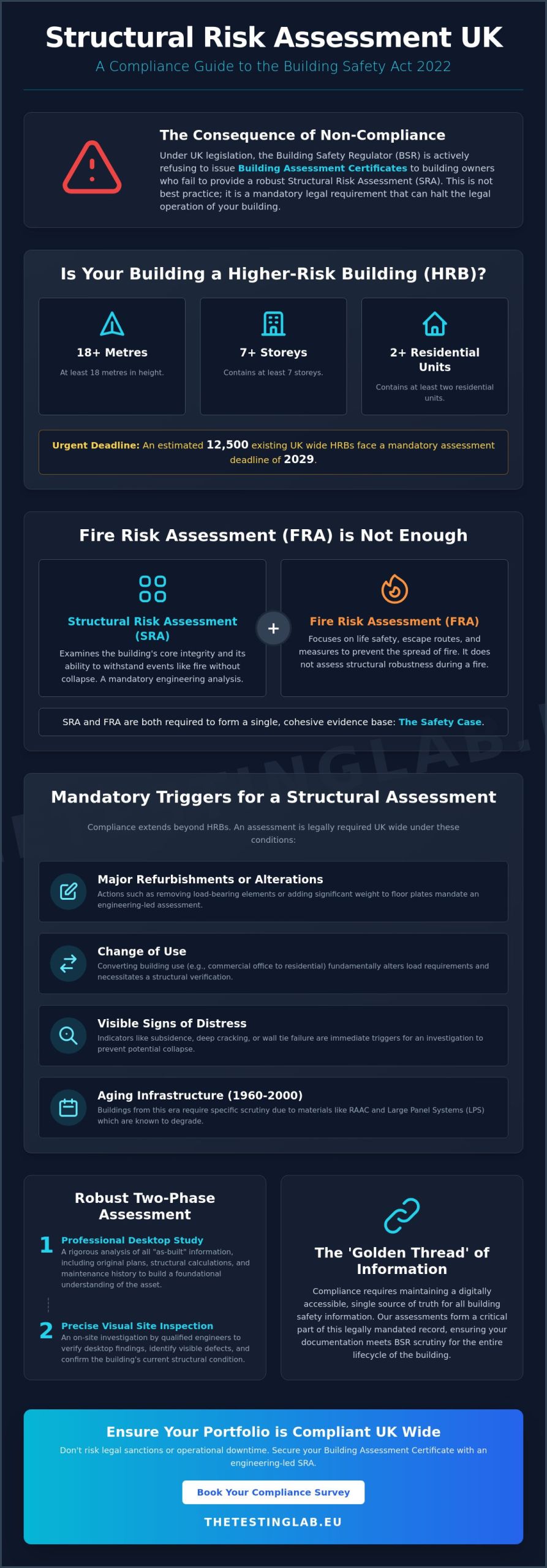
The Building Safety Regulator is already refusing to issue Building Assessment Certificates to UK wide building owners who fail to provide a robust structural risk assessment. While fire safety often dominates the conversation, structural integrity is the second, frequently overlooked pillar of the Building Safety Act 2022. Understanding exactly when is a structural risk assessment required UK wide is no longer just a matter of best practice; it’s a mandatory legal trigger under Section 83 that dictates whether your building can legally operate.
It’s natural to feel uncertain about whether these rigorous standards apply to your specific portfolio, especially with an estimated 12,500 existing higher-risk buildings facing a 2029 assessment deadline. We’re here to take that professional responsibility off your shoulders by providing a clear, engineering-led roadmap to compliance. You’ll learn the specifics of the 18-metre or 7-storey rule, the golden thread requirements, and the practical scenarios where an assessment becomes mandatory. This guide ensures you have the technical knowledge to navigate BSR scrutiny and align your assets with the latest UK legislation, ensuring your documentation is as precise as our local compliance and surveying standards.
Key Takeaways
- Identify the legal triggers under the Building Safety Act 2022 to understand exactly when is a structural risk assessment required UK wide for your property portfolio.
- Master the 18-metre and 7-storey rule that defines Higher-Risk Buildings (HRBs) and mandates compliance to avoid the refusal of Building Assessment Certificates.
- Recognise how major refurbishments, structural alterations, or a change of use can trigger mandatory assessments even for buildings outside the standard HRB criteria.
- Learn the two-phase methodology for a robust assessment, combining a professional desktop study of “as-built” information with precise visual site inspections.
- Ensure full compliance with Section 83 duties and the “golden thread” of information to maintain legal building operation and mitigate long-term liability.
Structural Risk Assessment Requirements Under the Building Safety Act 2022
Under the Building Safety Act 2022, a structural risk assessment (SRA) is defined as a systematic evaluation of a building’s potential for structural failure or collapse. It isn’t merely a visual walk-around; it’s a rigorous engineering analysis. Determining when is a structural risk assessment required UK wide is essential for compliance with Section 83. This legislation places a non-delegable duty on Accountable Persons to assess building safety risks, focusing specifically on the prevention of fire spread and structural failure.
The Building Safety Regulator (BSR) now uses these assessments as a primary metric for issuing Building Assessment Certificates (BACs). Without a “suitable and sufficient” SRA, the BSR has the authority to refuse certification, effectively halting the legal operation of the building. This shift ensures that structural robustness is treated with the same urgency as fire prevention in high-density environments.
Why a Fire Risk Assessment is Not Enough
Many building owners mistakenly believe a standard Fire Risk Assessment (FRA) fulfills their legal obligations. It doesn’t. While an FRA focuses on life safety and evacuation routes, an SRA examines whether the building’s skeleton can withstand the thermal stress of a blaze. The danger lies in assuming fire safety measures cover the core integrity of the structure during an incident. The Safety Case is the integration of fire and structural risk data into a single, cohesive evidence base.
Legal Definitions of Higher-Risk Buildings (HRBs)
In England and Wales, the mandatory requirement for an SRA applies to “Higher-Risk Buildings” (HRBs). These are defined as buildings at least 18 metres in height or having at least 7 storeys, containing at least two residential units. The Principal Accountable Person (PAP) must maintain the Safety Case report, ensuring that the structural data remains current and digitally accessible. This forms part of the broader local compliance and surveying expertise we provide UK wide to ensure your assets remain legally compliant and structurally sound.
Triggers for Structural Risk Assessments in Commercial and Existing Portfolios
While the regulatory focus often rests on high-rise residential blocks, commercial building owners must understand that when is a structural risk assessment required UK wide extends far beyond the 18-metre threshold. Major refurbishments or structural alterations are the most common triggers. If you’re removing load-bearing elements or adding significant weight to a floor plate, an engineering-led assessment is mandatory to ensure the building’s continued stability.
Change of use is another critical factor. Converting a commercial office into a residential unit or an industrial space into a high-density gym fundamentally alters the load-bearing requirements. You’ll need to verify that the existing frame can handle these new stresses. Additionally, visible signs of distress like subsidence, wall tie failure, or deep cracking aren’t just aesthetic concerns; they are immediate indicators that a structural investigation is necessary to prevent potential collapse.
Lenders and insurers have also raised their standards. Determining when is a structural risk assessment required UK wide for older assets is now a standard part of the pre-acquisition process to protect against the extended 30-year liability period introduced by the Building Safety Act 2022. Following official government guidance ensures that your due diligence meets these evolving legal expectations.
Assessing Aging Infrastructure and Portfolios
Buildings constructed between 1960 and 2000 require specific material scrutiny due to the prevalence of Large Panel Systems (LPS) and Reinforced Autoclaved Aerated Concrete (RAAC). These materials have shown significant degradation over time, making regular assessments vital for portfolio safety. Since these structures often contain hazardous materials, a professional asbestos consultancy is usually required as part of the initial investigation phase.
Statutory Compliance for Non-HRB Commercial Assets
Even if your building doesn’t meet the HRB height criteria, you aren’t exempt from safety duties. The Health and Safety at Work Act 1974 mandates that employers and building owners ensure the safety of anyone on the premises. This broad duty means that any structural concern must be addressed proactively. For those managing complex portfolios, our local compliance and surveying services provide the precision needed to satisfy both insurers and regulators.
Conducting a Robust Assessment: Professional Standards and Compliance
A high-quality assessment follows a rigorous, four-phase methodology to ensure every risk is accounted for. Determining when is a structural risk assessment required UK wide often depends on the complexity of the building’s history and its current condition. The process begins with a Phase 1 Desktop Study. Here, we review “as-built” information and original design codes to identify potential systemic weaknesses. This foundation leads into Phase 2, a visual site inspection focused on identifying critical structural elements that may have degraded over time.
If the visual inspection raises concerns, we move to Phase 3: intrusive investigation. This involves taking material samples for forensic laboratory analysis to detect issues that aren’t visible to the naked eye. Finally, Phase 4 involves risk categorisation and mitigation planning. These findings are then integrated into the Safety Case, providing the Building Safety Regulator with the “suitable and sufficient” evidence required for certification. This methodology ensures that compliance is a data-driven process rather than a subjective one.
The Role of Accredited Laboratory Testing
Scientific precision is non-negotiable when verifying the integrity of aging concrete or steel. We use advanced techniques like XRD analysis and XRF analysis to determine the exact material composition and identify chemical degradation. This level of detail is essential for spotting deleterious materials, such as high-alumina cement or chlorides, which can cause sudden structural failure without warning. Testing provides the empirical evidence needed to satisfy BSR inspectors.
Selecting a Competent Professional
The Building Safety Regulator expects assessments to be led by chartered structural engineers or UKAS accredited consultancies. Choosing a partner with the right skills, knowledge, and experience is critical to avoiding the refusal of a Building Assessment Certificate. For building owners managing complex urban assets, our specialist surveying services in London provide the technical depth needed to ensure compliance UK wide. We don’t just identify risks; we provide the methodological framework to manage them for the long term, taking the professional responsibility off your shoulders.
Securing Long-Term Compliance and Structural Integrity
Our methodology relies on UKAS Accredited Laboratory Analysis and expert multi-disciplinary safety consultancies to provide the precision your portfolio demands. We offer comprehensive Safety Case support to ensure full BSA 2022 compliance, from initial desktop studies to forensic material testing. For those managing complex urban estates, our specialist surveying services provide the technical expertise needed to maintain these standards across the country. We take the professional responsibility off your shoulders by delivering data you can trust.
Request a UK-wide structural risk assessment consultation from The Testing Lab PLC.
Navigating these complex regulations doesn’t have to be a burden when you have a strategic partner to manage the technical weight. We’re ready to help you secure your assets and ensure your buildings remain safe for the future.
Frequently Asked Questions
Is a structural risk assessment mandatory for all UK buildings?
A structural risk assessment is not mandatory for every building; however, it is a strict legal requirement for all Higher-Risk Buildings (HRBs) under the Building Safety Act 2022. These are residential structures that are at least 18 metres tall or contain 7 storeys. Determining when is a structural risk assessment required UK wide also involves identifying triggers like major refurbishments, change of use, or visible distress in non-residential assets. For complex portfolios, our local compliance and surveying expertise ensures all statutory obligations are met.
How often should a structural risk assessment be reviewed?
You must review your assessment whenever a significant change occurs to the building’s structure or its intended use. For Higher-Risk Buildings, the Safety Case must be a living document that reflects the current state of the asset at all times. We suggest a formal review every five years as a minimum, or immediately following any structural alterations, to ensure your Building Assessment Certificate remains valid under Building Safety Regulator scrutiny.
What is the difference between a structural survey and a structural risk assessment?
A structural survey is a snapshot of a building’s current condition and visible defects, while a structural risk assessment is a systematic evaluation of the potential for failure or collapse. The assessment is a more rigorous, risk-based analysis required for statutory compliance. It evaluates how critical structural elements might perform under extreme conditions, such as fire or accidental loading, to provide a data-driven safety case for the regulator.
Can a Fire Risk Assessor carry out a structural risk assessment?
A standard Fire Risk Assessor typically doesn’t have the engineering qualifications to perform a “suitable and sufficient” structural risk assessment. The Building Safety Regulator requires these assessments to be led by competent professionals, usually chartered structural engineers with specific expertise in building physics. While fire safety and structural integrity are integrated within a building’s Safety Case, the technical analysis of load-bearing capacities requires distinct engineering mastery to ensure legal accuracy.

Article by
P J F Thomas
CEO and Founder of TTL plc.
Disclaimer
Items declared are AI generated but do reflect our services. Please get in contact if you have any questions.