
With approximately 5,000 asbestos-related deaths still occurring annually in the UK, it’s clear that a one-time training certificate isn’t enough to protect your tenants or your business. For those overseeing diverse portfolios, asbestos awareness for property managers must evolve from a box-ticking exercise into a precise, continuous management strategy. You likely feel the weight of complex legislation across your UK wide portfolio. The pressure to ensure every site meets the stringent requirements of CAR 2012 is constant.
This guide will help you master the legal requirements of asbestos management to ensure your assets remain fully compliant with current health and safety standards. We’ll examine the latest HSE guidance on survey quality and the necessity of impartial four-stage clearances. By understanding these technical processes, you can reduce exposure risks and avoid the heavy fines associated with non-compliance. For those managing assets in the capital, our London asbestos and legionella surveying services provide the strategic partnership needed to handle these critical risks with scientific precision.
Key Takeaways
- Identify your specific legal responsibilities as a dutyholder under CAR 2012 to maintain compliance across your UK wide portfolio.
- Master the five essential steps to developing a professional Asbestos Management Plan that addresses site-specific risks and building ages.
- Improve asbestos awareness for property managers by learning how to evaluate the condition and location of materials during precise risk assessments.
- Understand the technical requirements of the 4-stage clearance process and when to engage professional consultancy for air testing.
- Transition from reactive fixes to a systematic management approach that reduces the risk of HSE fines and tenant exposure.
Understanding the Duty to Manage: UK Legislation for Property Managers
The Control of Asbestos Regulations 2012 (CAR 2012) remains the primary legislation governing asbestos safety UK wide. For those in charge of non-domestic premises, achieving high-level asbestos awareness for property managers is a statutory necessity rather than an optional skill. This isn’t just about identifying a material; it’s about establishing a rigorous methodology to prevent exposure in buildings constructed before 2000. You can find a detailed Asbestos overview to understand why these minerals pose such a significant health risk and why the HSE maintains such strict oversight.
Failure to comply isn’t just a paperwork error. The HSE actively enforces these regulations, and non-compliance can lead to unlimited fines or custodial sentences. With asbestos-related deaths still reaching 2,218 mesothelioma cases in 2023, the regulator’s focus on dutyholder accountability has never been sharper. As a property manager, you’re the first line of defense in ensuring that contractors and tenants aren’t walking into a hazardous environment without proper data.
The Dutyholder Concept in Commercial and Residential Management
In commercial settings or the common parts of residential blocks, the responsibility usually falls on the person or entity responsible for maintenance. According to Regulation 4 of CAR 2012, the Dutyholder is the person who has, to any extent, control of the premises or the means of access to them. Property managers often inhabit this role as strategic partners, tasked with identifying asbestos-containing materials (ACMs) across diverse portfolios. It’s your job to ensure that any risk is assessed and managed systematically, regardless of whether the site is a single office or a complex industrial estate. This requires a clear understanding of where your responsibility ends and the tenant’s begins, particularly in multi-let buildings.
Management Surveys vs. Refurbishment & Demolition (R&D) Surveys
Precision in surveying is vital for maintaining safety. A Management Survey is the standard requirement for daily building occupation, designed to locate ACMs that could be disturbed during normal use. However, if you’re planning upgrades or structural changes, you must commission an R&D survey first. This more intrusive inspection is mandatory before any maintenance or tenant improvements begin. Engaging professional Asbestos Consultancy Services ensures that these surveys meet the high standards expected by the HSE and provide a clear roadmap for your management plan. This proactive approach prevents the costly delays and legal risks associated with accidental asbestos disturbance during construction.
Implementing a Professional Asbestos Management Plan (AMP)
Developing a robust Asbestos Management Plan (AMP) is the operational core of your dutyholder responsibilities. It’s not enough to simply know asbestos exists; you must actively manage the risk it poses to occupants and visitors. Under The Control of Asbestos Regulations 2012, your AMP must be a living document that guides every interaction with the building’s fabric. True asbestos awareness for property managers means moving beyond basic identification to a system of continuous monitoring and clear communication across your UK wide portfolio.
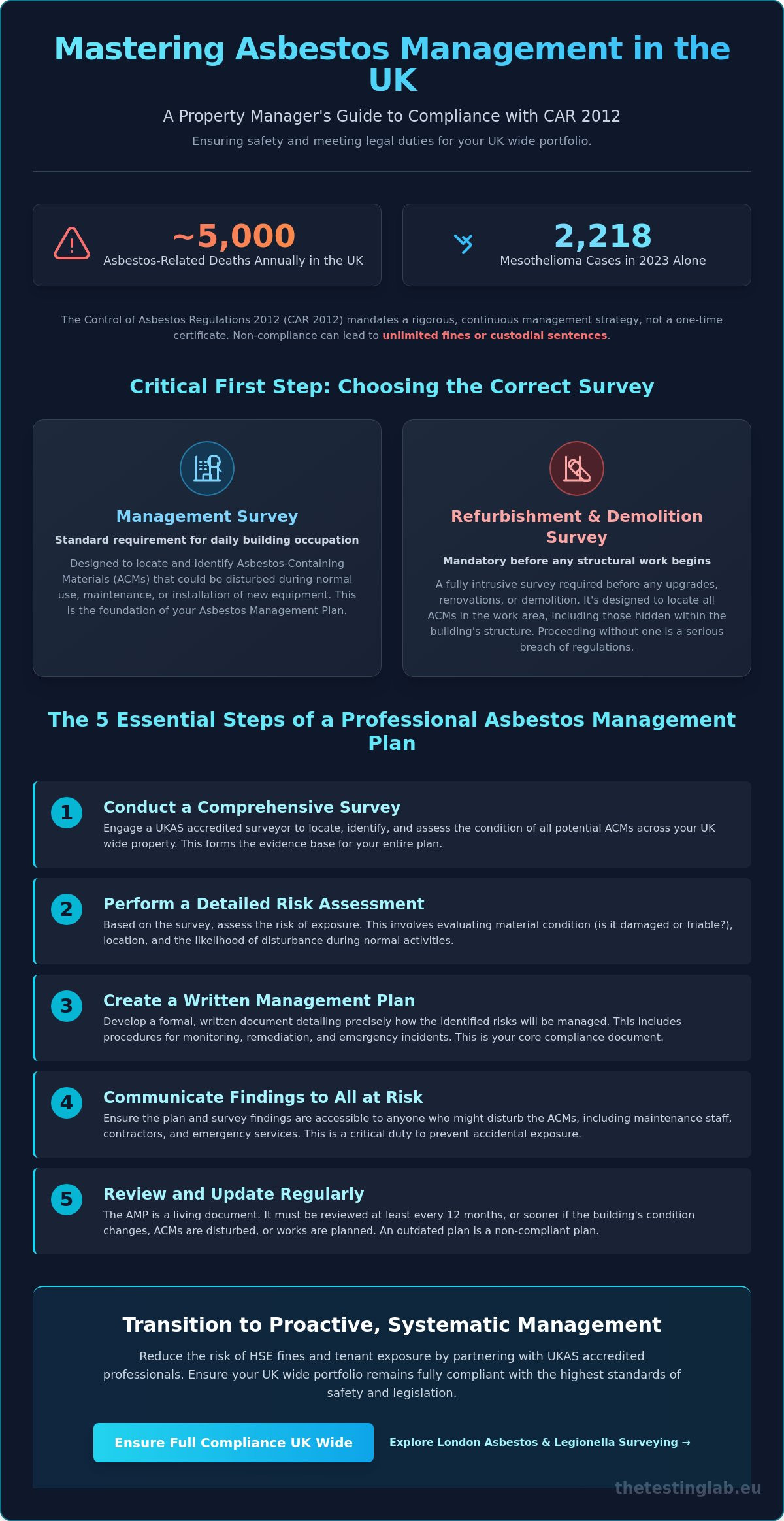
A compliant AMP follows five rigorous steps:
- Conduct a comprehensive management survey to locate and identify ACMs.
- Perform a detailed risk assessment based on material condition and potential for disturbance.
- Create a written plan detailing exactly how you’ll manage or remediate these risks.
- Communicate findings to everyone at risk, including maintenance staff, contractors, and tenants.
- Review and update the plan at least every 12 months or whenever the building’s status changes.
Material scoring is a critical component of this process. You must evaluate whether the material is friable or damaged and how likely it is to be disturbed during daily operations. High-traffic areas require more frequent re-inspections because the risk of accidental damage is significantly higher. If you’re managing multiple sites, London and UK-wide Asbestos Surveying provides the technical foundation needed for these precise assessments.
The Critical Role of UKAS Accredited Testing and Analysis
UKAS accreditation represents the UK-wide benchmark for technical competence in laboratory analysis. Using non-accredited samples is a significant risk that could leave your organization vulnerable during health and safety litigation. UKAS accreditation ensures the validity of bulk asbestos identification by confirming that the laboratory operates under a strictly controlled quality management system. This level of precision is essential when defending your compliance record or making high-stakes remediation decisions.
Digital Record Keeping and Accessibility
Your asbestos register must be accessible instantly to be effective. Digital records allow you to share critical safety data with emergency services or maintenance contractors before they even arrive on-site. It’s your responsibility to ensure that no one drills into a wall or enters a ceiling void without first checking the register. For complex portfolios, seeking professional consultancy can help streamline this data management process and ensure your records remain fully compliant.
Mitigating Risk: Air Clearance and Professional Consultancy
Developing high-level asbestos awareness for property managers is the foundation, but the execution of remediation requires a tactical shift toward professional consultancy. When asbestos-containing materials (ACMs) are identified for removal or encapsulation, you must move beyond passive monitoring into active project oversight. This transition ensures that every stage of the remediation process is handled with engineering precision. Engaging a strategic partner for these critical phases removes the burden of professional responsibility from your shoulders while ensuring the safety of your UK wide portfolio.
A comprehensive approach to asbestos awareness for property managers must also include ground-level risks. During property extensions or groundworks, managing asbestos in soils is a frequent challenge that requires specialized testing. Failure to identify soil contamination early can lead to project delays and significant environmental liabilities. By integrating soil investigation with building surveys, you create a seamless compliance framework that protects both the structure and the land it sits on.
4-Stage Clearance and Air Monitoring Protocols
The 4-stage clearance process is a mandatory technical safeguard designed to verify that a building is safe for re-entry after licensed removal work. This sequence includes a preliminary site inspection, a thorough visual inspection of the work area, air monitoring to check fiber levels, and a final post-remediation check. Independent air monitoring is a vital safeguard for property managers. It provides an unbiased, scientific verification that the removal contractor has met the required standards. For sites involving land disturbance, Asbestos in Soils Testing is equally critical to ensure the safety of the entire site perimeter.
Choosing a UK-Wide Asbestos Management Partner
Selecting a consultancy requires looking for UKAS accreditation and a proven track record across diverse property types. A strategic partner should offer a full suite of services, from initial management surveys to complex lab testing and air clearance. The Testing Lab PLC supports property managers with UK wide site surveys and precise laboratory analysis, ensuring every asset meets the highest safety standards. Our methodological approach provides the transparency and data-driven insights you need to manage risk effectively. Contact our specialists for a UK-wide compliance audit to secure your properties and ensure long-term legislative compliance.
Securing Your Portfolio Through Strategic Compliance
Mastering the complexities of CAR 2012 requires more than a basic understanding of the law. It demands a systematic approach to risk assessment and the implementation of a live Asbestos Management Plan. By prioritizing asbestos awareness for property managers, you’ve taken the first step toward safeguarding your UK wide portfolio. The focus now shifts to maintaining that safety through regular re-inspections and the technical precision of independent air monitoring.
Partnering with an expert ensures that every technical requirement, from bulk sample analysis to complex 4-stage clearances, is handled with scientific accuracy. As an independent UK-wide consultancy with a UKAS accredited laboratory, we specialize in building surveys and detailed soil analysis. This strategic partnership takes the professional responsibility off your shoulders and places it in expert hands. You can rely on our methodological approach to keep your operations efficient and compliant.
Request an Asbestos Management Quote for Your UK Portfolio to ensure your assets remain fully compliant and your tenants stay protected. Securing your properties today provides the peace of mind you need for a compliant future.
Frequently Asked Questions
Is asbestos awareness training a legal requirement for property managers?
How often should an asbestos management survey be updated?
An asbestos management plan must be reviewed every 12 months at a minimum. While the initial survey provides a baseline, the condition of asbestos-containing materials (ACMs) can change due to wear, moisture, or building use. Regular re-inspections are necessary to verify that the materials remain in a safe condition. If any building works occur or the property’s use changes, you should update the survey and management plan immediately to reflect the new risk profile.
What happens if a property manager fails to identify asbestos before a renovation?
Failing to identify asbestos before renovation work begins can lead to immediate HSE enforcement action, including stop-work notices and unlimited fines. Beyond the legal and financial repercussions, it places contractors and tenants at risk of inhaling hazardous fibers. If accidental disturbance occurs, the site must be evacuated and a professional 4-stage clearance process must be completed before re-entry is permitted. This often results in significant project delays and substantial remediation costs.
Can I take my own asbestos samples for laboratory testing?
While there’s no law explicitly forbidding you from taking a sample, it’s strongly discouraged due to the high risk of fiber release and personal exposure. Professional surveyors use specific wetting agents and shadow vacuuming techniques to contain fibers during sampling. For a legally defensible audit trail, you should engage a UKAS accredited consultancy. This ensures the sample is taken safely and analyzed with the precision required for a compliant asbestos register across your portfolio.

Article by
P J F Thomas
CEO and Founder of TTL plc.
Disclaimer
Items declared are AI generated but do reflect our services. Please get in contact if you have any questions.