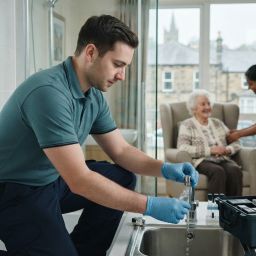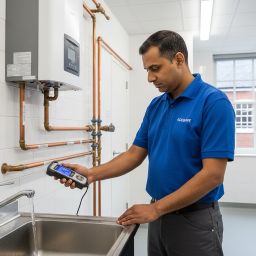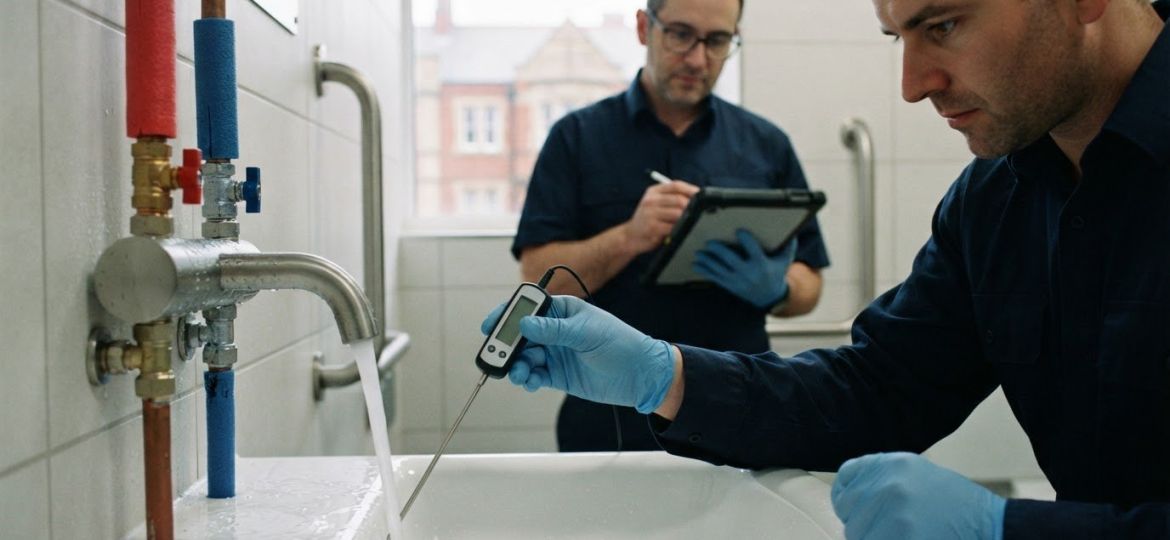
Get instant Quote for support with understanding how a thermostatic mixing valve (TMV) helps protect users from scalding, and why its outlet temperature must be considered alongside Legionella controls. A reading at the outlet alone does not show that the wider water system is being managed effectively. TMV temperature testing for legionella compliance is one part of a site-specific approach.
UK duties under the Health and Safety at Work etc. Act 1974 and the Control of Substances Hazardous to Health Regulations 2002 sit alongside HSE guidance in ACOP L8 and HSG274. This guide explains what TMV checks can show, what to record and how the site’s risk assessment informs testing and review. The Testing Lab PLC provides UK-wide Legionella Risk Assessments, which are LCA-registered, and water-management services. Every water system in England, Scotland and Wales is unique and must be assessed individually. The Testing Lab PLC has over 18 years of industry experience and is a national service provider with its head office in Doncaster.
Key Takeaways
- TMV temperature testing for legionella compliance should consider both the mixed water delivered at the outlet and the hot water supplied to the valve.
- Use the site’s control plan to identify each valve, set out the checks and record results consistently.
- Follow the applicable guidance and system risk assessment when setting the test method, limits and monitoring frequency.
- Use unusual readings or recurring issues to review wider Legionella controls, monitoring and any necessary remedial action.
What TMV Temperature Testing Means for Legionella Compliance
TMV temperature testing for legionella compliance checks whether a thermostatic mixing valve operates as intended and delivers mixed water in line with the site’s control plan. The check should consider the valve’s role in reducing scald risk alongside the system’s Legionella controls. A safe mixed-water temperature at the outlet does not, on its own, show that the wider water system is effectively managed.
How TMVs fit into UK Legionella control
In the UK, the Health and Safety at Work etc. Act 1974 and the Control of Substances Hazardous to Health Regulations 2002 provide the legislative basis for managing risks to health, including exposure to Legionella. The Health and Safety Executive’s ACOP L8 sets out a code of practice for controlling Legionella bacteria in water systems. It is not legislation, but has special legal status. HSG274 provides supporting technical guidance, including guidance for hot and cold water systems. Legionella bacteria can cause Legionnaires’ disease, so TMV checks need to form part of a broader, documented control approach.
Quotable takeaway: “A TMV check provides evidence about one valve, not proof that Legionella risks are controlled across the entire water system.”
A TMV blends hot and cold supplies to reduce scald risk. Legionella controls must also account for water conditions upstream and elsewhere in the system. A valve reading cannot replace a risk assessment or system-wide monitoring plan.
The Testing Lab PLC provides UK-wide Legionella Risk Assessments, which are LCA-registered, alongside water-management services. Every water system in England, Scotland and Wales is unique and must be assessed individually. The company has over 18 years of industry experience, and Doncaster is the head office of this national service provider.
How to Plan and Record TMV Temperature Testing
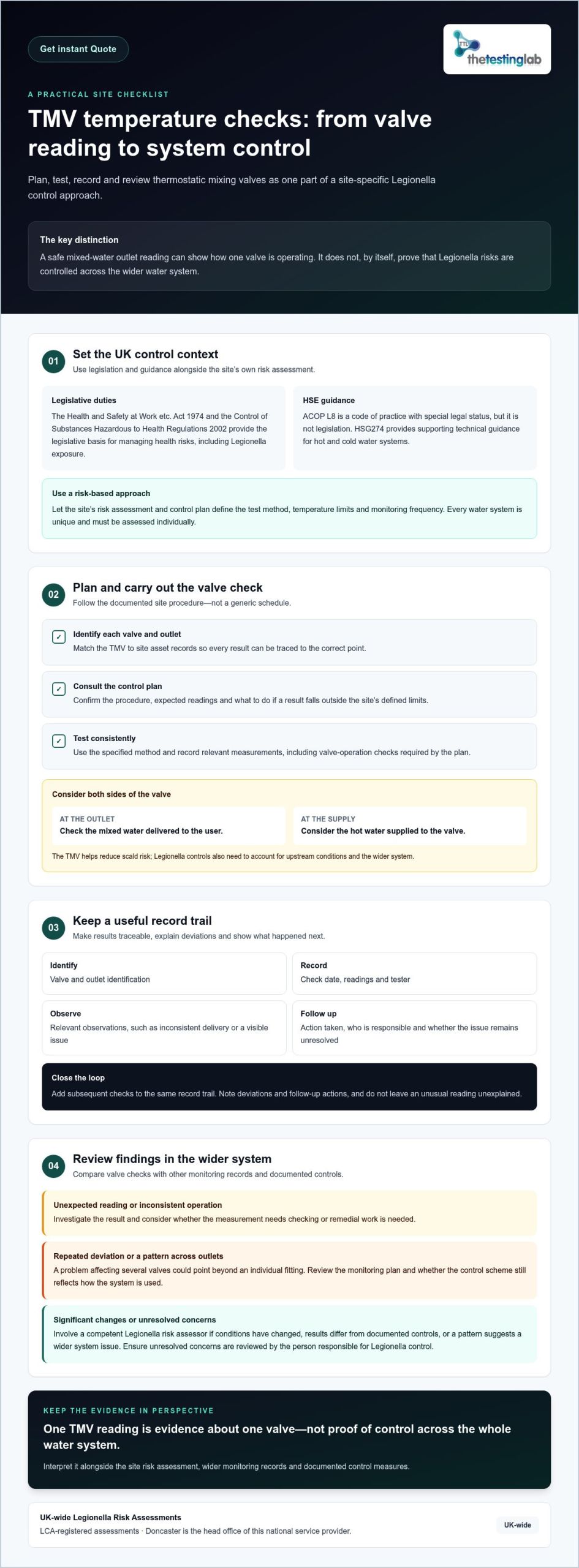
Start with the site’s control plan rather than applying a generic schedule. UK health and safety duties require monitoring to reflect the risks identified for the system. The HSE guidance on Legionella and Legionnaires’ disease supports this risk-based approach. Use the relevant guidance and assessment to set the test method, temperature limits and frequency.
- Identify the valve and outlet. Match each TMV to the site’s asset records so that results can be traced to the correct point.
- Consult the control plan. Confirm the procedure, expected readings and the steps to take if a result falls outside the site’s limits.
- Test consistently. Follow the specified method and record the relevant measurements, including any valve-operation checks required by the plan.
- Record and review. Document the result, note deviations and assign follow-up actions. Do not leave an unusual reading unexplained.
A temperature reading is useful evidence, but it does not prove effective control across the whole water system. Interpret it alongside the site’s other monitoring records and documented controls.
What to document when a TMV is checked
Record the valve and outlet identification, check date, readings, tester and relevant observations, such as inconsistent delivery or a visible issue. If a result falls outside the site’s defined limits, note the action taken, who is responsible for follow-up and whether the issue remains unresolved. Add subsequent checks to the same record trail so it is clear whether the issue was addressed.
Keep TMV records consistent with the wider risk assessment and control documentation. The Testing Lab PLC’s LCA-registered Legionella Risk Assessments can support a structured review of system controls. If your monitoring records reveal gaps, request support with a UK-wide Legionella risk assessment.
Turn TMV Findings into UK-Wide Legionella Risk Management
Compare TMV results with the site’s documented control measures and other monitoring records. An unexpected reading, inconsistent valve operation or repeated deviation should prompt investigation. Depending on the findings, this may involve checking the measurement, arranging remedial work, reviewing the monitoring plan or reassessing whether the existing control scheme still reflects how the system is used.
Escalate a problem that persists or appears across several outlets. For example, temperature variations at multiple valves could indicate an issue beyond an individual fitting. Record the evidence and actions taken, then ensure unresolved concerns are reviewed by the person responsible for Legionella control. UK health and safety duties require risks to be managed, so findings should inform practical decisions rather than remain isolated entries in a log.
When to involve a Legionella risk assessor
Involve a competent risk assessor when readings or valve performance differ from the site’s documented controls, when a pattern suggests a wider system issue, or when significant changes mean the current assessment may no longer reflect conditions on site. The assessment can help determine whether the risk assessment, monitoring plan or remedial priorities need revision.
The Testing Lab PLC provides UK-wide Legionella Risk Assessments, and its assessments are LCA-registered. The company has over 18 years of industry experience, with Doncaster as the head office of this national service provider. A Legionella Risk Assessment can put TMV temperature testing for legionella compliance in the context of the whole water system.
For a practical next step, Get instant Quote for support with an individual Legionella assessment.
Make Your Monitoring Plan Ready for the Next Review
At your next review, check that TMV temperature testing for legionella compliance still reflects how the system operates. Changes to outlets, occupancy, water use or maintenance can affect whether existing controls remain suitable. Give each finding a clear owner, record its outcome and set a point for review so unresolved issues are not missed between monitoring cycles.
A structured, site-specific approach helps turn routine readings into decisions that support ongoing water management across the UK. The Testing Lab PLC provides UK-wide support through LCA-registered Legionella Risk Assessments. The company has over 18 years of industry experience, and Doncaster is the head office of this national service provider.
Get instant Quote to discuss a practical next step for your site. For direct enquiries, call 0800 177 7264 or email [email protected]. Clear records and a proportionate plan help keep monitoring findings useful and actionable.
Frequently Asked Questions
Is TMV temperature testing enough to prove Legionella compliance?
No. A TMV check gives information about one valve and its outlet, but cannot show whether other parts of the system are controlled. For example, it does not establish conditions in storage, infrequently used outlets or pipework elsewhere. Under UK health and safety duties, the result needs to be considered alongside the site’s wider Legionella risk controls.
How often should a TMV be temperature tested?
Follow the interval set by the site’s risk assessment and control plan, rather than assuming every valve needs the same schedule. HSE’s HSG274 Part 2 recommends monthly temperature checks at sentinel outlets, but this should not automatically be read as a requirement to test every TMV monthly. Keep valve checks and servicing aligned with applicable guidance and the manufacturer’s instructions.
Can a TMV prevent Legionella growth?
No. A TMV controls scald risk by blending hot and cold water; it does not disinfect water or prevent bacteria multiplying in the wider system. Because mixed water may be warm, control also depends on managing the supplies and system conditions around the valve. A properly functioning TMV is a safety measure, not a stand-alone Legionella control.
Who can carry out TMV temperature testing for Legionella compliance?
A competent person familiar with the site’s procedure, the valve and the required safety controls should carry out the check and record the results. Escalate persistent deviations or faults for appropriate assessment. The Testing Lab PLC provides UK-wide Legionella Risk Assessments for sites in Carlisle, Chester, Lancaster, Liverpool, Manchester, Preston, Salford, Berwick-upon-Tweed, Durham, Middlesbrough, Newcastle upon Tyne, Sunderland, Bradford, Doncaster, Huddersfield, Hull, Leeds, Sheffield and Wakefield.

Article by
P J F Thomas
CEO and Founder of TTL plc.
Disclaimer
Items declared are AI generated but do reflect our services. Please get in contact if you have any questions.