

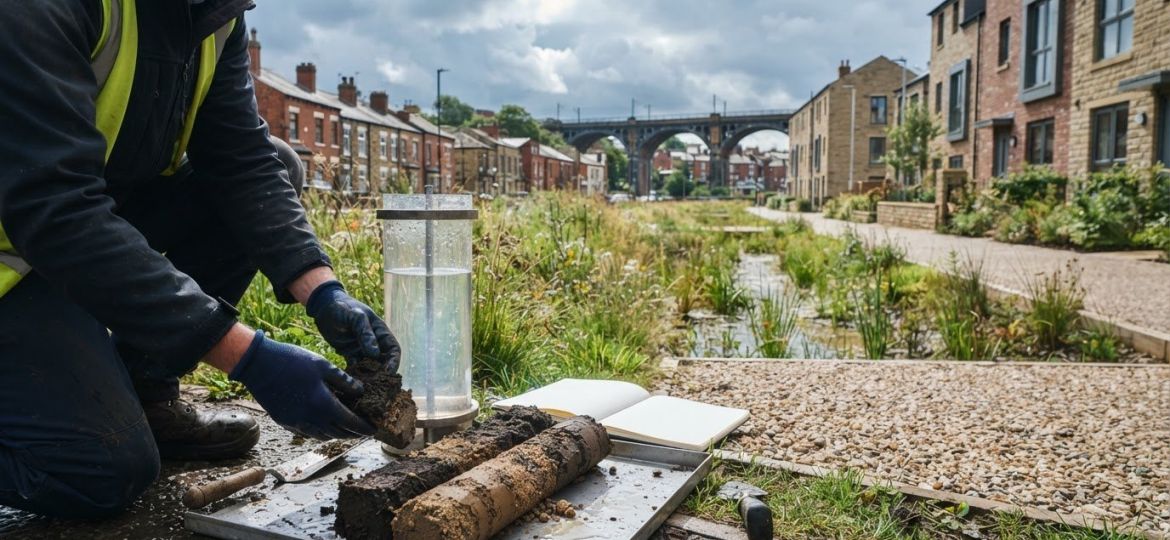
Relying solely on basic percolation pit tests is the fastest way to trigger a planning refusal under the Flood and Water Management Act 2010 and current Defra National Standards. You already know how frustrating it is when ambiguous infiltration data stalls earthworks or when unrecorded ground contaminants threaten sensitive aquifers. That’s why rigorous soil testing for sustainable drainage systems (SuDS) must pair field percolation measurements directly with laboratory chemical characterisation before detailed drainage layouts are finalized.
Discover the mandatory soil testing protocols, infiltration standards, and geotechnical requirements needed for SuDS compliance across the UK. We’ll examine how to balance in-situ BRE Digest 365 soakage trials with BS EN ISO 17892 laboratory permeability analysis to size attenuation features accurately. As a National Service Provider with our head office in Doncaster, we deliver the UK-wide geotechnical insight required to ensure your surface water strategy achieves immediate, defensible approval.
Key Takeaways
- Understand how defensible soil testing for sustainable drainage systems (SuDS) ensures swift planning approvals under the Flood and Water Management Act 2010.
- Discover the critical differences between field-based BRE Digest 365 percolation trials and laboratory permeability tests to meet strict CIRIA C753 design criteria.
- Learn how assessing clay fractions, filtration capacity, and organic profiles through BS 3882 topsoil testing protects groundwater quality in surface attenuation assets.
- Identify the UKAS accreditation standards and centralized logistics needed to secure dependable, UK-wide geotechnical data from our Doncaster headquarters.
Statutory Standards and Infiltration Drivers for UK SuDS Design
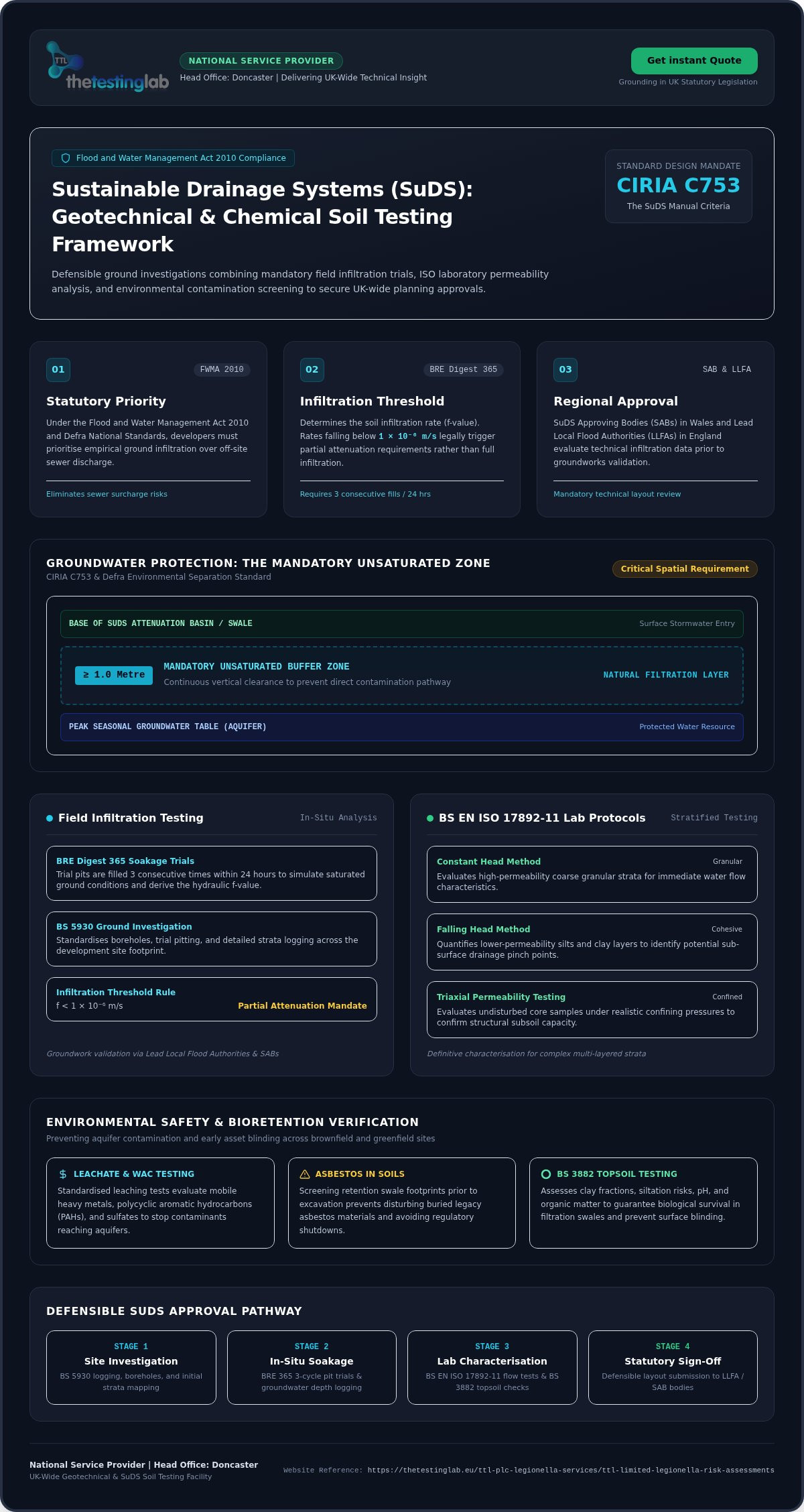
Implementing sustainable drainage systems (SuDS) requires rigorous geotechnical evidence before local planning authorities grant layout validation. Across the UK, surface water management is grounded in statutory frameworks designed to eliminate sewer surcharge risks. Under the Flood and Water Management Act 2010 and revised national planning policies, developers must prioritise infiltration over off-site discharge. Planning authorities enforce CIRIA C753 (The SuDS Manual) standards, demanding empirical proof that soils can manage extreme storms. Infiltration design also mandates a minimum 1.0-metre unsaturated zone between the base of any basin and the highest recorded seasonal groundwater table to protect groundwater quality.
Meeting CIRIA C753 and BRE Digest 365 Compliance
Defensible drainage design rests on standardized ground investigations:
- BRE Digest 365 Soakage Trials: Determines the soil infiltration rate ($f$-value) by filling trial pits three consecutive times over 24 hours, simulating saturated conditions. Soils with rates below $1 times 10^{-6}text{ m/s}$ require partial attenuation rather than unattenuated infiltration.
- BS 5930 Ground Investigation: Provides the definitive code of practice for site investigations, standardising boreholes, trial pitting, and strata logging.
- SAB Geotechnical Reviews: In Wales, local authority SuDS Approving Bodies (SABs) legally evaluate infiltration data before groundworks begin. In England, planning authorities enforce equivalent technical rigor through Lead Local Flood Authorities (LLFAs).
Conducting accurate soil testing for sustainable drainage systems (SuDS) eliminates project uncertainty early. Operating as a National Service Provider from our Doncaster head office, we deliver UK-wide geotechnical testing to verify subsurface permeability and protect critical aquifers.
Critical Laboratory and On-Site Soil Testing Protocols
Relying solely on surface soakaway pits leaves engineering designs exposed to catastrophic hydraulic errors. Precise laboratory analysis under BS EN ISO 17892-11 provides the definitive constant head and falling head permeability data needed to evaluate complex stratified layers. Constant head procedures test coarse granular strata, whereas falling head methods quantify low-permeability silts and clays. Triaxial permeability tests verify undisturbed cohesive core samples under realistic confining pressures, ensuring structures meet the updated Defra National standards for sustainable drainage systems. Alongside hydraulic conductivity, planting media must be assessed for clay fractions and siltation risks using verified BS 3882 topsoil testing to prevent early basin blinding.
Preventing Groundwater Contamination via Chemical Soil Screening
Uncontrolled infiltration on brownfield ground risks washing historic industrial contaminants directly into protected groundwater aquifers:
- Leachability Screening: Standardized leachate analysis and WAC testing protocols evaluate the risk of mobile heavy metals, polycyclic aromatic hydrocarbons, and sulfates dissolving into underlying groundwater tables.
- Hazardous Ground Materials: Excavating retention swales without prior testing risks disturbing buried legacy contaminants like asbestos in soils, leading to costly site shutdowns and regulatory intervention.
- Bioretention Soil Chemistry: Testing soil pH, plant nutrients, and organic matter content ensures the long-term biological survival of vegetation required for bio-filtration swales.
Pairing chemical soil characterisation with geotechnical flow measurements ensures compliant soil testing for sustainable drainage systems (SuDS) across every development stage. From our central Doncaster testing facility, we provide dependable, UK-wide analytical data for complex multi-regional developments; you can request specialist lab analysis to confirm your project’s environmental safety parameters.
Selecting an Accredited Laboratory for National Infrastructure Projects
Securing planning consent under current drainage legislation requires geotechnical data backed by ISO/IEC 17025:2017 standards. Civil consultants routinely cross-reference desk studies against the BGS Infiltration SuDS dataset, but desktop research can’t substitute for accredited laboratory validation. Submitting unaccredited percolation results creates immediate validation refusals from Lead Local Flood Authorities. Independent UKAS accreditation for environmental and geotechnical testing ensures that infiltration parameters, grain-size distributions, and chemical leaching results remain entirely defensible. Aligning infiltration data with technical reports from construction material testing laboratories establishes a unified geotechnical baseline for civil engineers and local approving bodies.
Laboratory testing protocols evaluate core samples extracted from borehole investigations under BS 5930, removing seasonal weather variables that distort field soakaway results. This method gives engineers certified hydraulic conductivities alongside precise particle-size distributions needed to design permeable pavements and subterranean attenuation structures.
Centralised Technical Support from Doncaster for UK-Wide Developments
Managing multi-site commercial developments across regional borders often introduces severe logistical friction and testing bottlenecks. Doncaster is the head office of this National Service Provider, maintaining a centralised analytical hub that guarantees dependable turnaround times across the UK. Dedicated technical account managers oversee every phase of testing, interpreting complex triaxial and chemical data into clear compliance documentation for municipal planners.
Early scheduling of verified soil testing for sustainable drainage systems (SuDS) prevents costly drainage redesigns and keeps earthworks on programme. When multi-site project milestones demand immediate certainty, Get instant Quote to coordinate your testing schedule UK-wide.
Secure Robust Drainage Approval with Defensible Soil Data
Achieving rapid drainage approval demands moving beyond basic field estimates. Coupling BRE Digest 365 infiltration trials with UKAS-accredited laboratory testing ensures your designs satisfy CIRIA C753 criteria, maintain vital groundwater clearances, and withstand local planning scrutiny. Rigorous chemical screening also protects aquifers by confirming that surface attenuation won’t mobilise underlying historic ground contaminants.
Partnering with an experienced specialist gives your civil engineering team total technical certainty. Operating as a National Service Provider, our Doncaster head office coordinates comprehensive chemical, geotechnical, and topsoil testing programmes across the UK. By integrating reliable soil testing for sustainable drainage systems (SuDS) into your pre-construction phase, you protect project schedules and build lasting hydrological resilience. Get instant Quote today to streamline your site testing workflow and secure compliant, audit-ready data.
Frequently Asked Questions
Why is soil testing mandatory for sustainable drainage systems in the UK?
Under the Flood and Water Management Act 2010 and national planning policy frameworks, planning authorities require empirical ground data before authorizing drainage designs. Comprehensive soil testing for sustainable drainage systems (SuDS) proves whether in-situ infiltration can safely disperse surface water without triggering localized surface flooding. Without defensible percolation rates, Lead Local Flood Authorities will reject outline drainage submissions across UK-wide developments.
What is the difference between BRE 365 testing and laboratory permeability testing?
BRE Digest 365 measures in-situ infiltration rates directly within full-scale trial pits excavated on site over 24-hour saturation cycles. In contrast, laboratory testing under BS EN ISO 17892 isolates soil cores to measure hydraulic conductivity under strict controls. Doncaster is the head office of this National Service Provider, coordinating UK-wide laboratory testing to corroborate field data with certified geotechnical analysis.
Can infiltration SuDS be installed on sites with contaminated ground?
Infiltration SuDS can’t discharge untreated surface runoff directly into ground containing mobile contaminants. Infiltrating water through contaminated strata risks leaching toxic compounds into underlying potable aquifers and violating UK groundwater protection regulations. On brownfield sites, developers must complete chemical soil testing and leachate screening. If contaminants exist, designers must install impermeable geomembrane liners and lined attenuation basins.
How do soil clay content and particle size affect SuDS sizing?
Soil particle distribution directly determines how rapidly stormwater drains into the subsurface. High clay fractions create tightly packed, low-permeability boundaries that drastically reduce infiltration rates. When completing soil testing for sustainable drainage systems (SuDS), identifying elevated clay percentages dictates larger attenuation storage volumes, deeper sub-base aggregates, or hybrid discharge arrangements to prevent standing water from exceeding standard drain-down limits.

Article by
P J F Thomas
CEO and Founder of TTL plc.
Disclaimer
Items declared are AI generated but do reflect our services. Please get in contact if you have any questions.

