Your asbestos removal project isn’t finished when the last bag of waste leaves the site. It’s only truly complete when a rigorous forensic audit proves the environment is safe for human life. Navigating the Control of Asbestos Regulations 2012 (CAR 2012) often feels like a bureaucratic maze, especially when you’re under pressure to secure a valid certificate of reoccupation asbestos without compromising on safety. We know the fear of project delays and the uncertainty surrounding analyst independence can make the final stages of a project feel incredibly stressful.
This guide will demystify the entire process, showing you how to ensure 100% safety for inhabitants and full HSE compliance. We’ll provide a clear, logical breakdown of the four mandatory stages, from the initial site condition check to final air monitoring and enclosure dismantling. By following this professional framework, you can move from the risks of removal to the certainty of a safe, legally compliant building reoccupation. This systematic approach takes the weight of professional responsibility off your shoulders and puts your project on the path to a successful conclusion.
Key Takeaways
- Understand why Regulation 20 of CAR 2012 mandates a four-stage clearance for all licensed asbestos removal projects to ensure total site safety.
- Navigate the technical requirements of each phase, including the critical stage two visual inspection and mandatory air monitoring protocols.
- Learn how to secure a legally valid certificate of reoccupation asbestos that stands up to HSE scrutiny and protects building inhabitants.
- Discover why appointing an independent, UKAS accredited analyst is essential to eliminate conflicts of interest and ensure impartiality.
- Master the transition from a hazardous work site to a safe, reoccupied environment by following the latest HSG248 analyst’s guide standards.
What is Four-Stage Clearance and Why is it Legally Required?
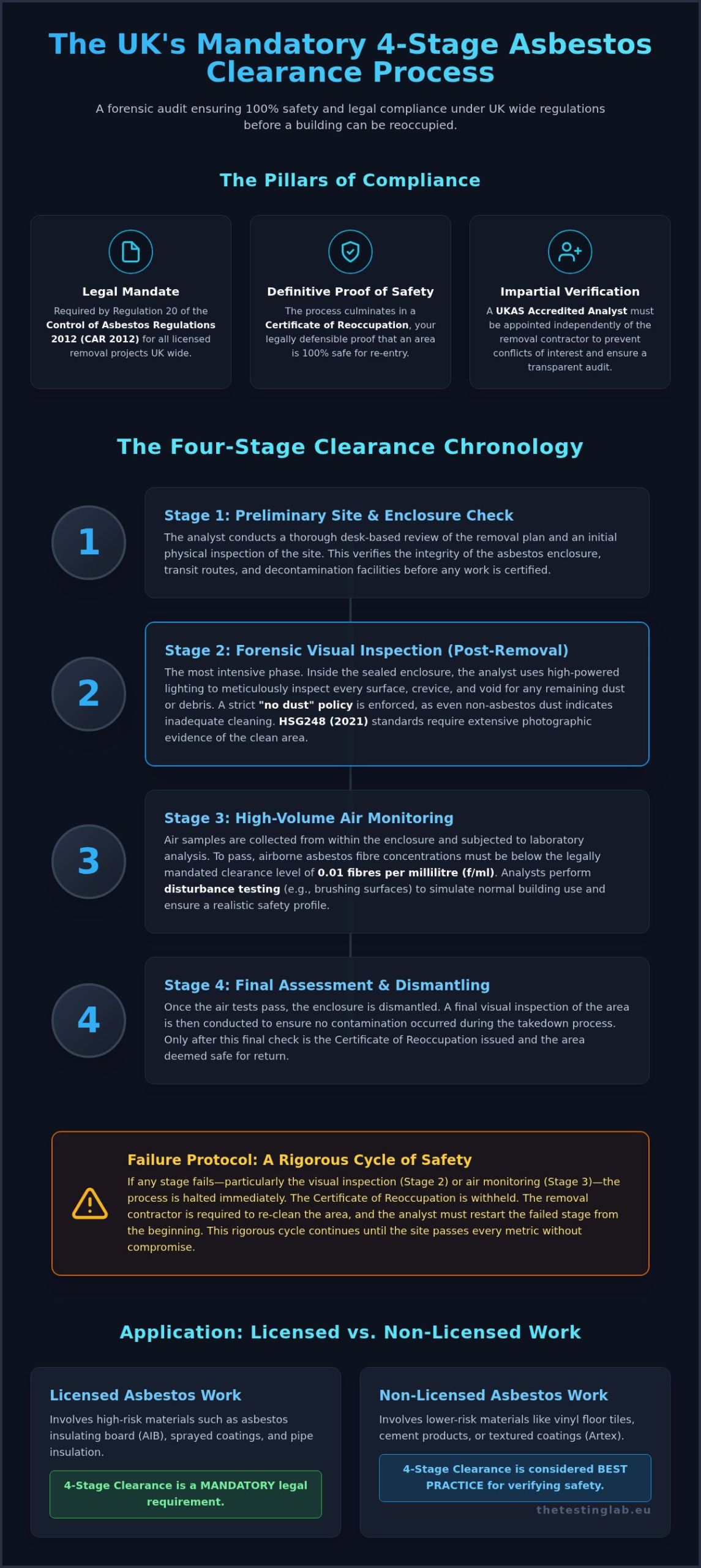
The four-stage clearance is a rigorous, legally mandated forensic auditing process designed to ensure a work area is entirely free from asbestos contamination following abatement. Under Regulation 20 of the Control of Asbestos Regulations 2012 (CAR 2012), this procedure isn’t optional for licensed works; it’s a statutory requirement. The primary objective is to provide objective evidence that the environment is safe for unprotected individuals to enter. This culmination of the project is documented through the issuance of a certificate of reoccupation asbestos, a vital legal document that transfers the responsibility of safety back to the duty holder with confidence.
In the UK, the Duty Holder carries the legal weight of compliance. A critical aspect of asbestos abatement procedures is the requirement for independence. The HSE strongly recommends that the analyst performing the clearance is directly appointed by the building owner, not the removal contractor. This separation ensures an impartial audit, preventing any conflict of interest and guaranteeing that safety standards aren’t compromised for project speed. Our asbestos consultancy team operates as your strategic partner in this process, taking the technical burden off your shoulders.
Licensed vs. Non-Licensed Asbestos Work
Not every asbestos job requires a full four-stage clearance, but the distinction is vital for legal compliance. Licensed work involves high-risk materials like Asbestos Insulating Board (AIB), sprayed coatings, or pipe lagging. For these materials, the four-stage process is a strict legal necessity. While non-licensed work, such as removing vinyl floor tiles, may only require a thorough visual inspection, applying the four-stage framework is often considered best practice to eliminate residual risk in sensitive environments.
HSG248: The 2021 Analyst Guide Standards
The Health and Safety Executive (HSE) updated its technical guidance, HSG248 Asbestos: The Analysts’ Guide, in July 2021. These updated standards introduced more stringent requirements for visual inspections and increased the time analysts must spend inside the enclosure. These changes aren’t just suggestions. They’re the benchmark used UK-wide to ensure consistency. For building managers, adhering to these standards means your certificate of reoccupation asbestos is backed by the most current, scientifically robust methodology available.
The Step-by-Step Breakdown of the Four-Stage Clearance Process
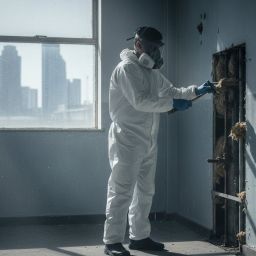
The clearance process is a methodical sequence of four distinct stages, each acting as a safety gate that must be cleared before moving to the next. This logical structure ensures that by the time you receive your certificate of reoccupation asbestos, the environment has been subjected to a rigorous forensic audit. Our analysts treat each stage as a precision task, ensuring no detail is overlooked during the transition from a construction site back to a safe building.
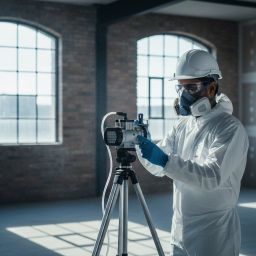
Stage 1 involves a preliminary check of the site condition. We verify the integrity of the enclosure, ensure transit routes are clean, and confirm all site documentation is current. Stage 2 is the most intensive phase: a thorough visual inspection of the entire work area. Since the 2021 update to HSE’s Asbestos: The Analysts’ Guide, this stage requires extensive photographic evidence of all inspected areas. This creates a transparent digital audit trail that was often missing in older reporting styles.
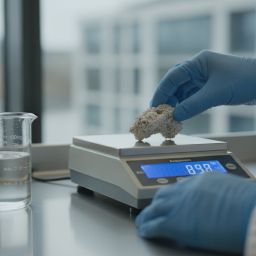
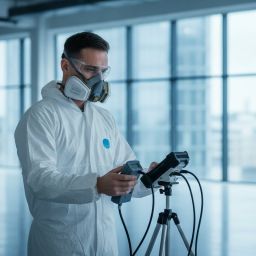
Stage 3 moves into air monitoring. High-volume pumps sample the air to ensure fiber levels are below the limit of quantification, which is 0.01 f/ml. Finally, Stage 4 occurs after the enclosure is dismantled. We perform a final assessment of the area to ensure no dust was released during the strike-down process. If you’re managing a complex site, our asbestos consultancy team can help you coordinate these stages to avoid unnecessary downtime.
What Happens During Stage 2 Visual Inspections?
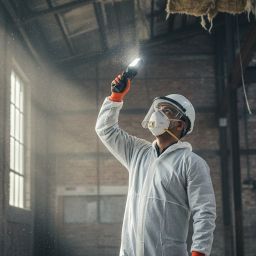
Stage 2 operates under a zero-tolerance ‘no dust’ policy. It’s a common misconception that only asbestos-containing debris causes a failure; in reality, any visible dust or dirt will lead to a failed inspection. Our analysts use high-powered lighting to scrutinize ceiling voids, crevices, and rough masonry. If the area isn’t ‘clinically clean’, the removal contractor must re-clean before we can proceed. This level of detail is what guarantees the integrity of your certificate of reoccupation asbestos.
Maintaining such high standards of hygiene is beneficial for any building beyond the scope of asbestos removal. For those looking to ensure their environment remains spotless, The Line Cleaning LLC provides professional cleaning services for residential and commercial properties.
Disturbance Testing and Failure Protocols
During Stage 3, we don’t just place pumps in a room. We perform disturbance testing, using brushes to agitate surfaces and simulate normal building occupancy. This creates a realistic safety profile for the inhabitants. If a stage fails, the process stops immediately. The contractor must perform remedial cleaning, and the analyst must document the failure in detail. Only after a full re-clean and a successful repeat of the failed stage can the process continue toward final certification.
Choosing an Independent UKAS Accredited Analyst
The integrity of your asbestos project depends entirely on the independence of the final audit. When a removal contractor hires their own analyst, it creates an inherent conflict of interest that can lead to compromised safety standards. As a strategic partner, we provide asbestos consultancy across the UK to act as a rigorous, independent barrier between the contractor and the duty holder. This separation of duties is the only way to ensure that the audit is honest and that your liability is properly managed. If residual fibers are discovered in the future, an independent, UKAS-backed audit trail is your strongest defense against health and safety litigation.
UKAS accreditation is not just a badge of quality; it’s a legal necessity for licensed work. A certificate of reoccupation asbestos issued by a laboratory without ISO/IEC 17025 accreditation holds no legal weight for licensed projects. We operate as a UK-wide laboratory, ensuring that whether your project is in London or Scotland, the technical competence and methodology remain consistent. This national reach allows commercial clients to standardize their safety protocols across multiple sites with total confidence in the results.
The Digital Audit Trail and GPS Reporting
Modern compliance requires more than just a paper trail. Since the second edition of HSE’s Asbestos: The Analysts’ Guide was released in July 2021, the requirements for evidence have become much more stringent. Our analysts utilize digital reporting tools to capture high-resolution photo evidence of every enclosure corner, transit route, and waste bag. These reports are GPS-stamped, proving our team was on-site for the full duration required by the HSE. This level of transparency eliminates the risk of ‘drive-by’ clearances and provides a robust, digitally-backed defense for any future health and safety audits.
Securing Your Certificate of Reoccupation
The final document is a comprehensive technical report that summarizes the safety profile of your building. A legally valid certificate of reoccupation asbestos must contain the unique site reference, detailed results from all four stages, and the signature of a UKAS-accredited analyst. It is the definitive proof that the area is safe for unprotected persons. To ensure your next project meets these rigorous standards, you can request a specialist asbestos survey or clearance quote from our expert team. We take the professional responsibility off your shoulders, delivering precision and peace of mind through every stage of the process.
Securing Long-Term Safety and Compliance
Transitioning from a hazardous site to a safe, functional building requires a commitment to methodological precision. You’ve seen how the four-stage clearance acts as a vital safety gate, ensuring every crevice and void is free from contamination before re-entry. Once the environment is certified safe, facility managers can then explore Machinery Moving to begin the safe relocation or installation of essential plant equipment. This systematic approach transforms a complex regulatory requirement into a clear pathway for project success.
Securing a valid certificate of reoccupation asbestos shouldn’t be a source of stress. It’s the final, authoritative step in a successful abatement project. Our team at The Testing Lab PLC operates as a UKAS Accredited Laboratory, providing the CAR 2012 compliant reporting and independent asbestos specialist oversight you need for full peace of mind. Our UK-wide reach ensures your national projects receive the same high standard of forensic auditing regardless of location.
Don’t leave your project’s safety to chance. Contact The Testing Lab PLC for UK-wide Asbestos Clearance Services to ensure your building is safe, compliant, and ready for its next chapter. We’re here to take the professional burden off your shoulders and help you move forward with confidence.
Frequently Asked Questions
Who is responsible for arranging the four-stage clearance?
The building owner or designated Duty Holder is legally responsible for appointing the analyst. While removal contractors often offer to include this as a bundled service, the HSE’s HSG248 guidance emphasizes that the analyst should be independent of the removal company. This separation ensures an impartial audit and protects the Duty Holder from future liability. By hiring an independent UKAS accredited laboratory, you guarantee the integrity of the final safety check.
How long does a four-stage clearance usually take to complete?
Completion times vary based on the enclosure’s size and complexity. A small domestic project might be completed in four to six hours, while large industrial sites can require several days of intensive work. Stage 3 air monitoring alone requires a minimum of one hour of sampling time per pump to achieve the required limit of quantification. We provide a realistic timeline during the planning phase to help you manage building reoccupation effectively.
What happens if the site fails one of the stages?
If a site fails any stage, the process halts immediately until the issue is rectified. For a Stage 2 failure, the removal contractor must re-clean the area before the analyst performs a new visual inspection. This rigorous gatekeeping is essential. It ensures that when the final certificate of reoccupation asbestos is issued, it’s based on a site that is clinically clean and safe for inhabitants without exception.
Is a four-stage clearance required for non-licensed asbestos removal?
A four-stage clearance is only a legal requirement for licensed asbestos removal projects involving high-risk materials. However, for non-licensed or NNLW (Notifiable Non-Licensed Work), we often recommend it as best practice to provide documented proof of safety. For materials like asbestos cement or vinyl floor tiles, a thorough visual inspection and a single-stage air test are often sufficient to meet your statutory duty of care.
Can people enter the building while the air monitoring is being conducted?
No individuals should enter the work area or the immediate vicinity while air monitoring is in progress. The enclosure must remain sealed to prevent any potential fiber release during the disturbance testing phase. Unprotected persons can only return to the area once the analyst has completed Stage 4 and officially handed over the certificate of reoccupation asbestos. This protocol maintains a sterile environment for accurate and reliable testing results.
What is the difference between a clearance test and a standard air test?
A clearance test is a comprehensive four-stage audit, whereas a standard air test is a single-point measurement. Standard tests, such as leak or background monitoring, check fiber levels in a specific area at a specific time. In contrast, a clearance test includes a forensic visual inspection and active disturbance of surfaces. This makes it the only valid method for certifying an area safe after major removal work has taken place.

Article by
P J F Thomas
CEO and Founder of TTL plc.
Disclaimer
Items declared are AI generated but do reflect our services. Please get in contact if you have any questions.